
PWR-120 · Lesson 2 of 12 · 23 min
Firetube and watertube boilers
▶ Video coming soon A video version of this lesson is on the way.
On Monday, September 21, 2026, Lorne took Tamar on a slow walk round the boiler room with the plant's equipment list in hand. Boiler 3 had been back in service since Saturday, and its casing panels were still being refitted after the inspection. "Every boiler here is one of two kinds," Lorne said, tapping the steel casing of boiler 3 and then pointing across the room to the long, round shell of hot water boiler 1. "In that one, the water is in the tubes. In that one, the fire is in the tubes. Once you know which is which, you know how each one will behave when something goes wrong."
This lesson explains what a boiler is, the parts every boiler shares, the two main families of boilers, how each is built and how water circulates in it, the other types an operator meets, and how to compare boilers by size and efficiency.
What a boiler is
A boiler is a closed vessel in which water is heated, and usually turned to steam, by heat from burning fuel, by electricity or by waste heat from another process. Every fired boiler has the same basic parts: a furnace or combustion chamber where fuel burns; heating surfaces that carry heat from the hot gases into the water; a water space and, in a steam boiler, a steam space; fittings that keep the boiler safe and tell the operator what is happening; and a burner, fans and controls. The hot gases leave through a flue or breeching to the stack.
A boiler stores a great deal of energy. Water held above its atmospheric boiling point is ready to flash into steam the moment the pressure is released, and a kilogram of water flashing to steam expands to more than a thousand times its volume. That is why boilers are built, inspected and operated under law, and why the first rule of boiler operation is to keep the pressure inside its limits and the heating surfaces covered with water.
Firetube boilers
In a firetube boiler, the hot combustion gases pass through tubes that are surrounded by water inside a large cylindrical shell. The most common modern design is the Scotch marine or packaged firetube boiler: a horizontal shell with a large furnace tube (sometimes called the Morison tube when it is corrugated) running through its lower part, and banks of smaller tubes above it. The burner fires into the furnace; the gases turn at the back in a combustion chamber or turnaround, travel forward through the first bank of tubes, turn again in a smoke box, and travel back through a second bank. Each run of the gases is called a pass, so a boiler with a furnace and two tube banks is a three-pass boiler.
The ends of the shell are flat plates called tube sheets, and the tubes are expanded or welded into them. Because flat plates bend under pressure, the parts of the tube sheets without tubes are held by stays, rods or gussets that tie the plates together. In a dryback boiler the rear turnaround is a refractory-lined box outside the water space; in a wetback boiler the turnaround is surrounded by water, which cools it and adds heating surface.
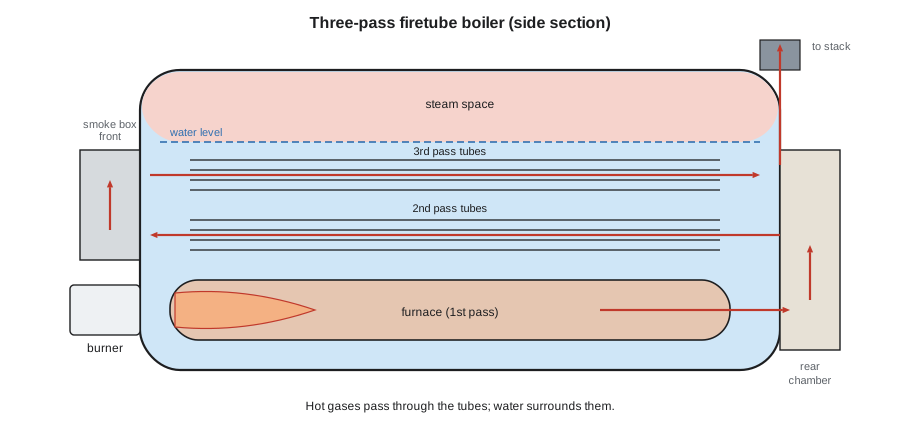
Firetube boilers hold a large volume of water for their output. That gives them steady pressure when the load swings, because the stored hot water flashes to steam and carries the boiler through a short peak. It also means they take longer to warm up, and that a shell failure releases a large mass of hot water at once. Their pressure is limited by the shell: as the diameter grows, the shell plate must get thicker to hold the same pressure. Packaged firetube boilers are common up to about 2,000 boiler horsepower and 350 psi or less (typical).
Cantwell's two hot water boilers are three-pass wetback firetube boilers. They work at low pressure and modest temperature, where a firetube design's large water volume suits a heating loop well.
Watertube boilers
In a watertube boiler, the water and steam are inside the tubes and the hot gases pass around them. The tubes connect drums and headers: a steam drum at the top, where steam separates from the water, and in many designs a mud drum or lower drum at the bottom, where sediment collects and from which the boiler is blown down. Small-diameter tubes can hold much higher pressures than a large shell, and the boiler can be made very large, so watertube boilers are used for high pressures, large outputs and superheated steam.
Packaged watertube boilers are shipped to site as one unit. They are named by the shape of their tube arrangement when seen from the end. In a D-type boiler, the steam drum sits above the mud drum on one side, and the furnace is on the other side, enclosed by curved tubes that form the letter D. An A-type boiler has two lower drums and one upper drum, with the furnace in the middle. An O-type has one upper and one lower drum with the furnace between them. Many furnaces are lined with waterwall tubes, tubes placed side by side, or joined by welded fins into a gas-tight membrane wall, which absorb the flame's radiant heat and protect the casing.
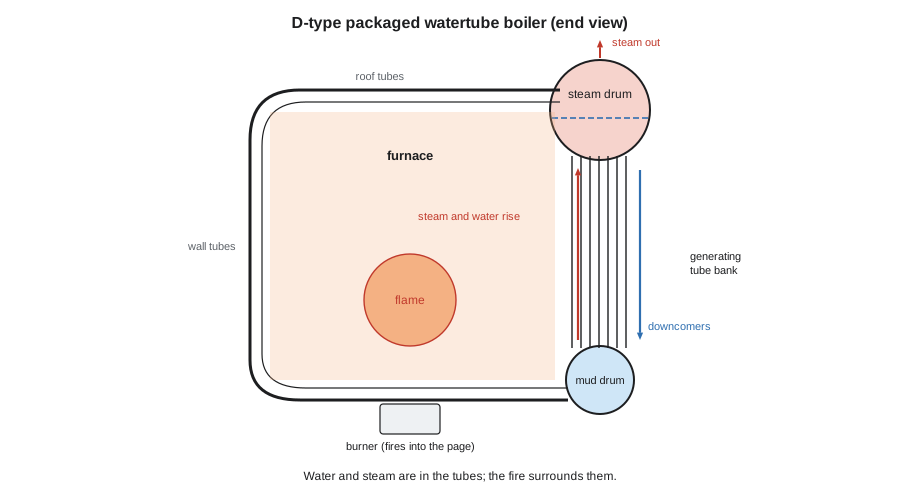
Cantwell's three steam boilers are D-type packaged watertube boilers. Each holds much less water than a firetube boiler of the same output, so it warms up faster and responds quickly to changes in firing, but its drum level can swing quickly too, and losing feedwater can uncover tubes in minutes. That is why the plant takes its feedwater supply and its level controls so seriously (lessons 4 and 8).
How water circulates
In most watertube boilers water moves by natural circulation. Some tubes, called downcomers, are in a cooler part of the gas path or outside it altogether; the water in them is dense and sinks. Other tubes, called risers or generating tubes, are in the hottest gases; the water in them forms steam bubbles, and the lighter mixture of steam and water rises to the steam drum. The difference in density keeps the water flowing round the loop as long as the boiler is fired and full of water. In the drum, baffles and separators let the steam leave from the top and send the water back to the downcomers.
Circulation is what keeps the tubes cool enough to survive. A tube that is full of moving water stays within a few degrees of the water temperature even though the gas outside it may be well over 1,800 °F. A tube that loses its water, through low water, a blockage or heavy scale, overheats within minutes, softens and bulges or ruptures. Some large boilers use forced or assisted circulation, with pumps, and once-through boilers have no drum at all; those are found mostly in power stations and are beyond this course.
In a firetube boiler, the same principle works in the shell: water heated around the furnace tube and the hottest tubes rises, and cooler water flows down along the shell to take its place. Scale on the furnace tube is especially dangerous, because the furnace tube is the hottest surface in the boiler and the scale stops the water from cooling it.
Comparing the two families
| Feature | Firetube | Watertube |
|---|---|---|
| Where the water is | In the shell, around the tubes | In the tubes and drums |
| Water volume for its size | Large | Small |
| Response to load swings | Steady pressure; slow to change firing | Fast response; level can swing quickly |
| Warm-up time | Longer | Shorter |
| Pressure range | Low to moderate | Low to very high |
| Output range | Small to medium | Medium to very large |
| Superheating | Rare | Common in power boilers |
| Effect of a failure | Large release of stored hot water | Smaller release, but tube failures are more frequent |
Neither family is better in every way. A hospital that needs a small, steady supply of low pressure steam may choose firetube boilers; a district energy plant like Cantwell, which needs fast response and higher output, chooses watertube steam boilers. Many plants, Cantwell included, have both.
Other boilers you will meet
Cast iron sectional boilers are made of cast sections bolted or pressed together, each containing passages for water. They are common in older buildings for low pressure steam and hot water heating. Cast iron cracks if it is heated or cooled unevenly, so these boilers must never be fed cold water when hot.
Copper-finned and stainless condensing boilers are small, low water volume boilers used for building heating. A condensing boiler cools its flue gas enough that the water vapor in it condenses, recovering the latent heat; it needs return water below about 130 °F (typical) to condense, and its acidic condensate must be drained and neutralized.
Electric boilers heat water with immersion elements or electrodes and have no furnace or flue. They still have pressure parts and need the same safety valves, level controls and inspections.
Coil-type and flash boilers are compact, low water volume boilers that make steam quickly. They need very reliable feedwater controls because they hold so little water.
Heat recovery steam generators (HRSGs) make steam from the exhaust of a gas turbine or engine instead of from a burner, sometimes with supplementary firing. They are common in combined heat and power plants. Waste heat boilers recover heat from industrial processes such as kilns and furnaces.
Rating and comparing boilers
A boiler's output is the heat it delivers to the water and steam, usually stated in Btu/h or as steam flow in lb/h at a stated pressure and feedwater temperature, or in boiler horsepower. Its input is the heat in the fuel it burns. Its efficiency is output divided by input. Its heating surface is the area of metal with gas on one side and water on the other, in square feet; Ohio's licensing threshold uses it.
Because steam flow depends on the feedwater temperature and the steam pressure, manufacturers sometimes quote an equivalent evaporation from and at 212 °F: the steam the boiler would make if it took water at 212 °F and turned it into steam at the same temperature. It lets boilers working at different conditions be compared fairly.
Worked problem
Equivalent evaporation
Boiler 3 makes 25,400 lb/h of steam with 988 Btu added to each pound. The latent heat at 212 °F is 970 Btu/lb. What is its equivalent evaporation from and at 212 °F, and what is that in boiler horsepower?
Show solution
- Heat per hour:
- \[25{,}400 \times 988 = 25{,}095{,}200 \text{ Btu/h}\]
- Equivalent evaporation:
- \[25{,}095{,}200 \div 970 \approx 25{,}871 \text{ lb/h}\]
- Boiler horsepower (34.5 lb/h from and at 212 °F):
- \[25{,}871 \div 34.5 \approx 750 \text{ BoHP}\]
Answer: About 25,871 lb/h, or about 750 boiler horsepower at this load. The figure is a little higher than the actual steam flow because Cantwell's feedwater enters above 212 °F.
Worked problem
Heating surface loading
A firetube hot water boiler delivers 10,200,000 Btu/h and has 1,250 sq ft of heating surface. Cantwell's watertube steam boiler delivers 27,300,000 Btu/h from 4,100 sq ft. Which boiler puts more heat through each square foot?
Show solution
- Firetube:
- \[10{,}200{,}000 \div 1{,}250 = 8{,}160 \text{ Btu/(h·ft}^2)\]
- Watertube:
- \[27{,}300{,}000 \div 4{,}100 \approx 6{,}659 \text{ Btu/(h·ft}^2)\]
Answer: The firetube boiler, at about 8,160 Btu per hour per square foot against about 6,660. Heat loading per square foot is one way designers judge how hard a boiler is working; it is not a figure operators change, but it explains why clean heating surfaces matter so much.
Reading a nameplate
Every boiler built to the code carries a nameplate or stamping with the manufacturer, serial number, year built, the maximum allowable working pressure (MAWP), the heating surface, the output, the ASME certification mark and the National Board registration number. The safety valves must be set at or below the MAWP. When the state inspector visited on September 16, he read boiler 3's nameplate and stamping before anything else, to confirm he was inspecting the boiler the records described.
Tamar copied the nameplates of all five boilers into her notebook that afternoon. Boiler 3's MAWP was 250 psi, well above its 200 psi safety valve setting and its 150 psi operating pressure. The hot water boilers' MAWP was 160 psi (typical for this design), with relief valves set to match.
Common mistakes
MistakeCalling a boiler firetube because it has tubes.
InsteadAsk where the water is: around the tubes (firetube) or inside them (watertube).
MistakeExpecting a watertube boiler's level to be as steady as a firetube's.
InsteadLow water volume means the level can swing quickly; watch it closely.
MistakeFeeding cold water to a hot cast iron boiler.
InsteadCast iron cracks with uneven heating or cooling.
MistakeTreating scale as a cleanliness problem only.
InsteadScale stops water from cooling the metal and leads to overheating and failure.
MistakeSetting a safety valve above the nameplate MAWP.
InsteadSafety valves are set at or below the MAWP.
Summary and key terms
- Every fired boiler has a furnace, heating surfaces, a water and steam space, fittings, a burner and controls.
- Firetube boilers carry hot gases through tubes surrounded by water in a shell; Scotch marine boilers are the common type.
- Watertube boilers carry water and steam in tubes between drums; D, A and O types are common packaged designs.
- Natural circulation, driven by density differences, keeps tubes cool; low water or scale lets them overheat.
- Firetube boilers hold more water and respond steadily; watertube boilers hold less, respond quickly and suit high pressures.
- Nameplates give the MAWP and registration; safety valves are set at or below the MAWP.
- Firetube boiler
- A boiler with hot gases in tubes surrounded by water.
- Watertube boiler
- A boiler with water and steam inside tubes surrounded by hot gases.
- Pass
- One run of the combustion gases through the boiler.
- Steam drum
- The upper drum where steam separates from water.
- Downcomer
- A tube carrying cooler water down from the steam drum.
- MAWP
- Maximum allowable working pressure stamped on a pressure vessel.
Practice problems
Work each problem on paper first, then reveal the answer to check.
In which boiler family are the combustion gases inside the tubes?
Show answer
Firetube.
What drives natural circulation in a watertube boiler?
Show answer
The density difference between cooler water in downcomers and the steam and water mixture in risers.
What is a wetback firetube boiler?
Show answer
One whose rear turnaround chamber is surrounded by water.
Why must a hot cast iron boiler never be fed cold water?
Show answer
Uneven cooling can crack the cast iron.
What must a safety valve's set pressure never exceed?
Show answer
The boiler's MAWP.
Lesson quiz · 5 questions
Score 60% or more to complete this lesson.
Create a free account to save your progress, take quizzes and earn a certificate.