
PHYS-381 · Lesson 9 of 12 · 21 min
Electric fields in matter: polarization, dielectrics and the displacement field
So far the only materials have been conductors, in which charges move freely, and vacuum. Most materials are insulators, or dielectrics, in which every charge is bound to a particular atom or molecule. A field cannot make bound charges flow, but it can stretch atoms and rotate molecules, producing tiny dipoles. The net effect of trillions of tiny dipoles is a polarization of the material, which produces its own field. This lesson describes polarization, shows that its field is that of bound charges on the surface and in the volume, introduces the displacement field \(\mathbf{D}\) that tracks only the free charge, and applies the result to capacitors and to a dielectric sphere in a uniform field.
How matter polarizes
There are two microscopic mechanisms. In any atom, an applied field pushes the nucleus one way and the electron cloud the other, inducing a dipole moment proportional to the field, \(\mathbf{p} = \alpha\mathbf{E}\), where \(\alpha\) is the atomic polarizability. A crude model treats the atom as a point nucleus inside a uniform sphere of electron charge of radius \(a\); the field inside such a sphere, from lesson 4, gives \(\alpha = 4\pi\varepsilon_0 a^3\), so polarizability is roughly the atomic volume times \(4\pi\varepsilon_0\). Measured values of \(\alpha/(4\pi\varepsilon_0)\) range from 0.2 cubic angstroms for helium, a small and tightly bound atom, to about 60 for cesium. Molecules have different polarizabilities along different axes, so in general the relation is a tensor, but for most materials a single number suffices.
The second mechanism applies to polar molecules, such as water, which have a permanent dipole moment even without a field. In a field, a dipole feels a torque \(\mathbf{N} = \mathbf{p}\times\mathbf{E}\) that tries to line it up with the field, and in a nonuniform field it also feels a net force \((\mathbf{p}\cdot\nabla)\mathbf{E}\), which is why a charged comb attracts a thin stream of water. Thermal agitation fights the alignment, so at ordinary field strengths only a small fraction of the full alignment is achieved, and the net polarization is again proportional to the field. Polar molecules produce much larger effects than induced ones, which is why water has a dielectric constant of about 80 while nonpolar liquids such as oil have about 2.
Polarization and bound charge
The polarization \(\mathbf{P}\) is the dipole moment per unit volume. Its potential, by adding the dipole potentials of every volume element, is
Using \(\hat{\boldsymbol{\mathscr{r}}}/\mathscr{r}^2 = \nabla'(1/\mathscr{r})\), integrating by parts and applying the divergence theorem turns this into
The polarized material produces exactly the field of a surface charge \(\sigma_b\) and a volume charge \(\rho_b\), called bound charges. They are real accumulations of charge, not mathematical fictions. In a uniformly polarized slab the positive ends of the dipoles inside cancel the negative ends of their neighbors, leaving uncancelled charge only at the surfaces: \(+P\) per unit area on the face \(\mathbf{P}\) points toward, \(-P\) on the opposite face. When the polarization is nonuniform, the cancellation is imperfect inside too, leaving \(\rho_b = -\nabla\cdot\mathbf{P}\). The total bound charge of a neutral object is always zero, as the divergence theorem confirms.
The displacement field
Inside a dielectric, the total charge density is the sum of the free charge \(\rho_f\), which we control, and the bound charge \(\rho_b\), which the material supplies in response. Gauss's law reads \(\varepsilon_0\nabla\cdot\mathbf{E} = \rho_f - \nabla\cdot\mathbf{P}\). Collecting the divergences, define the electric displacement
Gauss's law for \(\mathbf{D}\) involves only the free charge. But \(\mathbf{D}\) is not simply a field produced by free charge, because its curl is not zero in general: \(\nabla\times\mathbf{D} = \nabla\times\mathbf{P}\), which is nonzero at the edges of a polarized bar, for example. Gauss's law for \(\mathbf{D}\) is useful exactly when symmetry would let us use Gauss's law for \(\mathbf{E}\) in vacuum: spheres, cylinders and planes. The name displacement comes from Maxwell's picture of the ether as an elastic medium in which charges are displaced; the picture is gone, but the name survives.
At a boundary between two materials, the pillbox and loop arguments of lesson 4 give two conditions:
Linear dielectrics
In most materials, at fields well below breakdown, the polarization is proportional to the field, \(\mathbf{P} = \varepsilon_0\chi_e\mathbf{E}\), where the electric susceptibility \(\chi_e\) is a property of the material. Then
with \(\varepsilon\) the permittivity and \(\varepsilon_r\) the relative permittivity or dielectric constant. Typical values are 1.0005 for air, 2.25 for polyethylene, 4 to 10 for glasses, about 80 for water at room temperature and more than 1000 for ferroelectric ceramics such as barium titanate. If a linear dielectric fills all the space around a free charge distribution, \(\mathbf{D}\) is the vacuum field of the free charge and \(\mathbf{E}\) is that divided by \(\varepsilon_r\). The bound charge that collects around each free charge partly screens it. That is why water, with \(\varepsilon_r \approx 80\), is such a good solvent for salts: the attraction between sodium and chloride ions is reduced eightyfold, so thermal motion pulls them apart.
Filling a capacitor with dielectric multiplies its capacitance by \(\varepsilon_r\). At fixed charge, the bound surface charge on the dielectric partly cancels the free charge on the plates, reducing the field and the voltage. Practical capacitors use thin films of high-permittivity materials both to raise \(C\) and because good dielectrics withstand much higher fields than air before breaking down.
A dielectric sphere in a uniform field
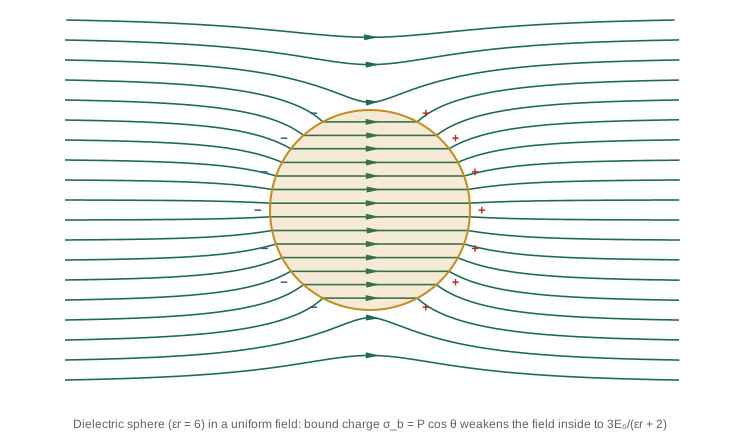
The dielectric analog of the conducting sphere in lesson 8 is a sphere of linear dielectric \(\varepsilon_r\) placed in a uniform field \(E_0\hat{\mathbf{z}}\). Solving Laplace's equation inside and outside with the boundary conditions that \(V\) is continuous and \(\varepsilon\,\partial V/\partial r\) is continuous at the surface gives a uniform field inside,
and outside, the uniform field plus the field of a dipole at the center. The bound surface charge \(\sigma_b = P\cos\theta\) produces, inside, a uniform field \(-\mathbf{P}/(3\varepsilon_0)\) opposing the applied one, the result of the worked example in lesson 8. As \(\varepsilon_r\) grows, the internal field falls toward zero and the sphere behaves like a conductor.
Polarization in numbers
The program evaluates the sphere formulas for several materials in a field of 10 kV/m, then checks one of them by integrating the field at the middle of a glass sphere directly from its bound surface charge \(P\cos\theta\), ring by ring. Next it solves a parallel-plate capacitor 2 mm wide at 100 V containing a 1 mm glass slab, using the fact that \(D\) is the same in both layers. Finally it inverts the Clausius–Mossotti relation, \(\frac{\varepsilon_r - 1}{\varepsilon_r + 2} = \frac{N\alpha}{3\varepsilon_0}\), to get atomic polarizabilities of helium and argon from their measured dielectric constants as gases at 0 °C and one atmosphere.
import math
# 1. Dielectric sphere in a uniform field E0: inside, E = 3 E0/(er + 2) and P = 3 eps0 (er - 1)/(er + 2) E0.
eps0 = 8.8541878188e-12; E0 = 1.0e4
for name, er in (("polyethylene", 2.25), ("glass", 6.0), ("water", 80.0), ("ideal conductor limit", 1e9)):
    Ein = 3*E0/(er + 2); P = 3*eps0*(er - 1)/(er + 2)*E0
    print(f"{name:22s} er = {er:<8g} E inside = {Ein:9.2f} V/m  P = {P*1e9:8.3f} nC/m^2  "
          f"(bound charge at the poles +/-{P*1e9:.1f} nC/m^2)")

# 2. Check the sphere result numerically: field at the middle from the bound surface charge
#    sigma_b = P cos(theta) on the surface, integrated directly (it should be -P/(3 eps0)).
er = 6.0; P = 3*eps0*(er - 1)/(er + 2)*E0; R = 0.05; k = 1/(4*math.pi*eps0)
n = 2000; Ez = 0.0
for i in range(n):
    th = math.pi*(i + .5)/n
    dq = P*math.cos(th)*2*math.pi*R*R*math.sin(th)*math.pi/n
    Ez += -k*dq*math.cos(th)/R**2          # field at the origin points away from each charge element
print(f"glass sphere: field of bound charge at the middle {Ez:.2f} V/m, -P/(3 eps0) = {-P/(3*eps0):.2f} V/m, "
      f"total {E0 + Ez:.2f} V/m")

# 3. Parallel-plate capacitor (gap 2 mm, 100 V) with a 1 mm glass slab: series layers of D = eps E
d, t, V0 = 2e-3, 1e-3, 100.0
for er in (1.0, 6.0):
    # D is the same in both layers: V0 = D (t/(eps0 er) + (d - t)/eps0)
    D = V0/(t/(eps0*er) + (d - t)/eps0)
    print(f"slab er = {er}: D = {D*1e6:.3f} uC/m^2, E in slab {D/(eps0*er):.0f} V/m, E in air {D/eps0:.0f} V/m, "
          f"C per area {D/V0*1e9:.3f} nF/m^2")

# 4. Clausius-Mossotti: atomic polarizability from the dielectric constant of a dilute gas
N = 101325/(1.380649e-23*273.15)
for gas, er in (("helium", 1.0000684), ("argon", 1.000554)):
    alpha = 3*eps0/N*(er - 1)/(er + 2)
print(f"{gas}: alpha/(4 pi eps0) = {alpha/(4*math.pi*eps0)*1e30:.3f} x 10^-30 m^3")polyethylene er = 2.25 E inside = 7058.82 V/m P = 78.125 nC/m^2 (bound charge at the poles +/-78.1 nC/m^2) glass er = 6 E inside = 3750.00 V/m P = 166.016 nC/m^2 (bound charge at the poles +/-166.0 nC/m^2) water er = 80 E inside = 365.85 V/m P = 255.908 nC/m^2 (bound charge at the poles +/-255.9 nC/m^2) ideal conductor limit er = 1e+09 E inside = 0.00 V/m P = 265.626 nC/m^2 (bound charge at the poles +/-265.6 nC/m^2) glass sphere: field of bound charge at the middle -6250.00 V/m, -P/(3 eps0) = -6250.00 V/m, total 3750.00 V/m slab er = 1.0: D = 0.443 uC/m^2, E in slab 50000 V/m, E in air 50000 V/m, C per area 4.427 nF/m^2 slab er = 6.0: D = 0.759 uC/m^2, E in slab 14286 V/m, E in air 85714 V/m, C per area 7.589 nF/m^2 helium: alpha/(4 pi eps0) = 0.203 x 10^-30 m^3 argon: alpha/(4 pi eps0) = 1.641 x 10^-30 m^3
Polyethylene keeps 71% of the applied field inside, glass 37.5% and water under 4%; the ideal-conductor limit keeps none. The polarization saturates at \(3\varepsilon_0E_0 = 266\) nC/m\(^2\), the value at which the bound charge exactly cancels the field. The direct integration over the bound surface charge of the glass sphere gives a field of \(-6250\) V/m at the middle, exactly \(-P/(3\varepsilon_0)\), and adding the applied 10 kV/m leaves 3750 V/m. In the capacitor, inserting the glass slab raises \(D\) and the capacitance per area by 71%, cuts the field in the glass to 14.3 kV/m and raises the field in the remaining air gap to 85.7 kV/m. That concentration of field in the air is a real hazard: an air gap or bubble in high-voltage insulation can break down even when the insulation itself is fine, producing partial discharges that slowly erode it. The Clausius–Mossotti inversion gives 0.20 and 1.64 cubic angstroms for helium and argon, close to tabulated values. The relation, due to Ottaviano Mossotti in 1850 and Rudolf Clausius in 1879, corrects for the fact that each atom feels the field of its polarized neighbors as well as the applied field.
Worked problem
A coaxial cable with dielectric
A long cylinder of radius \(a\) carries free charge \(\lambda\) per unit length and is surrounded out to radius \(b\) by a dielectric of constant \(\varepsilon_r\). Find \(\mathbf{D}\), \(\mathbf{E}\) and the bound charges.
Show solution
- Gauss's law for \(\mathbf{D}\) with a coaxial cylinder: \(D\cdot 2\pi sl = \lambda l\), so \(D = \lambda/(2\pi s)\) everywhere outside the wire.
- \(E = D/(\varepsilon_0\varepsilon_r)\) in the dielectric (\(a < s < b\)) and \(D/\varepsilon_0\) outside it.
- \(P = \varepsilon_0\chi_eE = \frac{\varepsilon_r - 1}{\varepsilon_r}\frac{\lambda}{2\pi s}\); \(\rho_b = -\nabla\cdot\mathbf{P} = 0\), since \(sP_s\) is constant.
- Bound surface charge per unit length: \(-\frac{\varepsilon_r - 1}{\varepsilon_r}\lambda\) at \(s = a\) and \(+\frac{\varepsilon_r - 1}{\varepsilon_r}\lambda\) at \(s = b\).
Answer: \(D = \lambda/2\pi s\); \(E\) is reduced by \(\varepsilon_r\) inside the dielectric because bound charge \(-\frac{\varepsilon_r - 1}{\varepsilon_r}\lambda\) on the inner surface screens the wire.
Common mistakes
MistakeTreating bound charge as fictitious.
InsteadIt is real charge, displaced slightly within each molecule, and it produces a real field.
MistakeAssuming \(\mathbf{D}\) is determined by the free charge alone.
InsteadOnly its divergence is; its curl equals the curl of \(\mathbf{P}\).
MistakeUsing Gauss's law for \(\mathbf{D}\) without symmetry.
InsteadIt gives the field only in spherical, cylindrical or planar geometries.
MistakeDividing every field by \(\varepsilon_r\) when the dielectric fills only part of the space.
InsteadUse the boundary conditions; the field in an air gap can increase.
MistakeExpecting the field inside a dielectric sphere to be \(E_0/\varepsilon_r\).
InsteadIt is \(3E_0/(\varepsilon_r + 2)\), because the sphere's shape matters.
Summary and key terms
- Atoms acquire induced dipoles \(\mathbf{p} = \alpha\mathbf{E}\); polar molecules align partially against thermal motion.
- A polarized material produces the field of bound charges \(\sigma_b = \mathbf{P}\cdot\hat{\mathbf{n}}\) and \(\rho_b = -\nabla\cdot\mathbf{P}\).
- \(\mathbf{D} = \varepsilon_0\mathbf{E} + \mathbf{P}\) satisfies \(\nabla\cdot\mathbf{D} = \rho_f\).
- In a linear dielectric \(\mathbf{D} = \varepsilon\mathbf{E}\) with \(\varepsilon_r = 1 + \chi_e\); filling a capacitor multiplies C by \(\varepsilon_r\).
- At a boundary \(D^\perp\) jumps by \(\sigma_f\) and \(E^\parallel\) is continuous.
- A dielectric sphere in \(E_0\) has a uniform internal field \(3E_0/(\varepsilon_r + 2)\).
- dielectric
- An insulating material whose charges are bound but can be displaced slightly.
- polarizability
- The ratio alpha of induced dipole moment to applied field.
- polarization
- Dipole moment per unit volume, P.
- bound charge
- Charge appearing at surfaces and nonuniformities of a polarized material.
- electric displacement
- D = epsilon-zero E + P, whose divergence is the free charge density.
- dielectric constant
- The relative permittivity epsilon-r = 1 + chi-e of a linear dielectric.
Practice problems
Work each problem on paper first, then reveal the answer to check.
A slab is uniformly polarized with \(P = 2.0\) μC/m\(^2\) perpendicular to its faces. Find the bound charge densities.
Show answer
\(\sigma_b = \pm 2.0\) μC/m\(^2\) on the faces; \(\rho_b = 0\) inside.
A capacitor of 10 nF in air is filled with a material of \(\varepsilon_r = 3.5\). Find its new capacitance.
Show answer
35 nF.
A point charge of 1.0 nC is embedded in a large block of \(\varepsilon_r = 4\) material. Find the field 1.0 cm away.
Show answer
\(E = kq/(\varepsilon_r r^2) = 8.99 \times 10^9 \times 10^{-9}/(4 \times 10^{-4}) = 22.5\) kV/m.
A field of 5.0 kV/m in air meets a flat glass surface (\(\varepsilon_r = 6\)) at normal incidence. Find E inside the glass.
Show answer
\(D^\perp\) is continuous with no free charge: \(E = 5.0/6 = 0.83\) kV/m.
Estimate the polarizability of a hydrogen atom with the uniform-sphere model, taking \(a = 0.053\) nm.
Show answer
\(\alpha/(4\pi\varepsilon_0) = a^3 = 1.5 \times 10^{-31}\) m\(^3\); the exact quantum value is 4.5 times larger.
Find the torque on a dipole of moment \(6.2 \times 10^{-30}\) C m at right angles to a field of 1 MV/m.
Show answer
\(N = pE = 6.2 \times 10^{-24}\) N m.
Lesson quiz · 5 questions
Score 60% or more to complete this lesson.
Create a free account to save your progress, take quizzes and earn a certificate.