
PHYS-271 · Lesson 8 of 12 · 23 min
The Schrödinger equation in one dimension: wells, barriers and tunneling
De Broglie's matter waves needed an equation, as light waves have Maxwell's equations and waves on a string have the wave equation. Erwin Schrödinger, then a professor in Zurich, found it over the Christmas holidays of 1925, which he spent in the Swiss resort of Arosa, and published it in four papers in 1926. With it he calculated the energy levels of hydrogen, reproducing Bohr's results without Bohr's arbitrary rules. This lesson introduces the time-independent Schrödinger equation in one dimension and solves it for the three problems that teach the most: the particle in a box, the finite square well and the potential barrier. The last leads to quantum tunneling, the process behind alpha decay, the fusion that powers the Sun, the scanning tunneling microscope and the 2025 Nobel Prize in Physics.
The wave function and its equation
A particle moving along a line is described by a wave function \(\Psi(x, t)\), a complex number at each point and time. Born's rule, lesson 7, gives its meaning: \(|\Psi(x, t)|^2\,dx\) is the probability of finding the particle between \(x\) and \(x + dx\) at time \(t\). Since the particle must be somewhere, the wave function is normalized, \(\int |\Psi|^2\,dx = 1\).
For a free particle, a plane wave \(e^{i(kx - \omega t)}\) with \(p = \hbar k\) and \(E = \hbar\omega = p^2/2m\) must satisfy the equation. Differentiating once in time brings down \(-i\omega\), and twice in space brings down \(-k^2\), so \(i\hbar\,\partial\Psi/\partial t = -(\hbar^2/2m)\,\partial^2\Psi/\partial x^2\) is the equation whose plane-wave solutions obey \(E = p^2/2m\). Schrödinger's insight was to add the potential energy \(U(x)\) as the classical energy suggests:
This is not derived from anything more basic; it is a postulate, justified by its agreement with experiment. When the potential does not depend on time, there are solutions of the form \(\Psi = \psi(x) e^{-iEt/\hbar}\), called stationary states, whose probability density \(|\Psi|^2 = |\psi|^2\) does not change in time. Substituting gives the time-independent Schrödinger equation,
For a bound particle this equation has acceptable solutions, ones that stay finite and can be normalized, only for particular values of \(E\). Those are the allowed energy levels. Energy quantization, which Planck and Bohr had to assume, comes out of the mathematics automatically, just as only certain frequencies are allowed for a guitar string fixed at both ends. Stationary states do not radiate, which removes the classical collapse of lesson 1: an electron in a stationary state has a probability cloud that does not move.
The wave function must satisfy some conditions. It must be continuous, and where the potential is finite its slope \(d\psi/dx\) must also be continuous, because the equation relates the second derivative to finite quantities. In regions where \(E > U\), the solutions oscillate, with local wavelength \(h/\sqrt{2m(E - U)}\). Where \(E < U\), the classically forbidden regions, the solutions grow or decay exponentially, \(e^{\pm\kappa x}\) with \(\kappa = \sqrt{2m(U - E)}/\hbar\). A classical particle can never enter a region where its kinetic energy would be negative; a quantum particle can, with a probability that dies away over a distance of about \(1/\kappa\).
The particle in a box
The simplest bound system is a particle confined between rigid walls at \(x = 0\) and \(x = L\), with \(U = 0\) inside and \(U = \infty\) outside. The wave function must vanish outside and, by continuity, at the walls. Inside, the equation is \(\psi'' = -k^2\psi\) with \(k = \sqrt{2mE}/\hbar\), whose solutions are \(\sin kx\) and \(\cos kx\). The condition \(\psi(0) = 0\) rules out the cosine, and \(\psi(L) = 0\) requires \(kL = n\pi\). So the allowed states and energies are
The factor \(\sqrt{2/L}\) normalizes each state. Three features matter. The energies grow as \(n^2\), so the gaps widen with energy. The lowest energy is not zero: \(E_1 = h^2/8mL^2\), the zero-point energy, which the uncertainty principle requires, since a particle confined to a length \(L\) cannot have zero momentum spread. And the states have \(n - 1\) nodes inside the box, points where the particle is never found, though it is found on both sides of them.
For an electron in a box 1 nm long, \(E_1 = 0.376\) eV and \(E_2 - E_1 = 1.13\) eV, energies comparable with those of molecules. The model describes surprisingly well the electrons in long conjugated molecules such as beta-carotene, which gives carrots their color, and the electrons in quantum dots, semiconductor crystals a few nanometers across whose emission wavelength is set by their size. The 2023 Nobel Prize in Chemistry went to Moungi Bawendi, Louis Brus and Alexei Ekimov for discovering and making quantum dots, now used in television displays.
The finite square well
A real trap has finite walls. Let \(U = -U_0\) for \(|x| < a\) and \(U = 0\) outside, and look for bound states with \(-U_0 < E < 0\). Inside the well the wave function oscillates; outside, it decays exponentially into the walls. Matching \(\psi\) and \(\psi'\) at the edges gives transcendental equations that have no closed-form solution, so we solve them numerically. A finite well always has at least one bound state, and the number of states grows with the depth and width, roughly as \(\sqrt{2mU_0}\,a/\hbar\pi\). Because the wave function leaks into the walls, it fits into an effectively wider region than in the infinite well, and every level lies below the corresponding infinite-well level.
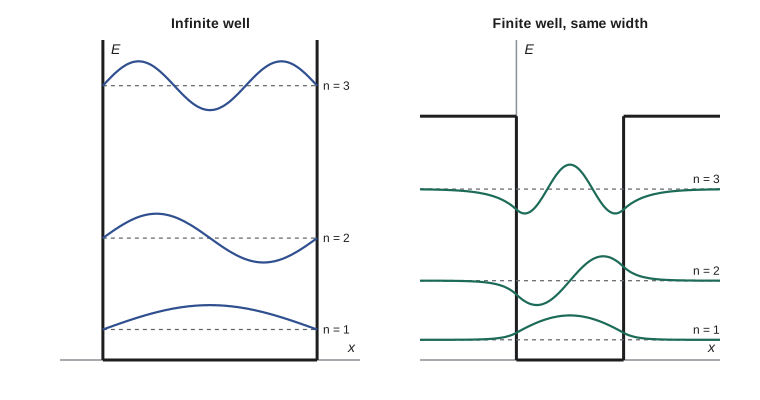
The program below finds the bound states of an electron in a well 1 nm wide and 2 eV deep by the shooting method. It starts from a decaying exponential deep in the left wall, integrates the Schrödinger equation across the well with the Numerov method, and adjusts the energy until the wave function also decays on the right. PHYS-234 developed the same technique in detail.
import math
hbar, me, eV = 1.054571817e-34, 9.1093837e-31, 1.602176634e-19
a, U0 = 0.5e-9, 2.0 * eV        # half-width and depth
L = 2.5e-9                       # integrate from -L to +L
N = 2000
dx = 2 * L / N
def U(x): return -U0 if abs(x) < a else 0.0
def shoot(E):
    # Numerov integration of psi'' = (2m/hbar^2)(U - E) psi, starting in the left wall
    k2 = lambda x: 2 * me * (E - U(x)) / hbar**2
    x0 = -L
    kap = math.sqrt(2 * me * (-E)) / hbar
    p0, p1 = 1e-30, 1e-30 * math.exp(kap * dx)
    for i in range(1, N):
        x = x0 + i * dx
        c0 = 1 + dx * dx * k2(x - dx) / 12
        c1 = 2 * (1 - 5 * dx * dx * k2(x) / 12)
        c2 = 1 + dx * dx * k2(x + dx) / 12
        p0, p1 = p1, (c1 * p1 - c0 * p0) / c2
        if abs(p1) > 1e200: p0, p1 = p0 * 1e-200, p1 * 1e-200
    return p1
levels, Es = [], [-U0 + 1e-4 * eV + i * (U0 - 2e-4 * eV) / 300 for i in range(301)]
prev = shoot(Es[0])
for E in Es[1:]:
    cur = shoot(E)
    if prev * cur < 0:                      # bisection on the sign change
        lo, hi, flo = E - (Es[1] - Es[0]), E, prev
        for _ in range(40):
            mid = 0.5 * (lo + hi); fm = shoot(mid)
            if fm * flo < 0: hi = mid
            else: lo, flo = mid, fm
        levels.append(0.5 * (lo + hi))
    prev = cur
for n, E in enumerate(levels, 1):
    inf = n**2 * math.pi**2 * hbar**2 / (2 * me * (2 * a)**2)
    print(f"n = {n}: E = {E / eV:+.4f} eV, height above floor {(E + U0) / eV:.4f} eV,"
f" infinite-well value {inf / eV:.4f} eV")n = 1: E = -1.7710 eV, height above floor 0.2290 eV, infinite-well value 0.3760 eV n = 2: E = -1.1126 eV, height above floor 0.8874 eV, infinite-well value 1.5041 eV n = 3: E = -0.1848 eV, height above floor 1.8152 eV, infinite-well value 3.3843 eV
The well holds three bound states, each lower above the floor than its infinite-well counterpart. The difference is largest for the highest state, which is barely bound and spreads far into the walls. Finite wells of this kind, made from thin layers of one semiconductor sandwiched between layers of another, are the active regions of the laser diodes in fiber-optic transmitters and Blu-ray players; the layer thickness sets the emission wavelength.
Barriers and tunneling
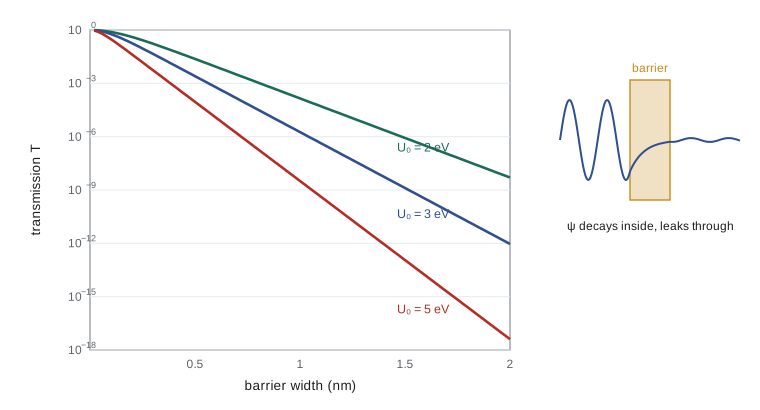
Now send a particle of energy \(E\) toward a rectangular barrier of height \(U_0 > E\) and width \(w\). Classically it bounces back every time. Quantum mechanically, the wave function decays inside the barrier as \(e^{-\kappa x}\) but does not reach zero, and if the barrier is thin enough a small wave emerges on the far side: the particle has a probability of passing through. Solving the Schrödinger equation in the three regions and matching \(\psi\) and \(\psi'\) at both edges gives the transmission probability exactly,
For a thick or high barrier, \(\kappa w \gg 1\), \(\sinh(\kappa w) \approx \tfrac12 e^{\kappa w}\) and \(T \approx 16 (E/U_0)(1 - E/U_0)\, e^{-2\kappa w}\). The exponential is what matters: every extra \(1/\kappa\) of thickness reduces the transmission by a factor \(e^2 \approx 7.4\). For an electron facing a barrier 1 eV higher than its energy, \(1/\kappa = 0.195\) nm, so a barrier a nanometer thick lets through about one electron in 7,000, and two nanometers only about one in 200 million.
import math
hbar, me, eV = 1.054571817e-34, 9.1093837e-31, 1.602176634e-19
def T_exact(E, U0, w, m=me):
    if E >= U0:
        k2 = math.sqrt(2 * m * (E - U0)) / hbar
        return 1 / (1 + U0**2 * math.sin(k2 * w)**2 / (4 * E * (E - U0)))
    kap = math.sqrt(2 * m * (U0 - E)) / hbar
    return 1 / (1 + U0**2 * math.sinh(kap * w)**2 / (4 * E * (U0 - E)))
E = 1.0 * eV
for U0 in (2.0, 3.0, 5.0):
    row = [T_exact(E, U0 * eV, w * 1e-9) for w in (0.25, 0.5, 1.0, 1.5, 2.0)]
    print(f"U0 = {U0:.0f} eV: " + "  ".join(f"{t:.2e}" for t in row) + "   (w = 0.25, 0.5, 1, 1.5, 2 nm)")
# STM: current ratio when the tip moves 0.1 nm
phi = 4.5 * eV
kap = math.sqrt(2 * me * phi) / hbar
print(f"STM: decay constant 1/kappa = {1 / kap * 1e9:.4f} nm; moving the tip 0.1 nm changes the current by a factor {math.exp(2 * kap * 0.1e-9):.1f}")
# above the barrier, resonances: T = 1 when k2 w = n pi
print(f"E = 3 eV over a 2 eV barrier 1 nm wide: T = {T_exact(3 * eV, 2 * eV, 1e-9):.3f}")U0 = 2 eV: 2.66e-01 2.35e-02 1.42e-04 8.46e-07 5.04e-09 (w = 0.25, 0.5, 1, 1.5, 2 nm) U0 = 3 eV: 9.11e-02 2.53e-03 1.81e-06 1.29e-09 9.22e-13 (w = 0.25, 0.5, 1, 1.5, 2 nm) U0 = 5 eV: 1.52e-02 9.08e-05 3.22e-09 1.14e-13 4.06e-18 (w = 0.25, 0.5, 1, 1.5, 2 nm) STM: decay constant 1/kappa = 0.0920 nm; moving the tip 0.1 nm changes the current by a factor 8.8 E = 3 eV over a 2 eV barrier 1 nm wide: T = 0.781
The table shows the steep fall with width and height. The second result explains the extraordinary sensitivity of the scanning tunneling microscope, invented by Gerd Binnig and Heinrich Rohrer at IBM Zurich in 1981, for which they shared the 1986 Nobel Prize. A sharp metal tip is brought within about a nanometer of a conducting surface, and electrons tunnel across the vacuum gap. Because the current changes by about a factor of 9 for each 0.1 nm of distance, a feedback loop that keeps the current constant traces the surface with a precision of a hundredth of a nanometer, enough to image individual atoms. The last line shows another quantum surprise: even a particle with more energy than the barrier is sometimes reflected, and it passes through perfectly only when a whole number of half-wavelengths fits across the barrier.
Tunneling in nature and technology
George Gamow, and independently Ronald Gurney and Edward Condon, explained alpha decay as tunneling in 1928. An alpha particle inside a heavy nucleus is held by the strong force but faces a Coulomb barrier about 25 MeV high on the way out, while its energy is only 4 to 9 MeV. It escapes by tunneling, and because the probability depends exponentially on the barrier thickness, a small change in alpha energy produces an enormous change in lifetime. Uranium-238 emits 4.27 MeV alphas and has a half-life of 4.5 billion years; polonium-212 emits 8.95 MeV alphas and has a half-life of 0.3 microseconds. A factor of two in energy gives a factor of \(10^{23}\) in lifetime, the Geiger–Nuttall rule that Gamow's theory explained.
Tunneling also lets the Sun shine. Protons in the solar core have average thermal energies of about 1.3 keV, far below the roughly 550 keV Coulomb barrier between two protons. Classically they could never touch. Quantum mechanically a tiny fraction tunnel through on each collision, enough to sustain fusion at the core temperature of 15 million kelvin. In electronics, tunneling sets the limit on how thin the insulating layers in transistors can be, and it is exploited in flash memory, where electrons tunnel onto an isolated gate to store a bit, and in tunnel diodes, discovered by Leo Esaki in 1957.
The 2025 Nobel Prize in Physics was awarded to John Clarke, Michel Devoret and John Martinis for experiments in 1984 and 1985 at the University of California, Berkeley, showing that an entire superconducting electrical circuit, with billions of electrons acting together, could tunnel out of a trapped state and had quantized energy levels. Macroscopic quantum tunneling of this kind is the operating principle of the superconducting qubits used in today's quantum computers, lesson 12.
Worked problem
The infinite well as a model of a conjugated molecule
Treat the six pi electrons of a molecule as electrons in a box of length 0.84 nm, two per level. Find the energy of the photon absorbed when an electron jumps from the highest filled level to the lowest empty one.
Show solution
- Six electrons fill \(n = 1, 2, 3\); the transition is from \(n = 3\) to \(n = 4\).
- \(E_n = n^2 h^2/(8mL^2)\); \(h^2/(8mL^2) = (6.626 \times 10^{-34})^2/(8 \times 9.109 \times 10^{-31} \times (0.84 \times 10^{-9})^2) = 8.54 \times 10^{-20}\) J = 0.533 eV.
- \(\Delta E = (16 - 9) \times 0.533 = 3.73\) eV.
- Wavelength \(\lambda = 1240/3.73 = 332\) nm, in the near ultraviolet.
Answer: About 3.7 eV, absorbed at about 330 nm; longer molecules have smaller gaps and absorb visible light, which is why long conjugated molecules are colored.
Common mistakes
MistakeExpecting the ground state energy of a particle in a box to be zero.
InsteadThe lowest state has \(n = 1\) and \(E_1 = h^2/8mL^2\); \(n = 0\) gives \(\psi = 0\), no particle at all.
MistakeTreating \(\psi\) itself as the probability.
InsteadThe probability density is \(|\psi|^2\); \(\psi\) can be negative or complex.
MistakeAssuming tunneling probability falls in proportion to barrier width.
InsteadIt falls exponentially, as \(e^{-2\kappa w}\).
MistakeThinking a particle with energy above a barrier always passes over it.
InsteadQuantum particles are partly reflected by steps and barriers even when \(E > U_0\).
Summary and key terms
- The Schrödinger equation governs the wave function \(\Psi\); \(|\Psi|^2\) is the probability density.
- Stationary states satisfy \(-(\hbar^2/2m)\psi'' + U\psi = E\psi\); bound states exist only at discrete energies.
- In an infinite well \(E_n = n^2h^2/8mL^2\), with a nonzero zero-point energy and \(n - 1\) nodes.
- A finite well has at least one bound state; its wave functions penetrate the walls and its levels are lower.
- Particles tunnel through barriers with probability falling as \(e^{-2\kappa w}\); tunneling explains alpha decay, solar fusion and the STM.
- Wave function
- The complex amplitude \(\Psi(x, t)\) whose square gives probability density.
- Stationary state
- A solution with definite energy whose probability density does not change in time.
- Zero-point energy
- The minimum energy of a confined particle, above the bottom of the potential.
- Classically forbidden region
- A region where \(E < U\); the wave function decays exponentially there.
- Tunneling
- Passage of a particle through a barrier higher than its energy.
Practice problems
Work each problem on paper first, then reveal the answer to check.
Find the three lowest energies of an electron in an infinite well 0.5 nm wide.
Show answer
\(E_1 = 1.50\) eV, \(E_2 = 6.02\) eV, \(E_3 = 13.5\) eV.
For the ground state of an infinite well, what is the probability of finding the particle in the middle third?
Show answer
\(\int_{L/3}^{2L/3} (2/L)\sin^2(\pi x/L)\,dx = 1/3 + \sqrt3/(2\pi) = 0.609\).
By what factor does tunneling probability change if a barrier is made twice as thick, when \(\kappa w = 5\) at the original thickness?
Show answer
Roughly \(e^{-10}\), about \(4.5 \times 10^{-5}\).
A proton and an electron with the same energy face the same barrier. Which tunnels more easily and why?
Show answer
The electron: \(\kappa\) grows as \(\sqrt m\), and the proton is 1,836 times heavier.
Why must \(d\psi/dx\) be continuous at the edge of a finite well?
Show answer
The Schrödinger equation makes \(\psi'r'\) finite there, so \(\psi'\) cannot jump.
Lesson quiz · 5 questions
Score 60% or more to complete this lesson.
Create a free account to save your progress, take quizzes and earn a certificate.