
PHYS-271 · Lesson 5 of 12 · 20 min
Blackbody radiation and the quantum hypothesis
Quantum theory began not with atoms but with the glow of hot objects. On 14 December 1900 Max Planck presented to the German Physical Society in Berlin a formula for the spectrum of thermal radiation that fitted the best measurements perfectly, together with a derivation that required a strange assumption: that energy is exchanged between matter and radiation only in whole multiples of a basic amount proportional to the frequency, \(E = hf\). Planck himself regarded the assumption as a mathematical device, an act of desperation, as he later put it. It took the work of Einstein and others over the next decade to show that it was the first glimpse of a new physics. This lesson follows the argument from the classical prediction to Planck's law and its consequences, from incandescent bulbs to the afterglow of the Big Bang.
Thermal radiation and the blackbody
Every object above absolute zero emits electromagnetic radiation because its charged particles are in thermal motion. Gustav Kirchhoff showed in 1859 that a good absorber at some wavelength is also a good emitter at that wavelength, and that an ideal absorber, a blackbody, emits a spectrum that depends only on its temperature, not on its material or shape. A practical blackbody is a cavity with a small hole: radiation entering the hole bounces around inside and is almost entirely absorbed, and radiation leaking out of the hole has the universal spectrum of the cavity walls. The radiation inside is called cavity radiation, and its spectrum is described by the spectral energy density \(u(\lambda, T)\), the energy per unit volume per unit wavelength.
Two experimental laws were known by 1900. Josef Stefan found in 1879, and Ludwig Boltzmann derived from thermodynamics in 1884, that the total power radiated per unit area of a blackbody is
Wilhelm Wien showed in 1893 that the wavelength of peak emission is inversely proportional to temperature,
The Sun's surface at about 5,800 K peaks near 500 nm, in the green, which is why our eyes are most sensitive there. Your skin at 307 K peaks near 9.4 μm, in the infrared, which is what thermal cameras see. Neither law said anything about the full shape of the spectrum.
Counting modes in a box
Lord Rayleigh in 1900, with a correction by James Jeans in 1905, applied classical physics to cavity radiation. The radiation in a cubical box of side \(a\) with conducting walls can be decomposed into standing waves, just like the modes of a vibrating string, but in three dimensions. A standing wave must fit a whole number of half-wavelengths along each axis, so its wave vector has components \(k_x = n_x \pi/a\), \(k_y = n_y \pi/a\), \(k_z = n_z \pi/a\) with positive integers \(n_x, n_y, n_z\). Each allowed mode is a point in a grid in \(k\)-space, one point per volume \((\pi/a)^3\).
The number of modes with wave number below \(k\) is the number of grid points in one octant of a sphere of radius \(k\), times 2 for the two independent polarizations of light:
With \(k = 2\pi f/c\), the number of modes per unit volume per unit frequency is
The number of modes grows as the square of the frequency, without limit. The program below checks the formula by counting grid points directly, which is a good way to convince yourself that the continuous approximation is accurate for large boxes.
import math
# count standing-wave modes (nx, ny, nz >= 1) with n^2 = nx^2+ny^2+nz^2 <= R^2, times 2 polarizations
for R in (10, 20, 40, 80):
    count = 0
    R2 = R * R
    for nx in range(1, R + 1):
        for ny in range(1, R + 1):
            rem = R2 - nx * nx - ny * ny
            if rem < 1:
                continue
            count += math.isqrt(rem)          # number of nz values with nz^2 <= rem
    exact = 2 * count
    formula = 2 * (1 / 8) * (4 / 3) * math.pi * R**3
print(f"R = {R:3d}: counted {exact:9d}, octant formula {formula:12.0f}, ratio {exact / formula:.4f}")R = 10: counted 820, octant formula 1047, ratio 0.7830 R = 20: counted 7438, octant formula 8378, ratio 0.8878 R = 40: counted 63232, octant formula 67021, ratio 0.9435 R = 80: counted 520970, octant formula 536165, ratio 0.9717
The count approaches the octant formula as the box grows. The shortfall at small \(R\) comes from the points on the coordinate planes, which are excluded because a standing wave with a zero index vanishes. For a real oven, \(R\) for visible light is about \(10^7\), and the formula is essentially exact.
Equipartition and the catastrophe
Each mode of the field behaves like a harmonic oscillator, and in classical statistical mechanics an oscillator in thermal equilibrium at temperature \(T\) has average energy \(kT\), half kinetic and half potential. Multiplying the mode density by \(kT\) gives the Rayleigh–Jeans law,
It agrees with measurements at long wavelengths. But it grows without limit at short wavelengths, and the total energy \(\int u\,df\) is infinite. A box of radiation at room temperature should hold an infinite amount of energy in its high-frequency modes. Every object in thermal equilibrium would pour its energy into the ultraviolet and beyond. That is the ultraviolet catastrophe. It is not a small error; it is a sign that the equipartition of energy fails for high-frequency oscillators.
Planck's hypothesis
Planck's assumption, in modern language, is that an oscillator of frequency \(f\) can have only the energies \(E_n = n h f\), with \(n = 0, 1, 2, \ldots\). In thermal equilibrium the probability of energy \(E_n\) is proportional to the Boltzmann factor \(e^{-E_n/kT}\). Writing \(x = hf/kT\), the average energy is
The sums are geometric series. When \(hf \ll kT\), the exponential is close to \(1 + hf/kT\), and \(\langle E \rangle \approx kT\), the classical value. When \(hf \gg kT\), \(\langle E \rangle \approx hf\, e^{-hf/kT}\), exponentially small: a mode whose quantum is much larger than the thermal energy is almost never excited, just like the frozen vibrations of the nitrogen molecule in lesson 1. Multiplying by the mode density gives Planck's law:
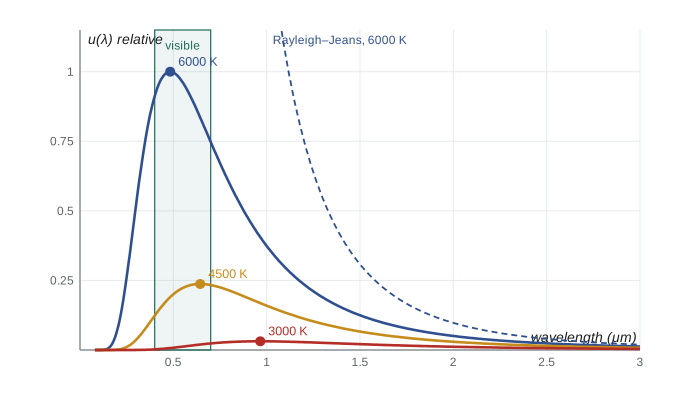
Planck fitted his formula to the Berlin data of Heinrich Rubens, Ferdinand Kurlbaum, Otto Lummer and Ernst Pringsheim and obtained \(h = 6.55 \times 10^{-34}\ \mathrm{J\,s}\) and a value of Boltzmann's constant that gave Avogadro's number to within a few per hundred of the modern value. Today \(h = 6.626\,070\,15 \times 10^{-34}\ \mathrm{J\,s}\) exactly, by definition: since 2019 the kilogram has been defined by fixing the value of Planck's constant, and is realized with a Kibble balance that weighs a mass against an electromagnetic force.
Recovering Stefan and Wien
Planck's law contains both earlier laws. Integrating over all frequencies with the substitution \(x = hf/kT\) gives
using \(\int_0^\infty x^3/(e^x - 1)\,dx = \pi^4/15\). The power radiated per unit area of a hole is \(c/4\) times the energy density, which gives \(\sigma = 2\pi^5 k^4/(15 h^3 c^2)\), a constant built from fundamental constants. Setting the derivative of \(u(\lambda, T)\) to zero gives \(x = 5(1 - e^{-x})\) with \(x = hc/\lambda kT\), whose root \(x = 4.965\) gives Wien's constant. The program below checks both numerically.
import math
h, c, k = 6.62607015e-34, 2.99792458e8, 1.380649e-23
# integral of x^3/(e^x - 1) by Simpson's rule on [1e-9, 60]
def f(x): return x**3 / math.expm1(x)
a, b, n = 1e-9, 60.0, 6000
hstep = (b - a) / n
S = f(a) + f(b) + sum((4 if i % 2 else 2) * f(a + i * hstep) for i in range(1, n))
I = S * hstep / 3
print(f"integral x^3/(e^x-1) = {I:.8f}, pi^4/15 = {math.pi**4 / 15:.8f}")
sigma = 2 * math.pi**5 * k**4 / (15 * h**3 * c**2)
print(f"Stefan-Boltzmann constant from h, c, k: {sigma:.4e} W m^-2 K^-4")
# Wien: solve x = 5(1 - e^-x) by Newton's method
x = 5.0
for _ in range(20):
    g = x - 5 * (1 - math.exp(-x)); dg = 1 - 5 * math.exp(-x)
    x -= g / dg
b_wien = h * c / (x * k)
print(f"root x = {x:.6f}; Wien constant b = {b_wien:.6e} m K")
for name, T in (("cosmic microwave background", 2.7255), ("human skin", 307.0),
                ("tungsten filament", 2800.0), ("solar surface", 5772.0), ("Sirius", 9940.0)):
    print(f"{name:28s} T = {T:8.1f} K  peak {b_wien / T * 1e6:10.3f} μm,"
f" emits {sigma * T**4:10.3e} W/m^2")integral x^3/(e^x-1) = 6.49393940, pi^4/15 = 6.49393940 Stefan-Boltzmann constant from h, c, k: 5.6704e-08 W m^-2 K^-4 root x = 4.965114; Wien constant b = 2.897772e-03 m K cosmic microwave background T = 2.7 K peak 1063.207 μm, emits 3.129e-06 W/m^2 human skin T = 307.0 K peak 9.439 μm, emits 5.037e+02 W/m^2 tungsten filament T = 2800.0 K peak 1.035 μm, emits 3.485e+06 W/m^2 solar surface T = 5772.0 K peak 0.502 μm, emits 6.294e+07 W/m^2 Sirius T = 9940.0 K peak 0.292 μm, emits 5.536e+08 W/m^2
Light bulbs, stars and the early universe
Planck's law explains why incandescent bulbs are inefficient. A tungsten filament at 2,800 K peaks near 1 μm, in the infrared, and only about a tenth of its radiation falls in the visible band; the rest heats the room. LEDs, which emit in a narrow band by a quantum process in a semiconductor, lesson 12, avoid this and use about a fifth of the power for the same light. It also explains the colors of stars. Betelgeuse at about 3,500 K glows orange-red, the Sun is white with a slight yellow tint, and Rigel at about 12,000 K is blue-white. Astronomers measure stellar temperatures by fitting Planck curves to stellar spectra.
The most perfect blackbody ever measured is the cosmic microwave background, the radiation left over from the hot early universe, discovered in 1965 by Arno Penzias and Robert Wilson. In 1990 the FIRAS instrument on NASA's COBE satellite measured its spectrum and found it to match a Planck curve at 2.725 K so closely that the error bars were thinner than the line drawn through the points. John Mather shared the 2006 Nobel Prize for this measurement. The peak is at about 1 mm in wavelength; the radiation fills the universe at about 400 photons per cubic centimeter.
What Planck's constant means
Planck's hypothesis introduced a new constant of nature with units of action, energy times time. The quantum \(hf\) is minute for everyday oscillations: a pendulum swinging once a second has \(hf = 6.6 \times 10^{-34}\) J, absurdly small compared with its energy of perhaps 0.01 J, so its energy levels form an effective continuum. For visible light, \(hf \approx 3 \times 10^{-19}\) J, or about 2 eV, which is comparable with \(kT\) only at several thousand kelvin. That is why quantization shows up first in the radiation of hot bodies. Planck thought the quantization belonged to the material oscillators in the walls. In 1905 Einstein took the bolder step of saying that light itself is quantized, the subject of lesson 6.
Worked problem
The temperature of a star from its color
A star's spectrum peaks at 420 nm. Estimate its surface temperature and the power radiated per square meter. If its radius is 1.7 times the Sun's, how luminous is it compared with the Sun (5,772 K)?
Show solution
- Wien's law: \(T = b/\lambda_{\text{max}} = 2.898 \times 10^{-3}/420 \times 10^{-9} = 6{,}900\) K.
- Stefan–Boltzmann: \(j = \sigma T^4 = 5.67 \times 10^{-8} \times 6900^4 = 1.29 \times 10^8\ \mathrm{W/m^2}\).
- Luminosity scales as \(R^2 T^4\): \(L/L_\odot = 1.7^2 \times (6900/5772)^4 = 2.89 \times 2.04 = 5.9\).
Answer: About 6,900 K, \(1.3 \times 10^8\ \mathrm{W/m^2}\), and roughly six times the Sun's luminosity.
Common mistakes
MistakeThinking a blackbody must look black.
InsteadA blackbody absorbs everything that falls on it; when hot it glows brightly. The Sun is a good blackbody.
MistakeUsing Wien's law with wavelength in nanometers and \(b\) in meter kelvins.
InsteadConvert units: 500 nm is \(5 \times 10^{-7}\) m.
MistakeAssuming the peak wavelength in \(u(\lambda)\) and the peak frequency in \(u(f)\) correspond to the same photon energy.
InsteadThey differ, because the distributions are per unit wavelength and per unit frequency; the frequency peak is at \(hf = 2.82\,kT\), the wavelength peak at \(hc/\lambda = 4.97\,kT\).
MistakeBelieving Planck intended to quantize light.
InsteadPlanck quantized the energy exchanged with the cavity walls; Einstein proposed light quanta in 1905.
Summary and key terms
- A blackbody's spectrum depends only on temperature; Stefan's law \(j = \sigma T^4\) and Wien's law \(\lambda_{\text{max}} T = b\) describe it.
- Counting modes in a cavity gives a density \(8\pi f^2/c^3\); equipartition then gives the Rayleigh–Jeans law and the ultraviolet catastrophe.
- Planck assumed oscillator energies \(nhf\), giving average energy \(hf/(e^{hf/kT} - 1)\) and the Planck law.
- Planck's law reproduces Rayleigh–Jeans at low frequency and yields \(\sigma\) and \(b\) from \(h\), \(c\) and \(k\).
- The cosmic microwave background is a near-perfect blackbody at 2.725 K.
- Blackbody
- An ideal absorber and emitter whose radiation depends only on temperature.
- Ultraviolet catastrophe
- The infinite energy predicted by classical equipartition for cavity radiation.
- Planck constant
- \(h = 6.626 \times 10^{-34}\ \mathrm{J\,s}\), the quantum of action.
- Planck law
- The spectral energy density of blackbody radiation.
- Mode
- A standing-wave pattern of the field in a cavity.
Practice problems
Work each problem on paper first, then reveal the answer to check.
At what wavelength does a person's body radiation peak, at 310 K?
Show answer
\(\lambda = 2.898 \times 10^{-3}/310 = 9.35\ \mu\mathrm{m}\), in the far infrared.
By what factor does the radiated power increase if the temperature of a filament rises from 2,000 K to 3,000 K?
Show answer
\((3/2)^4 = 5.06\).
For a mode with \(hf = 5kT\), what fraction of the classical average energy \(kT\) does it hold?
Show answer
\(\langle E \rangle /kT = 5/(e^5 - 1) = 0.034\).
Show that Planck's law reduces to Rayleigh–Jeans when \(hf \ll kT\).
Show answer
\(e^{hf/kT} - 1 \approx hf/kT\), so the factor \(hf/(e^{hf/kT}-1) \to kT\).
The cosmic microwave background is at 2.725 K. What is its peak wavelength?
Show answer
\(2.898 \times 10^{-3}/2.725 = 1.06\) mm.
Lesson quiz · 5 questions
Score 60% or more to complete this lesson.
Create a free account to save your progress, take quizzes and earn a certificate.