
PHYS-271 · Lesson 10 of 12 · 21 min
Many-electron atoms, the periodic table, lasers and X-rays
Hydrogen has one electron and an exact solution. Every other atom has several electrons that repel one another as well as being attracted to the nucleus, and the Schrödinger equation can no longer be solved exactly. Yet the main features of all atoms follow from two ideas added to the hydrogen results of lesson 9: electrons have an intrinsic angular momentum called spin, and no two electrons in an atom can occupy the same quantum state. With these, the periodic table that Dmitri Mendeleev assembled from chemical behavior in 1869 becomes a consequence of quantum mechanics. This lesson builds the periodic table, explains X-ray spectra and Moseley's law, and shows how stimulated emission leads to the laser.
Electron spin
In 1922 Otto Stern and Walther Gerlach in Frankfurt sent a beam of silver atoms through a strongly non-uniform magnetic field. Classically, atoms with magnetic moments pointing in random directions should have been deflected by a continuous range of amounts, smearing the beam into a band. Instead it split cleanly into two. Silver's outer electron has no orbital angular momentum, so the splitting had to come from something else. In 1925 two Dutch graduate students, George Uhlenbeck and Samuel Goudsmit, proposed that the electron itself has an intrinsic angular momentum, spin, with a component along any axis of only \(+\tfrac12\hbar\) or \(-\tfrac12\hbar\). The spin quantum number is \(s = \tfrac12\), and \(m_s = \pm\tfrac12\). Spin is not literally the electron spinning, which would require its surface to move faster than light; it is an intrinsic quantum property, like charge. Dirac's relativistic equation of 1928 showed that spin one-half follows naturally from combining quantum mechanics with special relativity.
With spin, each electron state in an atom is labeled by four quantum numbers \((n, l, m_l, m_s)\). For each \(n\) there are \(2n^2\) states: 2 for \(n = 1\), 8 for \(n = 2\), 18 for \(n = 3\). Protons and neutrons also have spin one-half, and the spin of the proton is what magnetic resonance imaging detects, lesson 12.
The exclusion principle
Wolfgang Pauli stated in 1925 that no two electrons in an atom can have the same four quantum numbers. The exclusion principle applies to all particles with half-integer spin, called fermions, which include electrons, protons and neutrons. Particles with integer spin, called bosons, such as photons, are not restricted and can crowd into the same state, which is what makes lasers possible. Without the exclusion principle every electron in an atom would drop into the \(1s\) state, all atoms would behave alike, and there would be no chemistry. With it, electrons fill the available states from the lowest energy upward, in shells and subshells.
Building up the periodic table
In a many-electron atom the inner electrons screen part of the nuclear charge from the outer ones. Because \(s\) electrons penetrate closer to the nucleus than \(p\) electrons, and \(p\) electrons closer than \(d\) electrons, lesson 9, the subshells of a given \(n\) are no longer degenerate: \(ns\) lies below \(np\), which lies below \(nd\). The filling order that results is \(1s, 2s, 2p, 3s, 3p, 4s, 3d, 4p, 5s, 4d, 5p, 6s, 4f, 5d, 6p, 7s, 5f, 6d, 7p\), which follows the Madelung rule: fill in order of increasing \(n + l\), and for equal \(n + l\), increasing \(n\). The \(4s\) subshell fills before \(3d\) because \(n + l = 4\) for \(4s\) and 5 for \(3d\).
# Electron configurations from the Madelung (n + l, n) filling order
letters = "spdf"
order = sorted(((n, l) for n in range(1, 8) for l in range(0, min(n, 4))), key=lambda t: (t[0] + t[1], t[0]))
names = {1: "H", 2: "He", 3: "Li", 6: "C", 8: "O", 10: "Ne", 11: "Na", 17: "Cl", 18: "Ar", 19: "K",
         20: "Ca", 26: "Fe", 29: "Cu", 36: "Kr", 47: "Ag", 54: "Xe", 79: "Au", 92: "U"}
def config(Z):
    out, left = [], Z
    for n, l in order:
        if left == 0: break
        k = min(left, 2 * (2 * l + 1))
        out.append(f"{n}{letters[l]}{k}")
        left -= k
    return " ".join(out)
for Z, sym in names.items():
    print(f"Z = {Z:2d} {sym:2s}: {config(Z)}")
print("filling order:", ", ".join(f"{n}{letters[l]}" for n, l in order[:15]))
# period lengths come from the capacities of the subshells filled between noble gases
caps = []
noble = [2, 10, 18, 36, 54, 86, 118]
prev = 0
for Zn in noble:
    caps.append(Zn - prev); prev = Zn
print("period lengths:", caps)Z = 1 H : 1s1 Z = 2 He: 1s2 Z = 3 Li: 1s2 2s1 Z = 6 C : 1s2 2s2 2p2 Z = 8 O : 1s2 2s2 2p4 Z = 10 Ne: 1s2 2s2 2p6 Z = 11 Na: 1s2 2s2 2p6 3s1 Z = 17 Cl: 1s2 2s2 2p6 3s2 3p5 Z = 18 Ar: 1s2 2s2 2p6 3s2 3p6 Z = 19 K : 1s2 2s2 2p6 3s2 3p6 4s1 Z = 20 Ca: 1s2 2s2 2p6 3s2 3p6 4s2 Z = 26 Fe: 1s2 2s2 2p6 3s2 3p6 4s2 3d6 Z = 29 Cu: 1s2 2s2 2p6 3s2 3p6 4s2 3d9 Z = 36 Kr: 1s2 2s2 2p6 3s2 3p6 4s2 3d10 4p6 Z = 47 Ag: 1s2 2s2 2p6 3s2 3p6 4s2 3d10 4p6 5s2 4d9 Z = 54 Xe: 1s2 2s2 2p6 3s2 3p6 4s2 3d10 4p6 5s2 4d10 5p6 Z = 79 Au: 1s2 2s2 2p6 3s2 3p6 4s2 3d10 4p6 5s2 4d10 5p6 6s2 4f14 5d9 Z = 92 U : 1s2 2s2 2p6 3s2 3p6 4s2 3d10 4p6 5s2 4d10 5p6 6s2 4f14 5d10 6p6 7s2 5f4 filling order: 1s, 2s, 2p, 3s, 3p, 4s, 3d, 4p, 5s, 4d, 5p, 6s, 4f, 5d, 6p period lengths: [2, 8, 8, 18, 18, 32, 32]
The rule reproduces the configurations of most elements. It fails for a few elements in the output. Copper's real configuration is \([\mathrm{Ar}]\,3d^{10} 4s^1\) rather than the predicted \(3d^9 4s^2\), and silver and gold behave the same way, because a completely filled \(d\) subshell is especially stable and the energies of the competing subshells are so close that small effects decide. Uranium, with \(5f^3 6d^1 7s^2\) rather than \(5f^4 7s^2\), is another exception. The period lengths 2, 8, 8, 18, 18, 32, 32 are the capacities of the subshells that fill between one noble gas and the next. The rows of the table are shells being filled, and the columns group elements with the same outer configuration, which is why they behave alike chemically: lithium, sodium and potassium all have one \(s\) electron outside a closed shell, lose it easily, and react violently with water.
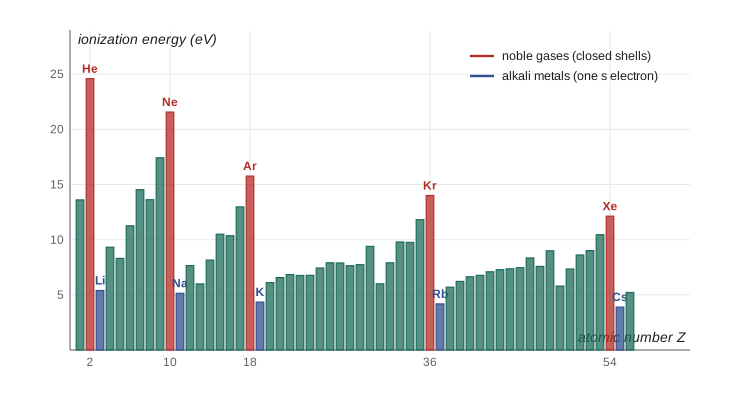
The ionization energies show the shell structure directly. They rise across each period as the nuclear charge grows and the added electrons in the same shell screen each other poorly, peak at the noble gases with their closed shells, and fall sharply at the next alkali metal, whose single electron starts a new shell farther out. Helium's ionization energy of 24.6 eV is the highest of any atom; cesium's 3.9 eV is among the lowest, which is why cesium is used in photocathodes and in the atomic clocks of lesson 12.
X-rays and Moseley's law
Wilhelm Röntgen discovered X-rays in 1895 at Würzburg, and within weeks they were being used to image broken bones. X-rays are produced when fast electrons strike a metal target. The spectrum has two parts. A continuous background, bremsstrahlung or braking radiation, comes from electrons decelerating in the fields of nuclei; its maximum photon energy equals the electron's kinetic energy, \(hf_{\text{max}} = eV\), the Duane–Hunt law, which gave another early measurement of \(h\). On top of the continuum sit sharp characteristic lines, different for each element. An incoming electron knocks out an inner electron, say from the \(n = 1\) shell, called the K shell; an electron from the \(n = 2\) shell, the L shell, drops into the hole and emits a \(K_\alpha\) X-ray.
In 1913 Henry Moseley at Manchester measured the \(K_\alpha\) lines of a series of elements using crystal diffraction and found that the square root of the frequency rises in a straight line with a whole number he could assign to each element. An L electron dropping into the K shell sees the nuclear charge screened by the one remaining K electron, an effective charge of about \(Z - 1\). Bohr's formula with that charge gives
Moseley's law showed that the atomic number \(Z\), the charge of the nucleus, is the true ordering principle of the periodic table, not the atomic mass. It explained why cobalt comes before nickel even though it is heavier, and it predicted missing elements at \(Z = 43, 61, 72\) and 75, all found later. Moseley was killed at Gallipoli in 1915 at the age of 27, a loss that led Britain to stop sending scientists to the front lines.
import math
hc = 1239.84198     # eV nm
elements = [("Al", 13, 1.487), ("Ti", 22, 4.511), ("Fe", 26, 6.404), ("Cu", 29, 8.048),
            ("Mo", 42, 17.479), ("Ag", 47, 22.163), ("W", 74, 59.32)]
print(f"{'element':8s}{'Z':>4s}{'Moseley keV':>13s}{'measured keV':>14s}{'wavelength pm':>15s}")
xs, ys = [], []
for sym, Z, meas in elements:
    pred = 10.2 * (Z - 1)**2 / 1000
    print(f"{sym:8s}{Z:4d}{pred:13.3f}{meas:14.3f}{hc / (meas * 1000) * 1000:15.2f}")
    xs.append(Z); ys.append(math.sqrt(meas * 1000 / 10.2))
n = len(xs); xm, ym = sum(xs) / n, sum(ys) / n
slope = sum((x - xm) * (y - ym) for x, y in zip(xs, ys)) / sum((x - xm)**2 for x in xs)
icept = ym - slope * xm
print(f"fit sqrt(E / 10.2 eV) = {slope:.3f} Z {icept:+.2f}  (Moseley: 1.000 Z - 1)")
# Duane-Hunt limit for a medical tube
for kV in (30, 80, 120):
print(f"{kV:4d} kV tube: shortest bremsstrahlung wavelength {hc / (kV * 1000) * 1000:.2f} pm")element Z Moseley keV measured keV wavelength pm Al 13 1.469 1.487 833.79 Ti 22 4.498 4.511 274.85 Fe 26 6.375 6.404 193.60 Cu 29 7.997 8.048 154.06 Mo 42 17.146 17.479 70.93 Ag 47 21.583 22.163 55.94 W 74 54.356 59.320 20.90 fit sqrt(E / 10.2 eV) = 1.052 Z -2.24 (Moseley: 1.000 Z - 1) 30 kV tube: shortest bremsstrahlung wavelength 41.33 pm 80 kV tube: shortest bremsstrahlung wavelength 15.50 pm 120 kV tube: shortest bremsstrahlung wavelength 10.33 pm
The simple screening estimate is within about 1% for light elements and falls increasingly below the measurement for heavy ones, by about 8% for tungsten, where relativistic effects and more complex screening matter. The fitted slope is close to 1, confirming that \(\sqrt{f}\) rises linearly with \(Z\). Copper's \(K_\alpha\) line at 0.154 nm is the standard X-ray source for crystal diffraction, and a medical tube at 80 kV produces bremsstrahlung down to 15.5 pm. The brightest X-ray sources today are synchrotrons, in which electrons circulating at nearly the speed of light radiate as they curve. The Canadian Light Source in Saskatoon, opened in 2004, and the Advanced Photon Source at Argonne near Chicago produce X-ray beams billions of times brighter than a laboratory tube, used to determine the structures of proteins and to study materials for batteries.
Absorption, emission and stimulated emission
An atom can interact with light in three ways. In absorption, a photon of the right energy raises the atom to an excited state. In spontaneous emission, an excited atom drops to a lower state and emits a photon in a random direction at a random time. In 1917 Einstein showed, by requiring that atoms in a cavity reach thermal equilibrium with Planck's radiation, lesson 5, that there must be a third process: stimulated emission. A photon passing an excited atom can trigger it to emit a second photon identical to the first, with the same energy, direction, phase and polarization. Einstein's argument also fixed the ratio of the rates of the three processes.
In thermal equilibrium the lower state is always more populated than the upper one, by the Boltzmann factor \(e^{-\Delta E/kT}\), so absorption beats stimulated emission and light passing through a gas is weakened. If the population can be inverted, with more atoms in the upper state, stimulated emission wins and light is amplified. That is the principle of the laser, Light Amplification by Stimulated Emission of Radiation. Charles Townes built the first microwave version, the maser, in 1954, and Theodore Maiman at Hughes Research Laboratories in California demonstrated the first laser, using a ruby crystal pumped by a flash lamp, on 16 May 1960.
Population inversion needs at least three levels. In a typical system atoms are pumped to a high, short-lived level, drop quickly to a long-lived upper laser level, and accumulate there; the laser transition takes them to a lower level that empties quickly. Mirrors at both ends of the gain medium form an optical cavity that sends the light back and forth through it, and one partly transparent mirror lets a beam out. The result is light that is nearly monochromatic, highly directional and coherent, with a single phase across the beam. PHYS-230 showed how coherent light makes interference and holography possible. Lasers now read barcodes, cut steel, carry internet traffic through optical fibers, correct vision and, in the LIGO detectors in Washington and Louisiana, measured the stretching of space by a gravitational wave to a thousandth of a proton's diameter in 2015.
Worked problem
Why a hot gas does not lase
For a transition with \(\Delta E = 2.0\) eV, find the ratio of upper to lower populations in thermal equilibrium at 300 K and at 6,000 K. What does this say about getting population inversion by heating?
Show solution
- At 300 K, \(kT = 0.0259\) eV, so \(N_2/N_1 = e^{-2.0/0.0259} = e^{-77} \approx 3 \times 10^{-34}\).
- At 6,000 K, \(kT = 0.517\) eV, so \(N_2/N_1 = e^{-3.87} = 0.021\).
- Even at the temperature of the Sun's surface only 2% of atoms are in the upper state; the ratio approaches 1 only as \(T \to \infty\) and never exceeds it.
Answer: Heating can never produce inversion; lasers need non-thermal pumping by light, electric discharge or current.
Common mistakes
MistakePicturing spin as a tiny ball rotating.
InsteadSpin is an intrinsic angular momentum with only two values of its component for the electron; no classical rotation can produce it.
MistakeFilling \(3d\) before \(4s\).
InsteadBy the Madelung rule \(4s\) (with \(n + l = 4\)) fills before \(3d\) (with \(n + l = 5\)).
MistakeThinking periodic table order comes from atomic mass.
InsteadMoseley showed it follows the nuclear charge \(Z\); cobalt and nickel, argon and potassium are out of mass order.
MistakeBelieving a laser simply concentrates ordinary light.
InsteadA laser amplifies by stimulated emission, which needs a population inversion; it produces coherent light no lens can make from a lamp.
Summary and key terms
- Electrons have spin one-half, \(m_s = \pm\tfrac12\); the Stern–Gerlach experiment splits a silver beam in two.
- The Pauli exclusion principle allows at most one electron per set \((n, l, m_l, m_s)\).
- Subshells fill in order of \(n + l\), then \(n\); shell closings explain the periods 2, 8, 8, 18, 18, 32, 32.
- Characteristic X-rays follow Moseley's law \(hf \approx 10.2\ \mathrm{eV}(Z-1)^2\); the continuum ends at \(eV\).
- Stimulated emission and population inversion make lasers possible.
- Spin
- An intrinsic angular momentum; \(s = \tfrac12\) for electrons, protons and neutrons.
- Exclusion principle
- No two fermions can occupy the same quantum state.
- Shell
- The set of electron states with the same \(n\).
- Characteristic X-ray
- An X-ray emitted when an electron fills an inner-shell vacancy.
- Population inversion
- More atoms in an upper level than a lower one, required for laser gain.
Practice problems
Work each problem on paper first, then reveal the answer to check.
Write the configuration of phosphorus, \(Z = 15\).
Show answer
\(1s^2\,2s^2\,2p^6\,3s^2\,3p^3\).
How many electrons can occupy the \(n = 4\) shell?
Show answer
\(2n^2 = 32\).
Estimate the \(K_\alpha\) energy of nickel, \(Z = 28\).
Show answer
\(10.2 \times 27^2 = 7.44\) keV (measured 7.48 keV).
Why are fluorine and chlorine similar chemically?
Show answer
Both have \(ns^2\,np^5\), one electron short of a closed shell, so both readily gain an electron.
A helium–neon laser emits 632.8 nm light. What is the energy of its photons?
Show answer
\(1240/632.8 = 1.96\) eV.
Lesson quiz · 5 questions
Score 60% or more to complete this lesson.
Create a free account to save your progress, take quizzes and earn a certificate.