
PHYS-271 · Lesson 2 of 12 · 22 min
Special relativity I: postulates, time dilation and length contraction
In 1905 Albert Einstein, a 26-year-old technical examiner at the Swiss patent office in Bern, published a paper with the modest title On the Electrodynamics of Moving Bodies. It began not with the Michelson–Morley experiment but with a puzzle about magnets and coils. Move a magnet past a stationary coil and a current flows; move the coil past a stationary magnet and the same current flows. Yet the textbook explanations were completely different in the two cases, an electric field in one and a magnetic force in the other. Einstein took the sameness of the result as a clue that only relative motion matters, for electromagnetism as well as for mechanics. From that idea and one more postulate he derived the whole of special relativity.
This lesson states the postulates, uses a simple light clock to derive time dilation, deduces length contraction, and checks both against experiments with muons, atomic clocks and particle accelerators. Lesson 3 then builds the full Lorentz transformation and the geometry of spacetime.
Frames of reference
An inertial frame is a frame of reference in which a free particle, one with no forces on it, moves in a straight line at constant speed. A train moving smoothly along a straight track is, to a very good approximation, an inertial frame; so is the platform. Galileo pointed out in 1632 that no experiment inside a smoothly moving ship's cabin can tell whether the ship is moving: butterflies fly the same way, water drips straight down into a bowl. This is the principle of relativity for mechanics. In Galilean relativity, if the train moves at speed \(v\) along \(x\), coordinates in the two frames are related by \(x' = x - vt\) and \(t' = t\), and velocities simply add: a ball thrown forward at \(u'\) on the train moves at \(u = u' + v\) relative to the platform.
Apply that rule to light and you get a contradiction with Maxwell's equations, which give the same speed \(c\) without any reference to the motion of the source or observer. Either Maxwell's equations hold only in one special frame, the ether frame, or the Galilean addition of velocities is wrong. Michelson and Morley found no special frame. Einstein chose to keep the principle of relativity and give up Galilean addition.
The two postulates
Einstein's postulates are short.
- The principle of relativity: the laws of physics take the same form in every inertial frame. No experiment, mechanical, electrical or optical, can single out a frame at absolute rest.
- The constancy of the speed of light: light in vacuum travels at the same speed \(c\) in every inertial frame, independent of the motion of its source.
The second postulate is the strange one. It says that if you chase a light beam at half the speed of light, you still measure it to move away from you at \(c\). Since speed is distance divided by time, something about our measurements of distance and time must differ between frames. Einstein's insight was that the notion of time itself, and in particular of two events being simultaneous, had never been examined carefully. Clocks in different places must be synchronized by some signal, and if the signal is light, the constancy of \(c\) fixes what synchronization means.
Since 1983 the second postulate has also been built into the units. The meter is defined as the distance light travels in vacuum in \(1/299\,792\,458\) of a second, so the speed of light is exactly \(c = 299\,792\,458\ \mathrm{m/s}\) by definition. Measuring the speed of light is now a way of calibrating a ruler.
The light clock
The simplest clock to analyze is a light clock: two parallel mirrors a distance \(L\) apart, with a pulse of light bouncing between them. Each round trip is one tick. In the clock's own rest frame a tick takes
Now put the clock on a train moving at speed \(v\) parallel to the mirrors, and watch it from the platform. The light still goes up and down between the mirrors, but the mirrors move while it does, so in the platform frame the light follows a zigzag path. Each leg is the hypotenuse of a right triangle with height \(L\) and base \(v\,\Delta t/2\), where \(\Delta t\) is the tick time measured on the platform. The second postulate says the light still moves at \(c\) along this longer path, so
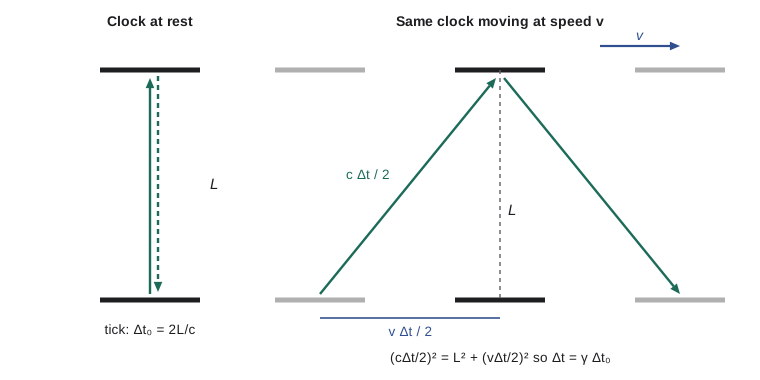
Solving for \(\Delta t\) gives
The moving clock ticks slowly, by the Lorentz factor \(\gamma\), which is always at least 1. The interval \(\Delta t_0\) measured by a clock that is present at both events, here the departure and return of the light pulse, is called the proper time. Any other inertial observer, for whom the two events happen at different places, measures a longer time. This is time dilation.
Nothing in the argument depends on the clock being made of mirrors. If a light clock and a wristwatch sat side by side on the train and ran at different rates, a passenger could detect the train's motion by comparing them, violating the first postulate. So every process, a heartbeat, a quartz crystal, the decay of a particle, slows by the same factor. Time dilation is a property of time, not of clocks.
How big is gamma?
For everyday speeds \(\gamma\) is indistinguishable from 1. Expanding for small \(\beta\) gives \(\gamma \approx 1 + \tfrac12 \beta^2\), so a jet airliner at 250 m/s has \(\gamma - 1 \approx 3.5 \times 10^{-13}\). The program below tabulates \(\gamma\) from walking speed to the speed of the protons in the Large Hadron Collider, and shows why the expansion is useful: computing \(1 - \sqrt{1 - \beta^2}\) directly for tiny \(\beta\) loses precision to rounding.
import math
c = 299792458.0
cases = [("walking person", 1.4), ("highway car", 30.0), ("jet airliner", 250.0),
         ("GPS satellite", 3874.0), ("Earth around the Sun", 29780.0),
         ("electron in a TV-style tube", 0.3 * c), ("muon from cosmic rays", 0.998 * c),
         ("LHC proton at 6.8 TeV", None)]
mp_GeV = 0.938272
for name, v in cases:
    if v is None:
        g = 6800 / mp_GeV                     # gamma = E / (m c^2)
        one_minus_beta = 1 / (2 * g * g)      # 1 - beta for gamma >> 1
        print(f"{name:28s} gamma = {g:12.1f}   1 - beta = {one_minus_beta:.2e}")
        continue
    b = v / c
    g_direct = 1 / math.sqrt(1 - b * b)
    g_minus_1 = b * b / 2 + 3 * b**4 / 8      # series, accurate for small beta
    if b < 0.01:
        print(f"{name:28s} beta = {b:.3e}   gamma - 1 = {g_minus_1:.3e}")
    else:
print(f"{name:28s} beta = {b:.4f} gamma = {g_direct:.4f}")walking person beta = 4.670e-09 gamma - 1 = 1.090e-17 highway car beta = 1.001e-07 gamma - 1 = 5.007e-15 jet airliner beta = 8.339e-07 gamma - 1 = 3.477e-13 GPS satellite beta = 1.292e-05 gamma - 1 = 8.349e-11 Earth around the Sun beta = 9.934e-05 gamma - 1 = 4.934e-09 electron in a TV-style tube beta = 0.3000 gamma = 1.0483 muon from cosmic rays beta = 0.9980 gamma = 15.8193 LHC proton at 6.8 TeV gamma = 7247.4 1 - beta = 9.52e-09
Relativity matters when \(\beta\) is a sizeable fraction of 1. At 30% of light speed time runs about 5% slow; at 99.8% it runs about sixteen times slow. A proton in the Large Hadron Collider has \(\gamma\) above 7,000: one second of its time corresponds to about two hours in the laboratory.
Muons: time dilation in the sky
Cosmic-ray protons strike nuclei in the upper atmosphere and produce showers of particles, among them muons, which are heavy cousins of the electron. Muons are unstable, decaying with a mean lifetime of \(\tau = 2.197\ \mu\mathrm{s}\) in their own rest frame. Most are produced 10 to 15 km up. Even at nearly the speed of light, a muon travels only \(c\tau \approx 660\) m in one lifetime. Without time dilation, only a tiny fraction would survive to sea level, yet a detector the size of a dinner plate at sea level counts about one muon per second.
Bruno Rossi and David Hall turned this into a quantitative test in 1941, comparing muon counts on Mount Evans in Colorado and in Denver. A cleaner version by David Frisch and James Smith in 1963 compared the count on Mount Washington in New Hampshire, 1,910 m above sea level, with the count at sea level in Cambridge, Massachusetts, selecting muons with a narrow band of speeds near \(0.995c\). The program below reproduces the logic.
import math
c = 299792458.0
tau = 2.197e-6         # muon mean lifetime at rest, s
h = 1907.0             # height difference, m (Frisch and Smith, 1963)
beta = 0.9952          # speed of the selected muons
gamma = 1 / math.sqrt(1 - beta**2)
t_lab = h / (beta * c)                    # flight time in the Earth frame
survive_newton = math.exp(-t_lab / tau)   # if clocks were not affected
survive_rel = math.exp(-t_lab / (gamma * tau))
N_top = 563            # muons per hour counted at the summit
print(f"gamma = {gamma:.2f}, flight time in Earth frame = {t_lab * 1e6:.2f} microseconds")
print(f"muon's own elapsed time = {t_lab / gamma * 1e6:.3f} microseconds")
print(f"expected at sea level without dilation: {N_top * survive_newton:.0f} per hour")
print(f"expected at sea level with dilation:    {N_top * survive_rel:.0f} per hour")
print("measured by Frisch and Smith: about 408 per hour")gamma = 10.22, flight time in Earth frame = 6.39 microseconds muon's own elapsed time = 0.626 microseconds expected at sea level without dilation: 31 per hour expected at sea level with dilation: 424 per hour measured by Frisch and Smith: about 408 per hour
Without time dilation only about 30 of the 563 muons per hour should reach sea level. Frisch and Smith counted about 408, in good agreement with the relativistic prediction of a little over 400. The experiment was later filmed as a teaching film, and the same logic is checked every day in particle detectors. A sharper test came at the muon storage ring at CERN in 1977, where muons circulating at \(\gamma = 29.3\) lived 29.3 times longer than at rest, confirming the formula to about one part in a thousand.
Length contraction
Look at the same muon from its own frame. In that frame the muon is at rest and lives 2.2 microseconds on average, so how does it get to sea level? The mountain moves toward it. If the trip takes only \(\Delta t_0 = \Delta t/\gamma\) of the muon's time, the distance between summit and sea level, as measured in the muon's frame, must be
where \(L_0 = v\,\Delta t\) is the height measured on the Earth. Lengths along the direction of motion are contracted by the factor \(\gamma\). The length \(L_0\) measured in the frame where the object is at rest is the proper length, and it is the longest length any observer measures. Lengths perpendicular to the motion are unchanged. To see why, imagine two trains passing on parallel tracks, each carrying a horizontal paint brush at the same height above its own rails. If perpendicular lengths shrank, each brush would pass below the other's, and both crews would see their own mark on top: a contradiction, since the marks are physical facts. The light clock argument relied on this, since we took the mirror separation \(L\) to be the same in both frames.
Time dilation and length contraction are two sides of the same coin. In the Earth frame the muon lives longer and travels the full 1.9 km. In the muon frame it lives its usual life and the atmosphere is squashed to about a tenth of its height. Both frames agree on the one thing that can be checked directly, whether the muon reaches the detector before it decays.
Clocks on jets and satellites
In 1971 Joseph Hafele and Richard Keating flew cesium-beam atomic clocks around the world on commercial jets, once eastward and once westward, and compared them with clocks at the U.S. Naval Observatory. The flying clocks differed from the ground clocks by tens of nanoseconds, in agreement with predictions that combined the time dilation of this lesson with the gravitational effect of general relativity, under which clocks higher in a gravitational field run faster. The eastward clocks lost about 59 ns and the westward clocks gained about 273 ns. In 2010 researchers at NIST compared two aluminum-ion optical clocks and detected time dilation at a relative speed of only 10 m/s, a speed you could reach on a bicycle.
The Global Positioning System must correct for both effects every day. Its satellites orbit at about 3.9 km/s, so their clocks lose about 7 microseconds per day from motion, and gain about 45 microseconds per day from being higher in the Earth's gravitational field. Lesson 12 computes the net correction and shows why ignoring it would put your position off by kilometers within a day.
Worked problem
A trip to Proxima Centauri
Proxima Centauri is 4.24 light-years away. A spacecraft travels there at \(\beta = 0.8\). How long does the trip take according to Earth clocks and according to the crew? How far is the star in the crew's frame?
Show solution
- Earth time: \(\Delta t = d/v = 4.24\ \mathrm{ly} / 0.8c = 5.30\) years.
- Lorentz factor: \(\gamma = 1/\sqrt{1 - 0.64} = 1/0.6 = 1.667\).
- Crew time (proper time, since the crew are present at departure and arrival): \(\Delta t_0 = \Delta t/\gamma = 5.30 \times 0.6 = 3.18\) years.
- Distance in the crew frame: \(L = L_0/\gamma = 4.24 \times 0.6 = 2.54\) light-years, which they cover at \(0.8c\) in \(2.54/0.8 = 3.18\) years, consistent with the crew clock.
Answer: 5.30 years by Earth clocks, 3.18 years for the crew, who see the distance contracted to 2.54 light-years.
Common mistakes
MistakeThinking time dilation is an illusion caused by light taking time to reach the observer.
InsteadThe light delay is removed in the analysis; the moving clock really accumulates less time, as the muon counts and flying clocks show.
MistakeApplying the contraction to lengths perpendicular to the motion.
InsteadOnly lengths along the direction of relative motion contract.
MistakeUsing the wrong time as proper time.
InsteadProper time belongs to the clock present at both events, the one for which the events happen at the same place.
MistakeComputing \(\gamma - 1\) directly for tiny speeds.
InsteadUse \(\gamma - 1 \approx \beta^2/2\); the direct formula loses all precision to rounding when \(\beta^2\) is below about \(10^{-16}\).
Summary and key terms
- The laws of physics are the same in all inertial frames, and light in vacuum moves at \(c\) in every frame.
- The light clock gives time dilation, \(\Delta t = \gamma\,\Delta t_0\), with \(\gamma = 1/\sqrt{1 - v^2/c^2}\).
- Proper time is measured by a clock present at both events; every other observer measures more.
- Lengths along the motion contract, \(L = L_0/\gamma\); perpendicular lengths do not change.
- Muon survival, storage rings, flying atomic clocks and GPS all confirm time dilation.
- Inertial frame
- A frame in which free particles move at constant velocity.
- Lorentz factor
- \(\gamma = 1/\sqrt{1 - \beta^2}\), the factor by which moving clocks slow.
- Proper time
- The time between two events measured by a clock present at both.
- Proper length
- The length of an object measured in its own rest frame.
- Time dilation
- The slowing of moving clocks by the factor \(\gamma\).
Practice problems
Work each problem on paper first, then reveal the answer to check.
At what speed is \(\gamma = 2\)?
Show answer
\(1 - \beta^2 = 1/4\), so \(\beta = \sqrt{3}/2 = 0.866\), about 260,000 km/s.
A pion has a mean lifetime of 26 ns at rest. How far does it travel on average at \(\beta = 0.99\)?
Show answer
\(\gamma = 7.09\); lifetime 184 ns; distance \(0.99c \times 184\ \mathrm{ns} = 54.7\) m, instead of 7.7 m without dilation.
A spaceship 100 m long at rest passes Earth at \(0.6c\). What length do Earth observers measure?
Show answer
\(\gamma = 1.25\), so 80 m.
Estimate \(\gamma - 1\) for a satellite at 7.7 km/s.
Show answer
\(\beta = 2.57 \times 10^{-5}\), so \(\gamma - 1 \approx \beta^2/2 = 3.3 \times 10^{-10}\), about 29 microseconds per day.
Explain why time dilation must apply to all clocks equally.
Show answer
If different kinds of clock slowed differently, comparing them would reveal absolute motion, contradicting the principle of relativity.
Lesson quiz · 5 questions
Score 60% or more to complete this lesson.
Create a free account to save your progress, take quizzes and earn a certificate.