
NUC-330 · Lesson 10 of 12 · 21 min
Natural circulation
Hana spends Monday morning at a university TRIGA research reactor. Its small core sits near the bottom of an open pool of water and is cooled by natural circulation: water heated in the core rises, mixes into the pool and is replaced by cooler water from below. "Same physics as the BWRX-300 at Clinch River," Rohan says, when she gets back. "Hot water and steam rise, cold water sinks, and if you have arranged the plumbing properly, that alone moves enough coolant to take the heat away. The difference is the power level."
The principle
Natural circulation, also called natural convection in a loop, arises when a fluid is heated low down and cooled high up in a closed circuit. The heated leg holds lighter fluid than the cooled leg, so the cooled leg's column is heavier and pushes the fluid around the loop. In steady state, the buoyancy driving head equals the friction and form losses around the loop:
Here \(H\) is the vertical distance between the thermal center of the heat source and the thermal center of the heat sink, often called the elevation difference or thermal center height. Placing the heat sink well above the heat source and keeping loop resistance low are the two design rules for strong natural circulation.
Single-phase natural circulation
For single-phase liquid with a volumetric expansion coefficient \(\beta\), the density difference is \(\rho\beta\Delta T\), and the temperature rise across the core is \(\Delta T = Q/(\dot m c_p)\). Substituting into the balance gives
Flow rises only as the cube root of power. Doubling the power raises the flow by about 26 percent and the temperature rise by about 59 percent. Natural circulation is therefore self-regulating but weak: it is ideal for removing decay heat, which is a few percent of full power, and for very low-power reactors, but a large power reactor needs either pumps or a carefully designed two-phase system to carry full power this way.
Worked problem
Natural circulation in a pool reactor
A small pool reactor core produces 20 kW. The thermal center height between the core and the effective cooling region is 0.6 m. Water near 30 °C has \(\rho = 998\) kg/m³, \(\beta = 2.6\times10^{-4}\) /K and \(c_p = 4.18\) kJ/kg·K. The loop resistance is \(\sum K/A^{2} = 9\times10^{4}\) m⁻⁴. Estimate the core flow and temperature rise.
Show solution
- \(\dot m^{3} = 2 \times 998^{2} \times 9.81 \times 2.6\times10^{-4} \times 0.6 \times 20\,000 / (4180 \times 9\times10^{4})\).
- \(\dot m^{3} \approx 0.163\), so \(\dot m \approx 0.55\) kg/s.
- \(\Delta T = 20\,000/(0.55 \times 4180) \approx 8.8\) K.
Answer: About 0.55 kg/s with a core temperature rise of about 9 K. Real pool reactors are characterized by measurements and detailed models, but the cube-root scaling holds.
Two-phase natural circulation
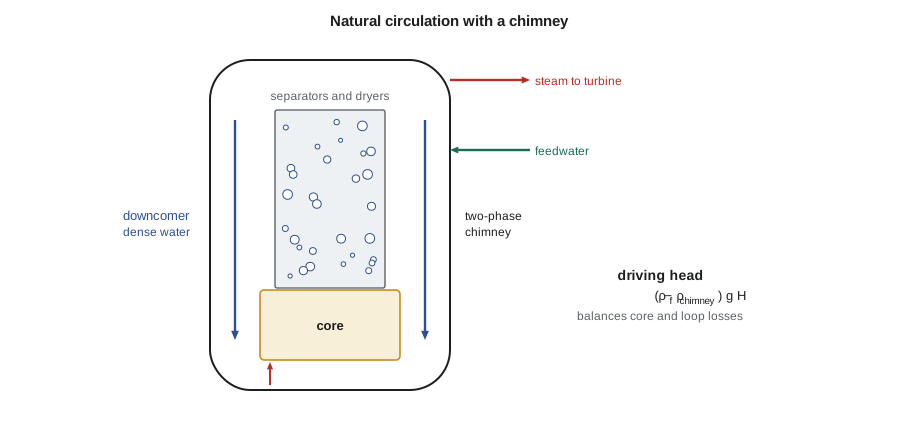
Boiling transforms natural circulation. The density difference between a liquid downcomer and a two-phase riser is far larger than any single-phase density difference: at 7 MPa, a riser at 50 percent void has a mixture density of about 390 kg/m³ against 740 kg/m³ in the downcomer. A tall riser, or chimney, above the core multiplies this difference by its height. This is how the BWRX-300, and before it larger natural-circulation boiling water reactor designs, can drive full core flow without pumps.
A chimney several meters tall at 50 to 60 percent void provides a driving head of roughly 20 to 40 kPa, comparable to the pressure drop of a BWR core with low-loss fuel. The design challenge is to keep the core, separator and downcomer pressure drops low, so that the available head moves enough flow, while maintaining stability, the density-wave concern of Lesson 5.
# Natural circulation: balance the buoyancy head against loop losses, for a BWR-style chimney
# and for a pool-type research reactor. Numbers are illustrative.
import math
def nc_single_phase(Q, H, K_over_A2, rho, beta, cp, g=9.81):
    """Solve rho*g*beta*dT*H = K*m^2/(2 rho A^2) with dT = Q/(m cp). Returns m, dT."""
    # m^3 = 2 rho^2 g beta H Q / (cp * K/A^2)
    m = (2 * rho**2 * g * beta * H * Q / (cp * K_over_A2)) ** (1/3)
    return m, Q / (m * cp)
for Q in (10e3, 20e3, 40e3):     # small pool reactor powers, W
    m, dT = nc_single_phase(Q, 0.6, 9.0e4, 998.0, 2.6e-4, 4180.0)
    print(f"pool reactor at {Q/1e3:4.0f} kW: core flow {m:5.2f} kg/s, core temperature rise {dT:4.1f} K")
print("flow scales as Q^(1/3): doubling power raises flow by", round(2 ** (1/3), 3))

# Two-phase chimney: driving head from the density difference between downcomer and chimney
rho_f, rho_g, g = 740.0, 36.5, 9.81
for H_ch, alpha in ((6.0, 0.50), (6.0, 0.60), (9.0, 0.60)):
    rho_mix = alpha * rho_g + (1 - alpha) * rho_f
    dp = (rho_f - rho_mix) * g * H_ch
print(f"chimney {H_ch:3.0f} m, mean void {alpha:4.2f}: driving head {dp/1000:5.1f} kPa")pool reactor at 10 kW: core flow 0.43 kg/s, core temperature rise 5.5 K pool reactor at 20 kW: core flow 0.55 kg/s, core temperature rise 8.8 K pool reactor at 40 kW: core flow 0.69 kg/s, core temperature rise 13.9 K flow scales as Q^(1/3): doubling power raises flow by 1.26 chimney 6 m, mean void 0.50: driving head 20.7 kPa chimney 6 m, mean void 0.60: driving head 24.8 kPa chimney 9 m, mean void 0.60: driving head 37.3 kPa
Natural circulation for decay heat removal
Every water-cooled reactor relies on natural circulation at some point. After the reactor coolant pumps stop, for example on loss of off-site power, the primary coolant continues to circulate between the core and the steam generators by natural circulation, provided the steam generators are above the core, still have water on their secondary sides and are being steamed or fed. Decay heat is a few percent of full power, and single-phase natural circulation carries it easily. Operators can confirm that natural circulation has been established by watching the hot and cold leg temperatures: a stable difference with a slowly falling average indicates good flow.
In the CANDU reactors used in Canada, natural circulation through the horizontal channels and the boilers is called thermosyphoning. Because the channels are horizontal, flow distribution among them in thermosyphoning is more sensitive to small elevation and resistance differences than in a vertical core, and test programs studied it in detail for code validation.
If the primary system loses inventory, natural circulation changes character. With some voiding, two-phase natural circulation can carry even more heat than single-phase flow. With more voiding, the loop may enter reflux condensation, where steam generated in the core flows to the steam generator tubes, condenses, and drains back to the core, a mode that still removes decay heat. If inventory falls further, circulation can stop. Understanding these modes is essential for small-break loss-of-coolant accidents, covered in Lesson 11.
Passive safety systems
Natural circulation is the basis of most passive safety systems, which work without pumps, operator action or, in many cases, electrical power. Examples include isolation condensers in BWRs, which condense reactor steam in a heat exchanger submerged in a large pool above the reactor and drain the condensate back by gravity; passive residual heat removal heat exchangers in some PWR designs; and passive containment cooling, in which air or water around a steel containment removes heat by natural convection. The BWRX-300 uses isolation condensers to remove decay heat after an isolation of the reactor, sized to work for days before the pools need refilling.
| System | Heat source | Heat sink | Driving force |
|---|---|---|---|
| BWR isolation condenser | reactor steam | water pool above the reactor | steam flow up, condensate drains down by gravity |
| PWR passive residual heat removal | primary coolant | in-containment water tank | single-phase natural circulation |
| Passive containment cooling | containment atmosphere | outside air and water film | natural convection of air |
| Pool reactor cooling | small core | pool and heat exchanger | buoyancy in the pool |
Passive does not mean simple. Natural-circulation systems have small driving heads, so small extra resistances, trapped non-condensable gases or unexpected elevation changes can degrade them. They are therefore tested extensively, often in scaled integral test facilities, and their performance is modeled with the codes of Lesson 12 using carefully validated correlations.
Scaling and testing
Natural-circulation loops cannot be tested at full scale for every condition, so engineers build scaled facilities. Scaling rules ensure that the ratios that matter, such as driving head to friction, time constants and, for two-phase flow, phase change numbers, are preserved. Height is often preserved at full scale, because buoyancy depends on it, while flow areas are reduced. Data from scaled facilities validate the codes that are then applied to the full-size plant.
Stability of natural circulation
Single-phase natural circulation loops can oscillate, especially at low power or with heat sources and sinks arranged unfavorably, and two-phase loops can show density-wave and flashing oscillations. Flashing is particularly relevant to natural-circulation boiling water reactors at low pressure during startup: as heated water rises up the chimney, the falling hydrostatic pressure lets it flash to steam, which changes the driving head and can set up oscillations. Startup procedures for natural-circulation reactors heat and pressurize the vessel in a controlled sequence that avoids unstable regions.
Hana's summary for Rohan fits on one page: the cube-root law for single-phase loops, the chimney equation for two-phase loops, and a list of things that can spoil natural circulation, headed by non-condensable gas. Rohan adds one line to the bottom: "And it never stops working because someone forgot to turn it on."
Natural circulation in a station blackout
A station blackout, the loss of all off-site and on-site alternating current power, is the classic test of natural circulation in a large plant. The reactor trips and the coolant pumps coast down within a minute or so. If the steam generators have water on their secondary sides and a way to release steam, through atmospheric relief valves for example, and if they can be fed, for instance by a turbine-driven auxiliary feedwater pump that runs on steam, then primary natural circulation carries decay heat from the core to the steam generators indefinitely. Rohan points out the chain of dependencies: natural circulation needs a heat sink, the heat sink needs feedwater, the feedwater pump needs steam and control power from batteries, and the batteries last only so long. After the 2011 Fukushima Daiichi accident, plants in both countries added portable pumps and generators and connection points so that heat sinks could be maintained for much longer periods.
In the BWRX-300, isolation condensers provide the same function without feedwater: the reactor steam itself carries heat to the condenser pools. The pools hold enough water to remove decay heat for a long period before refilling is needed, and refilling can be done from outside sources.
Comparing forced and natural circulation
| Property | Forced circulation | Natural circulation |
|---|---|---|
| Driving force | pump head, tens of meters | buoyancy, a few meters of water or less |
| Flow at full power | set by pump speed and loop resistance | set by power, elevation and resistance |
| Response to loss of power | coastdown, then natural circulation | continues unchanged |
| Sensitivity to added resistance | small | large |
| Sensitivity to non-condensable gas | small in liquid loops | can stop two-phase or condensing loops |
| Stability concerns | few in single-phase | density waves, flashing, low-power oscillations |
Neither mode is better in every respect. Forced circulation gives high, controllable flow and large thermal margins; natural circulation gives simplicity, independence from power supplies and inherent self-regulation. Most modern designs combine both, using pumps in normal operation where they help and natural circulation for decay heat removal, while a few, such as the BWRX-300, rely on natural circulation for both.
Natural circulation and the operator
Operators are trained to establish and confirm natural circulation, for example after a loss of all reactor coolant pumps. Indications include a hot leg temperature that settles above the cold leg by a steady margin, core exit temperatures that track the hot leg, and steam generator pressures that respond to steam release. Procedures warn against actions that could interrupt natural circulation, such as allowing voids to collect at the top of the steam generator tubes. Simulator training includes natural-circulation cooldowns so that the behavior is familiar long before it is needed.
Summary and key terms
- Natural circulation arises from heating low and cooling high in a loop; buoyancy head balances loop losses.
- Single-phase natural circulation flow scales as the cube root of power.
- Two-phase flow in a tall chimney gives a large driving head and can carry full power in designs such as the BWRX-300.
- Natural circulation removes decay heat after pump trips; reflux condensation can continue it with partial inventory.
- Passive safety systems such as isolation condensers rely on natural circulation and gravity.
- Non-condensable gases, extra resistance and instabilities can degrade natural circulation; scaled tests validate models.
- Natural circulation
- Flow driven by buoyancy from density differences between heated and cooled legs of a loop.
- Thermal center
- The effective elevation of a heat source or sink for natural circulation.
- Chimney
- A tall riser above a BWR core that increases the two-phase driving head.
- Thermosyphoning
- The CANDU term for natural circulation through fuel channels and boilers.
- Reflux condensation
- A mode in which steam from the core condenses in steam generator tubes and drains back.
- Isolation condenser
- A heat exchanger in an elevated pool that condenses reactor steam and returns it by gravity.
Practice problems
Work each problem on paper first, then reveal the answer to check.
If a pool reactor's natural circulation flow is 0.5 kg/s at 15 kW, estimate it at 30 kW.
Show answer
\(0.5 \times 2^{1/3} \approx 0.63\) kg/s.
Why are steam generators placed above the core in PWRs?
Show answer
So the heat sink is above the source, providing buoyancy head for natural circulation.
Estimate the driving head of a 6 m chimney at 7 MPa and 50 percent void.
Show answer
\((740 - 388) \times 9.81 \times 6 \approx 21\) kPa.
What is reflux condensation?
Show answer
Steam from the core condenses in steam generator tubes and drains back to the core.
Why can non-condensable gas be a problem for passive condensers?
Show answer
It blankets the heat transfer surface and reduces condensation.
Lesson quiz · 5 questions
Score 60% or more to complete this lesson.
Create a free account to save your progress, take quizzes and earn a certificate.