
NUC-320 · Lesson 3 of 12 · 22 min
The ALARA principle
Dose limits are the floor of protection, not its goal. The work that keeps most radiation workers' doses at a few percent of the limit is done under a principle with an awkward acronym: ALARA, as low as reasonably achievable. Marcel introduces it with a story from an outage at Clinch River. A valve repair was planned for a room with a general dose rate of 0.3 mSv/h. The first plan had six people working there for two hours each. After an ALARA review, the valve was flushed to remove a crud deposit, a temporary lead blanket was hung, two of the tasks were moved to a low-dose area by prefabricating parts, and the crew was rehearsed on a mock-up. The job took the same time but used a third of the collective dose. Nobody's dose was near a limit in either plan. The difference was ALARA.
The three principles of protection
The ICRP's system rests on three principles. Justification: any decision that changes radiation exposure should do more good than harm. Running a reactor, taking a CT scan or using a radiography source must have a net benefit. Optimization of protection: the likelihood of exposure, the number of people exposed and the size of their doses should all be kept as low as reasonably achievable, taking economic and social factors into account. Dose limitation: the dose to any individual from planned exposures, other than medical patients, should not exceed the limits. ALARA is the optimization principle in practice.
In the United States, 10 CFR 20.1101(b) requires each licensee to use, to the extent practical, procedures and engineering controls based on sound radiation protection principles to achieve occupational doses and doses to members of the public that are as low as is reasonably achievable. For power reactor effluents, Appendix I to 10 CFR Part 50 gives numerical design objectives that define ALARA for routine releases.
What reasonable means
ALARA does not mean as low as possible. Every reduction in dose costs something: money, time, other risks such as heat stress in protective clothing, or doses to other people, such as the crew that installs shielding. At some point, further reduction costs more than it is worth. The word reasonably asks protection staff to find that point honestly.
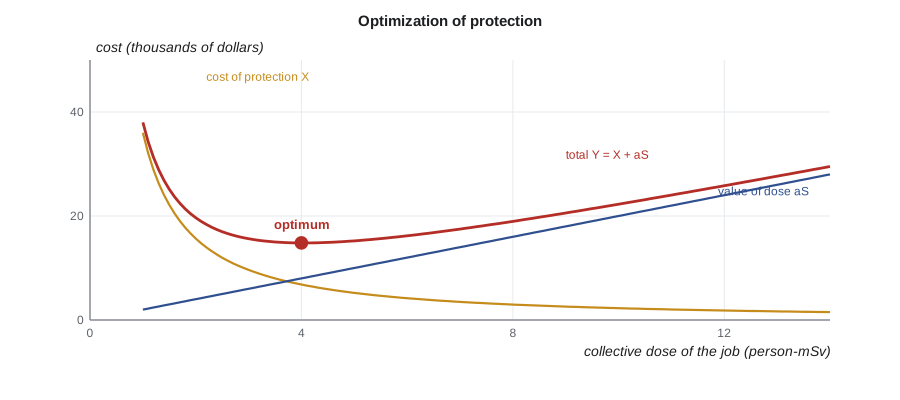
The usual tool is a comparison of options. For each way of doing a job, estimate the collective dose \(S\), in person-sieverts or person-millisieverts, and the cost \(X\) of the protection measures. The best option minimizes the total
where \(\alpha\) is a monetary value placed on a unit of collective dose. It is not a price on a life; it is a reference value that makes decisions consistent, so that money is spent where it saves the most dose. Options that lower \(S\) a little at huge cost lose; options that lower it a lot at small cost win.
The NRC's guidance on the dollar value of a person-rem averted, published in NUREG-1530, is used in regulatory analyzes. The 2015 revision raised the value to roughly five thousand dollars per person-rem. Licensees may use their own values for work planning; the values in this course are illustrative.
Worked problem
Choosing a shielding option
A planned job would give 12 person-mSv with no added protection. Option B, temporary lead blankets, costs 8000 dollars and cuts the dose to 5 person-mSv. Option C, flushing plus blankets, costs 30 000 dollars and cuts it to 3 person-mSv. Use an illustrative value of 2000 dollars per person-mSv.
Show solution
- Option A: \(Y = 0 + 2000 \times 12 = 24\,000\).
- Option B: \(Y = 8000 + 2000 \times 5 = 18\,000\).
- Option C: \(Y = 30\,000 + 2000 \times 3 = 36\,000\).
Answer: Option B gives the lowest total. Option C saves a further 2 person-mSv but at 11 000 dollars per person-mSv, more than five times the reference value. If one worker's individual dose was the concern, the comparison could change, which is why individual doses are also checked.
# ALARA optimization: total cost Y = X + alpha*S for each option (illustrative values).
alpha = 2000.0   # dollars per person-mSv, illustrative reference value

options = [            # name, protection cost X (dollars), collective dose S (person-mSv)
    ('A: no added protection', 0.0, 12.0),
    ('B: lead blankets', 8000.0, 5.0),
    ('C: flush plus blankets', 30000.0, 3.0),
]
best = None
for name, X, S in options:
    Y = X + alpha * S
    print(f"{name:26s} X = {X:8.0f}  S = {S:5.1f} person-mSv  Y = {Y:8.0f}")
    if best is None or Y < best[1]:
        best = (name, Y)
print("lowest total:", best[0])

# Marginal cost of each step: dollars spent per person-mSv averted
for (n1, X1, S1), (n2, X2, S2) in zip(options, options[1:]):
    print(f"step {n1[0]} -> {n2[0]}: {(X2 - X1) / (S1 - S2):8.0f} dollars per person-mSv averted")

# How high would alpha have to be for option C to win over B?
nameB, XB, SB = options[1]; nameC, XC, SC = options[2]
print(f"C beats B only if alpha > {(XC - XB) / (SB - SC):.0f} dollars per person-mSv")A: no added protection X = 0 S = 12.0 person-mSv Y = 24000 B: lead blankets X = 8000 S = 5.0 person-mSv Y = 18000 C: flush plus blankets X = 30000 S = 3.0 person-mSv Y = 36000 lowest total: B: lead blankets step A -> B: 1143 dollars per person-mSv averted step B -> C: 11000 dollars per person-mSv averted C beats B only if alpha > 11000 dollars per person-mSv
Collective dose and individual dose
Collective dose, the sum of individual doses over a group, measures the total detriment of a job or a program. It is the right quantity for comparing options, because it captures both the number of people and their doses. But it can hide unfairness: 20 person-mSv shared among 200 people is very different from 20 person-mSv given to two people. ALARA therefore looks at both. The ICRP uses dose constraints, prospective upper bounds on individual dose for a particular source or activity, set below the limit, so that optimization never results in a few people carrying the dose for everyone else.
At TVA plants, administrative control levels, typically 20 mSv (2 rem) per year or lower, play the role of dose constraints, and workers approaching them are reassigned or need management approval to continue.
The ALARA toolbox: time, distance, shielding and source reduction
For external exposure, every ALARA measure works through one of four levers. Reducing time in the field, through planning, rehearsal, prefabrication, better tools and remote monitoring, reduces dose in direct proportion. Increasing distance, through long-handled tools, remote cameras and robotic devices, reduces dose by the inverse square law for point sources. Shielding, permanent or temporary, cuts dose exponentially. And reducing the source itself, by flushing crud, draining and rinsing systems, chemistry control, choosing low-cobalt materials or letting short-lived activity decay, lowers dose for everyone who will ever work nearby. Lesson 4 quantifies the first three.
For internal exposure, the levers are containment of the source, ventilation, contamination control, respiratory protection and, for tritium, reducing the time spent in areas with tritiated water vapor. Respirators themselves add stress and slow work, so ALARA sometimes favors engineering controls over protective equipment even when both are possible.
ALARA in work planning
Large licensees build ALARA into the job cycle. Before a job, a radiation work permit is prepared with surveys of dose rates and contamination, an estimate of the collective dose, the protective measures and the stop-work criteria. Jobs above a set collective dose estimate go to an ALARA committee for review. During the job, electronic dosimeters with alarms, remote dose monitoring and real-time cameras let protection staff see dose accumulating and stop work if it runs ahead of the estimate. After the job, the actual dose is compared with the estimate and lessons are recorded so that the next outage starts from a better plan.
| Stage | ALARA activities |
|---|---|
| Design | shielding, layout, low-cobalt materials, remote handling, decay storage |
| Planning | surveys, dose estimates, mock-ups, prefabrication, permit preparation |
| Pre-job briefing | dose rates, hot spots, low-dose waiting areas, stop-work criteria |
| Execution | electronic dosimeters, remote monitoring, coverage by technicians |
| Post-job review | actual against estimated dose, lessons learned, updated plans |
Design is where ALARA is cheapest. A shield poured with the building wall costs a fraction of a temporary shield installed every outage for forty years. A valve placed where it can be reached from a low-dose corridor saves dose on every maintenance visit. That is why lesson 12 ends the course with a shielding design rather than a field job.
ALARA for the public
ALARA also applies to the public. Routine releases of radioactivity from a nuclear station are controlled by derived release limits that correspond to the public dose limit, but stations operate far below them. Environmental monitoring, covered in NUC-310, confirms that public doses near TVA's pressurized water reactor fleet are a small fraction of a millisievert per year.
For power reactors, Appendix I to 10 CFR Part 50 sets ALARA design objectives for liquid and gaseous effluents, such as 0.03 mSv (3 mrem) per year to the whole body of a member of the public from liquid effluents from each reactor. Actual public doses are typically far smaller.
Culture, not paperwork
Marcel's last point is that ALARA succeeds or fails on behavior. A worker who waits in a 0.5 mSv/h area instead of stepping back to the low-dose zone, a planner who skips the mock-up because the schedule is tight, or a supervisor who treats the dose estimate as a target to be reached rather than beaten undoes the paperwork. Successful programs make it normal to question a plan, reward crews that come in under their estimate and track small doses as carefully as large ones. ALARA is a habit of asking, every time, whether there is a reasonable way to do the job with less dose.
Setting dose targets
Most large programs set annual collective dose targets for each station and outage, based on the planned work and on past performance, and track progress against them week by week. A target is not a limit; missing it triggers a review, not a violation. Targets work best when they are built from the bottom up, job by job, so that each crew knows its share and can see how its choices affect the total. Industry benchmarking, in which stations compare their collective dose per reactor and per outage with similar units, gives a further check on whether a station's ALARA performance is good or merely habitual.
| ALARA question | Typical answer that reduces dose |
|---|---|
| Can the job be done at all without entering the field? | remote tools, cameras, robots, deferral to a lower-dose period |
| Can the source be reduced first? | flush, drain, decontaminate, let short-lived activity decay |
| Can the time in the field be shortened? | mock-up rehearsal, prefabrication, staging tools and parts |
| Can workers stand farther away? | long-handled tools, low-dose waiting areas, remote readouts |
| Is temporary shielding worth its installation dose? | compare installation dose with dose saved over the job |
| Will protective equipment slow the work? | balance internal dose averted against external dose added |
One subtle point in ALARA reviews is the dose to the people who install protective measures. Hanging lead blankets, building scaffolds for shielding or flushing a system all take time in the field. A temporary shield that saves 3 person-mSv on a short job but takes 2 person-mSv to install and remove saves only 1 person-mSv overall, which may not be worth its cost. Good reviews always count the whole dose, including the dose to install, inspect and remove.
Hana asks the class to apply the checklist to one last case: replacing a gauge on a line reading 0.8 mSv/h at contact, a ten-minute job. The class's answers include using an extension tool to read the gauge first, so the work is done only if it is really needed, and scheduling the replacement after the line has been drained, when the dose rate drops by a factor of five. The second answer costs nothing but a scheduling change, which is ALARA at its most effective.
A last caution concerns how ALARA is measured. A falling collective dose is good news only if the work still gets done safely. A station that defers necessary maintenance to save dose this year may face a larger dose, and a larger safety risk, when a component fails later. ALARA reviews therefore look at dose over the life of a plant and treat preventive maintenance and system cleanup as investments, not as dose to be avoided at any cost.
Summary and key terms
- The ICRP system rests on justification, optimization and dose limitation; ALARA is optimization in practice.
- Reasonable means weighing the cost of a measure against the dose it averts, often with a reference value α per unit collective dose.
- Collective dose compares options; dose constraints and administrative levels protect individuals from carrying an unfair share.
- Time, distance, shielding and source reduction are the levers for external dose.
- The cheapest ALARA is in design and planning; post-job reviews feed the next plan.
- ALARA depends on culture as much as on procedures.
- ALARA
- As low as reasonably achievable, economic and social factors taken into account.
- Justification
- The requirement that an exposure situation do more good than harm.
- Optimization
- Keeping doses and numbers exposed as low as reasonably achievable.
- Collective dose
- The sum of individual doses in a group, in person-sieverts.
- Dose constraint
- A prospective upper bound on individual dose from a particular source, set below the limit.
- Radiation work permit
- A job-specific document giving radiological conditions, controls and dose estimates.
Practice problems
Work each problem on paper first, then reveal the answer to check.
A measure costs 5000 dollars and averts 4 person-mSv. With α = 2000 dollars per person-mSv, is it justified on cost?
Show answer
Yes: it averts 8000 dollars of dose value for 5000 dollars.
Why is ALARA not 'as low as possible'?
Show answer
Every reduction has costs, including other risks and doses to other workers; reasonableness weighs them.
Give one source-reduction measure at a reactor.
Show answer
Flushing crud, chemistry control, low-cobalt materials or decay before work.
Why are dose constraints used alongside collective dose?
Show answer
To stop optimization from concentrating dose on a few individuals.
Where is ALARA cheapest?
Show answer
At the design stage.
What should happen when actual dose on a job runs well ahead of the estimate?
Show answer
Work should pause for review against the permit's stop-work criteria.
Lesson quiz · 5 questions
Score 60% or more to complete this lesson.
Create a free account to save your progress, take quizzes and earn a certificate.