
NUC-320 · Lesson 4 of 12 · 25 min
Time, distance and shielding
The third session moves from principles to arithmetic. Marcel sets a small sealed cobalt-60 check source in its lead pig on the bench, hands Hana a survey meter, and asks the class to predict the dose rate at 1 m before she lifts the lid with tongs. Nobody gets it right. By the end of the lesson, everyone can, and they can also say how long a worker may stay at a given spot, how far back to stand, and roughly how much lead it takes to make a difference.
Dose rate from a point source
For a gamma-emitting source small compared with the distance to it, the dose rate in air falls with the square of distance. The dose rate is the activity \(A\) multiplied by a dose-rate constant \(\Gamma\) for the nuclide, divided by the square of the distance \(r\):
The constant combines the number of photons per decay, their energies and the conversion from photon fluence to dose. It is tabulated for each nuclide in handbooks, in several unit systems. The values below are rounded and approximate, and are suitable for planning; published tables differ slightly depending on whether they give air kerma, exposure or ambient dose equivalent.
| Nuclide | Main gamma energies | Approximate Γ (mSv/h per GBq at 1 m) | Typical use |
|---|---|---|---|
| Cobalt-60 | 1.17 and 1.33 MeV | 0.35 | activation product in reactor systems; industrial and medical sources |
| Cesium-137 | 0.662 MeV (from Ba-137m) | 0.09 | fission product; calibration and gauge sources |
| Iridium-192 | several, about 0.3 to 0.6 MeV | 0.13 | industrial radiography |
| Sodium-24 | 1.37 and 2.75 MeV | 0.5 | activation of coolant impurities |
| Iodine-131 | 0.364 MeV | 0.06 | fission product; nuclear medicine |
United States practice often quotes the constant in R·m²/(h·Ci); for cobalt-60 it is about 1.3 R/h at 1 m per curie, and for cesium-137 about 0.33. Since 1 Ci = 37 GBq and 1 R of photons gives very nearly 0.01 Sv (1 rem) to tissue, the two sets of values agree to within the precision of the rounding.
Worked problem
Predicting the check source
Marcel's cobalt-60 source has an activity of 0.40 GBq. Estimate the dose rate at 1 m and at 30 cm.
Show solution
- At 1 m: \(\dot{H} = 0.35 \times 0.40 / 1^{2} = 0.14\) mSv/h, or 140 µSv/h.
- At 0.30 m: \(\dot{H} = 0.14 / 0.30^{2} = 1.56\) mSv/h.
- Hana's meter, with the lid lifted, reads 135 µSv/h at 1 m.
Answer: About 140 µSv/h at 1 m and 1.6 mSv/h at 30 cm. Moving from 1 m to 30 cm multiplies the dose rate by eleven.
Time
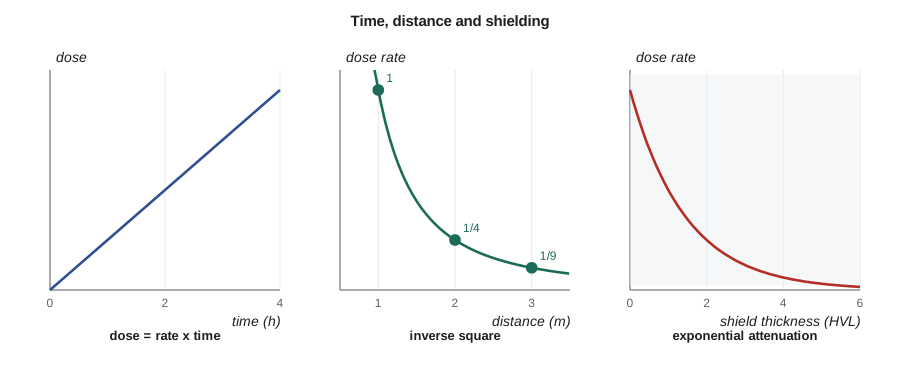
Dose is dose rate multiplied by time, \(H = \dot{H}\,t\), when the rate is steady. Halving the time halves the dose. That simple fact drives a large part of ALARA practice: good planning, rehearsal on mock-ups, the right tools staged in advance, and clear communication all shorten time in the field. It also explains stay times. If a worker may receive no more than a planned dose \(H_{\max}\) on a task, the stay time is
A job at 2 mSv/h with a planned dose of 0.5 mSv gives a stay time of 15 minutes. Electronic dosimeters with dose and dose-rate alarms enforce stay times in practice; the alarm set point is chosen so that a worker leaves before the planned dose is exceeded.
Time also works through decay. Short-lived activity, such as nitrogen-16 in reactor coolant with a half-life of about 7 seconds, or sodium-24 at about 15 hours, decays quickly after shutdown. Delaying entry into some areas for a day or more can lower dose rates dramatically.
Distance
For a point source, doubling the distance quarters the dose rate:
Distance is often the cheapest protection of all. Long-handled tongs, extension tools, remote cameras and simply standing back while waiting all exploit it. The inverse square law is powerful close to a source: moving a hand from 2 cm to 20 cm from a small source reduces the dose rate a hundred times, which is why sources must never be handled directly.
Real sources are not always points. A long pipe carrying contaminated water behaves like a line source. Close to a line source, at distances much smaller than its length, the dose rate falls roughly as \(1/r\), not \(1/r^{2}\). Far from it, at distances several times its length, it looks like a point and the inverse square law returns. A large tank or a contaminated floor behaves like an area source, and close to it the dose rate hardly changes with distance at all. Survey measurements at two distances show which behavior applies.
Shielding
The third lever is to put material between the source and the person. For gamma rays, a narrow beam passing through a thickness \(x\) of shield is attenuated exponentially:
where \(\mu\) is the linear attenuation coefficient of the material at that energy. Two convenient forms of the same idea are the half-value layer (HVL), the thickness that halves the dose rate, \(\text{HVL} = \ln 2/\mu\), and the tenth-value layer (TVL), the thickness that cuts it by ten, \(\text{TVL} = \ln 10/\mu\). Each additional HVL halves the rate again. Lesson 5 develops this properly, including the buildup of scattered radiation that makes real shields less effective than the narrow-beam formula suggests.
| Material | Cs-137 (0.662 MeV) HVL | Co-60 (1.25 MeV average) HVL | Co-60 TVL |
|---|---|---|---|
| Lead | about 0.6 cm | about 1.2 cm | about 4 cm |
| Steel | about 1.6 cm | about 2.1 cm | about 7 cm |
| Concrete | about 4.8 cm | about 6.2 cm | about 21 cm |
| Water | about 9 cm | about 11 cm | about 37 cm |
Beta particles need a different approach. They have a finite range: a few millimeters of plastic stop the betas from most fission and activation products. But high-energy betas stopped in heavy materials such as lead produce bremsstrahlung X-rays, so the rule is low-Z material first, plastic or aluminum, then a heavier layer outside if the bremsstrahlung matters. Neutrons need hydrogen-rich materials and absorbers, treated in lesson 6.
Worked problem
Choosing among time, distance and shielding
A worker must spend 20 minutes at a valve 1 m from a pipe hot spot reading 1.2 mSv/h. The planned dose is 0.1 mSv. Options: stand at 2 m with long tools, or hang lead blankets that give an HVL of about 1.2 cm per layer, each blanket 1.3 cm of lead equivalent.
Show solution
- Unprotected: \(1.2 \times 20/60 = 0.40\) mSv, four times the plan.
- At 2 m, if the hot spot behaves as a point: \(1.2/4 = 0.30\) mSv/h, giving 0.10 mSv in 20 minutes. Long tools would add some time, perhaps to 25 minutes, giving 0.125 mSv.
- With two blankets, about 2.6 cm of lead, roughly two HVLs: \(1.2/4 \approx 0.30\) mSv/h at 1 m, giving 0.10 mSv in 20 minutes, plus the dose to the crew who hang the blankets.
Answer: Either option roughly meets the plan. The ALARA choice depends on the dose to install the blankets and whether the tools slow the job; using both would cut the job dose to about a quarter of the plan.
# Time, distance and shielding for a gamma point source (approximate planning constants).
import math
GAMMA = {'Co-60': 0.35, 'Cs-137': 0.09, 'Ir-192': 0.13}   # mSv/h per GBq at 1 m, rounded

def rate(nuclide, A_GBq, r_m):
    return GAMMA[nuclide] * A_GBq / r_m**2      # mSv/h

A = 0.40   # GBq, check source
for r in (0.3, 1.0, 2.0, 3.0):
    print(f"Co-60 {A} GBq at {r:3.1f} m: {1000*rate('Co-60', A, r):7.1f} uSv/h")

# Stay time for a planned dose
for H_plan, Hdot in ((0.5, 2.0), (0.1, 1.2), (0.2, 0.8)):
    print(f"planned {H_plan} mSv at {Hdot} mSv/h -> stay time {60*H_plan/Hdot:5.1f} min")

# Line source of length L (uniform), perpendicular distance d from its midpoint:
# rate is proportional to (2/d)*atan(L/(2d)); compare with a point source of the same total activity.
L = 4.0
for d in (0.25, 0.5, 1.0, 4.0, 10.0):
    line = (2 / (d * L)) * math.atan(L / (2 * d))   # relative, per unit total activity
    point = 1 / d**2
    print(f"d = {d:5.2f} m: line/point ratio = {line/point:5.2f}")

# Shielding by half-value layers (broad-beam planning values, cm)
HVL = {'lead': 1.2, 'steel': 2.1, 'concrete': 6.2}
for m, h in HVL.items():
    for x in (h, 2*h, 10.0):
print(f"{x:5.1f} cm {m:8s}: transmission {0.5**(x/h):.3f}")Co-60 0.4 GBq at 0.3 m: 1555.6 uSv/h Co-60 0.4 GBq at 1.0 m: 140.0 uSv/h Co-60 0.4 GBq at 2.0 m: 35.0 uSv/h Co-60 0.4 GBq at 3.0 m: 15.6 uSv/h planned 0.5 mSv at 2.0 mSv/h -> stay time 15.0 min planned 0.1 mSv at 1.2 mSv/h -> stay time 5.0 min planned 0.2 mSv at 0.8 mSv/h -> stay time 15.0 min d = 0.25 m: line/point ratio = 0.18 d = 0.50 m: line/point ratio = 0.33 d = 1.00 m: line/point ratio = 0.55 d = 4.00 m: line/point ratio = 0.93 d = 10.00 m: line/point ratio = 0.99 1.2 cm lead : transmission 0.500 2.4 cm lead : transmission 0.250 10.0 cm lead : transmission 0.003 2.1 cm steel : transmission 0.500 4.2 cm steel : transmission 0.250 10.0 cm steel : transmission 0.037 6.2 cm concrete: transmission 0.500 12.4 cm concrete: transmission 0.250 10.0 cm concrete: transmission 0.327
Putting the three together
For a single worker exposed to a point source behind a simple shield, the three levers combine into one estimate:
Each factor offers a different kind of saving. Time saves in proportion; distance saves as the square; shielding saves exponentially but costs money, space and sometimes dose to install. In practice the cheapest savings are usually time and distance, which come from planning and tools, while shielding is the right answer for long jobs, frequent jobs or high dose rates.
Measuring rather than assuming
Hand calculations give planning estimates. They miss scattered radiation from walls and floors, self-shielding in the source, irregular geometry and nearby sources. Before any job, the area is surveyed with calibrated instruments, and the survey, not the calculation, sets the controls. Hana's reading of 135 µSv/h, close to the predicted 140, is a reminder that the physics works when the geometry is simple, and that it should be checked every time it is not.
Under 10 CFR 20.1003 and 20.1902, a radiation area, posted with a caution sign, is one where a person could receive more than 0.05 mSv (5 mrem) in one hour at 30 cm from the source; a high radiation area exceeds 1 mSv (100 mrem) in one hour at 30 cm, and has additional access controls under 20.1601. Stay-time planning keeps doses in these areas within the permit.
Working with a survey map
In practice, protection technicians record dose rates on a survey map of the work area: a sketch of the room with general area dose rates, contact readings on components, hot spots marked and the location of low-dose waiting areas. The map is posted at the entrance and attached to the radiation work permit. Workers use it to plan where to stand and where to wait. A good map shows not just the highest reading but the gradient, because the dose a worker receives depends on where the body actually is during the task.
Survey maps also expose the limits of the point-source picture. A room may contain several sources: a pipe, a valve body, a filter housing. Dose rates from each add at any point, and moving away from one may move a worker closer to another. When planning in such a field, technicians identify the largest contributor at each work location and shield or remove that one first, since shielding a minor source achieves little.
Worked problem
Several sources at once
At a work point a worker is 1.5 m from a valve reading 0.9 mSv/h at 1 m and 3 m from a filter housing reading 2.0 mSv/h at 1 m. Treating both as point sources, find the dose rate at the work point and which source to shield first.
Show solution
- Valve: \(0.9/1.5^{2} = 0.40\) mSv/h.
- Filter: \(2.0/3^{2} = 0.22\) mSv/h.
- Total about 0.62 mSv/h; the valve contributes almost two thirds.
Answer: About 0.6 mSv/h. Shielding the valve, the nearer source, gives the larger saving even though the filter is the stronger source.
Finally, the inverse square law applies to dose rate in air at a point. Extended bodies are irradiated non-uniformly near a source: a worker kneeling 30 cm from a valve receives a much higher dose to the knees and hands than to the chest dosimeter. That is why extremity dosimeters are issued for close work and why procedures specify where whole-body dosimeters are worn, normally on the part of the trunk nearest the source.
Hana sums up the session for the class with a habit she learned on shift: before any job in a radiation field, say aloud where you will stand, how long you will be there and what is between you and the source. If any of the three answers is vague, the plan is not ready.
Summary and key terms
- For a point source, dose rate = ΓA/r²; Γ is tabulated for each nuclide.
- Dose = dose rate × time; stay time = planned dose ÷ dose rate.
- Doubling distance quarters the dose rate for a point source; line and area sources fall off more slowly close in.
- Shielding attenuates gamma rays exponentially; each HVL halves and each TVL divides by ten.
- Betas are stopped by low-Z material first, to limit bremsstrahlung.
- Calculations plan the job; surveys with calibrated instruments set the controls.
- Dose-rate constant
- Dose rate at unit distance per unit activity for a given nuclide.
- Inverse square law
- For a point source, intensity falls as the square of distance.
- Stay time
- The time a worker may remain in a field before reaching a planned dose.
- Half-value layer
- Thickness of shield that halves the dose rate.
- Tenth-value layer
- Thickness of shield that reduces the dose rate to one tenth.
- Bremsstrahlung
- X-rays produced when charged particles slow down, especially in high-Z materials.
Practice problems
Work each problem on paper first, then reveal the answer to check.
A 2 GBq cesium-137 source: dose rate at 1 m?
Show answer
0.09 × 2 = 0.18 mSv/h.
The rate at 1 m is 400 µSv/h. What is it at 4 m?
Show answer
25 µSv/h.
A planned dose of 0.2 mSv in a 0.8 mSv/h field gives what stay time?
Show answer
15 minutes.
How many HVLs reduce a dose rate to about 1/30?
Show answer
About 5 (1/32).
Why shield a strong beta source with plastic before lead?
Show answer
Low-Z material stops the betas with little bremsstrahlung; lead outside then absorbs any X-rays.
Close to a long pipe, how does dose rate vary with distance?
Show answer
Roughly as 1/r, like a line source.
Lesson quiz · 5 questions
Score 60% or more to complete this lesson.
Create a free account to save your progress, take quizzes and earn a certificate.