
NUC-320 · Lesson 8 of 12 · 23 min
Contamination control
Contamination is radioactive material where it is not wanted: on floors, tools, clothing, skin or in the air. It is the link between external and internal dose, because loose contamination on a surface can be picked up on hands, carried out of a work area, or made airborne by sweeping and grinding and then inhaled. Marcel's outage smears in NUC-310 were the measurement side of contamination control. This lesson is about the control side: how stations are laid out, how work is done and how people and materials leave contaminated areas without spreading radioactivity.
Fixed and loose contamination
Fixed contamination is bound to a surface, such as activity in an oxide layer or under paint. It contributes to external dose rate but does not spread easily. Loose, or removable, contamination can be transferred by touch or air movement and is the main concern for intakes and spread. The two are measured differently. Direct readings with a contamination monitor held close to the surface measure total contamination. A smear, a filter paper wiped over a standard area, usually 100 cm², and counted in the laboratory, measures the loose part. Because a smear picks up only a fraction of the loose activity, typically assumed to be 10 % for a dry smear on a smooth surface, smear results are conservative indicators rather than exact measures.
where \(N_{\text{net}}\) is the net count rate, \(\varepsilon\) the counting efficiency, \(f\) the assumed removal fraction and \(A\) the area wiped. Results are usually expressed in becquerels per square centimeter, or in the United States in disintegrations per minute per 100 cm².
Zoning a station
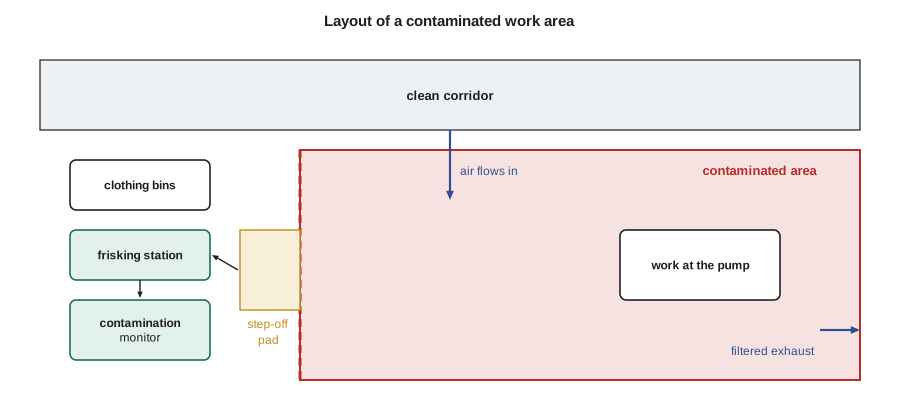
United States plants define a radiologically controlled area (RCA) inside the protected area. Within the RCA, contaminated areas are posted where removable contamination exceeds plant limits, typically related to 1000 dpm/100 cm² beta-gamma, and high contamination areas at much higher levels. 10 CFR Part 20 defines radiation areas, high radiation areas, very high radiation areas and airborne radioactivity areas, which are posted and controlled as lesson 4 described. Personnel contamination monitors at the RCA exit check every worker leaving.
Working in a contaminated area
Entry to a contaminated work area is planned on the radiation work permit described in lesson 3. Workers wear protective clothing chosen for the job: coveralls, shoe covers, gloves, often two pairs, and a hood or respirator if there is airborne contamination. Tools are wrapped or dedicated to the area. Work methods are chosen to avoid making contamination airborne: wet wiping instead of dry sweeping, local exhaust at grinding and cutting points, tents or glove bags around open systems, and HEPA-filtered vacuum cleaners.
Leaving is where most spread occurs. Protective clothing is removed in a fixed order at the step-off pad, outer gloves first, then the coverall rolled inside out, then shoe covers stepped out onto the clean side, then inner gloves, so that the contaminated outside of each layer never touches the clean side. Workers then monitor themselves, hands and feet at least, with a frisker or hand-and-foot monitor, and pass through a whole-body contamination monitor at the zone boundary. Training and supervision of undressing are among the most effective contamination controls of all.
Worked problem
Converting a smear result
A smear from a pump flange, wiped over 100 cm², gives a net count rate of 3.0 counts per second on a gas-flow proportional counter with a beta efficiency of 30 % for cobalt-60. Assume 10 % removal. What is the loose contamination level?
Show solution
- Activity on the smear: \(3.0/0.30 = 10\) Bq.
- Loose activity on the surface: \(10/0.10 = 100\) Bq over 100 cm².
- Contamination: \(100/100 = 1.0\) Bq/cm².
- In United States units: \(10\ \text{Bq} \times 60 = 600\) dpm on the smear, or 6000 dpm/100 cm² of loose activity with 10 % removal.
Answer: About 1 Bq/cm² of loose cobalt-60, enough to make the flange a contaminated area requiring protective clothing at most stations.
# Contamination: smear and direct-frisk results converted to surface levels.
def smear(net_cps, eff, removal=0.10, area_cm2=100.0):
    on_smear = net_cps / eff                 # Bq on the filter paper
    loose = on_smear / removal               # Bq on the wiped surface
    return on_smear, loose / area_cm2        # Bq, Bq/cm2

for net in (0.05, 0.5, 3.0):
    bq, c = smear(net, 0.30)
    print(f"net {net:4.2f} cps -> {bq:6.2f} Bq on smear -> {c:6.3f} Bq/cm2 loose "
          f"({c*60*100:7.0f} dpm/100 cm2)")

# Direct frisk with a pancake probe: probe efficiency per unit surface activity (illustrative)
probe_eff = 0.15          # counts per second per Bq of surface activity under the window (illustrative)
window = 15.0             # cm2, probe window area
for cpm_net in (100, 1000, 5000):
    total = (cpm_net / 60) / (probe_eff * window)    # Bq/cm2
    print(f"frisker net {cpm_net:5d} cpm -> total contamination about {total:5.2f} Bq/cm2")

# Compare loose results with an illustrative station release limit
limit = 0.4               # Bq/cm2, illustrative
for item, net in (('wrench', 0.05), ('pump flange', 3.0)):
    _, c = smear(net, 0.30)
print(f"{item:12s}: {c:5.2f} Bq/cm2 -> {'release' if c < limit else 'keep in controlled area or decontaminate'}")net 0.05 cps -> 0.17 Bq on smear -> 0.017 Bq/cm2 loose ( 100 dpm/100 cm2) net 0.50 cps -> 1.67 Bq on smear -> 0.167 Bq/cm2 loose ( 1000 dpm/100 cm2) net 3.00 cps -> 10.00 Bq on smear -> 1.000 Bq/cm2 loose ( 6000 dpm/100 cm2) frisker net 100 cpm -> total contamination about 0.74 Bq/cm2 frisker net 1000 cpm -> total contamination about 7.41 Bq/cm2 frisker net 5000 cpm -> total contamination about 37.04 Bq/cm2 wrench : 0.02 Bq/cm2 -> release pump flange : 1.00 Bq/cm2 -> keep in controlled area or decontaminate
Personnel contamination
When a contamination monitor alarms on a person, the response is calm and systematic. The worker stays in place, the protection technician locates the contamination with a frisker, and decontamination starts with the gentlest effective method: removing clothing, washing skin with lukewarm water and mild soap, and avoiding anything that abrades the skin or opens pores, which could increase uptake. Hair contamination is washed; contamination near the mouth or nose prompts a nasal swab and bioassay to check for intake. Skin doses are estimated from the activity and time on the skin, using dose rate coefficients for skin contamination, and compared with the skin limit. Most skin contaminations give trivial doses, but a hot particle, a tiny highly active fragment of fuel or activated corrosion product, can give a large local skin dose in hours and needs prompt removal.
Releasing materials and areas
Every tool, piece of equipment or bag of waste leaving a controlled area must be surveyed and released only if it meets release criteria. Criteria are set so that released items cannot give anyone a significant dose. Items that fail are decontaminated, kept for reuse inside the controlled area, or treated as radioactive waste. Because waste disposal is expensive, stations work hard to minimize what is taken into contaminated areas in the first place.
In the United States, release of items from licensed control has traditionally used surface contamination guidelines such as those in NRC Regulatory Guide 1.86 and similar tables, of the order of 1000 dpm/100 cm² removable and 5000 dpm/100 cm² total for beta-gamma emitters, with lower values for alpha emitters. Licensees follow the criteria approved for their facility.
Airborne contamination
Airborne radioactivity is controlled by preventing it and by measuring it. Ventilation is arranged so that air flows from clean areas toward progressively more contaminated ones and is exhausted through HEPA filters and, for iodine, charcoal filters, before a monitored stack. Continuous air monitors draw air through a filter and alarm when particulate activity rises, and grab samples during jobs provide the DAC-hour records described in lesson 7. For tritium, monitors measure the concentration of tritiated water vapor continuously.
Some work, such as cutting contaminated pipe, needs local containment: a tent or enclosure under negative pressure, so that any leak draws clean air in rather than letting contaminated air out. The negative pressure is checked with a simple manometer or by watching a ribbon at the entrance, and the exhaust passes through a portable HEPA unit.
Measuring program performance
Stations track contamination control with indicators: the number of personnel contamination events per outage, the area of the station posted as contaminated, the volume of radioactive waste produced and the number of items found contaminated outside controlled areas. A rising trend in any of them is a signal to look at work practices before a more serious event occurs. Marcel tells the class that the best contamination programs he has seen keep almost the whole station clean enough to walk through in ordinary clothing, so that protective clothing is a special measure rather than a daily routine.
| Control | Purpose |
|---|---|
| Zoning and posting | tells everyone where contamination may be and what is required |
| Containment and ventilation | keeps contamination at its source and out of the air |
| Protective clothing and undressing discipline | keeps contamination off skin and personal clothing |
| Monitoring at boundaries | catches contamination before it leaves an area |
| Release surveys | ensures items leaving control cannot give significant dose |
| Housekeeping and decontamination | reduces the area that needs control at all |
Choosing protective clothing
Protective clothing is chosen for the hazard, not by habit. Too little and contamination reaches skin or personal clothing; too much and workers overheat, move slowly and make mistakes, and the waste volume rises. A light job in an area with low loose contamination may need only shoe covers and gloves; a job opening a contaminated system needs a full set of coveralls, double gloves taped at the wrist, a hood and possibly a respirator; work on tritium systems needs plastic suits with supplied air. Heat stress is a real hazard in heavy protective clothing, and stay times in hot areas may be set by heat rather than by dose.
| Condition | Typical protective clothing |
|---|---|
| Clean area inside the controlled zone | personal clothing or station clothing, dosimeters |
| Low loose contamination on floors | shoe covers and gloves |
| Loose contamination on components | coveralls, double gloves, shoe covers, hood |
| Airborne particulate contamination | as above plus a respirator |
| Tritiated water vapor above set levels | plastic suit with supplied breathing air |
| Wet work with contaminated water | waterproof outer layer over coveralls |
Training covers not only what to wear but how to take it off, because most personnel contamination events happen at the step-off pad. Workers practice undressing in clean conditions until it is automatic, and supervisors watch the first few real exits after training. Mirrors at step-off pads, clear signs showing the order of removal and enough bins for each item help people get it right when they are tired at the end of a shift.
Worked problem
Skin dose from a contamination event
A worker's wrist shows 4 Bq/cm² of cobalt-60 over about 10 cm², found 2 hours after the work. Using an approximate skin dose rate coefficient of 1.5 µSv/h per Bq/cm² for cobalt-60 at the sensitive skin depth, estimate the skin dose and compare with the limit.
Show solution
- Skin dose rate: \(4 \times 1.5 = 6\) µSv/h.
- Over 2 hours, before decontamination: \(6 \times 2 = 12\) µSv to the skin.
- Skin limit: 500 mSv per year averaged over 1 cm².
Answer: About 12 µSv, negligible against the skin limit. The event matters as a sign of a contamination control problem, not as a dose.
Hana's group spends its practical session dressing and undressing under a fluorescent powder that glows under ultraviolet light, a common training method. Every one of them finds powder on a wrist or a shoe after their first attempt. By the third attempt nobody does. The lesson, Marcel says, is that undressing is a skill, and skills need practice before they are needed.
Waste minimization
Everything that enters a contaminated area may leave as radioactive waste, so contamination control and waste minimization go together. Stations remove packaging before taking materials into controlled areas, use reusable protective clothing that is laundered on site, segregate waste that is probably clean so it can be surveyed and released, and compact or incinerate low-level waste where licensed. Each cubic meter of waste avoided saves handling dose, storage space and disposal cost.
Summary and key terms
- Loose contamination spreads and causes intakes; fixed contamination adds only to external dose.
- Smears measure loose contamination with an assumed removal fraction, often 10 %.
- Stations are divided into zones or controlled areas with monitoring at each boundary.
- Protective clothing is removed in a fixed order at the step-off pad; undressing discipline prevents most spread.
- Personnel decontamination uses gentle methods; hot particles need prompt removal.
- Items leave control only after surveys against release criteria corresponding to trivial doses.
- Loose contamination
- Radioactive material on a surface that can be removed by wiping or contact.
- Smear
- A wipe over a standard area, counted to measure loose contamination.
- Step-off pad
- The marked boundary where protective clothing is removed when leaving a contaminated area.
- Hot particle
- A tiny fragment of high specific activity that can give a large local skin dose.
- Clearance level
- An activity concentration or surface level below which material may be released from regulatory control.
- HEPA filter
- High-efficiency particulate air filter removing at least 99.97 % of 0.3 µm particles.
Practice problems
Work each problem on paper first, then reveal the answer to check.
A smear over 100 cm² holds 25 Bq. With 10 % removal, what is the loose contamination?
Show answer
250 Bq/100 cm² = 2.5 Bq/cm².
Convert 2.5 Bq/cm² into dpm/100 cm².
Show answer
2.5 × 60 × 100 = 15 000 dpm/100 cm².
Why are coveralls rolled inside out when removed?
Show answer
So the contaminated outer surface does not touch the clean side or the person.
Why is abrasive scrubbing avoided in skin decontamination?
Show answer
It can damage skin and increase uptake.
How is a work tent kept from leaking contaminated air?
Show answer
It is held at negative pressure with filtered exhaust.
Name one indicator of contamination control performance.
Show answer
Personnel contamination events, contaminated floor area, waste volume or items found outside control.
Lesson quiz · 5 questions
Score 60% or more to complete this lesson.
Create a free account to save your progress, take quizzes and earn a certificate.