
NUC-220 · Lesson 9 of 12 · 24 min
Charged particle interactions
The ninth session takes Hana away from the reactor for an afternoon. Meridian Nuclear Engineering supports a hospital in Knoxville that is planning a proton therapy room, and Lina has been asked to check the shielding assumptions. The physics is the same physics that stops alpha particles in a sheet of paper and beta particles in a few millimeters of plastic, and it explains why radiation protection treats each radiation type so differently. Charged particles, unlike neutrons, interact with every electron they pass.
Continuous slowing down
A charged particle moving through matter feels the electric field of every atomic electron near its path. Each encounter transfers a little energy, ionizing or exciting the atom. Because a heavy charged particle such as a proton or alpha particle undergoes about \(10^5\) to \(10^6\) such small collisions per millimeter in water, it slows down almost continuously and travels in a nearly straight line, losing only a tiny fraction of its energy in each collision. That is unlike photons and neutrons, which travel a random distance and then interact in a single event.
The rate of energy loss per unit path length is the stopping power, \(S = -dE/dx\). Dividing by density gives the mass stopping power \(S/\rho\), in MeV cm²/g, which is nearly the same for materials of similar composition. Stopping power has two parts: collisional (electronic) stopping from interactions with electrons and radiative stopping from bremsstrahlung, the photons emitted when a charged particle is deflected by a nucleus. For heavy charged particles at the energies of interest, collisional stopping is essentially everything; for electrons, radiative stopping matters at high energies in heavy materials.
The Bethe formula
Hans Bethe derived the collisional stopping power of fast charged particles in 1930 using quantum mechanics. In the form used today, with relativistic corrections, the mass stopping power is
Here \(K = 0.307\ \text{MeV cm}^2/\text{mol}\), \(z\) is the particle's charge number, \(Z/A\) the ratio of atomic number to mass number of the medium, \(\beta = v/c\), \(\gamma\) the Lorentz factor, \(W_{\max}\) the largest energy that can be given to one electron and \(I\) the mean excitation energy of the medium, about 75 eV for water. Corrections for shell effects at low speeds and density effects at very high energies are needed for precise work.
The formula's structure explains the main features of charged-particle stopping. Stopping power scales with \(z^2\), so an alpha particle at the same speed as a proton loses energy four times faster. It scales as \(1/\beta^2\), so slower particles lose energy faster: a particle loses energy most rapidly near the end of its path. It does not depend on the particle's mass, only its speed and charge, so a proton and a deuteron at the same speed have the same stopping power. And it depends on the material mainly through its electron density, \(\rho Z/A\), which varies little among light materials; water, tissue and plastics behave similarly.
# Charged particle interactions: Bethe stopping power and a range estimate for protons and alphas in water.
import math
me_c2 = 0.510999       # MeV
K = 0.307075           # MeV cm2/mol
Z_A_water, I_water = 0.5551, 75e-6   # electrons per nucleon (mol/g) and mean excitation energy (MeV)

def stopping_power(T, M, z):
    """Mass stopping power (MeV cm2/g) in water for kinetic energy T (MeV), rest energy M (MeV), charge z."""
    gamma = 1 + T / M
    beta2 = 1 - 1 / gamma ** 2
    Wmax = 2 * me_c2 * beta2 * gamma ** 2 / (1 + 2 * gamma * me_c2 / M + (me_c2 / M) ** 2)
    L = 0.5 * math.log(2 * me_c2 * beta2 * gamma ** 2 * Wmax / I_water ** 2) - beta2
    return K * z ** 2 * Z_A_water / beta2 * L

def csda_range(T0, M, z, Tmin=0.5, steps=4000):
    """Continuous-slowing-down range in cm of water (density 1), integrating dE / S down to Tmin."""
    r, dT = 0.0, (T0 - Tmin) / steps
    T = T0
    for _ in range(steps):
        r += dT / stopping_power(T - dT / 2, M, z)
        T -= dT
    return r

Mp, Ma = 938.272, 3727.379
for T in (10, 50, 100, 150, 200):
    print(f"proton {T:4d} MeV: S = {stopping_power(T, Mp, 1):6.2f} MeV cm2/g, range about {csda_range(T, Mp, 1):6.2f} cm of water")
print(f"alpha 5.5 MeV: S = {stopping_power(5.5, Ma, 2):6.1f} MeV cm2/g (Bethe formula is rough this slow)")
# Alpha range in air from the empirical Geiger rule R(cm) = 0.318 E^1.5 for 4-7 MeV
for E in (4.2, 5.5, 6.0):
print(f"alpha {E} MeV: range in air about {0.318 * E ** 1.5:.1f} cm")proton 10 MeV: S = 45.95 MeV cm2/g, range about 0.12 cm of water proton 50 MeV: S = 12.46 MeV cm2/g, range about 2.22 cm of water proton 100 MeV: S = 7.29 MeV cm2/g, range about 7.71 cm of water proton 150 MeV: S = 5.45 MeV cm2/g, range about 15.77 cm of water proton 200 MeV: S = 4.49 MeV cm2/g, range about 25.95 cm of water alpha 5.5 MeV: S = 854.9 MeV cm2/g (Bethe formula is rough this slow) alpha 4.2 MeV: range in air about 2.7 cm alpha 5.5 MeV: range in air about 4.1 cm alpha 6.0 MeV: range in air about 4.7 cm
The proton ranges in the output agree with the reference values from the NIST PSTAR database to within a few percent. A 200 MeV proton travels about 26 cm in water, enough to reach a tumor deep in the body; a 70 MeV proton reaches about 4 cm, enough for eye tumors. Proton therapy machines vary the energy to place the end of the range precisely where the tumor is.
Range
Because heavy charged particles slow almost continuously, they have a well-defined range: almost all particles of a given starting energy stop at nearly the same depth. Integrating the reciprocal of the stopping power gives the continuous-slowing-down approximation (CSDA) range.
Small random fluctuations in the number of collisions spread the stopping depths by about 1 percent, an effect called range straggling. For alpha particles from radioactive decay, energies of 4 to 9 MeV give ranges of a few centimeters in air and about 40 micrometers in tissue, less than the thickness of the dead outer layer of skin. That is why alpha emitters are a hazard mainly when inhaled or swallowed, when they deposit all their energy in living cells over a tiny distance. The Geiger rule, \(R_{\text{air}} \approx 0.318\,T^{3/2}\) cm with \(T\) in MeV, gives a quick estimate of alpha ranges in air.
Worked problem
Range of a proton with the scaling rule
A 100 MeV proton has a range of about 7.7 cm in water. Estimate the range of a 100 MeV alpha particle, using the fact that range scales as \(M/z^2\) times a function of speed.
Show solution
- Two particles with the same speed have energies proportional to mass. A 100 MeV alpha has the same speed as a 25 MeV proton.
- From tables, a 25 MeV proton has a range of about 0.63 cm in water.
- Scaling: \(R_\alpha = (M_\alpha/M_p)(z_p/z_\alpha)^2 \times R_p(25\ \text{MeV}) = 4 \times \tfrac{1}{4} \times 0.63 = 0.63\ \text{cm}\).
Answer: A 100 MeV alpha particle stops in about 6 mm of water, more than ten times shorter than a proton of the same energy. Range-scaling rules let engineers reuse proton tables for other ions.
The Bragg peak
Since stopping power rises as the particle slows, the energy deposited per millimeter increases with depth and reaches a sharp maximum just before the particle stops. This is the Bragg peak, named after William Henry Bragg, who measured it for alpha particles in 1904. Beyond the peak, the dose falls to almost zero within a few millimeters.
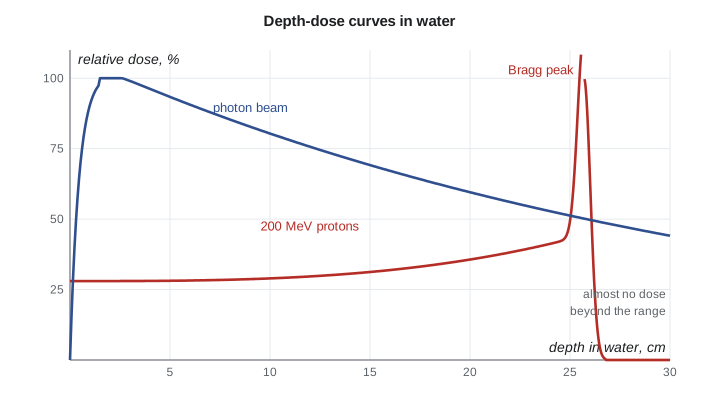
The Bragg peak is the reason for proton therapy. A photon beam deposits its maximum dose near the surface and continues through the patient, delivering dose to healthy tissue beyond the tumor. A proton beam deposits a lower dose on the way in, a high dose in the peak and almost nothing beyond. Treatment systems combine peaks of different energies to form a spread-out Bragg peak covering the whole tumor. For the hospital project, Lina's concern is not the patient beam itself but secondary neutrons produced when protons undergo nuclear reactions in the beamline and the patient; these dominate the shielding design, and the walls of a proton therapy room are typically 2 m or more of concrete.
Linear energy transfer
Radiobiologists describe the local density of energy deposition with linear energy transfer (LET), essentially the collisional stopping power in keV per micrometer of water. Fast electrons and the electrons set moving by gamma rays have low LET, about 0.2 to 2 keV/µm, spreading their ionization thinly. Alpha particles have high LET, about 100 keV/µm or more, leaving dense tracks that can break both strands of DNA at once. Damage of this kind is harder for cells to repair, which is why the radiation weighting factor for alpha particles is 20 (Lesson 12).
| Radiation | Typical energy | Range in water or tissue | LET (keV/µm) |
|---|---|---|---|
| Alpha particle | 5 MeV | about 40 µm | about 100 |
| Proton | 10 MeV | about 1.2 mm | about 4.6 |
| Proton | 150 MeV | about 16 cm | about 0.5 |
| Beta (electron) | 1 MeV | about 4 mm | about 0.2 |
| Fission fragment | 80 MeV | about 20 µm | several thousand |
Electrons and beta particles
Electrons follow the same Bethe-type collisional formula with changes for their small mass and for the identical-particle nature of electron-electron collisions. But their small mass makes them behave differently in two ways. First, an electron can lose up to half its energy in one collision with another electron and is easily deflected by nuclei, so it follows a tortuous path; its range is much less sharply defined than a proton's, and the useful quantity is the maximum penetration depth. Second, electrons lose energy by bremsstrahlung at a rate that, relative to collisional loss, is roughly proportional to \(ZT\).
For a 1 MeV beta particle in water, radiative losses are below 1 percent, but in lead (\(Z = 82\)) they are about 10 percent. This is why beta shields use low-Z materials such as plastic or aluminum first: they stop the betas while producing few bremsstrahlung photons. If high-energy beta emitters such as phosphorus-32 or strontium-90/yttrium-90 must be shielded further, a layer of lead goes outside the plastic to absorb the bremsstrahlung, never inside it. A rule of thumb for beta ranges is about 0.5 g/cm² per MeV of maximum energy, roughly 2 mm of plastic per MeV.
Worked problem
Shielding a strontium-90 source
Strontium-90 is in equilibrium with yttrium-90, whose beta particles have a maximum energy of 2.28 MeV. What thickness of acrylic (density 1.19 g/cm³) stops them?
Show solution
- Range estimate: \(0.5 \times 2.28 \approx 1.1\ \text{g/cm}^2\); more precise tables give about 1.1 g/cm².
- Thickness: \(1.1/1.19 = 0.93\ \text{cm}\).
- Use 1 cm of acrylic, then a thin lead layer outside it if bremsstrahlung dose matters.
Answer: Acrylic boxes about 1 cm thick are the standard shielding for high-energy beta sources in laboratories and nuclear medicine.
Charged particles in reactors
Charged particles are everywhere in a reactor even though they rarely leave the fuel. Fission fragments, carrying about 168 MeV between them, stop within about 10 micrometers in uranium dioxide; their energy loss is what heats the fuel, and the damage tracks they leave contribute to fuel swelling and gas release. Alpha particles from actinide decay and from boron-10 and lithium-6 absorption deposit their energy within micrometers. Beta particles from fission products carry part of the decay heat. Recoil protons from fast neutron collisions with hydrogen in water and plastics deposit most of the dose from fast neutrons in tissue. Lesson 12 shows how dosimetry turns these deposited energies into dose quantities.
Detectors rely on charged particles too. Gas-filled detectors such as the boron trifluoride and helium-3 tubes of Lesson 4 count the ions produced by charged reaction products. Scintillators convert part of the deposited energy into light. Semiconductor detectors collect the electron-hole pairs, about one for every 3 eV deposited in silicon or germanium, which is why germanium detectors give the sharp gamma-ray peaks of Lesson 2. In every case, a neutral particle such as a photon or neutron is detected through the charged particles it sets moving.
Common mistakes
MistakeThinking heavy charged particles stop gradually with an exponential tail like photons.
InsteadThey have a well-defined range with only about 1 percent straggling.
MistakeAssuming stopping power depends on the particle's mass.
InsteadAt a given speed it depends on charge squared, not mass.
MistakePutting lead in front of a beta source.
InsteadUse low-Z material first to stop the betas and limit bremsstrahlung; add lead outside.
MistakeAssuming alpha emitters are harmless because paper stops them.
InsteadThey are a serious hazard if inhaled or ingested, depositing energy densely in tissue.
MistakeExpecting the dose of a proton beam to be highest at the surface.
InsteadIt peaks in the Bragg peak near the end of the range.
Summary and key terms
- Charged particles slow almost continuously through many small collisions with electrons.
- The Bethe formula gives stopping power proportional to z²(Z/A)/β², with a logarithmic term involving I.
- Heavy charged particles have a well-defined range found by integrating 1/S; alphas travel a few cm in air and about 40 µm in tissue.
- The Bragg peak puts the maximum dose near the end of the range, the basis of proton therapy.
- LET measures energy deposition density; high-LET radiation such as alphas is more damaging per gray.
- Electrons scatter widely and radiate bremsstrahlung in proportion to ZT; shield betas with low-Z material first.
- Stopping power
- The energy lost per unit path length, −dE/dx.
- Mass stopping power
- Stopping power divided by density, in MeV cm²/g.
- Mean excitation energy
- The average ionization parameter I in the Bethe formula, about 75 eV for water.
- CSDA range
- The path length to stop, found by integrating the reciprocal of the stopping power.
- Range straggling
- The spread in stopping depth from random fluctuations in energy loss.
- Bragg peak
- The sharp maximum in energy deposition near the end of a heavy charged particle range.
- Linear energy transfer
- The energy deposited locally per unit length, in keV/µm.
- Bremsstrahlung
- Photons emitted when a charged particle is deflected by a nucleus.
Practice problems
Work each problem on paper first, then reveal the answer to check.
How much faster does an alpha particle lose energy than a proton at the same speed?
Show answer
Four times, because stopping power scales with z².
Use the Geiger rule to estimate the air range of a 5.0 MeV alpha.
Show answer
0.318 × 5.0^1.5 = 3.6 cm.
From the program, what is the range of a 150 MeV proton in water?
Show answer
About 15.8 cm.
Why do proton therapy rooms need thick concrete walls when the protons stop in the patient?
Show answer
Nuclear reactions in the beamline and patient produce penetrating secondary neutrons.
Estimate the fraction of a 2 MeV electron's energy loss to bremsstrahlung in lead.
Show answer
82 × 2/800 ≈ 0.2, about 20 percent relative to collisional loss.
Why are alpha particles given a radiation weighting factor of 20?
Show answer
Their high LET produces dense, hard-to-repair damage in cells.
Lesson quiz · 5 questions
Score 60% or more to complete this lesson.
Create a free account to save your progress, take quizzes and earn a certificate.