
NUC-220 · Lesson 3 of 12 · 24 min
Decay kinetics and chains
Marcus Lee from the fuel and waste group brings the third session's problem. A hospital near Knoxville wants to know when to elute its molybdenum-99 generator for the most technetium-99m, and the waste group wants to know how long radon takes to build up inside a sealed container of uranium-bearing sludge. Both are questions about chains of decays, where the daughter of one decay is itself radioactive. Paul starts with the single decay law and builds up.
The decay law and activity
Each radioactive nucleus has a constant probability per unit time of decaying, the decay constant \(\lambda\). It does not age: a uranium atom that has existed for a billion years is no more likely to decay in the next second than one formed yesterday. For \(N\) nuclei the expected number of decays per unit time is \(\lambda N\), so the population falls exponentially.
The activity \(A\) is the number of decays per second, measured in becquerels (Bq). The older unit, the curie, equals \(3.7 \times 10^{10}\) Bq, roughly the activity of one gram of radium-226. The half-life is \(T_{1/2} = \ln 2/\lambda\) and the mean life is \(\tau = 1/\lambda = 1.443\,T_{1/2}\). Specific activity, the activity per gram, follows from \(\lambda N_A/M\): short-lived nuclides are intensely active per gram, and long-lived ones are weakly active.
Worked problem
Specific activity of cobalt-60
Find the specific activity of cobalt-60, half-life 5.27 years, molar mass 60 g/mol.
Show solution
- \(T_{1/2} = 5.27 \times 3.156 \times 10^7 = 1.663 \times 10^8\ \text{s}\), so \(\lambda = 0.693/1.663 \times 10^8 = 4.17 \times 10^{-9}\ \text{s}^{-1}\).
- \(a = 4.17 \times 10^{-9} \times 6.022 \times 10^{23}/60 = 4.19 \times 10^{13}\ \text{Bq/g}\).
- In curies: \(4.19 \times 10^{13}/3.7 \times 10^{10} = 1130\ \text{Ci/g}\).
Answer: A gram of pure cobalt-60 is over a thousand curies. Sterilization sources hold hundreds of thousands of curies in a few kilograms of cobalt metal, of which only a fraction is cobalt-60.
Randomness and counting statistics
Because decay is random, the number of decays counted in a fixed time fluctuates. For large counts the fluctuation follows Poisson statistics: if the expected count is \(N\), the standard deviation is \(\sqrt{N}\). A count of 10 000 has a relative uncertainty of 1 percent; a count of 100 has 10 percent. Lina's group plans counting times around this rule, counting low-activity samples longer so that the result is meaningful, and always subtracting a background count with its own uncertainty.
Two-member chains: the Bateman equations
When a parent (1) decays to a radioactive daughter (2), the daughter is created at rate \(\lambda_1 N_1\) and destroyed at rate \(\lambda_2 N_2\).
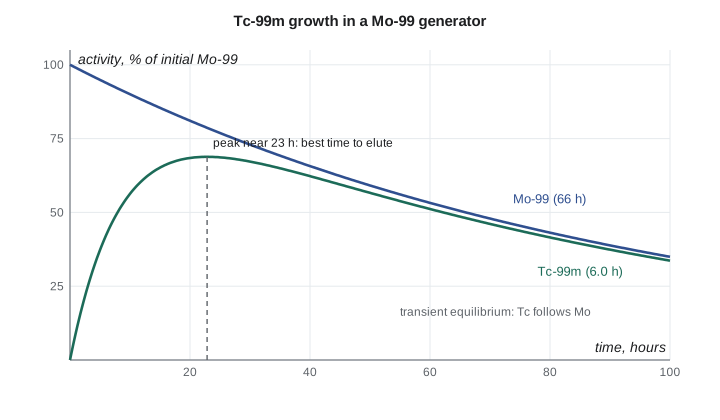
Harry Bateman generalized this solution to chains of any length in 1910, and his equations remain the basis of every depletion and decay calculation in nuclear engineering. Starting from pure parent, the daughter activity rises from zero, reaches a maximum and then follows the parent. The time of the maximum is where parent and daughter activities are equal.
Transient and secular equilibrium
If the parent lives longer than the daughter (\(\lambda_1 < \lambda_2\)), the daughter eventually decays at a fixed ratio to the parent. In transient equilibrium the parent's half-life is longer but not overwhelmingly so; the activity ratio settles at \(\lambda_2/(\lambda_2 - \lambda_1)\), slightly above one. Molybdenum-99 (65.9 hours) and technetium-99m (6.01 hours) are the classic example. In secular equilibrium the parent lives so much longer that its activity hardly changes over many daughter half-lives, and the daughter's activity simply equals the parent's. Radium-226 (1600 years) and radon-222 (3.82 days) behave this way.
If the daughter lives longer than the parent, no equilibrium forms: the parent dies away and the daughter then decays on its own. This case matters in reactors, where short-lived fission products feed longer-lived daughters; iodine-135 (6.6 hours) feeding xenon-135 (9.1 hours) is the most important example, discussed below.
# Decay chains: Bateman solution for parent -> daughter -> stable, and equilibrium.
import math

def bateman2(N1_0, l1, l2, t):
    """Parent and daughter numbers at time t, starting with parent only."""
    N1 = N1_0 * math.exp(-l1 * t)
    N2 = N1_0 * l1 / (l2 - l1) * (math.exp(-l1 * t) - math.exp(-l2 * t))
    return N1, N2

# Mo-99 (65.94 h) -> Tc-99m (6.01 h); about 87.5 percent of Mo-99 decays feed Tc-99m
l1, l2, br = math.log(2) / 65.94, math.log(2) / 6.01, 0.875
N0 = 1.0e15
print(" hours   Mo-99 activity   Tc-99m activity   ratio")
for t in (0, 6, 12, 23, 48, 96):
    N1, N2 = bateman2(N0, l1, l2, t)
    A1, A2 = l1 * N1 / 3600, br * l2 * N2 / 3600     # becquerels
    print(f"{t:6d} {A1 / 1e9:12.1f} GBq {A2 / 1e9:12.1f} GBq {A2 / A1:8.3f}")
t_max = math.log(l2 / l1) / (l2 - l1)
print(f"Tc-99m activity peaks {t_max:.1f} h after elution")
print(f"Transient equilibrium ratio: {br * l2 / (l2 - l1):.3f}")

# Secular equilibrium: Ra-226 (1600 y) -> Rn-222 (3.82 d) in a sealed sample
lr, ln_ = math.log(2) / (1600 * 365.25), math.log(2) / 3.82
for days in (3.82, 7.64, 19.1, 38.2):
    frac = 1 - math.exp(-(ln_ - lr) * days)
print(f"after {days:5.2f} days, radon activity is {frac:.1%} of radium's") hours Mo-99 activity Tc-99m activity ratio
0 2.9 GBq 0.0 GBq 0.000
6 2.7 GBq 1.2 GBq 0.449
12 2.6 GBq 1.8 GBq 0.689
23 2.3 GBq 2.0 GBq 0.876
48 1.8 GBq 1.7 GBq 0.956
96 1.1 GBq 1.0 GBq 0.963
Tc-99m activity peaks 22.9 h after elution
Transient equilibrium ratio: 0.963
after 3.82 days, radon activity is 50.0% of radium's
after 7.64 days, radon activity is 75.0% of radium's
after 19.10 days, radon activity is 96.9% of radium's
after 38.20 days, radon activity is 99.9% of radium'sThe program answers both of Marcus's questions. Technetium-99m peaks about 23 hours after the previous elution, which is why hospitals elute once a day; eluting more often gives smaller yields. In a sealed container, radon reaches half the radium activity in one radon half-life, 97 percent in five and essentially full equilibrium in ten, about five weeks. Sludge drums must be vented or the radon's gamma-emitting daughters accounted for in dose estimates, and samples for radium analysis are sealed for three to four weeks before counting so that equilibrium has formed.
Long chains and natural radioactivity
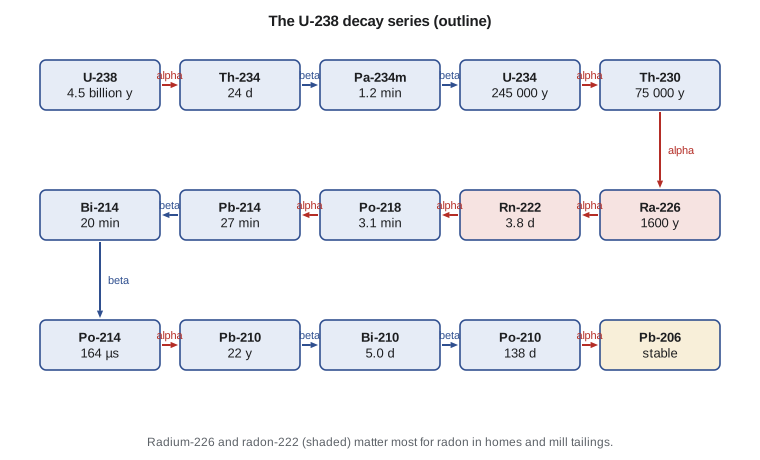
Three natural decay series begin with long-lived heavy nuclides and end at stable lead. The uranium series starts at uranium-238 and ends at lead-206 after eight alpha and six beta decays; the actinium series starts at uranium-235 and ends at lead-207; the thorium series starts at thorium-232 and ends at lead-208. Each series includes an isotope of radon, a gas that can escape from rock and soil into buildings. In undisturbed ore, every member of a series is in secular equilibrium with the head of the chain, so a kilogram of uranium ore contains as much radium activity as uranium-238 activity.
Mining and milling break those equilibria. Uranium is extracted chemically, leaving most of the radium and thorium-230 in the tailings, which is why mill tailings remain radioactive for tens of thousands of years even after the uranium is gone. Freshly refined uranium, by contrast, has very little daughter activity, which builds back only over geological time.
Decay chains inside a reactor
In an operating reactor, the Bateman equations gain production terms from fission and neutron capture. The most important chain for operators is iodine-135 decaying to xenon-135. Xenon-135 has an enormous thermal neutron absorption cross section, about 2.6 million barns (Lesson 5), so it acts as a poison. At steady power, xenon is produced by fission directly and by iodine decay, and destroyed by decay and by neutron absorption; it settles at an equilibrium that costs the core a few percent in reactivity.
After a shutdown, burnout by neutrons stops but iodine keeps decaying into xenon, so xenon rises for about ten hours before decaying away over the following day or two. A reactor without enough excess reactivity cannot restart during this xenon peak, an effect that has shaped operating procedures since the first production reactors in the 1940s. Spatial xenon oscillations can also develop in large cores, which control systems are designed to damp. Small modular reactors such as the one planned at Clinch River are less prone to spatial oscillations because their cores are small compared with the neutron migration length.
Branching and partial decay constants
Many nuclides decay by more than one route. Each route has its own partial decay constant, and the total decay constant is their sum, \(\lambda = \sum_i \lambda_i\). The fraction of decays following route \(i\) is the branching ratio \(b_i = \lambda_i/\lambda\). The half-life you measure is always set by the total, because every route depletes the same parent. Potassium-40, for instance, decays by beta-minus with a branching ratio of about 0.89 and by electron capture with about 0.11; its half-life of 1.25 billion years applies to both routes, and the argon-40 produced by the capture branch accumulates in rocks, which is the basis of potassium-argon dating.
Branching matters in chain calculations because only part of the parent's decays feed a given daughter. In a molybdenum-99 generator, about 87.5 percent of decays lead to technetium-99m and the rest go directly to the ground state of technetium-99, so the daughter production term carries that factor, as the program below shows. In decay heat and shielding calculations, the emission probability of each particle or photon plays the same role: the activity tells you how many decays occur, and the branching and emission data tell you what each decay sends out.
A related idea is the effective half-life of a radionuclide inside the body or inside a process system, where physical decay and removal act together. If removal is also first order with constant \(\lambda_b\), the two simply add, \(\lambda_{\text{eff}} = \lambda + \lambda_b\). Iodine-131 has a physical half-life of 8.02 days, but the thyroid clears it with a biological half-life of roughly 80 days, so its effective half-life in the thyroid is about 7.3 days. Lesson 12 uses effective half-lives to estimate committed doses from intakes.
Decay heat and the sum of many chains
Hundreds of fission product chains decay at once in used fuel. Each contributes heat at its own rate, and the total, decay heat, falls roughly as a power law in time rather than as a single exponential. Engineers estimate it with standards that sum tabulated chains or with fitted correlations. A rough rule, the Way-Wigner approximation, gives decay power as a fraction of operating power in terms of the time since shutdown and the operating time.
With this formula, a core that operated for a year produces about 6 percent of full power one second after shutdown, about 1 percent after a few hours and about 0.3 percent after a week. For an 870 MW thermal SMR, 0.3 percent is still 2.6 MW, which is why passive cooling must work for days. Design calculations use far more accurate standards, but the approximation shows how slowly the long tail of chains decays.
Worked problem
How long to wait before maintenance?
A pump casing has 40 GBq of activation products. 70 percent of the activity is manganese-56 (2.58 hours) and 30 percent is cobalt-60 (5.27 years). How much does waiting 24 hours reduce the activity?
Show solution
- Manganese-56 after 24 h: \(28 \times 0.5^{24/2.58} = 28 \times 0.0016 = 0.045\ \text{GBq}\).
- Cobalt-60 after 24 h: \(12 \times 0.5^{24/(5.27 \times 8766)} \approx 12.0\ \text{GBq}\).
- Total falls from 40 to about 12 GBq, a factor of 3.3.
Answer: Waiting a day removes the short-lived activity almost entirely, but after that further waiting does little, because cobalt-60 dominates. The gamma energies differ too, so dose rate falls by a different factor than activity; Lesson 12 shows how to convert.
Common mistakes
MistakeThinking older radioactive atoms are more likely to decay.
InsteadThe decay probability per unit time is constant; there is no aging.
MistakeAssuming daughter activity equals parent activity at all times.
InsteadEquality holds only in secular equilibrium after many daughter half-lives.
MistakeUsing the parent's half-life to estimate when the daughter peaks.
InsteadUse t_max = ln(λ₂/λ₁)/(λ₂ − λ₁), which depends on both.
MistakeTreating decay heat as a single exponential.
InsteadIt is a sum over many chains and falls roughly as a power of time.
MistakeReporting a count without its uncertainty.
InsteadFor Poisson counting, the standard deviation is the square root of the count.
Summary and key terms
- N(t) = N₀e^(−λt); activity A = λN in becquerels; T½ = ln 2/λ.
- Specific activity is inversely proportional to half-life and molar mass.
- Bateman equations describe chains; a daughter starting from zero peaks at t_max = ln(λ₂/λ₁)/(λ₂ − λ₁).
- Transient equilibrium gives a fixed activity ratio above one; secular equilibrium gives equal activities.
- Natural series from U-238, U-235 and Th-232 end at stable lead and include radon.
- In reactors, the iodine-135 to xenon-135 chain and summed decay heat drive operating and safety limits.
- Decay constant
- The probability per unit time that a nucleus decays.
- Becquerel
- One decay per second.
- Curie
- 3.7 × 10¹⁰ becquerels.
- Specific activity
- Activity per unit mass of a radionuclide.
- Bateman equations
- The solutions for the numbers of each member of a decay chain over time.
- Transient equilibrium
- A fixed daughter-to-parent activity ratio reached when the parent is somewhat longer-lived.
- Secular equilibrium
- Equal daughter and parent activities when the parent is far longer-lived.
- Xenon poisoning
- Loss of reactivity from the strong neutron absorber xenon-135.
Practice problems
Work each problem on paper first, then reveal the answer to check.
Find the activity of 1 μg of iodine-131 (8.02 days, M = 131).
Show answer
λ = 1.0 × 10⁻⁶ s⁻¹; N = 4.6 × 10¹⁵; A = 4.6 × 10⁹ Bq, about 0.12 Ci.
A sample gives 2500 counts. What is the standard deviation?
Show answer
√2500 = 50, a 2 percent relative uncertainty.
When does a daughter of 1 h half-life peak if the parent half-life is 10 h?
Show answer
λ₁ = 0.0693, λ₂ = 0.693 h⁻¹; t = ln 10/0.624 = 3.7 h.
What is the transient equilibrium activity ratio for Mo-99/Tc-99m, ignoring branching?
Show answer
λ₂/(λ₂ − λ₁) = 0.1153/(0.1153 − 0.0105) = 1.10.
How long until radon reaches 90 percent of radium activity in a sealed sample?
Show answer
t = 3.82 × ln 10/ln 2 = 12.7 days.
Using Way-Wigner, estimate decay power one day after shutdown for T = 1 year.
Show answer
0.066 × (86400^−0.2 − (86400 + 3.15 × 10⁷)^−0.2) ≈ 0.066 × (0.103 − 0.031) ≈ 0.5 percent.
Lesson quiz · 5 questions
Score 60% or more to complete this lesson.
Create a free account to save your progress, take quizzes and earn a certificate.