
NUC-220 · Lesson 4 of 12 · 24 min
Nuclear reactions and Q-values
The fourth session starts with a design review comment. The instrumentation team at Meridian Nuclear Engineering has proposed boron-lined neutron detectors for the startup range of the Clinch River reactor, and a reviewer has asked why boron-10 and not helium-3 or lithium-6, and whether the oxygen in the reactor water will produce a gamma hazard in the steam lines. Both questions turn on nuclear reactions: what happens when a particle strikes a nucleus, and how much energy the reaction releases or needs.
Writing nuclear reactions
A nuclear reaction has a projectile \(a\) striking a target nucleus \(X\), producing a residual nucleus \(Y\) and an outgoing particle \(b\). The long form is \(a + X \to Y + b\); the compact form used throughout nuclear data is \(X(a,b)Y\). For example, \(^{10}\text{B}(n,\alpha)^{7}\text{Li}\) means a neutron striking boron-10 and producing an alpha particle and lithium-7. Reactions conserve the total number of nucleons, total charge, energy, momentum and angular momentum, so the residual nucleus can always be found by bookkeeping.
Reactions are classified by what comes out. In elastic scattering, \(X(n,n)X\), the target is left in its ground state and kinetic energy is conserved. In inelastic scattering, \(X(n,n')X^*\), the target is left excited and later emits a gamma ray. In radiative capture, \(X(n,\gamma)\), the projectile is absorbed and the excitation leaves as gamma rays; this is how reactors make cobalt-60 from cobalt-59 and plutonium-239 from uranium-238. In transmutation reactions such as \((n,p)\) and \((n,\alpha)\), a charged particle leaves. In fission, \((n,f)\), the nucleus splits.
The Q-value
The Q-value is the energy released by a reaction, equal to the decrease in rest mass. A positive Q means the reaction releases energy (exothermic); a negative Q means kinetic energy must be supplied (endothermic).
As in Lesson 1, atomic masses are used so that electron masses cancel; when a proton appears in a reaction, the hydrogen-1 atomic mass is used for it, and for an alpha particle the helium-4 atomic mass. The second form of the equation is the same statement in terms of kinetic energies: Q is the gain in total kinetic energy of the particles. Because the masses of nuclei are known to better than a millionth of a percent, Q-values computed from mass tables are extremely precise.
# Nuclear reactions: Q-values and threshold energies from atomic masses.
U = 931.494
m = {'n': 1.008665, 'H-1': 1.007825, 'H-2': 2.014102, 'H-3': 3.016049, 'He-3': 3.016029,
     'He-4': 4.002603, 'Li-6': 6.015123, 'Li-7': 7.016003, 'B-10': 10.012937, 'C-12': 12.000000,
     'N-14': 14.003074, 'O-17': 16.999132, 'O-16': 15.994915, 'N-16': 16.006102}

def q_value(reactants, products):
    return (sum(m[x] for x in reactants) - sum(m[x] for x in products)) * U

reactions = [
    ('B-10(n,alpha)Li-7', ['B-10', 'n'], ['Li-7', 'He-4']),
    ('Li-6(n,alpha)H-3', ['Li-6', 'n'], ['H-3', 'He-4']),
    ('He-3(n,p)H-3', ['He-3', 'n'], ['H-3', 'H-1']),
    ('N-14(alpha,p)O-17', ['N-14', 'He-4'], ['O-17', 'H-1']),
    ('O-16(n,p)N-16', ['O-16', 'n'], ['N-16', 'H-1']),
    ('H-2(d,n)He-3', ['H-2', 'H-2'], ['He-3', 'n']),
]
for name, r, p in reactions:
    Q = q_value(r, p)
    line = f"{name:20s} Q = {Q:+8.3f} MeV"
    if Q < 0:   # endothermic: threshold in the lab with a projectile hitting a target at rest
        proj, targ = (r[1], r[0])
        Eth = -Q * (m[proj] + m[targ]) / m[targ]
        line += f"   threshold {Eth:.2f} MeV"
print(line)B-10(n,alpha)Li-7 Q = +2.791 MeV Li-6(n,alpha)H-3 Q = +4.784 MeV He-3(n,p)H-3 Q = +0.764 MeV N-14(alpha,p)O-17 Q = -1.192 MeV threshold 1.53 MeV O-16(n,p)N-16 Q = -9.638 MeV threshold 10.25 MeV H-2(d,n)He-3 Q = +3.270 MeV
The program answers the reviewer's first question. Boron-10, lithium-6 and helium-3 all absorb slow neutrons in exothermic reactions that release charged particles with hundreds of keV to several MeV of energy, easily detected by the ionization they produce. Boron-10's reaction releases 2.79 MeV to the ground state, though about 94 percent of reactions leave lithium-7 in an excited state, releasing 2.31 MeV as kinetic energy plus a 0.48 MeV gamma. Lithium-6 releases 4.78 MeV. Helium-3 gives the cleanest signal but is scarce and expensive, because it comes mainly from the decay of tritium. Boron-10 is abundant (about 20 percent of natural boron), easy to coat on tube walls or use as boron trifluoride gas, and has a very large cross section, which is why it is the usual choice.
Thresholds for endothermic reactions
A negative Q-value is not the whole story. Because momentum must be conserved, some of the projectile's kinetic energy must remain as motion of the products, so the projectile needs more than \(|Q|\). For a projectile striking a target at rest, the threshold kinetic energy is
For neutrons on oxygen-16, the \((n,p)\) reaction has \(Q = -9.64\) MeV and a threshold of about 10.2 MeV, so only the fastest fission neutrons can cause it. Yet it happens often enough in a reactor core to matter. The product, nitrogen-16, has a half-life of only 7.1 seconds and emits gamma rays of 6.1 and 7.1 MeV, among the most energetic in any reactor. In a boiling water reactor such as the BWRX-300 planned at Clinch River, nitrogen-16 travels with the steam to the turbine, so turbine buildings in BWRs need shielding and access controls during power operation. The short half-life means the activity vanishes within minutes of shutdown. That is the answer to the reviewer's second question.
Worked problem
Threshold for the nitrogen-14 alpha-proton reaction
Rutherford's 1919 reaction \(^{14}\text{N}(\alpha,p)^{17}\text{O}\) has \(Q = -1.19\) MeV. What alpha energy is needed?
Show solution
- Masses: alpha 4.0026 u, nitrogen-14 14.0031 u.
- \(T_{\text{th}} = 1.19 \times (4.0026 + 14.0031)/14.0031 = 1.19 \times 1.286\).
- \(T_{\text{th}} = 1.53\ \text{MeV}\).
Answer: Rutherford's alpha particles from radium daughters carried several MeV, enough to cause the reaction. It was the first artificial transmutation of one element into another.
Energy in the products
For exothermic reactions with slow neutrons, the projectile brings almost no kinetic energy, so the products share \(Q\) in inverse proportion to their masses, just as in alpha decay. In boron-10 capture, the alpha particle gets about 1.47 MeV and the lithium-7 nucleus 0.84 MeV (for the main branch). Both stop within a few micrometers in solid material, depositing their energy locally. This is the basis of boron neutron capture therapy for some cancers: boron compounds that collect in tumor cells are irradiated with neutrons, and the short-range products damage only the cells containing boron.
For reactions with a fast projectile, the energy of the outgoing particle depends on its angle. The full relation, from conservation of energy and momentum, is the Q-equation; engineers use it to calculate the energies of neutrons from accelerator sources such as deuterium-tritium generators, which produce 14.1 MeV neutrons used in oil-well logging and materials testing.
Using conservation laws as a check
Conservation laws are the fastest way to catch mistakes in reaction bookkeeping. Write the mass number and atomic number of each particle as superscript and subscript, then check that both sums balance across the arrow. A neutron is \(^1_0 n\), a proton \(^1_1 p\), an alpha \(^4_2\alpha\), a gamma ray \(^0_0\gamma\). For \(^{6}_{3}\text{Li} + ^1_0 n \to ^{3}_{1}\text{H} + ^{4}_{2}\alpha\), the mass numbers give \(6 + 1 = 3 + 4\) and the charges \(3 + 0 = 1 + 2\). This reaction is how tritium is bred in proposed fusion blankets (Lesson 8), and it also explains why lithium-6 is used in neutron detectors and in shielding that must avoid the high-energy capture gamma rays of hydrogen.
Charge and nucleon number fix the residual nucleus, but energy and momentum fix what can happen. A reaction that balances on paper may still be impossible at a given energy if its Q-value is too negative, and even an allowed exothermic reaction with charged particles can be extremely unlikely if the particles must tunnel through a Coulomb barrier, as Lesson 8 shows for fusion. Neutrons carry no charge and face no such barrier, which is why they can cause reactions at almost any energy.
The compound nucleus
Niels Bohr proposed in 1936 that many reactions proceed in two steps. The projectile is absorbed, forming a compound nucleus in which its energy is quickly shared among all the nucleons. The compound nucleus then lives for a time long compared with the transit time of the projectile, about \(10^{-16}\) seconds, and decays in a way that does not depend on how it was formed. A neutron absorbed by uranium-235 forms uranium-236 with about 6.5 MeV of excitation (Lesson 1); that excited uranium-236 then fissions about 85 percent of the time and emits gamma rays (capture) the rest of the time, whatever the neutron's direction.
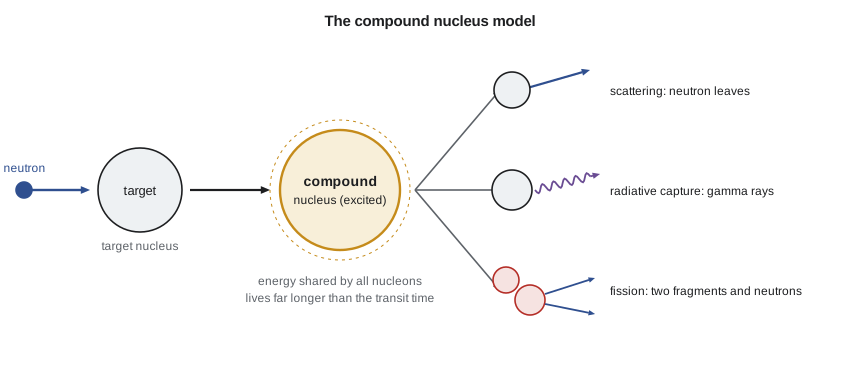
The compound nucleus picture explains resonances. A compound nucleus has discrete excited levels, and when the projectile's energy plus the separation energy matches a level, the formation probability rises sharply. Cross sections of heavy nuclei for neutrons between about 1 eV and a few keV show thousands of these resonances. Lesson 5 shows how they appear in cross-section plots and Lesson 11 how they shape neutron slowing down in reactor fuel.
At higher projectile energies, reactions can also proceed directly, with the projectile interacting with only one or a few nucleons on a fast timescale. Direct reactions dominate above about 20 MeV and in reactions that pick up or strip off single nucleons. For reactor neutrons, nearly all reactions of interest are compound nucleus or potential scattering processes.
Activation
Neutron capture turns stable nuclides into radioactive ones, a process called activation. It is useful when deliberate, such as producing cobalt-60 for sterilization or molybdenum-99 for medicine, and a design concern when not. Activation of structural steel, concrete and coolant impurities sets the doses that maintenance workers receive and the amount of radioactive waste a plant produces at decommissioning.
| Target | Reaction | Product half-life | Why it matters |
|---|---|---|---|
| Cobalt-59 (in steel) | (n,γ) cobalt-60 | 5.27 years | main source of maintenance dose; limits cobalt in reactor materials |
| Iron-54 | (n,p) manganese-54 | 312 days | activation product in steel and corrosion products |
| Oxygen-16 (in water) | (n,p) nitrogen-16 | 7.1 seconds | high-energy gamma in BWR steam lines |
| Hydrogen-2 (heavy water) | (n,γ) tritium | 12.3 years | tritium management in CANDU reactors |
| Nitrogen-14 (in air) | (n,p) carbon-14 | 5730 years | long-lived waste and gaseous emissions |
| Silver-109 (control alloys) | (n,γ) silver-110m | 250 days | activation in older control rod materials |
The activity produced by activation follows a simple balance. Atoms of the product are created at the reaction rate \(R = N\sigma\phi\) (Lesson 5) and decay at \(\lambda N_p\). Starting from zero, the product activity grows toward a saturation value equal to the production rate.
After one half-life of irradiation the activity reaches half of saturation, and after several it is essentially saturated. This is why short irradiations are enough for short-lived products, while cobalt-60 in reactor components keeps building up for years. When irradiation stops, the activity decays with the product's own half-life.
Worked problem
Saturation activity of a sodium sample
A 1 g sodium sample (all sodium-23, cross section 0.53 b) sits in a thermal flux of \(10^{12}\ \text{n/cm}^2\text{s}\) for 10 hours. Sodium-24 has a half-life of 15.0 hours. Find its activity.
Show solution
- \(N = 6.022 \times 10^{23}/23 = 2.62 \times 10^{22}\) atoms.
- Saturation: \(N\sigma\phi = 2.62 \times 10^{22} \times 0.53 \times 10^{-24} \times 10^{12} = 1.39 \times 10^{10}\ \text{Bq}\).
- Fraction reached: \(1 - 0.5^{10/15} = 1 - 0.63 = 0.37\).
- Activity: \(0.37 \times 1.39 \times 10^{10} = 5.1 \times 10^9\ \text{Bq}\), about 0.14 Ci.
Answer: Sodium-24 emits strong gamma rays of 1.37 and 2.75 MeV. Activation analysis of this kind is also used to measure trace elements in samples and to estimate neutron doses after criticality accidents, from sodium-24 in blood.
Common mistakes
MistakeWriting (n,p) when the reaction emits an alpha particle.
InsteadThe second symbol is the outgoing light particle; (n,α) emits helium-4.
MistakeAssuming an endothermic reaction starts when the projectile energy equals |Q|.
InsteadThe threshold is higher by the factor (mₐ + M_X)/M_X because momentum must be conserved.
MistakeUsing nuclear masses for some particles and atomic masses for others.
InsteadUse atomic masses throughout, with hydrogen-1 for protons and helium-4 for alphas.
MistakeThinking activation stops instantly when the reactor shuts down.
InsteadProduction stops, but the products keep decaying with their own half-lives.
MistakeExpecting activity to grow linearly with irradiation time forever.
InsteadIt saturates at Nσφ after several product half-lives.
Summary and key terms
- Reactions are written X(a,b)Y and conserve nucleons, charge, energy and momentum.
- Q = [(mₐ + M_X) − (m_b + M_Y)]c²; positive Q releases energy, negative Q needs energy.
- Endothermic thresholds are T_th ≈ −Q(mₐ + M_X)/M_X.
- Boron-10, lithium-6 and helium-3 absorb slow neutrons with exothermic charged-particle reactions, the basis of neutron detectors.
- The compound nucleus forms, shares energy and decays independently of its formation; resonances follow from its levels.
- Activation grows as Nσφ(1 − e^(−λt)) and sets maintenance doses and decommissioning waste.
- Reaction notation
- X(a,b)Y: target, projectile, outgoing particle, residual nucleus.
- Exothermic reaction
- A reaction with positive Q that releases energy.
- Threshold energy
- The minimum projectile kinetic energy for an endothermic reaction.
- Radiative capture
- Absorption of a particle followed by emission of gamma rays, written (n,γ).
- Compound nucleus
- An excited intermediate nucleus formed when a projectile is absorbed.
- Resonance
- A sharp rise in cross section where the projectile energy matches a compound-nucleus level.
- Activation
- Production of radioactive nuclides by neutron capture or other reactions.
- Saturation activity
- The limiting activity Nσφ reached after long irradiation.
Practice problems
Work each problem on paper first, then reveal the answer to check.
Complete the reaction ⁶Li(n, ?)³H.
Show answer
An alpha particle: 1 + 6 = 3 + 4 nucleons and 0 + 3 = 1 + 2 charge.
Why is ¹⁶O(n,p)¹⁶N important in a BWR but not after shutdown?
Show answer
Its 7.1 s nitrogen-16 emits 6 to 7 MeV gammas in the steam; it decays within minutes once neutrons stop.
A reaction has Q = −2.0 MeV, projectile mass 1 u and target mass 9 u. Find the threshold.
Show answer
2.0 × 10/9 = 2.22 MeV.
What fraction of saturation is reached after irradiating for two product half-lives?
Show answer
1 − 0.5² = 0.75.
From the program, what is the Q-value of D-D fusion to helium-3 and a neutron?
Show answer
+3.27 MeV.
Why do plant designers specify low-cobalt steel?
Show answer
Cobalt-59 activates to cobalt-60, whose high-energy gammas dominate maintenance dose.
Lesson quiz · 5 questions
Score 60% or more to complete this lesson.
Create a free account to save your progress, take quizzes and earn a certificate.