
NUC-220 · Lesson 12 of 12 · 21 min
Dosimetry quantities
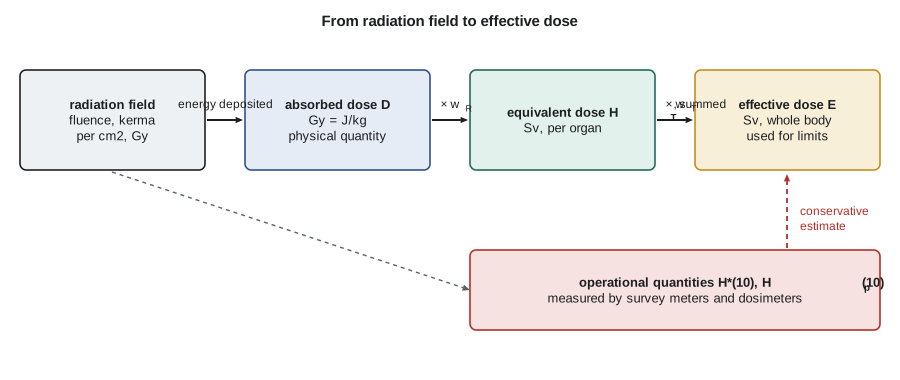
The final session belongs to Lina. Every topic in the course, from decay to photon attenuation, eventually feeds into one question that the NRC and the public ask about the Clinch River project: how much radiation dose will workers and neighbors receive? Answering it requires a chain of carefully defined quantities that connect energy deposited in matter to biological risk. Lina walks Hana through that chain, from the physical quantities measured by instruments to the protection quantities used for limits.
Activity, fluence and kerma
Dosimetry starts with the source and the radiation field. Activity, in becquerels (one decay per second), describes the source (Lesson 3). The field at a point is described by fluence \(\Phi\), the number of particles crossing unit area, in cm⁻² or m⁻², and fluence rate, the same quantity per second, which for neutrons is the flux of Lesson 5.
The first energy quantity is kerma, an acronym for kinetic energy released per unit mass. It is the energy transferred from uncharged radiation, photons or neutrons, to charged particles in a small mass of material, divided by that mass. For photons of energy \(E\),
Kerma is measured in grays, joules per kilogram. Air kerma is the standard calibration quantity for photon instruments and the basis of dose-rate constants for gamma sources.
Absorbed dose
Absorbed dose \(D\) is the energy deposited by ionizing radiation per unit mass of material:
Kerma counts energy given to charged particles; absorbed dose counts energy they actually deposit. The two are nearly equal when the electrons set moving deposit their energy close to where they start, a condition called charged-particle equilibrium. Absorbed dose applies to any material and any radiation, and it is the fundamental physical quantity of dosimetry. The older unit, the rad, equals 0.01 Gy; it remains in use in some United States regulations and instruments.
A gray is a small amount of energy. One gray deposited in a 70 kg person is 70 joules, enough to raise body temperature by only about 0.0002 °C. Radiation harms through the ionization pattern, not the heat: a few grays to the whole body in a short time can be fatal, while the same energy as heat would be imperceptible.
Equivalent dose
Different radiations cause different biological damage for the same absorbed dose, as Lesson 9's discussion of LET showed. For protection, the International Commission on Radiological Protection (ICRP) defines the equivalent dose to an organ or tissue \(T\) by weighting the absorbed dose with a radiation weighting factor \(w_R\):
| Radiation | Radiation weighting factor w_R (ICRP 103) |
|---|---|
| Photons, all energies | 1 |
| Electrons and muons | 1 |
| Protons and charged pions | 2 |
| Alpha particles, fission fragments, heavy ions | 20 |
| Neutrons | continuous function of energy, about 2.5 to 20, peaking near 1 MeV |
The sievert has the same base units as the gray, J/kg, but a different meaning: it is a protection quantity designed to scale with risk of stochastic effects such as cancer; the older unit, the rem, equals 0.01 Sv, and millirem (mrem) are still common in United States practice, with 1 mSv = 100 mrem. The neutron weighting factor peaks near 1 MeV because neutrons of that energy produce recoil protons with high LET in tissue.
Effective dose
Organs differ in their sensitivity to radiation-induced cancer and heritable effects. To express the overall risk of a non-uniform exposure as a single number, ICRP defines the effective dose:
| Tissue or organ | Tissue weighting factor w_T (ICRP 103) |
|---|---|
| Red bone marrow, colon, lung, stomach, breast, remainder tissues | 0.12 each |
| Gonads | 0.08 |
| Bladder, esophagus, liver, thyroid | 0.04 each |
| Bone surface, brain, salivary glands, skin | 0.01 each |
Effective dose is the quantity in which dose limits for workers and the public are expressed. A uniform whole-body exposure of 1 mSv equivalent dose to every tissue gives an effective dose of 1 mSv. If only the lung receives 3 mSv, the effective dose is \(0.12 \times 3 = 0.36\) mSv, representing roughly the same overall risk as a uniform 0.36 mSv. Effective dose is defined for a reference person, averaged over sex and age; it is a tool for protection planning and compliance, not for estimating the risk to a specific individual.
# Dosimetry quantities: absorbed dose, equivalent dose, effective dose and gamma dose-rate estimates.
import math
# Absorbed dose from deposited energy: D = E / m
E_dep = 0.30          # joules deposited
m = 70.0              # kg
D = E_dep / m
print(f"Absorbed dose: {D * 1000:.2f} mGy")

# Equivalent dose in an organ, H_T = sum(w_R * D_T,R), ICRP 103 radiation weighting factors
w_R = {'photons': 1, 'electrons': 1, 'protons': 2, 'alphas': 20}
organ_doses = {'photons': 2.0e-3, 'alphas': 0.05e-3}       # Gy in the lung
H = sum(w_R[r] * d for r, d in organ_doses.items())
print(f"Lung equivalent dose: {H * 1000:.1f} mSv")

# Effective dose from organ equivalent doses with ICRP 103 tissue weighting factors (partial list)
w_T = {'lung': 0.12, 'stomach': 0.12, 'red marrow': 0.12, 'thyroid': 0.04, 'skin': 0.01}
H_T = {'lung': H, 'stomach': 0.2e-3, 'red marrow': 0.3e-3, 'thyroid': 0.1e-3, 'skin': 0.5e-3}
E = sum(w_T[t] * H_T[t] for t in H_T)
print(f"Effective dose: {E * 1000:.3f} mSv")

# Gamma dose rate from a point source: Gamma constant approach
Gamma_cs = 0.0927     # uSv/h per MBq at 1 m for Cs-137/Ba-137m (approximate air-kerma based value)
A = 3700              # MBq (100 mCi)
for r in (1, 2, 5):
    print(f"Cs-137 {A} MBq at {r} m: {Gamma_cs * A / r ** 2:7.1f} uSv/h")
# Neutron fluence to dose: about 400 pSv cm2 for fast neutrons (approximate)
flux, hours = 50.0, 2.0       # n/cm2/s
dose = flux * hours * 3600 * 400e-12
print(f"Fast neutron flux {flux} n/cm2/s for {hours} h: about {dose * 1e6:.0f} uSv")Absorbed dose: 4.29 mGy Lung equivalent dose: 3.0 mSv Effective dose: 0.429 mSv Cs-137 3700 MBq at 1 m: 343.0 uSv/h Cs-137 3700 MBq at 2 m: 85.7 uSv/h Cs-137 3700 MBq at 5 m: 13.7 uSv/h Fast neutron flux 50.0 n/cm2/s for 2.0 h: about 144 uSv
The program follows the chain. Depositing 0.3 J in a 70 kg body gives 4.3 mGy. A lung exposure combining 2 mGy of photons and 0.05 mGy of alpha particles gives an equivalent dose of 3.0 mSv, with the small alpha dose contributing a third because of its weighting factor of 20. Combining lung and other organ doses gives an effective dose of 0.43 mSv. The last lines estimate the dose rate from a 3700 MBq (100 mCi) cesium-137 source at several distances using a dose-rate constant of about 0.093 µSv/h per MBq at 1 m, and the dose from two hours in a fast neutron field using a fluence-to-dose coefficient of about 400 pSv cm².
Operational quantities
Effective dose cannot be measured directly, because it requires doses to organs inside the body. Instruments and dosimeters therefore measure operational quantities defined by the International Commission on Radiation Units and Measurements (ICRU), designed to give a reasonable and usually conservative estimate of effective dose. Ambient dose equivalent \(H^*(10)\) is used for area survey meters; personal dose equivalent \(H_p(10)\) is measured by dosimeters worn on the trunk; \(H_p(0.07)\) estimates skin dose and \(H_p(3)\) dose to the lens of the eye. The 10 refers to a depth of 10 mm in tissue. A survey meter reading in µSv/h near a source is a reading of \(H^*(10)\) rate. ICRU Report 95 (2020) proposes revised operational quantities defined more directly from effective dose; adoption by regulators and instrument makers is under way.
Internal dose
So far the chain has assumed radiation from outside the body. When radioactive material is inhaled or swallowed, it keeps irradiating tissues until it decays or is excreted. The protection quantity for internal exposure is the committed effective dose, the effective dose integrated over 50 years after intake for adults and to age 70 for children. It is calculated by multiplying the activity taken in by a dose coefficient, in sieverts per becquerel, published by ICRP for each nuclide, chemical form and route of intake. Tritiated water, for example, has an ingestion dose coefficient of about \(1.8 \times 10^{-11}\) Sv/Bq, while plutonium-239 inhaled as an insoluble oxide is millions of times more dangerous per becquerel because its alpha particles irradiate the lung and bone for decades. Bioassay programs at nuclear plants, using urine samples for tritium and whole-body counters for gamma emitters such as cesium-137 and cobalt-60, measure intakes so that internal dose can be added to external dose in each worker's record.
Dose rate from a gamma source
For a point gamma source in air, the dose rate at distance \(r\) follows from the activity, the inverse-square law and a nuclide-specific dose-rate constant \(\Gamma\):
Worked problem
Working time near a source
A technician must work 2 m from a 3700 MBq cesium-137 source for a task. The Meridian Nuclear Engineering administrative control level is 0.1 mSv per task. How long can the task take without shielding?
Show solution
- Dose rate at 2 m: \(0.0927 \times 3700/2^2 = 85.7\ \mu\text{Sv/h}\).
- Allowed time: \(100\ \mu\text{Sv}/85.7\ \mu\text{Sv/h} = 1.17\ \text{h}\).
- Moving to 5 m cuts the rate to \(13.7\ \mu\text{Sv/h}\), allowing over 7 hours.
Answer: Time, distance and shielding are the three tools of external dose control. The ALARA principle means the task would also be planned to use remote tools or a portable shield if they reduce dose at reasonable cost.
Dose limits and context
Radiation protection rests on three ICRP principles: justification (an exposure must do more good than harm), optimization (doses kept as low as reasonably achievable, ALARA) and dose limitation. In the United States, limits are set in regulations under the Atomic Energy Act. Both countries limit public exposure from licensed activities to 1 mSv per year. For workers, the Canadian limit for nuclear energy workers is 50 mSv in one year and 100 mSv over five years, while the United States limit for occupational exposure is 50 mSv (5 rem) per year. Pregnant workers, the lens of the eye, skin and extremities have separate limits. Actual worker doses at well-run plants are a small fraction of the limits, typically around 1 mSv per year on average, and doses to neighbors of nuclear plants are usually below 0.01 mSv per year.
| Exposure | Typical effective dose (approximate) |
|---|---|
| Natural background, world average | about 2.4 mSv per year |
| Natural radon in homes | about 1 to 1.5 mSv per year on average, highly variable |
| Chest X-ray | about 0.02 to 0.1 mSv |
| Return flight across North America | about 0.02 to 0.04 mSv |
| CT scan of the abdomen | about 8 to 10 mSv |
| Living next to a nuclear plant for a year | below 0.01 mSv |
Biological effects fall into two classes. Deterministic effects, now called tissue reactions, such as skin burns, cataracts and acute radiation syndrome, occur only above a threshold dose, typically above about 0.5 to 1 Gy, and grow more severe with dose. Stochastic effects, mainly cancer, are assumed to occur with a probability proportional to dose, with no threshold; this linear no-threshold model is used for protection, with a nominal risk coefficient of about 5 percent per sievert for the whole population. Limits are set to prevent tissue reactions entirely and to keep stochastic risk low.
From physics to protection
This course has followed radiation from its origin in the nucleus to its effects in tissue. Binding energy explains why nuclei decay, fission and fuse. Decay kinetics give activities. Cross sections and stopping powers describe how radiation travels and deposits energy. Attenuation and moderation set the design of shields and cores. Dosimetry converts all of it into the quantities that regulators, workers and the public use. Hana's next course, in reactor physics, builds directly on Lessons 5, 7 and 11, while radiation protection work at Meridian Nuclear Engineering draws on every lesson here.
Common mistakes
MistakeTreating gray and sievert as interchangeable.
InsteadThe gray is physical absorbed dose; the sievert includes radiation and tissue weighting for protection.
MistakeUsing effective dose to estimate an individual patient's risk.
InsteadIt is a protection quantity for a reference person, not a personal risk estimate.
MistakeForgetting the inverse-square law when moving away from a source.
InsteadDoubling distance cuts the dose rate from a point source by four.
MistakeAssuming instruments read effective dose.
InsteadThey measure operational quantities such as H*(10) and Hp(10).
MistakeAssuming all radiation effects have thresholds.
InsteadStochastic effects are assumed to have none; tissue reactions do.
Summary and key terms
- Fluence and kerma describe the radiation field and the energy transferred to charged particles.
- Absorbed dose D, in grays (J/kg), is energy deposited per unit mass.
- Equivalent dose H_T = Σ w_R D_T,R, in sieverts, weights by radiation type.
- Effective dose E = Σ w_T H_T weights by tissue sensitivity and is used for limits.
- Operational quantities H*(10) and Hp(10) are what instruments and dosimeters measure.
- Public limits are 1 mSv per year; worker limits are about 50 mSv per year, with ALARA keeping actual doses far lower.
- Kerma
- Kinetic energy released per unit mass by uncharged radiation, in grays.
- Absorbed dose
- Energy deposited per unit mass, in grays.
- Radiation weighting factor
- A factor w_R that converts absorbed dose to equivalent dose by radiation type.
- Equivalent dose
- Absorbed dose in an organ weighted by radiation type, in sieverts.
- Tissue weighting factor
- A factor w_T representing an organ’s share of total radiation risk.
- Effective dose
- The sum of tissue-weighted equivalent doses, in sieverts.
- Ambient dose equivalent
- The operational quantity H*(10) measured by area survey meters.
- ALARA
- As low as reasonably achievable, the optimization principle of radiation protection.
Practice problems
Work each problem on paper first, then reveal the answer to check.
A tissue receives 1 mGy of photons and 0.1 mGy of alphas. Find its equivalent dose.
Show answer
1 × 1 + 20 × 0.1 = 3 mSv.
Only the thyroid receives 10 mSv. What is the effective dose?
Show answer
0.04 × 10 = 0.4 mSv.
From the program, what is the dose rate 1 m from 3700 MBq of cesium-137?
Show answer
About 343 µSv/h.
What quantity does a personal dosimeter worn on the chest measure?
Show answer
Personal dose equivalent Hp(10).
What are the three ICRP principles of protection?
Show answer
Justification, optimization (ALARA) and dose limitation.
A worker spends 3 hours in a fast neutron fluence rate of 20 n/cm²s. Estimate the dose using 400 pSv cm².
Show answer
20 × 10 800 × 400 × 10⁻¹² Sv = 86 µSv.
Lesson quiz · 5 questions
Score 60% or more to complete this lesson.
Create a free account to save your progress, take quizzes and earn a certificate.