
NUC-220 · Lesson 8 of 12 · 24 min
Fusion physics
The eighth session begins with a newspaper clipping on Paul's desk about a fusion start-up. Meridian Nuclear Engineering has been asked to bid on tritium handling and shielding studies for a fusion pilot plant, and the business development team wants the physics group to explain what fusion is, what it needs and how its radiation differs from fission. Fusion is the other way to release nuclear binding energy: instead of splitting the heaviest nuclei, it joins the lightest ones, climbing the steep left side of the binding energy curve from Lesson 1.
Why light nuclei release energy when they fuse
Binding energy per nucleon rises steeply from hydrogen to helium-4, which at 7.07 MeV per nucleon is unusually tightly bound for its size. Joining two hydrogen isotopes into helium therefore releases a large amount of energy per nucleon, several times more than fission. The Sun has run on this for 4.6 billion years, fusing ordinary hydrogen into helium through the proton-proton chain at a core temperature of about 15 million kelvin.
The proton-proton chain is far too slow for a power plant on Earth: its first step requires one of the protons to turn into a neutron through the weak interaction during the brief encounter, which is extremely improbable. The Sun works only because its core holds enormous amounts of hydrogen at high density for billions of years. Terrestrial fusion uses the heavier hydrogen isotopes, deuterium and tritium, whose reactions proceed through the strong force and are vastly faster.
Fusion reactions
The candidate reactions for power plants all involve isotopes of hydrogen and helium, plus a few light nuclei.
# Fusion physics: Q-values, Coulomb barrier and the energy shared between products.
U = 931.494
m = {'n': 1.008665, 'H-1': 1.007825, 'H-2': 2.014102, 'H-3': 3.016049, 'He-3': 3.016029, 'He-4': 4.002603,
     'Li-6': 6.015123, 'B-11': 11.009305}
def Q(r, p): return (sum(m[x] for x in r) - sum(m[x] for x in p)) * U

for name, r, p in (('D-T', ['H-2', 'H-3'], ['He-4', 'n']), ('D-D (n branch)', ['H-2', 'H-2'], ['He-3', 'n']),
                   ('D-D (p branch)', ['H-2', 'H-2'], ['H-3', 'H-1']), ('D-He3', ['H-2', 'He-3'], ['He-4', 'H-1']),
                   ('p-B11', ['H-1', 'B-11'], ['He-4', 'He-4', 'He-4'])):
    print(f"{name:15s} Q = {Q(r, p):6.2f} MeV")

# D-T energy split: two-body decay at rest, energy inversely proportional to mass
q = Q(['H-2', 'H-3'], ['He-4', 'n'])
En = q * m['He-4'] / (m['He-4'] + m['n'])
print(f"\nD-T: neutron carries {En:.2f} MeV, alpha {q - En:.2f} MeV")

# Coulomb barrier for D-T at touching distance r = 1.44 MeV fm * Z1 Z2 / (R1 + R2)
R = lambda A: 1.2 * A ** (1 / 3)
Vc = 1.44 * 1 * 1 / (R(2) + R(3))
kT = 15e3   # 15 keV plasma, in eV
print(f"Coulomb barrier about {Vc * 1000:.0f} keV; plasma temperature 15 keV is {Vc * 1e6 / kT:.0f} times lower")
print(f"15 keV corresponds to {kT * 11604.5 / 1e6:.0f} million kelvin")

# Lawson-type triple product target for D-T ignition (approximate)
n, T, tau = 1.0e20, 15, 3.0   # m^-3, keV, s
print(f"Triple product n T tau = {n * T * tau:.1e} keV s/m3 (ignition needs about 3e21)")D-T Q = 17.59 MeV D-D (n branch) Q = 3.27 MeV D-D (p branch) Q = 4.03 MeV D-He3 Q = 18.35 MeV p-B11 Q = 8.68 MeV D-T: neutron carries 14.05 MeV, alpha 3.54 MeV Coulomb barrier about 444 keV; plasma temperature 15 keV is 30 times lower 15 keV corresponds to 174 million kelvin Triple product n T tau = 4.5e+21 keV s/m3 (ignition needs about 3e21)
The deuterium-tritium reaction releases 17.6 MeV, the most of any practical reaction, and has by far the largest cross section at achievable temperatures. Because momentum is conserved and the reactants start almost at rest compared with the energy released, the products share the energy in inverse proportion to their masses, exactly as in alpha decay (Lesson 2). The neutron, one-fifth of the product mass, takes four-fifths of the energy: 14.1 MeV. The alpha particle takes 3.5 MeV.
That split shapes everything about a D-T plant. The alpha particles are charged and stay in the magnetically confined plasma, heating it; that self-heating is what a burning plasma needs. The neutrons escape the plasma, carrying 80 percent of the power to the surrounding blanket, where they deposit heat, breed tritium and activate the structure. Per unit of energy, D-T fusion produces about three times as many neutrons as fission, and they are much more energetic.
Worked problem
Energy per kilogram of D-T fuel
Compare the energy released per kilogram of D-T fuel with that of uranium-235 fission.
Show solution
- Mass of one D plus one T: \(2.014 + 3.016 = 5.030\ \text{u} = 8.35 \times 10^{-27}\ \text{kg}\).
- Energy: \(17.6\ \text{MeV} = 2.82 \times 10^{-12}\ \text{J}\).
- Per kilogram: \(2.82 \times 10^{-12}/8.35 \times 10^{-27} = 3.4 \times 10^{14}\ \text{J/kg}\).
- Fission: \(200\ \text{MeV}\) per \(235\ \text{u}\) gives \(8.2 \times 10^{13}\ \text{J/kg}\).
Answer: D-T fusion releases about four times more energy per kilogram of fuel than fission of uranium-235, and about ten million times more than burning coal.
The Coulomb barrier and tunneling
Fusion's difficulty is electric repulsion. Both nuclei are positively charged, so they must approach to within a few femtometers, where the strong force takes over. The Coulomb potential energy at that distance is a few hundred keV.
For D-T at a touching distance of about 3.2 fm, the barrier is about 0.44 MeV, as the program shows. Yet fusion plasmas run at about 15 keV, thirty times lower. Two effects make this work. First, the particles have a Maxwell-Boltzmann spread of energies, so a small fraction are much faster than average. Second, quantum tunneling, the same physics George Gamow used in 1928 to explain alpha decay, lets nuclei penetrate the barrier with a probability that rises steeply with energy. Fusion in a plasma comes mostly from particles in a narrow window of energies, the Gamow peak, where the falling number of fast particles and the rising tunneling probability multiply to a maximum.
The barrier also explains why D-T is preferred. The higher the product of charges \(Z_1 Z_2\), the higher the barrier: D-He3 has \(Z_1 Z_2 = 2\) and p-B11 has 5, against 1 for D-T. These alternative fuels need plasmas several times hotter to reach useful reaction rates, although they produce fewer or no neutrons, which is why they remain of long-term interest.
Reactivity and plasma temperature
A plasma's fusion rate depends on the reactivity \(\langle\sigma v\rangle\), the cross section multiplied by relative speed and averaged over the Maxwell-Boltzmann distribution. For two species with densities \(n_1\) and \(n_2\), the volumetric reaction rate is
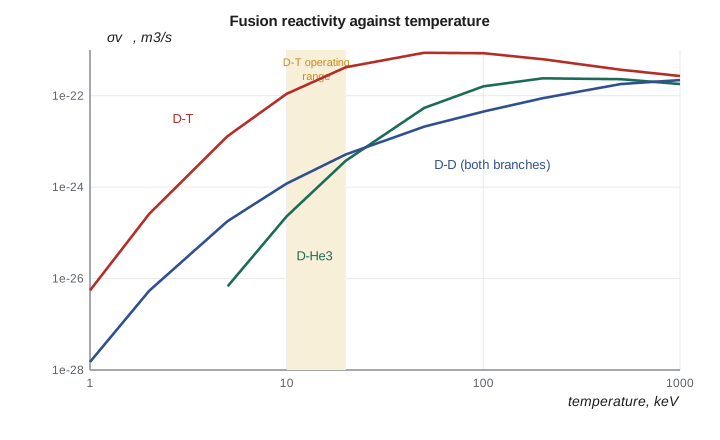
Plasma physicists quote temperature in kiloelectronvolts, where \(1\ \text{keV}\) corresponds to about 11.6 million kelvin. The D-T reactivity rises steeply up to about 10 keV and peaks near 70 keV. In practice, magnetically confined D-T plasmas aim for 10 to 20 keV, where the reactivity divided by temperature squared, which sets the fusion power at fixed plasma pressure, is greatest. That is the 15 keV, about 174 million kelvin, in the program output, roughly ten times hotter than the core of the Sun. The Sun makes up for its lower temperature with huge density and size.
Energy balance and the Lawson criterion
A fusion plasma loses energy by radiation and by heat conduction to its surroundings. To keep itself hot through alpha heating alone, a condition called ignition, the plasma must hold its energy long enough. In 1955 John Lawson expressed this as a requirement on the product of density and energy confinement time; the modern form uses the triple product of density, temperature and confinement time.
The program's example uses a density of \(10^{20}\ \text{m}^{-3}\), a temperature of 15 keV and a confinement time of 3 seconds, which just exceeds the target. Those numbers show the challenge. The density is about a millionth of air's at sea level, so the plasma pressure is a few atmospheres; holding it at 174 million kelvin for seconds requires magnetic fields strong enough to keep the charged particles from touching any wall.
Fusion performance is also described by the gain \(Q_{\text{fus}}\), the ratio of fusion power to external heating power. This is not the reaction Q-value: \(Q_{\text{fus}} = 1\) is breakeven, \(Q_{\text{fus}} = 5\) means alpha heating equals external heating, and ignition corresponds to infinite gain. A power plant needs \(Q_{\text{fus}}\) well above 10 to cover the energy used by its magnets, heating systems and cooling.
Confinement approaches
Two main approaches pursue these conditions. Magnetic confinement holds a low-density plasma for seconds or longer in a magnetic field. The leading design is the tokamak, a torus in which a strong toroidal field from external coils combines with a field from current in the plasma to form nested magnetic surfaces. The international ITER project in southern France is a large tokamak designed to reach \(Q_{\text{fus}} = 10\). Stellarators shape the field with twisted external coils instead of relying on plasma current. Several private companies are building compact tokamaks using high-temperature superconducting magnets, which allow stronger fields in smaller machines.
Inertial confinement compresses a tiny fuel capsule to enormous density for a fraction of a nanosecond, using lasers or other drivers, so that fusion occurs before the fuel flies apart. In December 2022, the National Ignition Facility in California produced more fusion energy from a capsule than the laser energy delivered to it, the first laboratory experiment to do so, although the lasers themselves drew far more electricity from the grid.
| Approach | Density (m⁻³) | Confinement time | Examples |
|---|---|---|---|
| Magnetic (tokamak, stellarator) | about 10²⁰ | seconds | ITER, JET (closed 2023), Wendelstein 7-X |
| Inertial (laser) | about 10³¹ | about 10⁻¹⁰ s | National Ignition Facility |
| Sun (gravitational) | about 10³² | millions of years | proton-proton chain |
Fuel cycle and radiation
Deuterium is abundant: about one hydrogen atom in 6700 in ordinary water is deuterium, and heavy water production for CANDU reactors in Ontario has shown it can be extracted economically. Tritium, with a half-life of 12.3 years, is almost absent in nature. A D-T power plant must breed its own tritium by surrounding the plasma with a blanket containing lithium, using the \(^6\text{Li}(n,\alpha)\text{T}\) reaction from Lesson 4 and fast-neutron reactions in lithium-7. A tritium breeding ratio above about 1.05 is needed to cover losses and decay. Today's civilian tritium supply comes largely from CANDU reactors, where neutron capture in deuterium produces it in the heavy water moderator.
Fusion produces no long-lived fission products and no actinides, and a D-T plasma cannot run away: any disturbance cools or disperses it and stops the reaction within seconds. The radiation issues are different from fission. The 14.1 MeV neutrons activate the vacuum vessel and blanket, so materials are chosen for low activation, such as special steels, vanadium alloys and silicon carbide. They also displace atoms in the structure and produce helium inside metals through \((n,\alpha)\) reactions, which limits component life. Tritium itself is a low-energy beta emitter (18.6 keV, Lesson 2) that is hazardous mainly if taken into the body as tritiated water, so plants need careful tritium accounting and containment. These are the questions Meridian Nuclear Engineering would address in its bid.
Worked problem
Neutron wall loading
A fusion plant produces 500 MW of D-T fusion power in a plasma surrounded by a first wall of area 680 m². Find the neutron power per unit area of the wall.
Show solution
- Neutron fraction of D-T power: \(14.1/17.6 = 0.80\).
- Neutron power: \(0.80 \times 500 = 400\ \text{MW}\).
- Wall loading: \(400/680 = 0.59\ \text{MW/m}^2\).
Answer: These figures are close to ITER's. Commercial plants aim for 1 to 3 MW/m², which drives the need for materials that withstand intense 14 MeV neutron irradiation for years.
Common mistakes
MistakeThinking fusion needs temperatures above the Coulomb barrier.
InsteadTunneling and the Maxwellian tail let plasmas fuse at about 15 keV, well below the 0.4 MeV barrier.
MistakeConfusing the reaction Q-value with plasma gain Q_fus.
InsteadThe reaction Q is energy per reaction; Q_fus is fusion power over heating power.
MistakeAssuming fusion produces no radioactivity.
InsteadD-T neutrons activate structures, and tritium is radioactive, though there are no long-lived fission products.
MistakeExpecting the alpha particle to carry most of the D-T energy.
InsteadThe lighter neutron carries 80 percent.
MistakeAssuming tritium can be mined.
InsteadIt must be bred from lithium or produced in reactors.
Summary and key terms
- Fusing light nuclei releases energy because binding energy per nucleon rises steeply toward helium-4.
- D-T fusion releases 17.6 MeV, with 14.1 MeV in the neutron and 3.5 MeV in the alpha particle.
- Fusion occurs below the Coulomb barrier through tunneling, mostly in the Gamow peak of the Maxwellian distribution.
- D-T plasmas operate near 10 to 20 keV, about 100 to 200 million kelvin.
- Ignition requires a triple product nTτ_E of about 3 × 10²¹ keV s/m³.
- Tritium must be bred from lithium; 14 MeV neutrons drive materials and activation challenges.
- Fusion
- Joining of light nuclei into heavier ones, releasing energy.
- Coulomb barrier
- The electrostatic repulsion that nuclei must overcome or tunnel through to fuse.
- Gamow peak
- The narrow energy window where most fusion reactions in a plasma occur.
- Reactivity ⟨σv⟩
- Cross section times relative speed averaged over the particle distribution.
- Triple product
- Density times temperature times energy confinement time.
- Ignition
- A plasma state in which alpha heating alone sustains the temperature.
- Tokamak
- A toroidal magnetic confinement device using external coils and plasma current.
- Tritium breeding ratio
- Tritium atoms produced per tritium atom burned.
Practice problems
Work each problem on paper first, then reveal the answer to check.
Why does the neutron get 80 percent of the D-T energy?
Show answer
Momentum conservation splits the energy in inverse proportion to mass; the neutron has one-fifth of the mass.
Convert 10 keV to kelvin.
Show answer
About 116 million K.
Why is D-He3 harder to ignite than D-T?
Show answer
Its Coulomb barrier is twice as high (Z₁Z₂ = 2), so it needs much hotter plasma.
A plasma has n = 2 × 10²⁰ m⁻³ and T = 12 keV. What confinement time meets 3 × 10²¹ keV s/m³?
Show answer
τ = 3 × 10²¹/(2 × 10²⁰ × 12) = 1.25 s.
How is tritium bred in a fusion blanket?
Show answer
Neutrons react with lithium, mainly ⁶Li(n,α)T.
From the program, what is the D-D (neutron branch) Q-value?
Show answer
3.27 MeV.
Lesson quiz · 5 questions
Score 60% or more to complete this lesson.
Create a free account to save your progress, take quizzes and earn a certificate.