
NUC-220 · Lesson 6 of 12 · 24 min
Neutron interactions
Lina Morales from radiation protection joins the sixth session with a question from the field. A survey of the Clinch River construction laydown area found nothing unusual, but she wants to know how neutrons from the future reactor will behave in the concrete, steel and water around the core, and why neutron shielding looks so different from gamma shielding. Paul answers that neutrons are unusual particles: they carry no charge, so they ignore electrons entirely and interact only with nuclei, and the type of nucleus matters far more than its density.
Why neutrons are different
Charged particles and photons lose energy mainly by interacting with atomic electrons, so the material's electron density sets how fast they stop. Neutrons have no charge and only a tiny magnetic moment, so they pass through electron clouds untouched. They interact only when they come within a few femtometers of a nucleus, through the strong nuclear force. Because nuclei occupy about one part in \(10^{12}\) of the volume of matter, neutrons travel centimeters between collisions even in dense solids.
Two consequences follow. Neutrons are highly penetrating, and their interactions depend on individual nuclides rather than bulk properties such as density or atomic number. Lead, an excellent gamma shield, is nearly useless for slowing neutrons, while water and polyethylene, which are poor gamma shields per centimeter, are excellent at slowing them. Neutron shields therefore combine light materials to slow neutrons, absorbers such as boron to capture them, and heavy materials to stop the gamma rays produced along the way.
The five main interactions
Neutron interactions fall into two families: scattering, in which a neutron comes out again, and absorption, in which it does not.
| Interaction | Notation | What happens | Where it matters |
|---|---|---|---|
| Elastic scattering | (n,n) | neutron bounces off; kinetic energy is shared but conserved | slowing down in moderators |
| Inelastic scattering | (n,n') | nucleus left excited; emits gamma rays | fast neutrons in steel and uranium-238 |
| Radiative capture | (n,γ) | neutron absorbed; gamma rays emitted | activation, breeding, poisons |
| Charged-particle emission | (n,p), (n,α) | neutron absorbed; proton or alpha emitted | detectors, boron control, nitrogen-16 |
| Fission | (n,f) | nucleus splits, releasing energy and neutrons | power production (Lesson 7) |
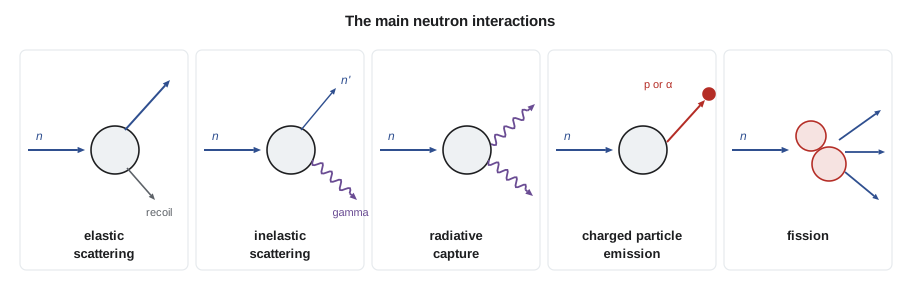
Elastic scattering
In elastic scattering, the neutron and nucleus behave like billiard balls: total kinetic energy and momentum are both conserved. In a head-on collision with a nucleus of mass number \(A\), the neutron loses the most energy, leaving with \(\alpha E\), where
For hydrogen, \(A = 1\), so \(\alpha = 0\): a neutron can lose all its energy in one collision, just as a cue ball stops dead when it hits another ball squarely. For carbon, \(\alpha = 0.716\), so the neutron keeps at least 72 percent of its energy; for uranium, \(\alpha = 0.983\), so it barely slows. For scattering that is isotropic in the center-of-mass frame, which is a good approximation for neutrons below about 1 MeV on light nuclei, the energy after a collision is uniformly distributed between \(\alpha E\) and \(E\), and the average energy after collision is \((1+\alpha)E/2\).
# Neutron interactions: elastic-scattering kinematics and reaction branching.
import math

def alpha(A):
    """Smallest fraction of its energy a neutron keeps after one elastic collision."""
    return ((A - 1) / (A + 1)) ** 2

print(f"{'target':10s} {'A':>4s} {'alpha':>7s} {'max loss':>9s} {'avg E after (from 2 MeV)':>26s}")
for name, A in (('hydrogen', 1), ('deuterium', 2), ('carbon', 12), ('oxygen', 16), ('iron', 56), ('uranium', 238)):
    a = alpha(A)
    avg = 2.0 * (1 + a) / 2          # isotropic in the center-of-mass frame: mean of E and alpha*E
    print(f"{name:10s} {A:4d} {a:7.4f} {1 - a:9.1%} {avg:21.3f} MeV")

# Which reaction happens? Branching fractions at thermal energy (approximate cross sections, barns)
for name, sig_s, sig_g in (('H-1', 20.5, 0.332), ('C-12', 4.75, 0.0035), ('Fe-56', 12.4, 2.59), ('U-238', 9.3, 2.68)):
    tot = sig_s + sig_g
    print(f"{name:6s}: scatter {sig_s / tot:6.1%}, capture {sig_g / tot:6.1%} of thermal collisions")

# Neutron speed from kinetic energy (non-relativistic)
mn = 1.674927e-27; eV = 1.602177e-19
for E in (0.0253, 1.0, 1e3, 2e6):
    v = math.sqrt(2 * E * eV / mn)
print(f"E = {E:>10.4g} eV speed {v:12,.0f} m/s")target A alpha max loss avg E after (from 2 MeV) hydrogen 1 0.0000 100.0% 1.000 MeV deuterium 2 0.1111 88.9% 1.111 MeV carbon 12 0.7160 28.4% 1.716 MeV oxygen 16 0.7785 22.1% 1.779 MeV iron 56 0.9311 6.9% 1.931 MeV uranium 238 0.9833 1.7% 1.983 MeV H-1 : scatter 98.4%, capture 1.6% of thermal collisions C-12 : scatter 99.9%, capture 0.1% of thermal collisions Fe-56 : scatter 82.7%, capture 17.3% of thermal collisions U-238 : scatter 77.6%, capture 22.4% of thermal collisions E = 0.0253 eV speed 2,200 m/s E = 1 eV speed 13,832 m/s E = 1000 eV speed 437,393 m/s E = 2e+06 eV speed 19,560,831 m/s
The first table in the output is the core of moderator design. Light nuclei take large bites out of the neutron's energy, heavy nuclei take tiny ones. Lesson 11 turns this into the number of collisions needed to slow a fission neutron from 2 MeV to thermal energy, and shows why water, heavy water and graphite are the moderators of choice.
The second table shows something less obvious. Even hydrogen, whose thermal capture cross section is only 0.33 barns, captures a neutron in about 1.6 percent of thermal collisions. That is enough to make light water reactors need enriched fuel, while heavy water, whose deuterium captures far less, lets CANDU reactors, such as the existing units at Darlington and Pickering in Ontario, run on natural uranium. In iron and uranium-238, capture competes strongly with scattering, so thermal neutrons that wander into steel structures or fuel are likely to be absorbed.
Worked problem
Energy after one collision with deuterium
A 1 MeV neutron scatters elastically from deuterium. Find the minimum and average energies after the collision.
Show solution
- \(\alpha = \big((2-1)/(2+1)\big)^2 = 1/9 = 0.111\).
- Minimum energy: \(\alpha E = 0.111\ \text{MeV}\).
- Average energy: \((1 + 0.111)/2 \times 1 = 0.556\ \text{MeV}\).
Answer: A head-on collision with deuterium takes away 89 percent of the energy. Deuterium is a less efficient moderator than hydrogen per collision, but it captures so few neutrons that it gives the best overall moderating ratio (Lesson 11).
Inelastic scattering
If the neutron has enough energy, it can leave the target nucleus in an excited state. The neutron emerges with less kinetic energy than elastic scattering would leave, and the nucleus then emits one or more gamma rays. The threshold is slightly above the energy of the first excited level: about 45 keV for uranium-238, 0.85 MeV for iron-56, 4.4 MeV for carbon-12 and over 6 MeV for oxygen-16.
Inelastic scattering matters for fast neutrons in heavy materials. In a reactor core, fission neutrons with energies of a few MeV lose energy rapidly through inelastic collisions with uranium-238 before elastic scattering in the moderator takes over. In shields, steel and iron take fast neutrons below the inelastic thresholds quickly, which is why many shield designs place steel near the source and hydrogenous material farther out. The gamma rays produced by inelastic scattering, together with capture gammas, are a major source of secondary radiation that shields must stop.
Radiative capture
In radiative capture, the neutron is absorbed and the compound nucleus releases its excitation, about 5 to 8 MeV for most nuclei, as one or more gamma rays. Capture cross sections are largest for slow neutrons, following the one-over-v law at low energies and showing resonances higher up (Lesson 5).
Capture appears throughout reactor engineering. It breeds new fuel: uranium-238 captures a neutron to become uranium-239, which beta decays through neptunium-239 to plutonium-239, so a third or more of the energy late in a fuel cycle comes from fissioning plutonium made in the reactor. It poisons the reactor: xenon-135 and samarium-149 capture neutrons that would otherwise cause fission. It activates materials (Lesson 4). And it produces high-energy capture gamma rays that dominate the dose outside thick concrete shields; hydrogen's 2.22 MeV capture gamma ray and iron's 7.6 MeV gamma rays are the ones shield designers watch.
Charged-particle reactions
Some light nuclei absorb neutrons and emit a proton or alpha particle instead of a gamma ray. Lesson 4 covered boron-10, lithium-6 and helium-3 for slow neutrons, and the fast-neutron reactions that produce nitrogen-16 from oxygen-16. Boron-10's huge thermal cross section, 3840 barns, makes it the standard neutron absorber: boric acid dissolved in the coolant controls reactivity in pressurized water reactors, boron carbide fills control blades in boiling water reactors such as the BWRX-300 planned at Clinch River, and borated concrete and polyethylene line neutron shields. Because the products are charged particles that stop within micrometers, boron absorbers produce very little penetrating secondary radiation, a major advantage over cadmium, whose capture releases high-energy gamma rays.
Fission as an interaction
Fission is an absorption reaction in which the compound nucleus splits. For neutron cross-section bookkeeping, it is one more partial cross section: \(\sigma_a = \sigma_\gamma + \sigma_f\) for a fissile nuclide. The ratio \(\sigma_\gamma/\sigma_f\), written \(\alpha\) in reactor physics (a different alpha from the scattering parameter), tells how many absorptions are wasted on capture. For uranium-235 at thermal energies it is about 0.17, so about 85 percent of absorptions cause fission. Lesson 7 takes up the physics of the split itself.
Neutron energy ranges
Engineers sort neutrons by kinetic energy, because each range behaves differently. The boundaries are conventions rather than sharp physics, and different texts draw them differently, but the following are typical.
| Name | Energy range | Typical behavior |
|---|---|---|
| Cold | below about 0.005 eV | research beams for materials science |
| Thermal | about 0.025 eV (up to about 0.5 eV) | in equilibrium with the moderator; largest fission and capture cross sections |
| Epithermal | about 0.5 eV to 1 keV | resonance region of heavy nuclei |
| Intermediate | 1 keV to 0.1 MeV | unresolved resonances; slowing down continues |
| Fast | above about 0.1 MeV | born in fission at about 2 MeV on average; inelastic scattering, threshold reactions |
The program's speed table shows the scale. A thermal neutron at 0.0253 eV moves at 2200 m/s, about the speed of a rifle bullet. A 2 MeV fission neutron moves at nearly 20 000 km/s, about 7 percent of the speed of light. Slowing a neutron from fission energy to thermal energy reduces its speed by a factor of nearly 10 000 and its energy by a factor of about 80 million.
Thermal neutrons and the moderator
Once neutrons have slowed to energies comparable with the thermal motion of the moderator atoms, they can gain as well as lose energy in collisions. They come into rough equilibrium with the moderator, and their energies follow approximately a Maxwell-Boltzmann distribution characteristic of the moderator temperature. The most probable energy is \(kT\), which is 0.0253 eV at 20 °C. In a hot reactor moderator at about 300 °C, the distribution is shifted to higher energies, about 0.05 eV, and absorption by neutrons that do not follow 1/v exactly must be averaged over the distribution. Reactor physics codes handle this with temperature-dependent scattering laws for bound hydrogen in water and for carbon in graphite.
Neutron sources
Away from reactors, neutrons come from a handful of sources used in industry and research. Radioisotope sources mix an alpha emitter with beryllium, whose \((\alpha,n)\) reaction releases neutrons; americium-beryllium sources are used in moisture gauges and well logging. Californium-252 fissions spontaneously, producing about \(2.3 \times 10^{12}\) neutrons per second per gram, and serves as a compact source for startup and calibration. Accelerator generators fuse deuterium with tritium to give 14.1 MeV neutrons. Spallation sources fire high-energy protons at heavy targets to produce intense neutron beams for science. For reactor startup, the the Tennessee Valley Authority's Clinch River project design includes a neutron source and the boron-lined detectors discussed in Lesson 4, so that operators can see the neutron population rising long before the reactor produces measurable power.
Worked problem
Count rate in a boron-lined detector
A detector contains boron-10 with \(N = 2.0 \times 10^{19}\) atoms in its sensitive lining. It sits in a thermal flux of \(1.0 \times 10^{4}\ \text{n/cm}^2\text{s}\) during startup. Estimate its count rate if every reaction is counted.
Show solution
- \(R = N\sigma\phi\) for the whole lining, since \(N\) is the total number of atoms.
- \(R = 2.0 \times 10^{19} \times 3840 \times 10^{-24} \times 1.0 \times 10^{4}\).
- \(R = 768\ \text{counts per second}\).
Answer: Real detectors count fewer because some reaction products stop in the lining before reaching the gas, but a few hundred counts per second in a weak startup flux shows why boron detectors are sensitive enough for the source range.
Common mistakes
MistakeAssuming dense materials such as lead are good neutron shields.
InsteadNeutron interactions depend on nuclides; light nuclei slow neutrons and absorbers such as boron capture them.
MistakeThinking a neutron can lose all its energy in one collision with any nucleus.
InsteadOnly hydrogen allows that; heavier nuclei leave at least αE.
MistakeConfusing the scattering parameter α with the capture-to-fission ratio α.
InsteadThey share a symbol; check the context.
MistakeForgetting the gamma rays produced by inelastic scattering and capture.
InsteadShields must also stop these secondary gamma rays.
MistakeTreating thermal neutrons as all having 0.0253 eV.
InsteadThey follow a distribution set by the moderator temperature.
Summary and key terms
- Neutrons interact only with nuclei, so they penetrate far and depend on nuclides rather than density.
- The main interactions are elastic and inelastic scattering, capture, charged-particle emission and fission.
- In elastic scattering the energy after collision lies between αE and E, with α = ((A − 1)/(A + 1))².
- Inelastic scattering slows fast neutrons in heavy nuclei and produces gamma rays.
- Capture breeds plutonium-239, poisons the core, activates materials and produces capture gamma rays.
- Thermal neutrons are in rough equilibrium with the moderator; at 20 °C the most probable energy is 0.0253 eV and the speed 2200 m/s.
- Elastic scattering
- A collision that conserves kinetic energy.
- Inelastic scattering
- A collision that leaves the nucleus excited, followed by gamma emission.
- Scattering parameter α
- ((A − 1)/(A + 1))², the minimum fraction of energy kept after elastic scattering.
- Radiative capture
- Absorption of a neutron followed by gamma emission.
- Fertile nuclide
- A nuclide such as uranium-238 that becomes fissile after neutron capture and decay.
- Thermal neutron
- A neutron in rough thermal equilibrium with its surroundings.
- Fast neutron
- A neutron above about 0.1 MeV, such as one just born in fission.
- Neutron source
- A device or material that emits neutrons, such as americium-beryllium or californium-252.
Practice problems
Work each problem on paper first, then reveal the answer to check.
Find α for oxygen-16 and the minimum energy after a 1 MeV elastic collision.
Show answer
α = (15/17)² = 0.778; minimum 0.778 MeV.
Why do shields often put steel close to a fast neutron source?
Show answer
Inelastic scattering in iron quickly lowers fast neutron energies before hydrogenous layers finish the job.
Write the chain that makes plutonium-239 in fuel.
Show answer
U-238 (n,γ) U-239 → Np-239 → Pu-239 by two beta decays.
Why are boron absorbers preferred over cadmium in many shields?
Show answer
Boron's products are short-range charged particles; cadmium capture releases penetrating gamma rays.
Using the program, what fraction of thermal collisions with iron-56 end in capture?
Show answer
About 17 percent.
What is the speed of a 1 eV neutron?
Show answer
About 13 800 m/s.
Lesson quiz · 5 questions
Score 60% or more to complete this lesson.
Create a free account to save your progress, take quizzes and earn a certificate.