
NUC-220 · Lesson 1 of 12 · 25 min
Nuclear structure and binding energy
Six months after the public information sessions, Hana Okoye has moved from outreach to the physics group at Meridian Nuclear Engineering in Knoxville. The group checks shielding, activation and dose calculations for the Tennessee Valley Authority's Clinch River project, and every new engineer spends a term in Dr. Paul Brennan's in-house course before signing off on any of them. Paul opens the first session with a deceptively simple question: why do some nuclei hold together for billions of years while others fall apart in a fraction of a second? Answering it properly takes the whole of this course, but it starts with what a nucleus is made of and how tightly it is bound.
The nucleus and its constituents
A nucleus contains \(Z\) protons and \(N\) neutrons, together called nucleons, and its mass number is \(A = Z + N\). The atomic number \(Z\) fixes the element and its chemistry; the neutron number changes the isotope. Nuclides with the same \(Z\) are isotopes, those with the same \(N\) are isotones, and those with the same \(A\) are isobars. Nuclear engineers write a nuclide as \(^{A}_{Z}\text{X}\), for example \(^{235}_{92}\text{U}\), although the \(Z\) subscript is often dropped because the chemical symbol already implies it.
Nuclei are tiny. Their radius follows, to a good approximation, \(R = r_0 A^{1/3}\) with \(r_0 \approx 1.2\) femtometers (1 fm = \(10^{-15}\) m). Because the volume grows in proportion to \(A\), every nucleus has roughly the same density, about \(2 \times 10^{17}\ \text{kg/m}^3\). A teaspoon of nuclear matter would weigh hundreds of millions of metric tons. That near-constant density is the first clue that nuclear matter behaves like an incompressible liquid drop, a picture that leads directly to the mass formula later in this lesson.
Protons repel each other electrically, so something stronger must hold the nucleus together. That something is the strong nuclear force, acting between all nucleons regardless of charge. It is very strong at distances of about 1 fm but falls off sharply beyond 2 to 3 fm, so each nucleon feels only its nearest neighbors. The electric repulsion, by contrast, is weaker at short range but reaches across the whole nucleus. The competition between a short-range attraction and a long-range repulsion explains most of the systematic features of nuclear stability.
Mass units and mass-energy equivalence
Nuclear masses are measured in atomic mass units, defined so that one neutral carbon-12 atom has a mass of exactly 12 u. One atomic mass unit is \(1.660539 \times 10^{-27}\) kg, and by Einstein's relation \(E = mc^2\) it is equivalent to 931.494 MeV of energy. Engineers almost always work with atomic masses, which include the electrons, rather than bare nuclear masses, because tables list atomic masses and the electron masses cancel in most reaction balances. Lesson 2 shows the one common case, beta-plus decay, where they do not.
| Particle | Mass (u) | Rest energy (MeV) | Charge |
|---|---|---|---|
| Proton | 1.007276 | 938.272 | +1 |
| Neutron | 1.008665 | 939.565 | 0 |
| Electron | 0.000549 | 0.511 | −1 |
| Hydrogen-1 atom | 1.007825 | 938.783 | 0 |
Mass defect and binding energy
Weigh a helium-4 atom and you find 4.002603 u. Add up the masses of two hydrogen atoms and two neutrons and you get 4.032980 u. The assembled atom is lighter by 0.030377 u. This missing mass is the mass defect, and multiplied by 931.494 MeV per u it gives 28.30 MeV, the binding energy of helium-4. It is the energy you would have to supply to pull the nucleus apart into separate nucleons, and equally the energy released when those nucleons come together.
Binding energy grows with the number of nucleons, so the useful comparison is the binding energy per nucleon, \(B/A\). For the deuteron it is only 1.11 MeV, which is why deuterium is easy to break up. It rises steeply through the light nuclei, with bumps at helium-4, carbon-12 and oxygen-16, reaches a broad maximum of about 8.8 MeV near iron-56 and nickel-62, then declines slowly to about 7.6 MeV for uranium. That shape, the binding energy curve, is the single most important graph in nuclear engineering.
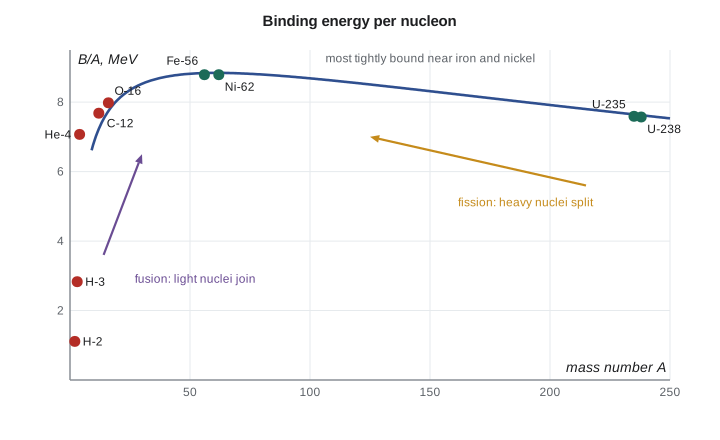
The curve explains where nuclear energy comes from. Split a uranium nucleus with \(B/A = 7.6\) MeV into two fragments near \(A = 95\) and \(A = 140\), where \(B/A\) is about 8.5 MeV, and the gain of about 0.9 MeV per nucleon over 235 nucleons gives roughly 200 MeV, the energy of one fission (Lesson 7). Join two light nuclei, such as deuterium and tritium, into helium-4 and the jump in \(B/A\) is even larger per nucleon, which is the basis of fusion (Lesson 8). Chemical reactions change electron binding energies of a few electronvolts; nuclear reactions change binding energies of millions of electronvolts. That factor of a million is why a small reactor core can run a city for years.
Worked problem
The binding energy of iron-56
The atomic mass of iron-56 is 55.934936 u. Find its binding energy and binding energy per nucleon.
Show solution
- Iron has \(Z = 26\) and \(N = 30\).
- Mass of the separate parts: \(26 \times 1.007825 + 30 \times 1.008665 = 26.20345 + 30.25995 = 56.46340\ \text{u}\).
- Mass defect: \(56.46340 - 55.934936 = 0.528464\ \text{u}\).
- Binding energy: \(0.528464 \times 931.494 = 492.3\ \text{MeV}\); per nucleon \(492.3/56 = 8.79\ \text{MeV}\).
Answer: Iron-56 is among the most tightly bound nuclei known. Neither splitting it nor adding to it releases energy, which is why iron accumulates at the end of a massive star's life.
The liquid-drop model and the mass formula
In 1935 Carl Friedrich von Weizsäcker and, independently, Hans Bethe wrote the binding energy as a sum of terms, each motivated by treating the nucleus as a charged liquid drop. The result, the semi-empirical mass formula, reproduces measured binding energies of medium and heavy nuclei to within about one percent using five fitted constants.
The volume term \(a_V A\) says each nucleon is bound by its neighbors with roughly the same energy, so binding grows with \(A\). The surface term subtracts binding for nucleons at the surface, which have fewer neighbors; its share is largest for light nuclei, which is why their \(B/A\) is low. The Coulomb term subtracts the electric repulsion of all pairs of protons; it grows as \(Z^2/A^{1/3}\) and is what makes heavy nuclei less tightly bound. The asymmetry term, a quantum effect from the Pauli principle, penalizes an imbalance between neutrons and protons. The pairing term \(\delta\) adds a little binding when both \(Z\) and \(N\) are even and subtracts it when both are odd, because nucleons pair up like electrons in orbitals.
| Term | Typical coefficient (MeV) | Physical origin | Effect |
|---|---|---|---|
| Volume | 15.75 | short-range strong force between neighbors | binding grows with A |
| Surface | 17.8 | fewer neighbors at the surface | reduces B most for light nuclei |
| Coulomb | 0.711 | electric repulsion between protons | reduces B most for heavy nuclei |
| Asymmetry | 23.7 | Pauli principle for two kinds of fermion | favors N close to Z |
| Pairing | 11.18 / √A | nucleons pair with opposite spins | even-even nuclei bound more strongly |
# Semi-empirical (liquid-drop) mass formula: binding energy of nuclei.
# Coefficients in MeV (one common fit; values differ slightly between textbooks).
aV, aS, aC, aA, aP = 15.75, 17.8, 0.711, 23.7, 11.18

def binding_energy(Z, A):
    N = A - Z
    B = aV * A - aS * A ** (2 / 3) - aC * Z * (Z - 1) / A ** (1 / 3) - aA * (N - Z) ** 2 / A
    if Z % 2 == 0 and N % 2 == 0:
        B += aP / A ** 0.5          # even-even: extra binding
    elif Z % 2 == 1 and N % 2 == 1:
        B -= aP / A ** 0.5          # odd-odd: less binding
    return B

# Measured values (approximate, from mass tables) for comparison
measured = {('He-4', 2, 4): 28.30, ('O-16', 8, 16): 127.62, ('Fe-56', 26, 56): 492.26,
            ('Zr-94', 40, 94): 814.68, ('U-235', 92, 235): 1783.87, ('U-238', 92, 238): 1801.69}
print(f"{'nuclide':8s} {'SEMF B':>9s} {'measured':>9s} {'B/A':>6s} {'error':>7s}")
for (name, Z, A), m in measured.items():
    b = binding_energy(Z, A)
    print(f"{name:8s} {b:9.1f} {m:9.1f} {m / A:6.2f} {100 * (b - m) / m:6.1f}%")

# Most stable Z for a given A (from minimizing the liquid-drop mass)
def z_stable(A):
    return A / (1.98 + 0.0155 * A ** (2 / 3))
for A in (40, 100, 150, 208, 238):
print(f"A = {A:3d}: most stable Z about {z_stable(A):5.1f}")nuclide SEMF B measured B/A error He-4 22.8 28.3 7.08 -19.3% O-16 126.0 127.6 7.98 -1.3% Fe-56 495.4 492.3 8.79 0.6% Zr-94 820.3 814.7 8.67 0.7% U-235 1796.5 1783.9 7.59 0.7% U-238 1814.7 1801.7 7.57 0.7% A = 40: most stable Z about 18.5 A = 100: most stable Z about 43.2 A = 150: most stable Z about 62.0 A = 208: most stable Z about 82.4 A = 238: most stable Z about 92.4
The program shows the formula working well from oxygen to uranium, within about one percent, and failing badly for helium-4, which is far more tightly bound than a liquid drop predicts. That failure is a reminder that the liquid drop is a model, not a description of the real nucleus. Light nuclei and nuclei near certain proton and neutron numbers show strong shell effects that the formula cannot capture.
The valley of stability
Plot every known nuclide on a chart with \(N\) across and \(Z\) up, and the roughly 250 stable ones form a narrow band. For light nuclei the band follows \(N = Z\); for heavier ones it bends toward more neutrons, reaching \(N/Z \approx 1.5\) at lead-208 and uranium-238. The mass formula explains the bend. Adding protons costs Coulomb energy that grows faster than the asymmetry penalty for extra neutrons, so heavy nuclei can lower their energy by carrying a neutron excess. Setting the derivative of the mass with respect to \(Z\) to zero at fixed \(A\) gives the most stable charge.
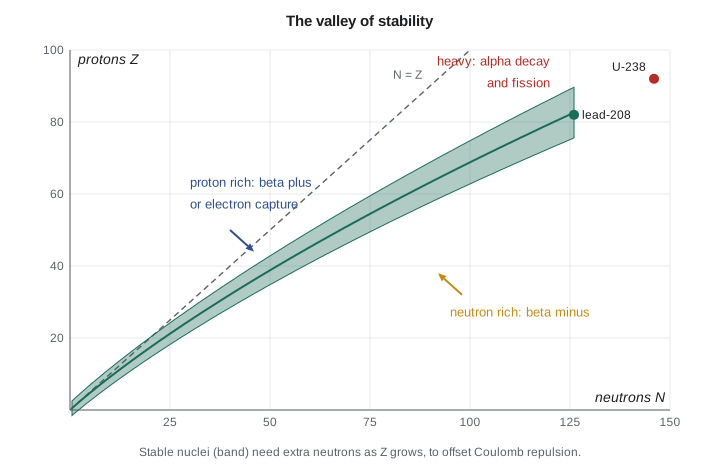
Nuclides on the neutron-rich side of the valley decay by beta-minus emission, which turns a neutron into a proton and moves them toward the valley. Those on the proton-rich side decay by beta-plus emission or electron capture. Above about \(Z = 83\), no nuclide is stable at all: the Coulomb energy is so large that the nucleus can lower its energy by shedding an alpha particle or, for the heaviest, by splitting. Fission products are born far down the neutron-rich side, which is why they are intensely beta radioactive (Lesson 7), and fusion fuels sit at the very bottom-left corner of the chart.
Magic numbers and the shell model
Some nuclides are noticeably more stable than their neighbors. They have 2, 8, 20, 28, 50, 82 or 126 protons or neutrons, the so-called magic numbers. Helium-4, oxygen-16, calcium-40 and lead-208 are doubly magic. Tin, with 50 protons, has ten stable isotopes, the most of any element. Maria Goeppert Mayer and Hans Jensen explained the pattern in 1949 by treating nucleons as moving in shells, much like electrons in atoms, once a strong spin-orbit interaction is included. Filled shells bind tightly, and the next nucleon added sits much higher in energy.
Shell structure matters to engineers in practical ways. Fission fragments cluster near the magic numbers 50 and 82, which shapes the double-humped fission yield curve in Lesson 7. Nuclei with magic neutron numbers tend to have small neutron capture cross sections, which is one reason zirconium (with isotopes near \(N = 50\)) makes such good fuel cladding. And the shell model predicts the spins and excited states that determine which gamma rays a decaying nuclide emits, information that radiation protection staff use every day to identify sources.
Separation energies and nuclear stability
Another useful quantity is the neutron separation energy \(S_n\), the energy needed to remove one neutron. It equals the difference in binding energy between a nucleus and the one with a neutron fewer. When a nucleus captures a slow neutron, it gains energy \(S_n\) as excitation, typically 5 to 8 MeV. For uranium-235 capturing a neutron to form uranium-236, that excitation, about 6.5 MeV, exceeds the energy barrier to fission, so even a slow neutron causes fission. For uranium-238, the excitation of uranium-239 is lower, because an even-even nucleus gains less from one added neutron, and it falls short of the barrier. The difference, rooted in the pairing term, is why uranium-235 is fissile and uranium-238 is not, a result Lesson 7 develops in detail.
Worked problem
Neutron separation energy of uranium-236
Atomic masses: uranium-235, 235.043930 u; uranium-236, 236.045568 u; neutron, 1.008665 u. Find the energy released when uranium-235 captures a neutron.
Show solution
- \(S_n = [M(^{235}\text{U}) + m_n - M(^{236}\text{U})]\,c^2\).
- \(= (235.043930 + 1.008665 - 236.045568) \times 931.494\).
- \(= 0.007027 \times 931.494 = 6.55\ \text{MeV}\).
Answer: The compound nucleus uranium-236 is born with about 6.5 MeV of excitation, more than the roughly 5.5 to 6 MeV fission barrier, so it splits even when the neutron brings almost no kinetic energy.
Why this matters at Clinch River
Paul closes the session by tying the physics to Meridian's work. Every number in a reactor shielding or decay heat calculation traces back to nuclear masses: the energy of a fission, the gamma rays a fission product emits, the heat of an activated steel bolt. The mass formula is too rough for design calculations, so the group uses evaluated nuclear data libraries, but the formula gives a quick check. When a code reports a binding energy, Q-value or decay energy that looks wrong, the first test is whether it falls where the binding energy curve says it should.
Common mistakes
MistakeTreating mass number and atomic mass as the same thing.
InsteadMass number is an integer count of nucleons; atomic mass is measured in u and is slightly different because of binding energy and electron masses.
MistakeSaying binding energy is energy stored inside the nucleus that is released when it breaks up.
InsteadBinding energy must be supplied to break a nucleus apart; energy is released when nuclei move to higher binding energy per nucleon.
MistakeComparing total binding energies to judge stability.
InsteadCompare binding energy per nucleon; uranium has a larger total B than iron but a lower B/A.
MistakeUsing nuclear masses with hydrogen masses in the same balance.
InsteadUse atomic masses throughout, including M(H-1) for protons, so electron masses cancel.
MistakeExpecting the mass formula to be exact.
InsteadIt is a smooth fit; it misses shell effects and is poor for light nuclei.
Summary and key terms
- A nucleus has Z protons and N neutrons; A = Z + N, and its radius is about 1.2 A^(1/3) fm.
- The strong force binds nucleons at short range; electric repulsion between protons acts across the whole nucleus.
- Binding energy B = [Z M(H) + N mₙ − M(atom)]c², with 931.494 MeV per u.
- B/A peaks near 8.8 MeV at iron and nickel, so fission of heavy and fusion of light nuclei both release energy.
- The semi-empirical mass formula has volume, surface, Coulomb, asymmetry and pairing terms.
- Stable nuclei lie in a valley that bends toward N > Z; magic numbers mark extra-stable shell closures.
- Nucleon
- A proton or neutron in a nucleus.
- Mass number
- The total number of nucleons, A = Z + N.
- Atomic mass unit
- One twelfth of the mass of a carbon-12 atom, equivalent to 931.494 MeV.
- Mass defect
- The difference between the mass of the separate nucleons and the mass of the nucleus or atom.
- Binding energy
- The energy needed to separate a nucleus into its nucleons.
- Valley of stability
- The band of stable nuclides on a chart of N against Z.
- Magic numbers
- Proton or neutron numbers 2, 8, 20, 28, 50, 82 and 126 that give extra stability.
- Neutron separation energy
- The energy needed to remove one neutron from a nucleus.
Practice problems
Work each problem on paper first, then reveal the answer to check.
Estimate the radius of a uranium-238 nucleus.
Show answer
R = 1.2 × 238^(1/3) = 1.2 × 6.20 = 7.4 fm.
The atomic mass of oxygen-16 is 15.994915 u. Find B/A.
Show answer
Parts: 8 × 1.007825 + 8 × 1.008665 = 16.13192 u; defect 0.137005 u; B = 127.6 MeV; B/A = 7.98 MeV.
Why is the binding energy per nucleon low for the lightest nuclei?
Show answer
A large fraction of their nucleons sit at the surface with fewer neighbors, so the surface term takes a big share.
Which term in the mass formula makes heavy nuclei less tightly bound per nucleon?
Show answer
The Coulomb term, which grows as Z²/A^(1/3).
Use the program's formula to find the most stable Z for A = 100.
Show answer
About 43, close to technetium, molybdenum and ruthenium isobars.
Roughly how much energy does fission of one uranium nucleus release, using B/A values?
Show answer
About (8.5 − 7.6) × 235 ≈ 210 MeV, close to the measured 200 MeV.
Lesson quiz · 5 questions
Score 60% or more to complete this lesson.
Create a free account to save your progress, take quizzes and earn a certificate.