
MSBA-321 · Lesson 9 of 12 · 20 min
Prepayments
▶ Video coming soon A video version of this lesson is on the way.
Prepayments flow in both directions at Cobalt Ridge. Some foundries ask for 30 percent up front before they pour custom castings, and the new Mexican distribution company would have to pay its first US-dollar suppliers in advance until it had a credit history. On the other side, large custom slurry pumps for mining projects are built to order, and Cobalt Ridge asks the customer for a deposit when the order is placed. In the old system, every prepayment was a manual journal to a suspense account, and matching them later to the real invoices was one of the most error-prone tasks at month end. The ninth session covered how Finance handles prepayments as part of the purchase and sales processes.
What makes a prepayment different
A prepayment is money paid or received before the invoice for the goods or services. It is not an expense or revenue yet; it is an asset (for a vendor prepayment, money Cobalt Ridge is owed in goods) or a liability (for a customer prepayment, goods Cobalt Ridge owes). The accounting goal is simple: hold the amount in a prepayment account until the invoice arrives, then apply it so the invoice is reduced and the prepayment account returns to zero. The process goal is equally simple: the prepayment must be linked to the order it belongs to, so that it is applied to the right invoice automatically rather than found by someone months later.
Vendor prepayments on purchase orders
Finance supports vendor prepayments as part of a purchase order. A prepayment is defined on the order header with either a fixed amount or a percentage of the order value, a prepayment category, and a limit for how much of the prepayment can be applied. From the order, the user creates a prepayment invoice, a vendor invoice for the prepayment amount that posts to the vendor and to the prepayment account from the vendor posting profile, rather than to inventory or expense. The prepayment invoice is then paid through the normal payment process from lesson 3.
When the real invoice for the goods is entered, the prepayment is applied to it. Finance can apply the prepayment automatically if the purchase order's prepayment is set to apply on invoice, or the user can apply it on the pending invoice with the apply prepayment action. Applying reverses the prepayment account and reduces the amount owed on the final invoice. If several invoices are received for the order, the prepayment can be applied in parts up to the remaining prepaid amount.
Worked problem
Applying a vendor prepayment
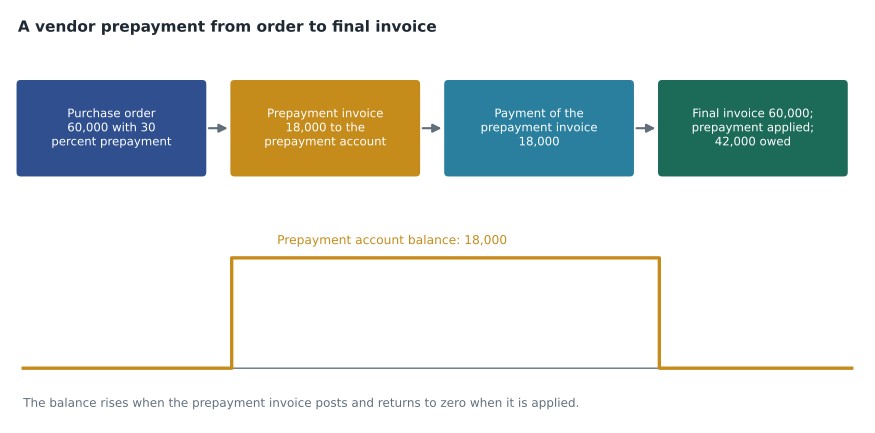
CRCA orders custom castings for 60,000 from a foundry that requires 30 percent prepayment. The foundry later invoices the full 60,000 after delivery. What does each step post, ignoring sales tax?
Show solution
- Prepayment invoice: 30 percent of 60,000 is 18,000. Debit 115100 Vendor prepayments 18,000; credit the vendor (trade payables) 18,000.
- Payment: debit the vendor 18,000; credit the bank 18,000. The vendor balance is zero, and the prepayment account holds 18,000.
- Final invoice: debit inventory 60,000; credit the vendor 60,000.
- Apply the prepayment: debit the vendor 18,000; credit 115100 18,000. The vendor is owed 42,000, and the prepayment account is zero.
Answer: The prepayment sits in 115100 until the final invoice, which then leaves 42,000 to pay the foundry.
Prepayment journal vouchers
Not every prepayment starts from a purchase order. A vendor might ask for a deposit before an order is finalized, or a payment might be made in an emergency. For those cases, a payment journal line can be marked as a prepayment, which posts the payment to the prepayment account from the posting profile instead of the vendor's summary account. Such a payment is called a prepayment journal voucher. It must later be settled against the invoice it relates to, and settlement moves the amount from the prepayment account back to the vendor. Cobalt Ridge allowed prepayment journal vouchers only with Thandeka's approval, because they are not linked to an order and are therefore easy to lose.
| Question | Prepayment on a purchase order | Prepayment journal voucher |
|---|---|---|
| Linked to an order? | Yes | No |
| How it is created | Prepayment invoice from the order | Payment line marked as prepayment |
| How it is applied | Automatically or with apply prepayment on the final invoice | Settled manually against the final invoice |
| Risk of being forgotten | Low | Higher; needs follow-up |
| Cobalt Ridge use | Standard for vendors that require prepayment | Exceptions only, with controller approval |
Sales tax on prepayments
Tax rules for prepayments vary by country. In some tax systems, tax is due when a deposit or prepayment is paid or received, not only when the invoice is issued. Finance supports this: posting profiles have an account for sales tax on prepayments, and prepayment invoices and prepayment journal vouchers can calculate tax when the tax rules require it. In the US, sales tax is generally due at the time of sale under each state's rules, and a deposit on a future sale is often not taxable until the sale occurs, but rules vary by state. Annelise recommended that CRUS's tax adviser confirm the treatment for customer deposits on mining orders before go-live. CRMX would follow Mexican VAT rules, where advance payments are generally taxable when received and require their own electronic invoice; the Mexican localization handles that.
Customer prepayments
On the sales side, Finance records customer prepayments as customer payments marked as prepayment, posted to the customer prepayment account from the customer posting profile (220500 in Cobalt Ridge's design). Many companies link the prepayment to the sales order so the sales team can see that the deposit has arrived, and some features let a sales order carry a prepayment requirement that must be met before the order can proceed. When the final sales invoice posts, the prepayment is settled against it, moving the amount from the prepayment liability to reduce the customer's receivable.
Ikenna and Annelise agreed on a process for mining deposits. The sales order for a custom pump records the deposit requirement, usually 20 percent. Credit management uses a terms of payment blocking rule so that orders with cash in advance terms are held until the deposit is paid. The customer payment is recorded as a prepayment and settled to the final invoice at shipment. A weekly report lists open customer prepayments by order, so that nothing sits in 220500 without a reason.
Worked problem
A customer deposit
A mining customer orders a custom slurry pump from CRUS for 400,000 with a 20 percent deposit. The pump ships four months later and is invoiced in full. What are the balances after each step, ignoring sales tax?
Show solution
- Deposit received: 20 percent of 400,000 is 80,000. Debit the bank 80,000; credit 220500 Customer prepayments 80,000.
- Credit management releases the order from the cash in advance hold once the deposit is recorded.
- Invoice at shipment: debit the customer 400,000; credit revenue 400,000.
- Settle the prepayment: debit 220500 80,000; credit the customer 80,000. The customer owes 320,000, and 220500 is zero for this order.
Answer: The deposit is a liability until the invoice; after settlement the customer owes 320,000.
Prepayments and the month-end close
Open prepayments must be reviewed at every month end. For vendor prepayments, the question is whether the goods have arrived but the invoice has not, in which case the accrual and the prepayment must both be considered. For customer prepayments, the question is whether the goods have shipped but the invoice has not been posted, which would leave revenue understated. Thandeka added both checks to the close checklist, with a list of open prepayments by order from each subledger.
Foreign currency prepayments add one more consideration. A prepayment paid in euros is recorded at the rate on the payment date. When it is applied to the final invoice, the invoice may be at a different rate, and settlement posts the difference as a realized exchange gain or loss. Whether open prepayments are revalued at month end depends on the company's accounting policy, because some accounting frameworks treat prepayments as non-monetary items that are not revalued; Finance's foreign currency revaluation can include or exclude them by account. Thandeka chose to exclude the prepayment accounts from revaluation, following Cobalt Ridge's accounting policy.
CRMX: prepaying new suppliers
CRMX would start trading in January 2027 with no credit history, so its first suppliers, including a US-dollar component maker, wanted payment in advance. Annelise set up CRMX with the same posting profile structure as the other companies, but with prepayment percentages on the vendor records of those suppliers, so that every purchase order would propose the prepayment automatically. The CRMX controller, approving every payment journal under the canon segregation of duties mitigation, would see prepayment invoices clearly labeled in the payment proposal.
Common reports
Three reports kept prepayments under control in the test cycles: open vendor prepayments by purchase order, open customer prepayments by sales order, and the balance of the two prepayment accounts reconciled to those lists. Because both prepayment accounts were set to Do not allow manual entry, the account balance should always equal the open prepayment transactions. Any difference would mean a manual posting had slipped through, which the account settings were designed to prevent.
Prepayments in purchasing and sales workflows
Prepayments also affect approvals. A prepayment invoice is still a vendor invoice, so it goes through the vendor invoice workflow; Cobalt Ridge added a condition so that prepayment invoices always go to the controller, whatever their amount, because paying before goods arrive carries more risk than paying after. On the sales side, credit management's terms of payment rule holds orders with cash in advance terms until the deposit is recorded, and the release reason for those holds is Deposit received, so the hold history shows that the deposit, not an override, released the order.
| Prepayment control | Vendor side | Customer side |
|---|---|---|
| Approval | Prepayment invoices always routed to the controller | Deposit requirement set on the sales order |
| Link to the order | Prepayment defined on the purchase order | Payment marked as prepayment for the order |
| Release or application | Applied to the final invoice | Order released from hold when the deposit is recorded |
| Monitoring | Weekly open vendor prepayments report | Weekly open customer prepayments report |
Refunding or canceling a prepayment
Sometimes an order is canceled after a prepayment. For a vendor prepayment, the vendor either refunds the money or issues a credit note; the refund is recorded as a vendor payment in reverse (money received from the vendor) and settled against the prepayment, or the prepayment invoice is credited. For a customer deposit, Cobalt Ridge refunds the customer with a vendor-style payment to the customer, settled against the prepayment, unless the contract allows the deposit to be kept for costs already incurred, in which case a free text invoice for the cancellation charge is settled against part of the deposit. Ikenna insisted that every cancellation be documented with the contract clause, because deposits are among the first things auditors and customers question.
Prepayments and purchasing agreements
Some prepayments are tied to longer commitments rather than single orders. A foundry might ask for an advance against a year-long purchase agreement for castings. In that case, the prepayment can be recorded on the first release order under the agreement, or as a prepayment journal voucher referenced to the agreement number, and applied gradually as invoices arrive. Cobalt Ridge chose the first approach where possible, because a prepayment on an order is applied automatically, and kept a register of agreement-level advances for the few cases where the second approach was unavoidable. The register listed the agreement, the advance, the amount applied so far and the remaining balance, and was reconciled to the vendor prepayment account each quarter.
Common mistakes
MistakeRecording prepayments as manual journals to a suspense account.
InsteadUse prepayment invoices on purchase orders, or payments marked as prepayment, so they post to the prepayment account and can be applied.
MistakeForgetting to apply a prepayment when the final invoice arrives.
InsteadSet the order to apply the prepayment on invoice, and review open prepayments at month end.
MistakeAssuming prepayments are never taxed.
InsteadCheck each country's tax rules for deposits and configure tax on prepayments where required.
MistakeRevaluing prepayments without checking the accounting policy.
InsteadInclude or exclude prepayment accounts from revaluation according to policy.
Summary and key terms
- Prepayments are held in prepayment accounts until the final invoice and then applied or settled.
- Vendor prepayments on purchase orders use prepayment invoices and are applied to the final invoice.
- Prepayment journal vouchers are payments marked as prepayment, not linked to an order, and need follow-up.
- Customer prepayments post to a liability account and are settled against the final sales invoice.
- Tax on prepayments and revaluation of foreign currency prepayments depend on country rules and accounting policy.
- Prepayment
- A payment made or received before the invoice for goods or services.
- Prepayment invoice
- A vendor invoice for a prepayment, created from a purchase order and posted to the prepayment account.
- Prepayment account
- The account that holds prepayments until they are applied, taken from the posting profile.
- Apply prepayment
- The action that offsets a prepayment against a final invoice.
- Prepayment journal voucher
- A payment journal line marked as a prepayment, not linked to an order.
- Customer prepayment
- A deposit received from a customer and held as a liability until invoicing.
Practice problems
Work each problem on paper first, then reveal the answer to check.
Where does a prepayment invoice post the debit side?
Show answer
To the vendor prepayment account from the vendor posting profile.
Why are prepayment journal vouchers riskier than prepayments on purchase orders?
Show answer
They are not linked to an order, so they must be found and settled manually.
After a 50,000 deposit on a 250,000 order is settled to the invoice, how much does the customer owe?
Show answer
200,000.
Lesson quiz · 5 questions
Score 60% or more to complete this lesson.
Create a free account to save your progress, take quizzes and earn a certificate.