
MSBA-321 · Lesson 4 of 12 · 18 min
Customer setup
▶ Video coming soon A video version of this lesson is on the way.
Ikenna took the lead for the receivables sessions. He manages credit and collections for all three companies, working from the CRUS office, and he arrived with a list of what had gone wrong in the old system: customers created by sales staff with no credit check, the same municipal water utility set up four times under slightly different names, payment terms typed differently on almost every account, and a credit limit field that nobody trusted because it was never enforced. About 1,800 customers would migrate. The fourth session was about making each of them a clean, complete customer record in Finance.
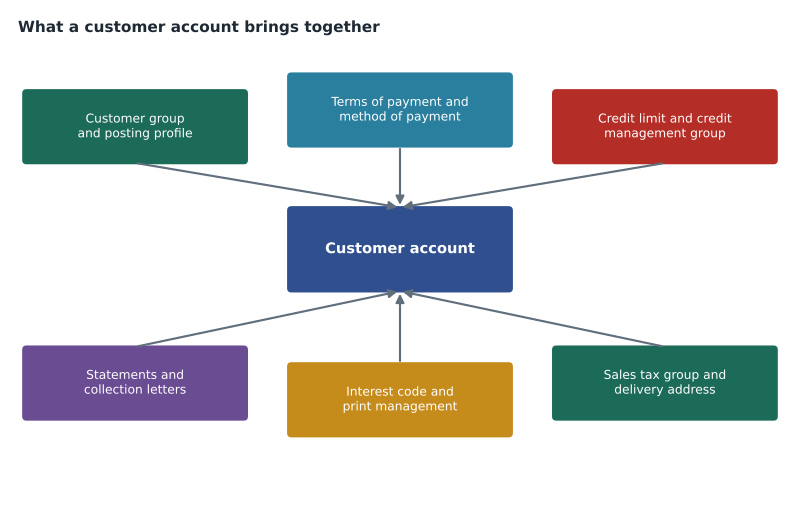
Much of what Clemency learned for vendors carries straight across to customers, with the direction reversed. A customer account belongs to one legal entity and is linked to a party; customer groups supply defaults and drive posting profiles; terms of payment and cash discounts decide when payment is due and what early payment earns; methods of payment describe how customers pay. This lesson covers those mirror images and then the settings that are specific to receivables: credit limits, statements, collection letters, interest, print management and the customer's address and tax details.
Customer accounts and parties
A customer account holds the settings that matter to one legal entity: customer group, currency, terms of payment, method of payment, posting profile, sales tax group, credit limit and the collections settings. The party in the global address book holds the name, addresses and contacts, so a distributor that buys from CRCA and CRUS has one party and two customer accounts. Like vendors, Cobalt Ridge's customer accounts use a shared number sequence, so a customer has the same number in every company.
The duplicate problem Ikenna described is solved partly by the address book and partly by procedure. When a new customer is created, the party search shows existing parties with similar names, and the user can choose to link the new customer account to an existing party instead of creating another. Cobalt Ridge made customer creation a task for a small customer master team, not for sales staff, and required a tax registration number or business number for every business customer.
Customer groups
A customer group is required on every customer. It supplies defaults such as terms of payment and the settle period, it is a key in customer posting profiles, and it is a common filter for reports, collection pools and credit rules. Ikenna and Annelise agreed on five groups for CRCA and CRUS.
| Customer group | Customers | Why it is separate |
|---|---|---|
| MUNI | Municipal water utilities and public bodies | Longer payment terms, tender rules, separate collection approach |
| MINE | Mining companies | Large project orders, credit insurance on some accounts |
| DIST | Distributors and dealers | Rebates and frequent small orders |
| ICO | Other Cobalt Ridge companies | Posts to intercompany due-from accounts |
| MISC | Occasional and one-time customers | Prepayment required; limited credit |
Customer posting profiles
A customer posting profile decides which summary account holds the receivable when a customer invoice posts, and which accounts are used for customer prepayments and for sales tax on prepayments. Profiles are defined by customer account, by customer group or for all customers. The default profile is set in the Accounts receivable parameters. Following the MSBA-320 design, every receivables control account was set to Do not allow manual entry.
| Account code | Account or group | Summary account | Prepayment account |
|---|---|---|---|
| Group | MUNI | 110100 Trade receivables | 220500 Customer prepayments |
| Group | MINE | 110100 Trade receivables | 220500 Customer prepayments |
| Group | DIST | 110100 Trade receivables | 220500 Customer prepayments |
| Group | ICO | 135100–135300 Due from (by company) | Not used |
| All | All other customers | 110100 Trade receivables | 220500 Customer prepayments |
Terms of payment, cash discounts and methods of payment
Customers get terms of payment just as vendors do, but the business question is different. For vendors, Cobalt Ridge wants to pay as late as the terms allow, unless a discount makes early payment worthwhile. For customers, it wants to be paid as early as possible without losing business. Ikenna standardized terms that had grown to 37 variations in the old system into five: Net 30 for most commercial customers, Net 45 for municipal customers (who often have approval cycles of their own), Net 60 for a handful of mining contracts, Due on receipt for one-time customers, and a cash in advance term used with prepayments.
Cobalt Ridge offered a cash discount to distributors only, 1 percent for payment within ten days, because distributors buy often and pay quickly when encouraged. Methods of payment for customers describe how customers pay: electronic funds transfer, wire, check, card through a payment service, or direct debit for a few distributors who had agreed to it. A customer method of payment can generate a direct debit file in the same way a vendor method generates a payment file.
Credit limits and credit settings
Every customer can have a credit limit, the maximum amount the company is willing to have outstanding. In Finance, the credit limit can be checked in two ways. The older, simpler check is controlled by the Accounts receivable parameters and the sales order: a warning or error when an order would push the customer's balance over the limit. The more complete approach is the credit management module, which uses blocking rules and a credit hold list. Cobalt Ridge would use credit management, which is the subject of lesson 8. During customer setup, the job was to give every customer a credit limit, a credit management group where customers share a limit, and an account status.
Ikenna's rule for limits was simple and defensible. Every new business customer starts with a limit based on a credit report, bank and trade references, and the size of the first expected order. Municipal customers get a standard limit approved by Thandeka, because their credit risk is low but their payment cycles are slow. One-time customers in the MISC group get no credit at all and pay in advance.
Statements, collection letters and interest
Several receivables settings on the customer decide what the customer receives from collections. A customer statement lists open transactions and recent activity and is sent on a schedule. Collection letters are reminders of overdue amounts, set up as a sequence of letter codes with increasing firmness. Interest codes define the interest or fees charged on overdue balances, with ranges by days or amount. The customer record says whether the customer receives statements, which collection letter sequence applies, and which interest code is used.
Cobalt Ridge decided not to charge interest to municipal customers, where public procurement rules made it impractical, and to charge interest to commercial customers only after 60 days overdue, with a collections manager able to waive it. Collection letters would go to every group except intercompany, with a gentler sequence for municipal customers. The detailed collections process is lesson 7.
Print management and contacts
Print management controls where invoices, statements, collection letters and other documents go: to a printer, to a file, or by email to a contact or an address with a purpose such as Invoice or Statement. Cobalt Ridge set the default for all customers to email the invoice to the contact with the Invoice purpose and to send statements to the contact with the Statement purpose. Ikenna insisted that every customer have an accounts payable contact with an email address before the customer could be used, because most of his collection delays started with an invoice that went to the wrong person.
Tax settings
Customer sales tax settings decide what tax is charged on sales. The customer's sales tax group combines with the item sales tax group to find tax codes. In the US, CRUS charges sales tax based on the delivery address and the customer's exemption status. Many distributors and mining customers have exemption certificates, recorded on the customer, and municipal customers are often exempt. Cobalt Ridge was evaluating a tax calculation service for US rates, which Finance can connect to through its tax integration, rather than maintaining rates by hand. The rule that matters for setup is that the delivery address drives tax, so every customer address must be complete and correct before the first invoice.
Worked problem
Cleaning a duplicate customer
The old system holds four records for the same Albany water utility, with different terms, two credit limits, and open invoices on three of them. How should they be migrated?
Show solution
- Choose one surviving account number and one party, with the correct legal name and tax registration.
- Set the MUNI customer group, Net 45 terms and the standard municipal credit limit.
- Migrate open invoices from all three old records as opening balances on the surviving account, keeping the original invoice numbers and due dates.
- Record the old account numbers in a field or note so the customer can be found by old references.
- Do not migrate the duplicate records at all.
Answer: One customer account and party, with all open items migrated onto it and the old numbers kept for reference.
One-time customers
Some sales are to customers who will probably never buy again: a contractor who needs one replacement pump, for example. Finance supports one-time customers: a sales order can create a customer account flagged as one-time, using the settings of a template customer, so that occasional buyers do not clutter the customer list with full records. Cobalt Ridge set the template to the MISC group, cash in advance terms and no credit limit. If a one-time customer starts buying regularly, the flag is cleared and the account is completed like any other.
Migrating customers
Customers migrate through data management, in the same order as vendors: groups, terms, methods, posting profiles, the customers themselves, then contacts and addresses, then open transactions as opening balances. Only customers with activity in the last three years migrate. Ikenna added one more check before cutover: every migrated customer had to have a credit limit, a delivery address with a tax jurisdiction, and an invoice contact. A data quality report run against the UAT environment listed the exceptions, and his team fixed them before the final rehearsal.
Customer account statuses and blocking
Separate from credit management, a customer account has an Invoice and delivery on hold setting, sometimes called the customer's blocked status. It can stop invoicing, delivery, or all transactions for the customer, much like a vendor hold. Cobalt Ridge used it sparingly: a customer in legal proceedings would be blocked for all transactions, and a customer whose account was being merged into another during migration would be blocked so no new orders landed on the old number. Day-to-day credit decisions would be made through credit management instead, because its holds come with reasons, release actions and workflow.
The customer record also has an account status used by credit management blocking rules, which lesson 8 explains. Ikenna defined three statuses beyond normal: Watch, for customers whose payments were slowing; Legal, for customers with a collection agency or lawyer involved; and Bankrupt. Each status was linked to a blocking rule, so changing a customer's status immediately changed how their orders were treated.
Customer master governance
Like the vendor master, the customer master needs ownership after go-live. Cobalt Ridge gave the customer master team the only security role that could create customers or change credit limits, terms, customer groups and posting profiles. Sales staff could request changes through a form, and changes to bank details for customers who pay by direct debit went through the same callback rule used for vendors. A monthly report of customer master changes, from the database log, went to Ikenna.
| Customer field | Who can change it | Control |
|---|---|---|
| Name, addresses, contacts | Customer master team | Request form from sales |
| Credit limit | Through credit limit adjustments only | Workflow approval (lesson 8) |
| Terms of payment and customer group | Customer master team | Ikenna approves exceptions to standard terms |
| Direct debit bank details | Customer master team | Callback to a known contact; database log |
Common mistakes
MistakeLetting sales staff create customers directly.
InsteadHave a customer master team create customers, check for existing parties, and require tax registration.
MistakeKeeping dozens of payment term variations.
InsteadStandardize terms so collections and reporting are consistent.
MistakeLeaving credit limits blank because they are not enforced.
InsteadSet a limit for every customer so credit management can use it.
MistakeMigrating customers with incomplete addresses.
InsteadComplete delivery addresses before cutover, because tax depends on them.
Summary and key terms
- Customer accounts belong to a legal entity and share parties in the global address book with other companies and with vendors.
- Customer groups supply defaults and are keys in customer posting profiles.
- Terms of payment, cash discounts and methods of payment are set up as for vendors, but with a collection mindset.
- Credit limits, credit management groups and account status prepare customers for credit management.
- Statements, collection letters, interest codes and print management decide what the customer receives and where.
- Customer group
- A required classification that supplies defaults and is used in posting profiles.
- Customer posting profile
- Rules that decide which summary and prepayment accounts customer transactions post to.
- Credit limit
- The maximum outstanding balance allowed for a customer.
- Collection letter
- A reminder of an overdue balance, sent in a sequence of increasing firmness.
- Interest code
- Rules for interest or fees charged on overdue balances.
- One-time customer
- A customer account created for an occasional buyer from a template.
- Print management
- Settings that decide where and how business documents are sent.
Practice problems
Work each problem on paper first, then reveal the answer to check.
How does Finance help prevent a second customer record for the same company?
Show answer
Party search shows existing parties so the new customer can be linked to one, and procedure limits who creates customers.
Why does every customer need a complete delivery address before invoicing?
Show answer
Sales tax is calculated from the delivery address.
What should a one-time customer template usually require?
Show answer
Payment in advance and no credit limit.
Lesson quiz · 5 questions
Score 60% or more to complete this lesson.
Create a free account to save your progress, take quizzes and earn a certificate.