
MSBA-321 · Lesson 5 of 12 · 18 min
Free-text and sales invoices
▶ Video coming soon A video version of this lesson is on the way.
Cobalt Ridge invoices customers in two very different ways. Most revenue comes from pumps and parts shipped against sales orders, where the invoice follows the packing slip and carries item numbers, quantities and prices. A smaller but important stream comes from things that are not items at all: engineering studies billed to a municipal utility, a fee for testing a customer's pump at the Hamilton plant, a recharge of shared costs to a distributor, or a one-off sale of scrap steel. Those are billed with free text invoices. The fifth session compared the two and showed how each posts, how corrections are made, and how invoices reach customers.
Sales order invoices
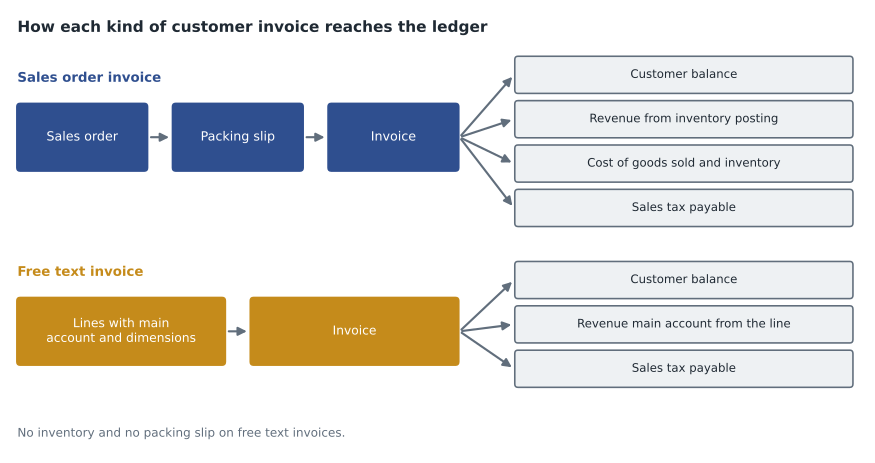
A sales order invoice is the last step of the order-to-cash process for items. A sales order is confirmed, picked, packed and shipped; the packing slip posts the physical issue from inventory; and the invoice posts the financial transaction. The invoice can be created for one order or for many orders at once in batch, and it can invoice the full order, the quantity shipped on selected packing slips, or a typed quantity. At Cobalt Ridge, invoicing runs nightly in batch for everything shipped that day, so invoices go out the morning after shipment.
When a sales order invoice posts, Finance debits the customer's summary account from the customer posting profile, credits revenue accounts from inventory posting setup for the item and customer combination, credits sales tax payable, and posts the cost of goods sold and inventory reduction. Revenue accounts in the MSBA-320 chart are in the 400000 range, and the dimensions on the invoice line (business unit, product line, plant) come from defaults on the customer, the item and the site. Because CR Profit and loss requires all five dimensions, the invoice cannot post if a dimension is missing, which is exactly the control Thandeka wanted.
Free text invoices
A free text invoice is a customer invoice that is not linked to a sales order. Each line has a description, a main account for the revenue or other credit, financial dimensions, a sales tax group and item sales tax group, a quantity and a unit price. There is no inventory and no packing slip. Free text invoices are entered on the All free text invoices page, can be approved by workflow, and post directly to the customer and the ledger.
| Question | Sales order invoice | Free text invoice |
|---|---|---|
| Linked to items and inventory? | Yes | No |
| Where does the revenue account come from? | Inventory posting setup | The main account on each line |
| Is there a packing slip? | Usually | No |
| Typical uses | Pumps, parts and stocked goods | Services, fees, recharges, scrap sales |
| Credit management blocking rules apply? | Yes | No; temporary limits and insurance only |
| Approval | Through the order process | Optional free text invoice workflow |
Free text invoice templates and recurring invoices
Many free text invoices repeat. A municipal utility might pay a fixed monthly fee for a pump monitoring service; a distributor might be recharged a share of a trade show every quarter. Finance supports free text invoice templates, which store lines, accounts and dimensions, and recurring free text invoices, where a template is assigned to customers with a start date, an end date and a frequency. A periodic process then generates the invoices on schedule, and they can be posted and sent in batch.
Ikenna set up two templates in CRUS: MONITOR for the monthly monitoring service and LOANPUMP for the rental of loaner pumps while a customer's pump is in for repair. The rental template had a quantity in days, so the invoice could be adjusted before posting. Recurring invoices still go through the free text invoice workflow if it is on, so a recurring invoice with a wrong amount is caught by an approver instead of going straight to the customer.
Sales tax on invoices
Both kinds of invoice calculate sales tax from the tax group combination on each line. On sales order invoices, the customer's tax group usually comes from the delivery address, and the item tax group from the item. On free text invoices, the user chooses the tax groups on each line, with defaults from the customer. For CRUS, an engineering study is often not taxable in many states while a loaner pump rental often is, so the item sales tax groups on the two templates differ. A tax calculation service, if adopted, would decide taxability by address and product code.
Worked problem
A free text invoice with tax
CRCA bills a municipal utility in Ontario for a pump efficiency study of 18,000 and travel recovery of 1,200, both subject to 13 percent HST. What is the invoice total, and which accounts are credited?
Show solution
- Line 1: 18,000 to engineering services revenue, with BusinessUnit MUN, Department ENG and the other dimensions.
- Line 2: 1,200 to recovered expenses, with the same dimensions.
- Tax: 13 percent of 19,200 is 2,496, credited to HST payable.
- The customer is debited 19,200 plus 2,496, which is 21,696.
Answer: The invoice total is 21,696, with revenue and recovery credited by line and 2,496 credited to HST payable.
Corrections and credit notes
Invoices are sometimes wrong, and posted invoices cannot be edited. Corrections are made with new documents. For sales order invoices, the usual path is a return order for goods coming back, or a credit note created from the original invoice on a sales order with negative quantities. For free text invoices, Finance can create a corrective document by copying the original invoice with Correct or Credit note functions, which reverse the original lines so the user can post a new, correct invoice. Either way, the credit note is settled against the original invoice so the customer's open balance is right.
Cobalt Ridge set three rules for credit notes. Every credit note must reference the original invoice number; credit notes over 5,000 need approval by Ikenna; and the reason for every credit note is recorded with a reason code, so that recurring causes such as wrong prices or damaged deliveries can be reported and fixed at the source.
Invoice numbering and documents
Customer invoice numbers come from number sequences. In the foundation course, Cobalt Ridge set continuous number sequences for invoices and vouchers, because tax authorities in all three countries expect invoice numbers without gaps. US rules vary by state; the CRUS invoice layout shows the tax amount and the exemption certificate number where a customer is exempt. CRMX invoices are a special case: in Mexico, invoices must be issued as electronic invoices (CFDI) validated by an authorized certification provider, which the Mexican localization in Finance supports through electronic invoicing.
Invoice documents are produced as business documents and sent through print management. Cobalt Ridge used the business document management feature to adjust the invoice layout: the company logo, remittance details with the bank account and a payment reference, and a short note on the payment terms. The payment reference mattered more than anything else on the document. Ikenna wanted every customer payment to carry the invoice number, so that settlement in lesson 6 could match payments automatically.
Electronic invoicing
More customers, especially large mining companies and some municipalities, ask for invoices in an electronic format rather than PDF. Finance's electronic invoicing service can generate and submit invoices in structured formats, such as PEPPOL-based formats used by public bodies in some countries, and country-specific formats like the Mexican CFDI. For CRCA and CRUS, Cobalt Ridge would start with PDF by email and add electronic formats customer by customer when requested. Annelise noted that the same service also receives electronic vendor invoices in some countries, which links to the invoice capture topic in lesson 10.
Revenue timing and accruals
The posting date of an invoice decides when revenue is recognized in the ledger. For sales orders, revenue follows the invoice, so goods shipped on the last day of the month but invoiced the next morning would fall in the wrong month. Cobalt Ridge handled this by running the nightly invoice batch with the shipment date as the invoice date on the last day of each month, and by checking the list of posted packing slips not yet invoiced as part of the month-end close. For service contracts billed in advance, such as an annual monitoring fee, revenue recognition belongs in subscription billing or deferral setup, which MB-310 includes but this course only touches on.
Invoice inquiries
Customers and colleagues ask about invoices every day. The customer's transactions page shows posted invoices, payments and settlements, with the open amount and due date; the invoice journal shows the posted document with its lines and tax; and the original document can be reprinted or emailed again from the journal. Ikenna's team used the customer balance list with aging to answer the most common question, which invoices are still open, in seconds.
Invoice approval for free text invoices
Because free text invoices bypass the sales order process, they are where errors and misuse are most likely: a revenue line coded to the wrong account, a recharge billed twice, or an invoice issued to the wrong customer. Finance offers a free text invoice workflow that can require approval before posting, with conditions on amount, customer group or main account. Cobalt Ridge configured it so that every free text invoice is approved by the business unit controller, and invoices over 25,000 or to customers over their credit limit also go to Ikenna. The workflow history then shows who approved each invoice, which auditors asked to see during the first year-end.
Ikenna added one more check: free text invoices were limited to a defined list of main accounts, such as engineering services revenue, rental revenue, recovered expenses and scrap sales. A free text invoice to a product sales account would be rejected in workflow, because product sales belong on sales orders. This was enforced through the workflow condition on the main account, rather than by technical customization.
Invoicing in batch and print management
Invoicing hundreds of sales orders one by one would be impossible, so Finance lets users post invoices for many orders together, with selection by customer, date or order, and lets the job run in batch. Cobalt Ridge's nightly batch posted invoices for every order shipped that day, then sent the documents through print management by email. A second batch posted and sent recurring free text invoices on the first business day of each month. Each batch produced a log, and the accounts receivable team checked the exceptions every morning: orders that could not be invoiced because of a missing price, a closed period, or a missing dimension.
| Morning invoicing exception | Usual cause | Fix |
|---|---|---|
| Order not invoiced: missing price | Price agreement expired | Sales updates the price; invoice in the next run |
| Order not invoiced: dimension missing | New product line without a default | Add the default dimension and repost |
| Email not sent | No contact with the Invoice purpose | Customer master team adds the contact; resend |
| Period closed | Shipment dated in a closed period | Controller decides whether to reopen or redate |
Invoices to intercompany customers
When CRCA sells pumps to CRUS for resale, the sale is an intercompany transaction. CRUS appears in CRCA as a customer in the ICO group, so the invoice posts to the due-from account from the posting profile rather than to trade receivables. If intercompany trade is set up, a sales order in CRCA can be linked to a purchase order in CRUS, and the invoice in CRCA can create the vendor invoice in CRUS automatically. Cobalt Ridge used this for regular product transfers between plants, and free text invoices for monthly recharges of shared engineering costs, settled in US dollars as the MSBA-320 design required.
Common mistakes
MistakeUsing free text invoices for stocked items to save time.
InsteadSell items on sales orders so inventory, costs and revenue post correctly.
MistakeEditing a posted invoice.
InsteadCorrect posted invoices with credit notes or corrective documents, settled against the original.
MistakeLeaving payment references off invoice documents.
InsteadShow the invoice number as the payment reference so payments can be matched automatically.
MistakeInvoicing month-end shipments in the following month.
InsteadInvoice with the shipment date at month end and check packing slips not yet invoiced.
Summary and key terms
- Sales order invoices follow packing slips and take revenue accounts from inventory posting setup.
- Free text invoices have no items; each line carries its own main account, dimensions and tax groups.
- Templates and recurring free text invoices handle repeated billing and can still go through workflow.
- Posted invoices are corrected with credit notes or corrective documents that are settled against the original.
- Invoice documents, numbering and electronic invoicing must meet each country's tax rules.
- Sales order invoice
- A customer invoice created from a sales order, usually after a packing slip.
- Free text invoice
- A customer invoice not linked to a sales order, with main accounts on each line.
- Recurring free text invoice
- A free text invoice generated on a schedule from a template.
- Credit note
- A document that reverses all or part of an invoice.
- Electronic invoicing
- Creating and submitting invoices in structured electronic formats.
- Business document management
- A feature for editing the layouts of business documents such as invoices.
Practice problems
Work each problem on paper first, then reveal the answer to check.
Which kind of invoice should CRUS use for a loaner pump rental billed by the day?
Show answer
A free text invoice, ideally from the LOANPUMP template.
Why do credit management blocking rules not stop free text invoices?
Show answer
Credit management blocking rules apply to sales orders only.
What is the most useful item on an invoice document for collections?
Show answer
A clear payment reference, such as the invoice number.
Lesson quiz · 5 questions
Score 60% or more to complete this lesson.
Create a free account to save your progress, take quizzes and earn a certificate.