
MSBA-321 · Lesson 3 of 12 · 20 min
Vendor payments
▶ Video coming soon A video version of this lesson is on the way.
Paying vendors is where accounts payable touches real money, and where mistakes are hardest to undo. In the old system, Cobalt Ridge ran payments twice a week: a clerk printed a list of due invoices, Thandeka ticked the ones to pay, the clerk typed them into the bank's website, and the bank's confirmation was filed in a binder. The third payables session replaced every step of that with a payment proposal, a vendor payment journal, a generated bank file and an approval trail. Clemency brought the old binder to the session as a reminder of what was being retired.
The payment cycle in Finance
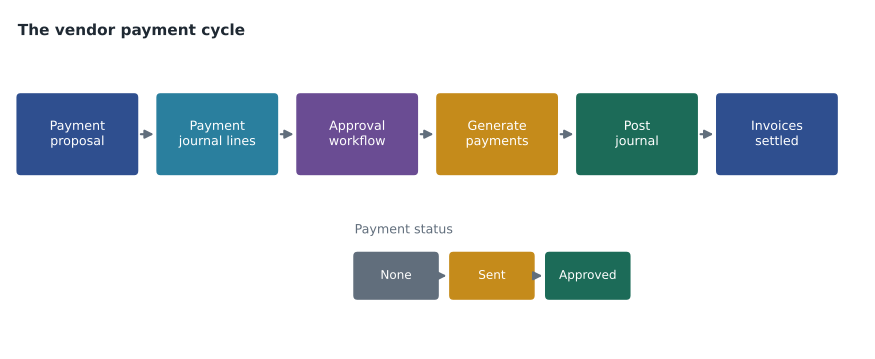
A vendor payment in Finance follows a predictable cycle. Invoices are selected, payment lines are created in a payment journal, the journal is approved, a payment file or checks are generated, the bank confirms, the journal is posted, and the payments are settled against the invoices they pay. Most of the setup from lesson 1, especially methods of payment, terms of payment and cash discounts, comes into play here.
Payment journals
A vendor payment journal holds payment lines. Each line names a vendor, an amount, a method of payment, an offset account (usually a bank account), and the invoices the payment will settle. Journal names, covered in MSBA-320, decide the voucher series, whether approval workflow is required and which posting layer is used. Cobalt Ridge created a journal name VENDPAY for each company with a payment journal approval workflow, separate from the general journal names, so that payments always go through their own approval route.
Lines can be entered by hand, which suits a one-off urgent payment, but most lines come from a payment proposal.
Payment proposals
A payment proposal selects open invoices according to criteria and creates payment lines for them. The main criteria are the proposal type and the dates. A proposal can select by due date, by cash discount date, or by both, so that invoices are paid either when they fall due or early enough to take the discount. Other criteria include a date range, the method of payment, the vendor group or individual vendors, the currency, a minimum or maximum payment amount, and the bank account balance available.
| Proposal setting | What it controls | Cobalt Ridge choice |
|---|---|---|
| Proposal type | Due date, cash discount date, or both | Both: take discounts, otherwise pay on due date |
| Select invoices by | Due date range or cash discount date range | Due or discount up to the next payment run plus three days |
| Payment date | The date the payment is made | Tuesday and Friday runs |
| Method of payment filter | Which methods to include | Separate runs for EFT, WIRE and CHQ |
| Minimum payment | Skip tiny balances | 25 (local currency) |
| Check bank balance | Do not propose more than the bank holds | On for CRMX, off for CRCA and CRUS (treasury manages funding) |
| Vendor on hold | Vendors on Payment or All hold are excluded | Always excluded |
The proposal opens on a review page where the user sees the vendors and invoices selected, with the payment amount, the discount being taken, and any warnings. Lines can be removed or amounts changed before the proposal is transferred to the journal. Clemency's team would review the proposal every Tuesday and Friday morning, remove anything under dispute, and transfer the rest.
Worked problem
Which invoices does the proposal pick?
A Friday payment run on May 15 uses proposal type Due date and cash discount, selecting invoices due or with discounts up to May 22. Three open invoices exist for one vendor: A for 10,000, due May 20, no discount; B for 8,000, due June 10, discount 2 percent until May 18; C for 5,000, due June 30, discount 2 percent until June 5. Which are proposed, and for how much?
Show solution
- A is due May 20, inside the range, so it is proposed for 10,000.
- B has a discount date of May 18, inside the range, so it is proposed early with a 160 discount, for 7,840.
- C is neither due nor discounted before May 22, so it is not proposed.
- The vendor payment line totals 17,840.
Answer: Invoices A and B are proposed, for a total payment of 17,840; C waits for a later run.
Approval and segregation of duties
A payment journal at Cobalt Ridge is never posted by the person who created it. The payment journal approval workflow routes VENDPAY journals to Thandeka (or a delegate) for approval, and the workflow cannot be bypassed because the journal name requires it. In CRMX, the foundation course accepted one segregation of duties conflict: the company has a single accounts clerk who both enters invoices and prepares payments. The mitigation was the canon rule that the controller approves every CRMX payment journal, plus a monthly review of the vendor master change log.
Approval should look at more than totals. The approver's checklist that Annelise suggested had four questions: are any vendors new or recently changed (bank details especially); are any payments unusually large compared with the vendor's history; are any invoices being paid before their due date without a discount; and does the total agree with the cash forecast that treasury expects.
Generating payments
After approval, the user selects Generate payments. For electronic methods, Finance creates a payment file using the electronic reporting format configured on the method of payment, and sets each line's payment status to Sent. For checks, it prints checks on the bank account's check layout, using the check number sequence on the bank account. Some formats produce a remittance advice for vendors at the same time, which can be emailed through print management.
Payment file formats depend on the bank and the country. Many banks now accept the international ISO 20022 credit transfer format, and Finance includes electronic reporting configurations for it, which partners or the bank can adapt. CRUS sends domestic payments as ACH files in the NACHA format and wires in ISO 20022. Annelise reminded the group that the format is chosen in agreement with the bank, tested in the bank's test environment, and then locked down: a payment file is the last point at which fraud can be stopped.
| Payment status | Meaning | Next step |
|---|---|---|
| None | The line has not been sent | Generate payments |
| Sent | A file or check has been generated | Wait for bank confirmation |
| Received | The bank has received the file (where the format supports it) | Wait for acceptance |
| Approved | The payment has been confirmed and can be posted | Post the journal |
| Rejected | The bank rejected the payment | Correct and regenerate, or remove the line |
Positive pay and check controls
For check payments, banks offer positive pay: the company sends the bank a file listing every check issued, and the bank only honors checks that match the file. Finance can generate positive pay files from the bank account using an electronic reporting format. In the US, positive pay is widely used and CRUS's bank required it for the check account. Cobalt Ridge also set the bank account to require check numbers to be assigned from a number sequence and recorded voided checks with a reason, so every check number is accounted for.
Posting and settlement
When the journal is posted, Finance debits the vendor's summary account and credits the bank account, and settles each payment against the invoices it was created for. Settlement closes the invoices, calculates the cash discount taken and posts it to the discount account, and, for foreign currency invoices, posts the realized exchange gain or loss to the accounts from the currency setup. In the MSBA-320 design, those accounts are 740100 for realized gains and losses and 740200 for unrealized gains and losses at revaluation.
Worked problem
A foreign currency payment
CRCA owes a European supplier 20,000 euros. The invoice posted at a rate of 1.48, recording a payable of 29,600 in the accounting currency. CRCA pays when the rate is 1.51. What does settlement post?
Show solution
- The payment costs 20,000 times 1.51, which is 30,200 in the accounting currency.
- The invoice carried 29,600, so the difference is 600.
- Paying more than the invoice was recorded at is a loss.
- Settlement posts a realized exchange loss of 600 to 740100.
Answer: The invoice is closed and a realized exchange loss of 600 posts to 740100.
Payments can also be made without selecting invoices, for example a deposit requested by a vendor. Such a payment stays open on the vendor as a debit balance until it is settled later against an invoice with Settle open transactions. Prepayments, which are planned and tracked differently, are the subject of lesson 9.
Centralized payments
When one legal entity pays invoices that belong to another, Finance can handle it as a centralized payment. The paying company posts the bank side, and intercompany accounting posts due-to and due-from entries in both companies, using the intercompany setup from MSBA-320. Cobalt Ridge discussed whether CRCA should pay for CRUS but decided against it for now: each company had its own bank and its own currency, and treasury preferred to fund each company directly. The setup was left in place for CRMX, whose large US-dollar supplier invoices could be paid by CRUS if needed.
Reversals, stopped payments and vendor inquiries
If a posted payment must be undone, for example a check that was lost and stopped, the payment can be reversed from the vendor transactions, which reopens the invoices. A stopped check is recorded on the bank account's check list. Vendors who ask about payment status are answered from the vendor's transactions and settlement history, and Clemency wanted the remittance advice emailed automatically after each payment run so that most of those calls would stop.
Reconciling payments with the bank
Every payment posted to the bank account must eventually appear on a bank statement. Bank reconciliation, including the matching rules that clear payments automatically, is covered in MSBA-322. For payables, the important point is the status discipline: a payment is posted when the bank has accepted it, not when the file is created, so the bank account in Finance reflects money that has actually left.
Bank accounts and payment funding
Every payment needs a source of funds, and in Finance that source is a bank account record in Cash and bank management, linked to a main account in the ledger. The bank account holds the bank's identifiers, the currency, the check layout and number sequence for checks, and the electronic reporting formats used for positive pay and statement import. Methods of payment point to a bank account as their offset, so a payment run for EFT in US dollars always draws on the right account.
Cobalt Ridge's treasury analyst manages funding across the companies. Before each payment run, the analyst checks the cash forecast and moves funds between accounts if needed, so that the operating account can cover the run. For CRMX, which would start with a small balance, the payment proposal's bank balance check was switched on, so that a run could never propose more than the account held. Cash forecasting, bank reconciliation and letters of credit are covered in MSBA-322; the link for payables is that the payment proposal is one of the main inputs to the short-term cash forecast.
Vendor payment reporting
After each run, Clemency's team checks three things: that every payment line reached Approved and was posted, that the remittance advices were sent, and that no vendor on hold was paid. The vendor transactions and settlement history answer most questions, and the payment journal itself keeps the approval history from workflow. Thandeka asked for one monthly measure as well: the cash discounts taken as a share of the discounts available. It shows whether the proposals are being run early enough to capture discounts, and in the first test cycles it was above 90 percent, compared with almost nothing in the old system.
| Check after a payment run | Where to look |
|---|---|
| All lines approved and posted | Payment journal lines and payment status |
| Remittance advices sent | Print management history for the run |
| No payments to vendors on hold | Vendor hold report compared with the payment journal |
| Discounts captured | Cash discount transactions compared with discounts available |
Common mistakes
MistakePosting a payment journal as soon as the file is generated.
InsteadWait for bank confirmation so the payment status reflects what the bank accepted.
MistakeLetting the person who prepares payments also approve them.
InsteadRequire a payment journal approval workflow and, where staff are few, approval by the controller.
MistakeRunning proposals by due date only.
InsteadInclude cash discount dates so early-payment discounts are not missed.
MistakeChanging the payment file format without bank testing.
InsteadAgree and test formats with the bank, then control changes tightly.
Summary and key terms
- Vendor payments move from proposal to journal, approval, generated file or checks, bank confirmation, posting and settlement.
- Payment proposals select invoices by due date, cash discount date or both, with filters for method, vendor and amount.
- Payment journals should have their own journal name with approval workflow.
- Payment files are produced by electronic reporting formats agreed with the bank; payment status tracks the file through the bank.
- Settlement closes invoices and posts cash discounts and realized exchange differences.
- Payment proposal
- A process that selects open invoices by criteria and creates payment lines.
- Vendor payment journal
- A journal that holds vendor payment lines before posting.
- Payment status
- The status of a payment line as it moves from None to Sent to Approved or Rejected.
- Positive pay
- A file of issued checks sent to the bank so it only honors matching checks.
- Settlement
- Matching a payment to the invoices it pays, closing them and posting differences.
- Centralized payment
- A payment made by one legal entity for invoices of another, with intercompany entries.
Practice problems
Work each problem on paper first, then reveal the answer to check.
Why should a vendor payment journal have its own journal name?
Show answer
So it can require a payment approval workflow and its own voucher series, separate from other journals.
A payment line shows status Sent. Should the journal be posted?
Show answer
Not yet; wait for the bank to confirm and the status to become Approved.
What does settlement post for a foreign currency invoice paid at a different rate?
Show answer
A realized exchange gain or loss.
Lesson quiz · 5 questions
Score 60% or more to complete this lesson.
Create a free account to save your progress, take quizzes and earn a certificate.