
MSBA-320 · Lesson 8 of 12 · 18 min
Intercompany accounting
▶ Video coming soon A video version of this lesson is on the way.
Cobalt Ridge's three companies traded with each other constantly. CRCA's engineering department designed pumps that both plants built. CRUS's Denver warehouse shipped spare parts to Canadian customers. Corporate costs such as the ERP licenses and the audit fee were paid by one company and charged to the others. And from January 2027, CRMX would buy finished pumps from both plants. In the old system, each of these was entered twice, once in each company, and the intercompany balances never quite agreed at month end. The eighth session showed how Finance records these transactions once and keeps both sides in balance.
Two kinds of intercompany activity
Finance handles intercompany activity in two different ways, and it is important to know which applies. Intercompany trade uses sales orders and purchase orders: when CRMX creates a purchase order to CRUS for pumps, an intercompany sales order is created automatically in CRUS, and invoices flow from one to the other. That is part of Supply Chain Management and accounts receivable and payable, and it is covered in other courses. Intercompany accounting, the subject of this lesson, is about general ledger entries that affect more than one legal entity, such as charging a share of a corporate cost from one company to another through a journal.
How intercompany accounting works
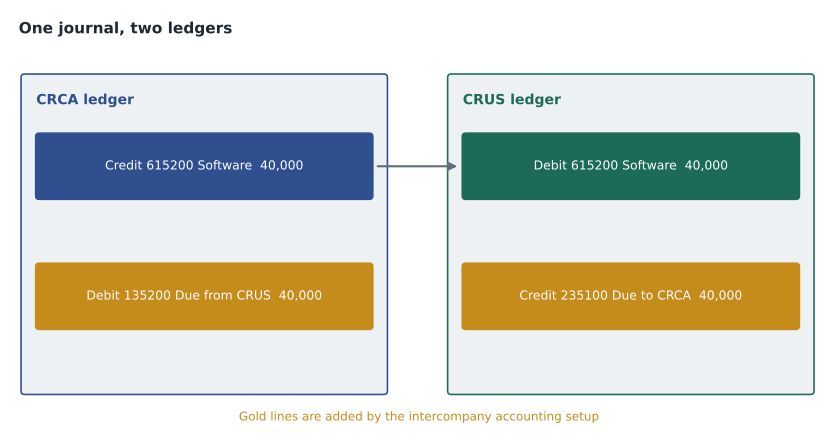
In a general journal, a line can name a different legal entity in the Company field for its account or offset account. If an accountant in CRCA enters a journal that debits a CRUS expense account and credits a CRCA expense account, the voucher now spans two companies. Each company's ledger must still balance on its own. The system makes that happen by adding due-to and due-from entries automatically: in CRCA it posts a due-from receivable from CRUS, and in CRUS it posts a due-to payable to CRCA. The accounts used come from the Intercompany accounting setup.
Setting up due-to and due-from accounts
The Intercompany accounting page, under General ledger posting setup, holds a row for each pair of companies that can post to each other. For each pair you choose the due-from main account in the originating company, which records the receivable, and the due-to main account in the destination company, which records the payable. Most groups use separate due-to and due-from accounts for each counterparty, so that balances can be matched pair by pair. Annelise created two accounts per counterparty in CR-COA and set them to Do not allow manual entry, so only the automatic intercompany postings could reach them.
| Originating company | Destination company | Due from (originating) | Due to (destination) |
|---|---|---|---|
| CRCA | CRUS | 135200 Due from CRUS | 235100 Due to CRCA |
| CRUS | CRCA | 135100 Due from CRCA | 235200 Due to CRUS |
| CRCA | CRMX | 135300 Due from CRMX | 235100 Due to CRCA |
| CRUS | CRMX | 135300 Due from CRMX | 235200 Due to CRUS |
| CRMX | CRCA | 135100 Due from CRCA | 235300 Due to CRMX |
| CRMX | CRUS | 135200 Due from CRUS | 235300 Due to CRMX |
Each row also has settings for posting, such as whether the destination company's entry posts automatically and how sales tax is handled when an intercompany line includes tax. Annelise kept tax out of intercompany journals altogether: corporate recharges between Cobalt Ridge companies were billed through intercompany invoices when tax applied, and through journals only when no tax applied, after checking the position with Thandeka and the tax advisers.
Worked problem
Recharging an annual license
CRCA pays a 120,000 license fee that benefits the whole group. Thandeka agrees that CRUS should bear 45,000 and CRMX 15,000 from January 2027. How should the January recharge be entered, and what does each ledger show?
Show solution
- In CRCA, enter a general journal with three lines: credit CRCA 615200 Software for 60,000; debit CRUS 615200 for 45,000, with company CRUS; debit CRMX 615200 for 15,000, with company CRMX.
- Post the journal; the system adds due-from entries in CRCA (135200 debit 45,000 and 135300 debit 15,000).
- In CRUS it adds a credit of 45,000 to 235100 Due to CRCA; in CRMX a credit of 15,000 to 235100 Due to CRCA.
- Each ledger balances: CRCA has a net software cost of 60,000 and receivables of 60,000; CRUS and CRMX have the expense and a payable to CRCA.
Answer: One journal in CRCA with lines for the other companies; the intercompany accounting setup adds the due-to and due-from entries in all three ledgers automatically.
Currencies in intercompany entries
When companies have different accounting currencies, an intercompany journal converts amounts for each company at that company's rate. A line entered in CRCA in Canadian dollars that posts to CRUS is converted to US dollars in the CRUS ledger using the default exchange rate type. Settling the balances later, by payment or by netting, can produce exchange differences in each company. For that reason many groups record intercompany recharges in a single agreed currency and settle them regularly. Cobalt Ridge agreed that recharges between CRCA and CRUS would be raised in US dollars and that CRMX would settle its balances monthly in US dollars as well.
Reconciling intercompany balances
Even with automatic due-to and due-from entries, balances can drift apart when entries are made outside intercompany accounting, such as a payment posted only in one company. A monthly intercompany reconciliation compares each due-from account in one company with the matching due-to account in the other. Because Cobalt Ridge used separate accounts for each counterparty, the comparison was a straightforward two-column check per pair. Financial reporting could produce the comparison as one report across all three companies. Differences were investigated before consolidation, where the balances would be eliminated.
| Pair | Due from balance | Due to balance | Difference |
|---|---|---|---|
| CRCA from CRUS / CRUS to CRCA | 412,600 | 412,600 | 0 |
| CRUS from CRCA / CRCA to CRUS | 88,150 | 86,900 | 1,250 |
| CRCA from CRMX / CRMX to CRCA | 15,000 | 15,000 | 0 |
Interunit accounting inside one company
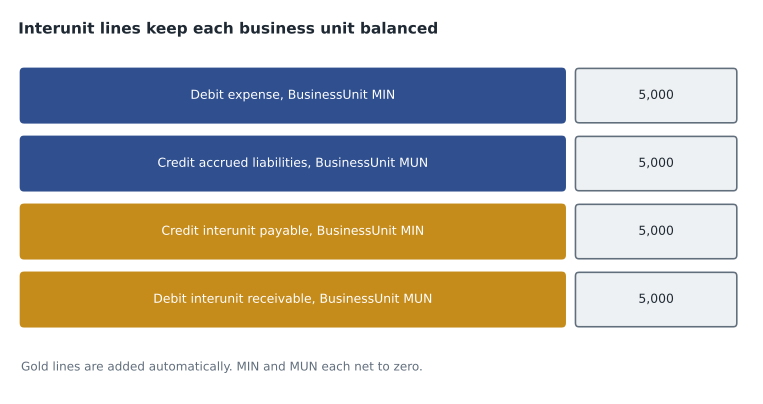
Intercompany accounting keeps each legal entity balanced. Many groups also want each business unit inside a company to balance, so they can produce a balance sheet for Municipal Water and one for Mining. Lesson 2 introduced the balancing financial dimension on the Ledger page for this purpose. When a voucher in CRCA debits an expense for MIN and credits a liability for MUN, the voucher balances for the company but not for each business unit. With BusinessUnit as the balancing dimension, the system adds interunit due-to and due-from lines, using the interunit accounts set up on the ledger, so that MIN and MUN each balance.
This is called interunit accounting, and it works the same way as intercompany accounting, but within one ledger and one currency. It lets management treat business units almost like separate companies for reporting, without the overhead of creating legal entities that have no legal reason to exist. Annelise warned that balancing by dimension adds lines to many vouchers and that the interunit accounts need regular review. Thandeka was happy with that trade-off: a balance sheet by business unit had been a request from the board for three years.
Intercompany in subledgers
Intercompany accounting is not limited to general journals. Several subledger processes can cross companies too, and they use the same due-to and due-from setup. Centralized payments let one company pay invoices that belong to other companies: CRCA's treasury team could pay a CRUS vendor from CRCA's US dollar bank account, and the system would post the payment in CRCA, settle the invoice in CRUS and record the intercompany balance between them. Vendor invoices can also be split across companies, for example an invoice for a group insurance policy charged partly to each company. Cobalt Ridge planned to use centralized payments later in the project, once the payables team was comfortable with the basics.
These features make the due-to and due-from setup even more important, because every company pair that can transact through any of these processes needs a row on the Intercompany accounting page. Annelise added a step to the new company checklist: when a legal entity joins the group, add its intercompany pairs with every existing company before any cross-company process is allowed. Missing rows are a common cause of posting errors on the first day a new company goes live.
Testing intercompany setup
Annelise's test script for intercompany accounting covered each company pair in both directions, a journal with lines in three companies at once, an entry in a foreign currency, an intercompany journal with an approval step, and a reversing intercompany accrual. For each test, the expected due-to and due-from entries were written in the script before the test was run, so that the result could be checked line by line. The interunit tests ran in CRCA alone, with vouchers that moved amounts between MUN, MIN and CORP and checked that each business unit balanced.
Security and controls
Posting into another company requires security in that company. A CRCA accountant cannot post an expense into CRUS unless they have rights in CRUS. Cobalt Ridge's shared services accountants were given the general ledger roles in all three companies, but CRMX's accounts clerk had rights only in CRMX. Intercompany journals were also covered by the same approval workflow as other general journals, with an extra condition: any journal posting to another company above 25,000 required approval by the controller of the destination company as well. In CRMX's case, that was the part-time Mexican controller.
Reporting on intercompany activity
Thandeka wanted one more view: the total of all intercompany charges for the year, by type and by company pair, for the transfer pricing documentation the tax advisers prepare each year. Because recharges used dedicated income and expense accounts and the due-to and due-from accounts were separated by counterparty, a financial report could produce that view directly from the ledgers of all three companies. Annelise added the report to the year-end checklist. The tax advisers would no longer need to rebuild the numbers from invoices and spreadsheets, and any difference between the two sides of a pair would already have been found in the monthly reconciliation.
Auditors look at intercompany balances closely, because errors there distort both companies and the group. A clean design, with counterparty accounts, automatic entries, approvals on cross-company journals and a monthly reconciliation, gives them a short list of tests and a clear trail for each one.
Intercompany and consolidation
Intercompany balances and transactions must be eliminated when the group is consolidated, because the group cannot owe money to itself or earn revenue from itself. Lesson 10 shows how elimination rules use the due-to and due-from accounts to remove these balances in the consolidation company. That is another reason to keep separate accounts for each counterparty: elimination rules become simple pairs that net to zero, and any difference shows up immediately as a reconciliation item.
Settling intercompany balances
Balances that are never settled grow quietly and become a source of exchange differences and audit questions. Cobalt Ridge agreed a monthly settlement: on the tenth business day of each month, each company would pay its net intercompany payable from the previous month. Payments between companies can be recorded through payment journals with intercompany lines, so that the payment in one company and the receipt in the other are posted together. Thandeka asked treasury to net the CRCA and CRUS balances where possible, so that only one payment crossed the border each month.
Policies to document
Intercompany accounting is as much policy as configuration. Annelise asked Thandeka to approve a short intercompany policy covering which costs are recharged and on what basis, which currency recharges use, when balances are settled, who approves cross-company journals, and how differences are resolved. The policy also stated when intercompany trade through sales and purchase orders must be used instead of journals, such as for any transfer of inventory or any charge that attracts sales tax. Writing this down before go-live meant the configuration had a clear basis, and the auditors had a document to test it against.
Common mistakes
MistakeEntering the same recharge separately in each company.
InsteadEnter it once in a journal with lines for the other companies; intercompany accounting posts both sides.
MistakeUsing one due-to and one due-from account for all counterparties.
InsteadUse separate accounts per counterparty so balances reconcile and eliminate in pairs.
MistakeUsing intercompany journals for inventory transfers or taxable charges.
InsteadUse intercompany trade with sales and purchase orders where documents and tax are needed.
MistakeLeaving intercompany balances unsettled for months.
InsteadSettle regularly in an agreed currency to limit exchange differences and reconciliation effort.
Summary and key terms
- Intercompany accounting records general ledger entries that affect more than one legal entity in a single journal.
- The Intercompany accounting page sets due-from and due-to accounts for each pair of companies.
- Each company converts its side at its own rate; regular settlement in an agreed currency limits differences.
- A balancing financial dimension adds interunit lines so units such as business units balance within one company.
- Intercompany balances are reconciled monthly and eliminated in consolidation.
- Intercompany accounting
- Ledger postings that affect more than one legal entity, with automatic due-to and due-from entries.
- Due-from account
- A receivable in the originating company for an amount owed by another company.
- Due-to account
- A payable in the destination company for an amount owed to another company.
- Intercompany trade
- Trading between companies through linked sales and purchase orders.
- Interunit accounting
- Automatic entries that keep each value of a balancing dimension balanced within one company.
Practice problems
Work each problem on paper first, then reveal the answer to check.
Where are due-to and due-from accounts set up?
Show answer
On the Intercompany accounting page under General ledger posting setup.
Why should due-to and due-from accounts not allow manual entry?
Show answer
So only automatic intercompany postings reach them and balances stay matched.
What feature gives a balance sheet by business unit inside one company?
Show answer
A balancing financial dimension with interunit accounting.
Lesson quiz · 5 questions
Score 60% or more to complete this lesson.
Create a free account to save your progress, take quizzes and earn a certificate.