
MSBA-320 · Lesson 12 of 12 · 18 min
Case study: setting up finance for a multinational
▶ Video coming soon A video version of this lesson is on the way.
The last session of the finance setup course was a working day rather than a lecture. Annelise put the CRMX finance setup on the screen as a list of open items, and the team worked through it together in the CONFIG sandbox, explaining each decision as they went. CRMX, the new Mexican distribution company, would start trading on January 1, 2027. It already existed as a legal entity from the foundation course, with its address in Monterrey and the Mexico localization turned on. Everything financial still had to be done. This lesson follows that day step by step, bringing together everything from the course.
The brief
Thandeka's brief for CRMX was short. CRMX keeps its books in Mexican pesos. It uses the group chart of accounts and the group dimensions. Its fiscal year is the calendar year. It reports to the group in the group reporting currency, US dollars. It buys pumps from CRCA and CRUS and sells them to mining customers in Mexico. It shares corporate costs through a monthly recharge from CRCA. It must produce Mexican statutory and electronic accounting reports. And it must be part of the quarterly consolidation in CRGP. The part-time controller in Monterrey would own CRMX's ledger, with Thandeka's team providing support from Akron.
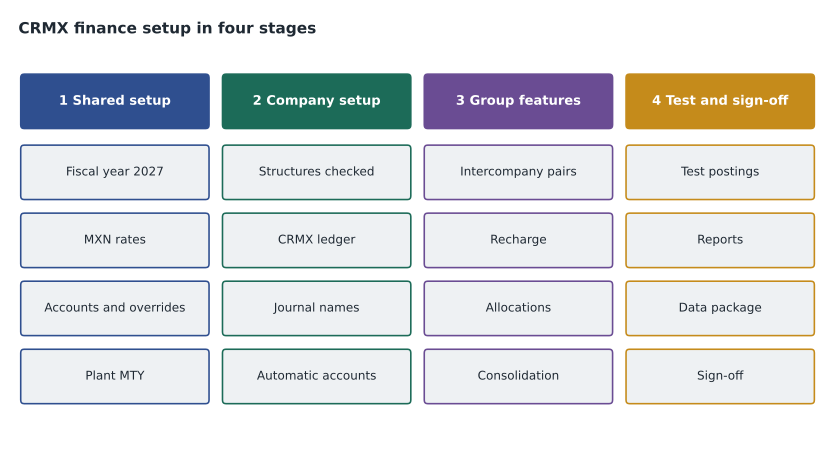
Stage 1: shared setup
Fiscal calendar. The team opened the CRFISCAL calendar and confirmed that fiscal year 2027 existed, with an opening period, twelve monthly operating periods and a closing period. It had been created in lesson 2. Nothing else was needed, because CRMX would share the group calendar. Fiscal year 2028 was added as well, so that no one would be caught by a missing year at the next year end.
Currency and rates. The Mexican peso already existed on the Currencies page with two-decimal rounding. The team checked the DEFAULT exchange rate type: the provider import already brought in MXN rates against CAD, USD and EUR every business day. They added MXN pairs to the BUDGET type with the 2027 planning rate agreed with Thandeka, and confirmed that CLOSING and AVERAGE would receive MXN rates at each month end. They also created an exchange rate type for the official central bank rate, as the Mexican controller had requested in lesson 6, with its own provider configuration, to be used only where Mexican tax reports required it.
Chart of accounts. CR-COA already covered CRMX's needs, with three additions: 135300 Due from CRMX and 235300 Due to CRMX for the intercompany pairs, and a value-added tax account group for Mexican VAT. The team set legal entity overrides to suspend the Canadian and US sales tax accounts for CRMX, and suspended the Mexican VAT accounts for CRCA and CRUS. They confirmed with the Mexican controller that every main account CRMX would use had its official grouping code assigned for the electronic accounting reports.
Dimensions. The Plant value MTY for the Monterrey hub had been created earlier, with a legal entity override making it active only for CRMX from January 1, 2027. Business units MUN and MIN applied to CRMX as they did to the other companies, since operating units are shared. CRMX's departments were created as operating units in Organization administration, which made them available immediately as Department dimension values. The team ran dimension data validation to confirm no existing master records were affected.
| Item | Action for CRMX | Lesson |
|---|---|---|
| Fiscal year 2027 | Confirmed in CRFISCAL; added 2028 | 2 |
| MXN rates | Checked DEFAULT; added BUDGET; created official rate type | 6 |
| Main accounts | Added intercompany accounts; overrides for tax accounts | 3, 8 |
| Dimension values | MTY active from January 1; CRMX departments as operating units | 4 |
| Account structures | No change; checked new accounts fall in existing ranges | 5 |
Stage 2: company setup
Account structures. The new intercompany accounts 135300 and 235300 fell inside the CR Balance sheet range, so no structure change was needed. The team activated nothing, which avoided a maintenance window. Annelise pointed out that this was the payoff of the range-based design from lesson 5: new accounts added inside existing ranges are validated automatically.
Ledger. On the Ledger page in CRMX, the team selected the chart CR-COA, the structures CR Balance sheet and CR Profit and loss, the fiscal calendar CRFISCAL, accounting currency MXN, reporting currency USD, DEFAULT as the exchange rate type and BUDGET as the budget exchange rate type, and BusinessUnit as the balancing financial dimension, the same as the other companies. They set the interunit accounts to the same main accounts used in CRCA and CRUS, so interunit balances would be consistent across the group. Once the ledger was saved with transactions, the accounting currency could not change, so the controller confirmed MXN on screen before saving.
Ledger calendar. In the CRMX ledger calendar, all 2026 periods were set to permanently closed, because CRMX would never post to them, and January 2027 was left open. The other 2027 periods were set to on hold until each month arrived, a choice the Mexican controller preferred so that nobody could post into a future month by mistake.
Journal names and number sequences. Using Copy into legal entity from data management, the team copied journal names, number sequences and accounts for automatic transactions from CRCA into CRMX, then changed the voucher series formats to include CRMX, such as ACR-CRMX-######. Approval workflow thresholds were converted to pesos: the 50,000 threshold for GENJRN became 900,000 pesos after a round-number discussion with Thandeka. Posting restrictions were set so the CRMX accounts clerk could prepare journals but only the controller could post them, the accepted segregation of duties arrangement recorded in the foundation course.
Accounts for automatic transactions. The team checked the copied automatic accounts: penny differences, rounding, the error account, realized and unrealized exchange gains and losses on 740100 and 740200. All used shared main accounts, so the copied setup worked without change. They added a default BusinessUnit of CORP for automatic postings that had no other source of business unit, so that the balancing dimension would always have a value.
Worked problem
Converting a workflow threshold
The GENJRN workflow in CRCA requires controller approval above 50,000 Canadian dollars. Thandeka wants the CRMX threshold to be roughly equivalent and a round number. The BUDGET rate for 2027 is 13.2 pesos per Canadian dollar. What threshold should CRMX use?
Show solution
- Convert the threshold: 50,000 times 13.2 is 660,000 pesos.
- Discuss with the controller whether to round to 650,000, 700,000 or another value that suits CRMX.
- Thandeka prefers a slightly higher threshold for the small CRMX team, and they agree 900,000 pesos after reviewing the expected journal sizes.
- Record the decision and its reason in the design document, because the threshold is a business choice, not a conversion.
Answer: About 660,000 pesos by conversion; the team chose 900,000 pesos deliberately and documented why. Thresholds are policy decisions informed by conversion.
Stage 3: group features
Intercompany accounting. The team added four rows to the Intercompany accounting page: CRCA to CRMX, CRMX to CRCA, CRUS to CRMX and CRMX to CRUS, using the accounts in the lesson 8 table. They tested each pair in both directions with a small journal and checked the due-to and due-from entries in both ledgers. They also confirmed that recharges to CRMX would be raised in US dollars, as the intercompany policy required.
Recharge. The monthly corporate cost recharge from CRCA was updated to include a CRMX line, starting with the January 2027 license share from lesson 8. The periodic journal from lesson 7 that held the recharge was updated, so the January retrieval would include CRMX automatically.
Allocations. The facility and IT allocation rules applied within each company. CRMX had no shared facilities to allocate in its first year, so no rules were added. The team noted this for the annual rule review in case CRMX grew.
Consolidation. In CRGP, the Consolidate online setup was updated to include CRMX as a source company with one hundred percent ownership. Currency translation already covered all main accounts by range, and MXN rates existed in CLOSING and AVERAGE, so no change was needed beyond adding the company. The elimination rule ELIM-ICBAL already covered the 135300 and 235300 ranges because it used the full due-to and due-from ranges, another payoff from planning ranges early. The multi-company reporting tree in financial reporting received a CRMX unit, and the group pack was rerun in the sandbox to check that CRMX appeared with zero balances.
Stage 4: test and sign-off
The team ran a set of test transactions dated January 2027 in the sandbox: a general journal accrual with a reversing entry, a journal with an invalid combination that should fail, an intercompany recharge from CRCA, a foreign currency journal in US dollars, an allocation request with no rules for CRMX to confirm it produced nothing, and a test consolidation into CRGP. Each result was compared with the expected entries written in the test script.
| Test | Expected result | Outcome |
|---|---|---|
| Accrual with reversing entry | Posts January 31; reverses February 1 | Passed |
| Expense without cost center | Rejected by account structure | Passed |
| Recharge from CRCA in US dollars | Due-from in CRCA; due-to and expense in CRMX at DEFAULT rate | Passed |
| Posting with Plant HAM in CRMX | Rejected by legal entity override | Passed |
| Consolidation including CRMX | Translated at CLOSING and AVERAGE; eliminations net to zero | Passed after adding a missing AVERAGE rate |
| Mexican electronic accounting report | Generated with grouping codes | Passed; reviewed by Mexican controller |
One test failed at first. The test consolidation for January 2027 stopped because there was no AVERAGE rate for MXN for January, which made sense: the month had not happened yet. The team entered a test rate in the sandbox and reran it. In production, the treasury analyst's month-end step would provide the real rate. Annelise added a check to the close checklist: confirm CLOSING and AVERAGE rates exist for every currency before running consolidation.
Moving it to production
With the tests passed, Annelise exported the CRMX company setup with the Finance setup template as a data package. Shared changes, such as the new main accounts and the official rate type, were exported separately. The packages were imported into UAT for a final user acceptance test with the Mexican controller, and then scheduled for production in the second week of December 2026, well before the January 1 start. Because no dimension or structure activation was needed, the import did not require a maintenance window.
What the case study shows
Thandeka summarized the day in four lessons for the team. Shared design decisions made early, such as one chart, range-based structures, shared dimensions and one calendar, made adding a company mostly a matter of checking rather than building. Company setup could be copied and adjusted rather than typed. Group features such as intercompany accounting and consolidation needed explicit additions for each new company, which is why they belonged on a checklist. And every threshold, override and rate type was a business decision that needed an owner and a written reason. The finance foundation for Cobalt Ridge was in place; the next courses would build payables, receivables, budgeting, fixed assets and period close on top of it.
The first month in production
The team also planned the first month of live operation for CRMX. The Mexican controller would close January with Thandeka's team watching each step: subledger cut-off, accruals with reversing entries, the corporate recharge, the intercompany reconciliation, revaluation of foreign currency balances, the Mexican electronic accounting reports and the January consolidation. Each step had been tested in the sandbox, but the first real close would show where the checklist needed more detail. A short review meeting was booked for the week after, so lessons learned could be added before February.
Using the checklist again
The CRMX checklist became a standard document. Annelise generalized it into a new legal entity finance checklist with the same four stages and a column for evidence, such as a screenshot of the ledger setup or the test script result. Thandeka planned to use it for the Chilean joint venture if the board approved it, with one extra step at the top: deciding whether a partly owned company needed a different consolidation approach. Kiri added the checklist to the project's handover pack, so that the support team after go-live would have it too.
Common mistakes
MistakeAdding a company without checking that every intercompany pair exists.
InsteadAdd Intercompany accounting rows for every pair in both directions and test each one.
MistakeConverting approval thresholds mechanically without discussion.
InsteadConvert for guidance, then set a business threshold with the controller and document the reason.
MistakeRunning a test consolidation without checking rates for every currency.
InsteadConfirm CLOSING and AVERAGE rates for all currencies before consolidation.
MistakeLeaving future periods open in a new company.
InsteadOpen only the current period and hold or close others according to policy.
Summary and key terms
- Adding a company to a well-designed group ledger is mostly checking and extending shared setup.
- Company setup such as journal names and automatic accounts can be copied with Copy into legal entity and adjusted.
- Intercompany pairs, recharges, consolidation sources and reporting trees must be extended explicitly for each new company.
- Tests should cover valid and invalid postings, intercompany, currency, allocation and consolidation, with expected results written first.
- Configuration is moved to production as data packages, ideally well before the company starts trading.
- Finance setup checklist
- A staged list of setup tasks, owners and evidence used when adding a legal entity.
- Official exchange rate
- A rate published by a central bank that some tax reports require, held in its own exchange rate type.
- Grouping code
- An official code mapped to each main account for Mexican electronic accounting reports.
- Test script
- A written list of test transactions with expected results, used to verify configuration.
- Cutover
- The planned move of configuration and data into production before go-live.
Practice problems
Work each problem on paper first, then reveal the answer to check.
Why did CRMX need no account structure change?
Show answer
Its new accounts fell inside the existing balance sheet range, which the structures already validated.
Which group setup had to be extended explicitly for CRMX?
Show answer
Intercompany accounting pairs, the recharge journal, consolidation sources and the reporting tree.
What caused the first consolidation test to fail?
Show answer
There was no AVERAGE rate for MXN for January 2027.
Lesson quiz · 5 questions
Score 60% or more to complete this lesson.
Create a free account to save your progress, take quizzes and earn a certificate.