
MSBA-320 · Lesson 1 of 12 · 19 min
Implementing finance
▶ Video coming soon A video version of this lesson is on the way.
The finance workstream at Cobalt Ridge started on a gray Tuesday in October 2026. The foundation sessions were finished: the team knew how to move around the application, the three legal entities existed in the CONFIG sandbox, number sequences and security roles were drafted, and Desmond had his developer environment. Now Thandeka Morrow, the controller, wanted to talk about the books themselves. Her team in Akron closed the month for CRUS and consolidated the Canadian subsidiary in Hamilton using a 2005-era system and a set of spreadsheets that only two people fully understood. CRMX, the Mexican distribution company, would start trading in January 2027 and would need a working ledger on day one. Annelise Vorster-Kim, the functional consultant, opened the session with a single slide: a list of decisions that had to be made before anyone typed a main account into the system.
What financial management setup covers
In Dynamics 365 Finance, financial management is the foundation every other module posts into. Accounts payable, accounts receivable, inventory, fixed assets, payroll integrations and projects all produce vouchers that land in the general ledger. The ledger in turn depends on a small number of shared building blocks: a fiscal calendar that defines years and periods, a chart of accounts of main accounts, financial dimensions that describe each posting, account structures that decide which combinations are valid, currencies and exchange rates, and journals that record manual entries. Around these sit the features that serve groups of companies: intercompany accounting, allocations and consolidations.
Annelise described these as the skeleton of the system. Once transactions have been posted, changing the skeleton is slow and expensive. A main account can be renamed, but a badly designed numbering scheme lives forever in reports. A financial dimension can be added later, but historical transactions will not have values for it. An account structure can be changed, but every open document and default that uses it must still validate. Getting the design broadly right before go-live is the most valuable thing a finance consultant does.
| Building block | Shared or per company | Covered in |
|---|---|---|
| Fiscal calendar | Shared; assigned to ledgers | Lesson 2 |
| Ledger | One per legal entity | Lesson 2 |
| Chart of accounts and main accounts | Shared; legal entity overrides possible | Lesson 3 |
| Financial dimensions and values | Mostly shared; some entity-backed values are company-specific | Lesson 4 |
| Account structures and advanced rules | Shared; assigned to ledgers | Lesson 5 |
| Currencies, exchange rate types and rates | Shared | Lesson 6 |
| Journal names and posting controls | Per company | Lesson 7 |
| Intercompany accounting, allocations, consolidations | Between companies or within a ledger | Lessons 8 to 10 |
Where this course fits in the MB-310 exam
This course is part of the preparation for Exam MB-310, Microsoft Dynamics 365 Finance Functional Consultant. When this course was written, the skills outline listed five areas: implementing financial management, which carries the largest share at roughly 35 to 40 percent; accounts receivable, credit, collections and subscription billing; accounts payable and expenses; budgeting; and fixed assets. The financial management area includes the general ledger, fiscal calendars, currencies, journals, intercompany accounting, allocations, consolidations, cash and bank management, tax and period close. This course covers the general ledger part. The next courses in the program cover payables and receivables, budgeting with fixed assets and cash, and tax with period close, and the readiness course maps everything to the current outline. Microsoft revises outlines regularly, so candidates should always read the current study guide on Microsoft Learn before booking.
The implementation approach
Microsoft's implementation guidance for Dynamics 365, called Success by Design, divides a project into four phases: initiate, implement, prepare and operate. Finance setup decisions belong mostly to the initiate and early implement phases. In practice, the finance workstream on a project like Cobalt Ridge's runs through a recognizable pattern of activities.
First come requirements workshops. Annelise interviewed Thandeka's team about how the business is measured: by business unit, by plant, by product line, by sales region. She collected the current chart of accounts, the monthly management pack, the statutory reports for each country and the list of manual journals the team posts every month. Second comes solution design: a written design for the chart of accounts, dimensions, account structures, currencies, calendars and journal controls. Third comes configuration in the CONFIG sandbox, followed by testing in UAT with migrated data. Finally the configuration is moved to production, usually as data packages, a few weeks before go-live.
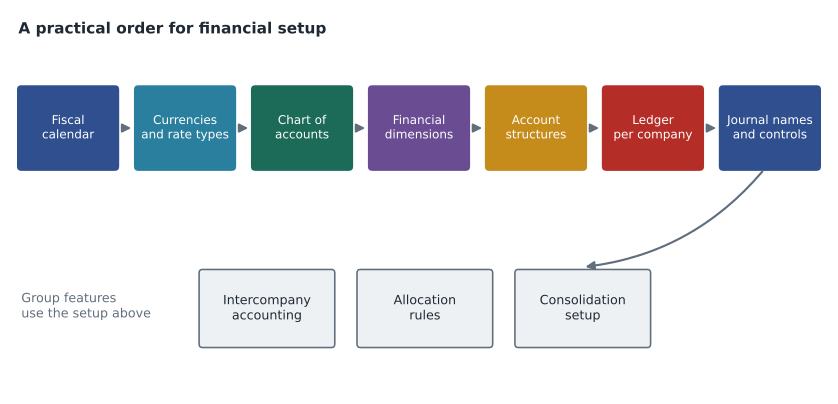
A dependency-driven setup order
Much of the configuration order is forced by dependencies. The Ledger page for a legal entity asks for a chart of accounts, account structures, a fiscal calendar, an accounting currency, a reporting currency and exchange rate types. None of these can be selected until they exist. Account structures in turn need main accounts and financial dimensions to exist. Journal names need voucher number sequences. So a sensible order is: fiscal calendars; currencies and exchange rate types; the chart of accounts and its main accounts; financial dimensions and their values; account structures; the ledger for each legal entity; then journal names, posting controls and the group features.
Annelise recommended building this order into the project plan as a configuration checklist, with an owner and a target date for each item. Thandeka owned the design decisions. Annelise owned the configuration. Desmond, the developer, owned any data entity extensions needed for migration. Kiri Langford, the project manager, tracked the checklist against the plan. The checklist would be reused when CRMX was added and again whenever Cobalt Ridge acquired another company.
Key design questions
Annelise's slide listed the questions that would shape everything else. Each one would be answered in the lessons that follow, but she wanted the team to see them together.
| Question | Why it matters | Cobalt Ridge answer |
|---|---|---|
| One shared chart of accounts or one per company? | A shared chart makes consolidation and comparison simple. | One shared chart for CRCA, CRUS and CRMX |
| What does each posting need to describe? | This decides the financial dimensions. | Business unit, department, cost center, product line, plant |
| Which combinations are valid? | This drives account structures and data quality. | Balance sheet accounts with few dimensions; profit and loss with all |
| What fiscal year? | Shared calendars simplify close and consolidation. | Calendar year with monthly periods for all three |
| Which reporting currency? | Group reporting needs one currency. | USD, the parent company currency |
| How are intercompany charges recorded? | Due-to and due-from balances must reconcile. | Intercompany accounting with one pair of accounts per company pair |
| How does consolidation work? | Defines a consolidation company or reporting-only approach. | Online consolidation into a consolidation company, plus multi-company reports |
Configuration versus customization
Thandeka asked a question every controller asks: could the system simply be made to work like the old one? Annelise drew a firm line between configuration, which uses settings, pages and data that Microsoft supports and updates, and customization, which uses code extensions written by a developer like Desmond. Finance setup is almost entirely configuration. The chart of accounts, dimensions, account structures, calendars and journals are all data. That matters because finance and operations apps follow the One Version update model: Microsoft ships service updates several times a year, and configuration carries forward without retesting code. Customizations must be retested on every update.
The practical rule Annelise gave the team was to try configuration first, then a supported extension point, and only then a new customization, and to record each customization request with a business reason and an owner. In the finance area, most requests for customization turn out to be report layouts, which are usually handled with financial reporting, electronic reporting or Power BI rather than code.
Worked problem
Ordering the setup
Kiri lists these tasks for CRMX in random order: create journal names; configure the CRMX ledger; create the MXN currency and rates; activate the account structures with the CRMX dimension values; create the 2027 fiscal year in the shared calendar. In what order should they be done?
Show solution
- The ledger needs a fiscal calendar and currencies, so the 2027 fiscal year and the MXN currency and rates come first.
- Account structures must be valid and active before the ledger uses them, so update and activate them next.
- Configure the CRMX ledger, selecting the shared chart, structures, calendar and currencies.
- Journal names need the ledger and voucher number sequences, so create them last.
Answer: Fiscal year, currency and rates, account structures, ledger, journal names. Dependencies drive the order.
Environments and moving configuration
The foundation course introduced Cobalt Ridge's environments: a developer environment for Desmond, the CONFIG sandbox for configuration and functional testing, and the UAT sandbox for user acceptance testing, migration rehearsals and training. Production would be provisioned about three weeks before go-live. Finance configuration is built and refined in CONFIG, where it can be changed freely. When a design is stable, Annelise exports it as data packages using the data management framework and imports it into UAT. The same packages, refined after testing, are imported into production.
This approach has a second benefit. The packages become a record of the configuration, and they can be reapplied when a new legal entity is created. For CRMX, many company-specific settings can be copied from CRCA or CRUS using the Copy into legal entity feature and then adjusted, rather than entered by hand. Shared data, such as the chart of accounts, dimensions and account structures, already exists for every company in the environment and only needs to be extended where CRMX needs new values.
Gathering country requirements
A multinational ledger has to satisfy more than one set of rules. Annelise asked Thandeka for a short list from each country before the design was finalized. For CRCA, that meant the federal and provincial sales tax returns, corporate income tax filings and the year-end financial statements the lenders received. For CRUS, it meant state sales and use tax returns, federal income tax and the same lender package. For CRMX, the list was longer: Mexican companies issue electronic invoices that the tax authority validates, keep accounting records in a prescribed electronic format with a grouping code for each account, and file returns monthly. The Mexico localization in Finance supports these requirements through country-specific features and electronic reporting configurations, which are turned on by the country on the legal entity's address.
These requirements shape the general ledger design in concrete ways. If the tax authority needs each main account mapped to an official grouping code, the chart of accounts needs a place to hold that mapping. If a lender's covenant is calculated on a specific definition of earnings, the financial reports need accounts arranged to produce it. If one country requires a fiscal year that differs from the group's, the ledger for that company needs its own calendar. Collecting these requirements early is cheaper than discovering them during the first statutory filing.
Annelise also asked about audit. External auditors want to trace any number in the financial statements back to vouchers and source documents, and they want evidence that controls such as journal approvals and posting restrictions work. Designing those controls into the setup from the start, rather than adding them after the auditors ask, was one of the reasons the finance workstream began with design rather than configuration.
Roles on the finance workstream
A finance implementation needs clear ownership. The controller or finance lead owns the design and signs off the configuration. The functional consultant turns requirements into setup and tests it. Key users from accounting, payables and receivables test their processes and later train others. The data migration lead maps old accounts to new and runs migration rehearsals. A developer builds any extensions and helps with integrations. On a smaller project several roles are held by one person; at Cobalt Ridge, Thandeka was both design owner and key user, and Annelise both consultant and data migration lead for finance.
Annelise ended the first session with a warning that would come up again and again: finance design is a business decision, not a system decision. The system can support almost any chart of accounts and any set of dimensions. The question is what the business needs to measure, who will maintain the data, and what reports the board, the lenders and the tax authorities expect. The rest of the course turns those answers into setup.
Common mistakes
MistakeStarting configuration before the chart of accounts and dimensions are designed.
InsteadAgree the design in writing first; configuration follows the design.
MistakeCopying the old chart of accounts line for line, including accounts that only existed to work around old system limits.
InsteadUse dimensions for detail the old system kept in account numbers, and keep main accounts for the natural classification of amounts.
MistakeEntering production setup by hand.
InsteadBuild in CONFIG, export data packages, and import the tested packages into UAT and production.
MistakeTreating report layout requests as customizations.
InsteadUse financial reporting, electronic reporting or Power BI for layouts before considering code.
Summary and key terms
- Financial management setup covers fiscal calendars, ledgers, the chart of accounts, financial dimensions, account structures, currencies, journals and group features.
- Most setup is shared across legal entities; ledgers and journal names belong to each company.
- Dependencies force a setup order: calendars and currencies, chart of accounts, dimensions, account structures, ledger, journals, then group features.
- Finance setup is configuration, which carries forward through One Version updates; customizations need retesting.
- Configuration is built in a sandbox and moved with data packages, which also speed up adding new legal entities.
- General ledger
- The module that records every financial transaction in main accounts and dimensions for a legal entity.
- Ledger
- The setup record that links a legal entity to its chart of accounts, structures, fiscal calendar and currencies.
- Success by Design
- Microsoft's implementation guidance for Dynamics 365, with initiate, implement, prepare and operate phases.
- Configuration
- Setting up the system with supported pages and data rather than code.
- Data package
- A file of exported data entities and a manifest, used to move configuration between environments.
Practice problems
Work each problem on paper first, then reveal the answer to check.
Why must account structures be set up before the ledger?
Show answer
The Ledger page requires account structures to be selected, so they must exist and be active first.
Name two benefits of moving configuration with data packages.
Show answer
Repeatable, tested moves between environments and a reusable record of configuration for new legal entities.
What share of the MB-310 outline did financial management carry when this course was written?
Show answer
About 35 to 40 percent, the largest area.
Lesson quiz · 5 questions
Score 60% or more to complete this lesson.
Create a free account to save your progress, take quizzes and earn a certificate.