
MSBA-320 · Lesson 4 of 12 · 18 min
Financial dimensions
▶ Video coming soon A video version of this lesson is on the way.
If the chart of accounts answers what an amount is, financial dimensions answer everything else: which business unit earned it, which department spent it, which plant made the product, which product line it belongs to. The fourth session was the one Thandeka had been waiting for, because her management pack was organized by exactly these questions and her old system could only answer them with account numbers and spreadsheets. Annelise opened the Financial dimensions page in the CONFIG sandbox and started with the basic idea.
What a financial dimension is
A financial dimension is an attribute recorded with a posting in addition to the main account. Each dimension has a set of dimension values. When a voucher posts, each line carries a main account and a value for each dimension that the account structure requires or allows. The combination, written for display with a separator such as 620100-MUN-ENG-HAM, is called a ledger dimension or account combination. Reports, inquiries, budgets and allocations can then summarize amounts by any dimension without needing separate accounts.
Finance supports two kinds of dimensions, and choosing between them is the first design decision for each one.
| Custom dimension | Entity-backed dimension | |
|---|---|---|
| Values come from | Entered on the Financial dimension values page | An existing table in the system, such as customers, projects, departments or business units |
| Maintained by | Finance master data users | The owner of the source records |
| Shared or per company | Always shared across legal entities | Some are shared, such as operating units; some are company-specific, such as customers |
| Value length | Up to 30 characters | Follows the source record |
| Good for | Classifications only finance cares about, such as product line | Organizations and records that already exist, such as departments and projects |
Entity-backed dimensions
An entity-backed dimension takes its values from another part of the system. When you create the dimension, you choose the source in the Use values from field: for example Departments, Cost centers, Business units, Projects, Customers, Vendors, Workers or Fixed assets. The advantage is that values are maintained in one place. When the human resources team creates a new department, the Department dimension immediately has a new value; nobody in finance needs to remember to add it. Renaming or deleting an entity-backed value is done in the source record, not on the dimension values page.
Some entity-backed values become available only when they are first used. Microsoft's documentation explains that a new record, such as a customer, does not appear as a selectable dimension value until it has been referenced in a transaction, posting profile, journal or similar context. Annelise mentioned this because testers often look for a brand-new customer in a dimension lookup and assume something is broken.
Some entity-backed dimensions are company-specific, also called company-striped. A customer dimension in CRCA only shows CRCA's customers. Operating unit dimensions, such as business unit and department, are shared, because operating units are not tied to one legal entity. That made the operating units from the foundation course an ideal basis for Cobalt Ridge's organizational dimensions.
Custom dimensions
A custom dimension has values that are entered and maintained directly on the Financial dimension values page. Custom dimensions are always shared across legal entities. They suit classifications that exist only for financial reporting and have no other home in the system. Cobalt Ridge's Product line dimension was a good example: product lines such as CENTRIF for municipal centrifugal pumps and SLURRY for mining slurry pumps were used in sales reporting and margin analysis, but there was no other table where they naturally lived.
Cobalt Ridge's dimension design
After two workshops with Thandeka and Piotr, Annelise settled on five dimensions. The number was deliberate. Every additional dimension adds data entry for users and combinations for the account structures, so each one had to answer a real reporting question.
| Dimension | Type | Values (examples) | Reporting question |
|---|---|---|---|
| BusinessUnit | Entity-backed: business units | MUN Municipal Water, MIN Mining, CORP Corporate | Profit by business unit |
| Department | Entity-backed: departments | ENG, OPS, FIN, SAL, IT, HR | Spending by function |
| CostCtr | Entity-backed: cost centers | CC100 to CC480 | Budget responsibility |
| ProductLine | Custom | CENTRIF, SLURRY, PARTS, SERV | Margin by product line |
| Plant | Custom | HAM, AKR, CGY, DEN, MTY | Cost by physical site |
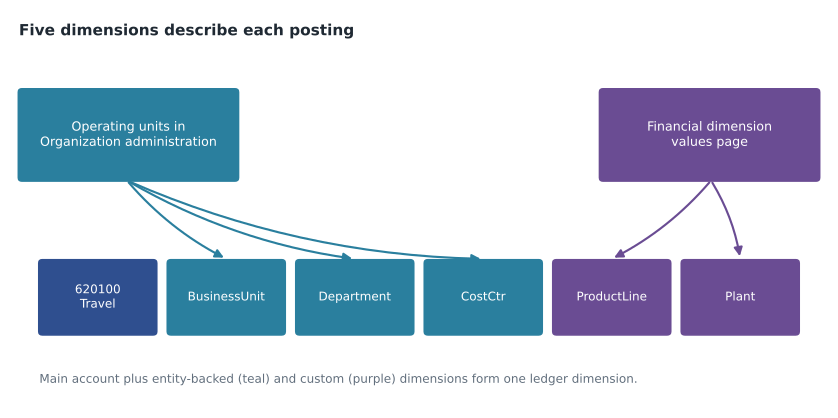
Thandeka asked why Plant was a custom dimension rather than backed by sites from Supply Chain Management. Annelise explained that sites are company-specific, while Cobalt Ridge wanted one list of plant codes across all three companies for group reporting. A custom dimension gave that shared list. The supply chain courses would show how inventory postings can default the plant value from the site.
Activating dimensions
Creating a dimension is not the end. A new dimension must be activated before it can be used, and activation changes the database. Microsoft's documentation explains that dimension activation adds a column for each financial dimension to the tables that store dimension combinations, and that SQL Server places a schema lock on those tables while it runs. For that reason, activating dimensions requires maintenance mode in production, so that no open transactions are affected and every server picks up the change. In sandbox environments, the Dimension attribute activation data entity can also be used; in production it cannot. Activation should therefore be scheduled for a planned maintenance window, and in practice most dimensions should be created and activated before go-live.
Annelise created and activated all five dimensions in CONFIG during the session, then added a note to the cutover plan: the same dimensions would arrive in UAT and production as part of a data package, followed by activation in the production maintenance window before migration.
Legal entity overrides on dimensions
Dimensions, like main accounts, have Legal entity overrides. You can suspend a dimension or a single value for specific companies, set active dates and record an owner. Cobalt Ridge used this to suspend the Plant values DEN and AKR for CRCA and HAM and CGY for CRUS, so users could not accidentally post a Canadian expense to an American plant. MTY, the Monterrey hub, would be active only for CRMX from January 1, 2027. Overrides are a cheap control that prevents a whole class of posting errors.
Default dimensions
Most dimension values reach transactions without anyone typing them. Master records such as customers, vendors, items, workers, fixed assets and projects can carry default dimensions. When a document is created, the system copies the defaults from the relevant records onto its lines. A purchase order for a CRCA engineering department buyer might pick up Department ENG from the worker and Plant HAM from the site, while the item supplies ProductLine PARTS. Where several records supply a value for the same dimension, the system applies an order of precedence defined for each document type, and users can change the values on the document before posting if they are allowed to.
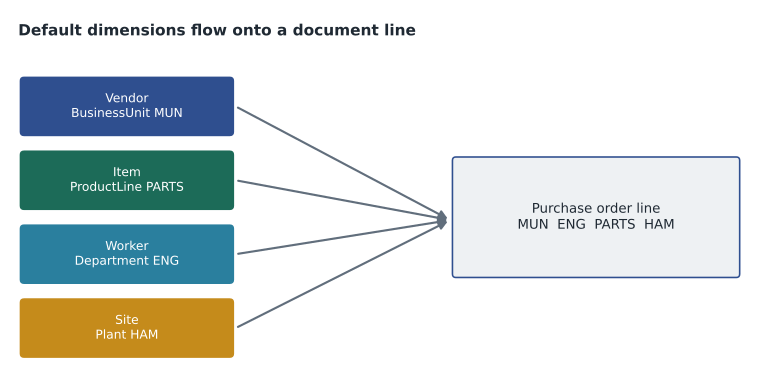
Default dimensions are where dimension quality is won or lost. If every customer and vendor has the right business unit, most postings will be correct without any effort from users. Annelise asked Piotr's team and the accounts payable lead to own default dimension values on items and vendors, and added a migration rule that no master record could be loaded without them.
Derived dimensions
A derived dimension sets other dimension values automatically when one value is entered. For example, Cobalt Ridge could derive BusinessUnit from CostCtr: if a cost center always belongs to one business unit, selecting CC210 would fill in MIN. Derived dimensions are configured on the dimension that drives them, by listing the dimensions to derive and the value combinations. They reduce data entry and make inconsistent combinations less likely, though they need maintenance whenever the organization changes.
Worked problem
Choosing the dimension type
Thandeka wants to report revenue by sales region: East, Central and West. Regions are not organizations in the system, salespeople move between regions, and finance will maintain the list. Should SalesRegion be custom or entity-backed?
Show solution
- Check whether a source table already holds regions: no operating unit or other record represents them.
- Check who maintains the list: finance, not another department.
- Check sharing: regions apply to all three companies, and custom dimensions are always shared.
- Consider whether the region could be derived from another value, such as the customer, to save entry.
Answer: A custom dimension, with default values on customers so most sales postings fill it in automatically.
Thandeka asked who would own each dimension. Annelise suggested that owners match the source: the human resources team for Department, the controller's team for CostCtr and ProductLine, and the operations team for Plant, with the finance master data team approving any new value before it was used in budgets. Ownership was recorded with each dimension using the owner setting in the legal entity overrides, so that anyone looking at the dimension could see who to ask.
Dimension sets for reporting
Reporting on every combination of five dimensions at once is rarely useful. A financial dimension set defines which dimensions to summarize by, such as Main account and BusinessUnit, or Main account, Department and CostCtr. The trial balance and other inquiries use dimension sets to show balances at the chosen level. Balances for each set are kept up to date by the system, and a set can be rebuilt if needed. Annelise created four sets that matched Thandeka's common views.
Financial tags
Finance also offers financial tags, an alternative to dimensions for information that is useful to record but not to validate. An organization can create up to twenty user-defined tags and enter values on transactions. Tags do not need activation, are not part of account structures and do not create new account combinations. Good uses are reference values such as a contract number or a campaign code that the business wants to search by. Annelise suggested a tag for the customer's purchase order reference on manual revenue journals. Microsoft documents the differences between tags and dimensions in a separate article, which is worth reading before choosing between them.
Checking dimension data
Even with defaults and derived values, some combinations will be wrong. Finance provides a Dimension data validation page that checks whether a ledger account or a default dimension combination is structurally valid against the current account structures. Annelise planned to run it after every migration rehearsal, because master records loaded from the old system were the most likely source of invalid defaults. A vendor with a default department that no longer exists, or a customer with a plant suspended for its company, would show up there before it caused a posting error on a real invoice.
Validation also matters when the organization changes. If Cobalt Ridge closes the Calgary warehouse in a few years, the CGY plant value can be suspended from a date, but every vendor, item and worker that carries CGY as a default will need a new value. The validation page, together with a simple inquiry on master records filtered by the old value, turns that clean-up into a list of records rather than a hunt.
Dimensions in other modules
Dimensions are not only for the general ledger. Budgets in budgeting are entered by main account and dimensions, so dimensions that budget owners are responsible for, such as CostCtr, must be in the account structures used for budgeting. Fixed assets carry default dimensions that flow into depreciation postings, so the cost of a machine in the Akron plant lands on the right plant and department every month. Projects can be an entity-backed dimension in their own right. Planning these uses early keeps the dimension design consistent across the whole implementation.
A change in the dimension service
Microsoft's documentation also notes a recent change. The Financial dimension service, an optional performance feature for large general journal imports through data management, is deprecated from September 11, 2026 with version 10.0.49, and future investment goes to optimized financial dimension handling. For Cobalt Ridge this changed nothing in the design, but Annelise noted it for the migration plan in lesson 11, because older migration guides recommend enabling that service.
Common mistakes
MistakeCreating a dimension for every attribute someone might want to report on.
InsteadKeep dimensions to real reporting questions; use financial tags for searchable references.
MistakeActivating a new dimension in production during working hours.
InsteadActivation requires maintenance mode in production; schedule it in a planned window, ideally before go-live.
MistakeMaking Department a custom dimension when departments already exist as operating units.
InsteadBack organizational dimensions with operating units so values are maintained once.
MistakeLeaving default dimensions empty on vendors, customers and items.
InsteadSet defaults on master records so postings are correct without manual entry.
Summary and key terms
- Financial dimensions describe each posting beyond the main account; values combine with the account into a ledger dimension.
- Custom dimensions are maintained on the dimension values page and always shared; entity-backed dimensions take values from existing records.
- Activation changes the database and requires maintenance mode in production.
- Legal entity overrides suspend dimensions or values per company; default and derived dimensions fill values automatically.
- Dimension sets summarize balances for inquiry; financial tags record up to twenty unvalidated attributes.
- Financial dimension
- An attribute, such as business unit or department, recorded with a posting in addition to the main account.
- Entity-backed dimension
- A dimension whose values come from an existing table such as departments or customers.
- Custom dimension
- A dimension whose values are maintained on the Financial dimension values page and shared across companies.
- Default dimension
- A dimension value stored on a master record and copied onto documents.
- Derived dimension
- A rule that fills in other dimension values when one value is selected.
- Financial tag
- A user-defined attribute recorded on transactions without validation or activation.
Practice problems
Work each problem on paper first, then reveal the answer to check.
Why did Cobalt Ridge make Plant a custom dimension?
Show answer
It needed one shared list of plant codes across all companies, and sites are company-specific.
What must happen in production before a new dimension can be used?
Show answer
It must be activated during maintenance mode.
Give one good use of a financial tag.
Show answer
A reference such as a contract or customer purchase order number that should be searchable but not validated.
Lesson quiz · 5 questions
Score 60% or more to complete this lesson.
Create a free account to save your progress, take quizzes and earn a certificate.