
MSBA-281 · Lesson 5 of 12 · 20 min
Opportunity management and pipeline view
▶ Video coming soon A video version of this lesson is on the way.
Every Monday at eight, Ottilie ran the pipeline meeting. Before Dynamics 365 it had been a spreadsheet that each seller updated on Sunday night, or forgot to. Since go-live it had been the opportunity list on the big screen, filtered to deals closing this quarter. It was better, but the meeting still spent most of its hour on one question: which of these deals is actually going to happen? Joaquim's refit at Harbor View Marina had been at 70 percent probability for six weeks. Nobody had spoken to the harbormaster since the site visit. "The record says it's healthy," Ottilie said. "I don't believe the record."
Before agents can help with opportunities, the opportunity records and the views sellers use must be in good order. This lesson covers how opportunities are managed in Dynamics 365 Sales, the pipeline view that sellers and managers work from, and the data an agent reads when it assesses an opportunity. It also introduces the risk signals that the Sales Opportunity Agent looks for, which lesson 7 covers in detail.
What an opportunity holds
An opportunity is a potential sale with an expected value and close date. It is usually created when a lead is qualified, or directly by a seller for an existing account. The columns that matter most for pipeline management, forecasting and agents are a small set, and Mirela asked sellers to treat them as non-negotiable.
| Column | What it means | Used by |
|---|---|---|
| Account and contact | Who the deal is with | Research, relationship insights |
| Estimated revenue | Expected value of the deal | Pipeline totals, forecasts, agent importance and risk |
| Estimated close date | When the seller expects a decision | Forecasts, agent risk assessment |
| Probability and rating | The seller's confidence | Weighted pipeline, scoring |
| Forecast category | Pipeline, Best case, Committed, Omitted, Won or Lost | Forecast columns |
| Pipeline phase | Set from the business process flow stage category | Pipeline charts |
| Budget amount, customer need, pain points | What the customer said | Agent research and summaries |
| Stakeholders and competitors | People involved and rival suppliers | Agent research, deal intelligence |
Microsoft's FAQ for the Sales Opportunity Agent lists the opportunity fields the agent uses: account, contact, estimated close date, actual close date, estimated revenue, budget amount, customer need and customer pain points, together with related competitors, connected accounts and stakeholders. Estimated revenue and estimated close date are used to assess importance and risk. If those fields are empty or stale, the agent has less to work with; if the competitor and stakeholder lists are empty, it shows that no insights are available.
The pipeline view
The pipeline view in Dynamics 365 Sales is a single workspace for reviewing and updating opportunities. It combines a list or grid of opportunities with charts and a side panel for the selected record. Sellers can edit key columns inline, such as estimated revenue, close date and forecast category, without opening each record. Managers can filter by team, period and stage. Microsoft has invested in this view as the main place where agent insights appear: the Sales Opportunity Agent shows its findings as action cards in the opportunities list and in a summary banner on the opportunity form.
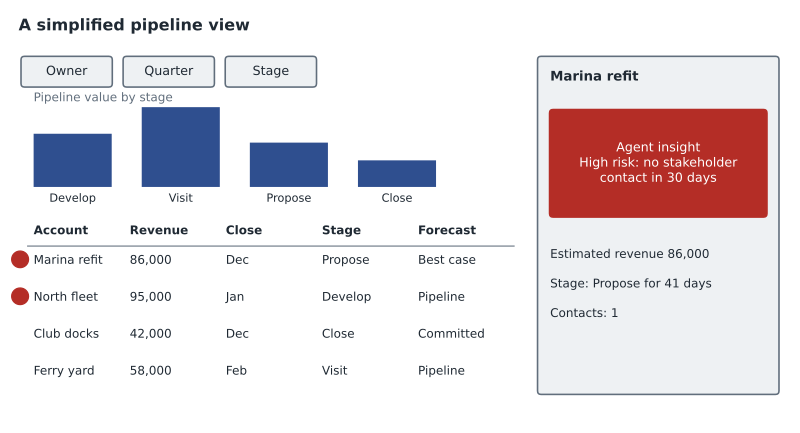
Kestrelbay adopted the pipeline view as the screen for the Monday meeting, replacing the filtered list. Mirela set up three saved views: My open deals for sellers, Team this quarter for Ottilie, and Large deals, for opportunities above 40,000 dollars of any age. Sellers were asked to update their deals in the pipeline view before eight on Monday, using inline editing. The rule had a side effect that pleased Ottilie: because updating was quick, sellers did it.
Keeping the pipeline honest
A pipeline is only as useful as its dates and amounts. Three problems appear in almost every sales team, and all three hurt both forecasting and AI.
Stale close dates. A deal whose close date has passed but is still open is a sign that nobody is managing it. Kestrelbay found 14 such deals after go-live. Mirela added a view filter called Overdue and a weekly scheduled flow, described in lesson 10, that creates a task for the owner of every overdue deal.
Happy-ears probability. Sellers tend to keep probability high on deals they like. Predictive opportunity scoring, configured in the previous course, gives a second opinion from history. The rule Ottilie adopted was not to overrule the seller but to discuss any deal where the seller's probability and the score differed by more than 30 points.
Missing people. Many refit deals had only one contact, usually the marina manager, even though a marina board or owner made the decision. The opportunity's stakeholders and the account's contacts matter for relationship insights and for the agent's research. Mirela added the Stakeholders subgrid to the opportunity form and asked sellers to add at least the decision maker and one other person to every deal above 40,000.
Worked problem
Reading a stalled deal
Joaquim's Harbor View Marina refit: estimated revenue 86,000, close date in five weeks, probability 70, forecast category Best case, stage Propose for 41 days. The last activity was a site visit report seven weeks ago. One contact: the marina manager. Score: 38. What does this record tell a manager?
Show solution
- Time in stage: 41 days in Propose is about twice Kestrelbay's average, which suggests the proposal is not moving.
- Activity: no email, call or meeting in seven weeks is a disengagement signal.
- People: one contact on a deal that needs board approval means the real decision makers are unknown.
- Score versus probability: a 32-point gap is a reason to discuss, not a verdict.
Answer: The deal is at risk despite its 70 percent probability. Joaquim should contact the manager this week, ask who on the board decides, add them as stakeholders and either confirm the date or move the deal to Pipeline.
Opportunity close and lost reasons
When a deal is won or lost, the seller closes the opportunity with a status reason. In the previous course Kestrelbay defined lost reasons: Price, Delivery time, Chose competitor, Project canceled and No decision. Close data is not just history. Predictive scoring learns from won and lost deals, the Sales Research Agent can answer questions about why deals are lost, and agents that assess risk use past patterns. A habit of closing deals promptly and honestly, with the right reason and competitor, makes every AI feature better.
Where agents fit in opportunity management
Lessons 6 to 8 introduce three kinds of agent help with opportunities. The Sales Opportunity Agent researches selected opportunities, surfaces stakeholder and competitor intelligence, and assesses risk and importance, showing the results in the pipeline view. The Sales Research Agent answers questions about the pipeline as a whole, such as which segments are slipping. And for simple, high-volume deals, agents that engage customers directly are possible: the Sales Close Agent did this in preview until it was retired in 2026, and its successor is the Sales Development agent.
There is also the Recommended Actions Agent, which Microsoft describes as providing prioritized actions to help sellers focus on the most effective tasks for their opportunities, and AI-powered data enrichment, which enriches opportunity data based on email interactions. Kestrelbay did not configure these in the first agent stage, but they use the same opportunity data and benefit from the same discipline.
Risk signals in plain terms
Microsoft's training describes the Sales Opportunity Agent detecting risks such as disengaged stakeholders, gaps in communication and emerging competitive pressure, drawing on CRM updates, email threads, meeting intelligence and web research. These are the same signals an experienced sales manager looks for, and it helps to understand them before handing them to an agent.
A disengaged stakeholder is a person on the deal who has stopped replying or attending. A communication gap is a long silence on the deal as a whole. Competitive pressure appears when a competitor is mentioned in an email or meeting, or when a competitor announces something relevant. Other signals include close dates that keep moving, revenue that keeps shrinking and deals that skip stages. None of them proves a deal will be lost, but each is a reason to act.
Data quality checklist for agent-ready opportunities
Before turning on the Sales Opportunity Agent, Mirela ran a one-off clean-up with the sellers, using a checklist that any team can reuse.
| Check | Target before the pilot |
|---|---|
| Open deals with a close date in the past | None |
| Deals above 40,000 with a decision maker stakeholder | All |
| Deals with customer need filled in | At least 80 percent |
| Competitors recorded where known | All refits and fleet contracts |
| Sellers' mailboxes synchronized | All 18 |
| Lost deals in the last year with a reason | All |
The clean-up took three afternoons. It moved six overdue deals to Lost with the reason No decision, added 31 stakeholders and filled in customer need on 40 deals. Ottilie said it was the most useful pipeline meeting they had ever had, and no agent had been turned on yet.
Pipeline reviews with agents in the room
Mirela suggested a new rhythm for the Monday meeting once the agent was running. Sellers update their deals by eight, the agent refreshes its research on its schedule, and the meeting starts with the deals that carry an agent risk card. For each one, the owner says whether they agree with the risk and what they will do. That turns the agent's output into a conversation, which is the point: the agent notices, the seller decides.
Opportunity hygiene as a weekly routine
The clean-up made the pipeline honest once. Keeping it honest needed a routine, so Mirela wrote a short weekly checklist that each seller ran before the Monday meeting, taking about ten minutes. Open every deal in My open deals with a close date in the next 30 days and confirm or change the date. Check that each deal above 40,000 has a decision maker. Close anything that is dead, with an honest reason. Add any competitor the customer has mentioned. Read any agent risk card and either act or note why not. The checklist became part of the pipeline view itself: Mirela added a column showing days since the last activity, so the oldest deals sorted to the top.
Pipeline coverage
Managers also need to know whether there is enough pipeline to meet the target. Pipeline coverage compares open pipeline value for a period with the remaining target for that period. A common rule of thumb in business-to-business sales is that coverage of about three times the remaining target is comfortable, though the right ratio depends on the team's win rate. Kestrelbay's win rate on refits was about one in three, so Ottilie used three times as her warning line for the quarter. Coverage depends entirely on honest amounts and dates, which is another reason the clean-up mattered.
Worked problem
Checking pipeline coverage
Ottilie's team needs 420,000 more in won revenue this quarter. Open pipeline closing this quarter is 1,080,000. The team wins about one deal in three by value. Is coverage adequate?
Show solution
- Coverage ratio: 1,080,000 divided by 420,000 is about 2.6 times.
- Expected revenue at a one-in-three win rate: about 360,000.
- Gap: about 60,000 short of the target if the win rate holds.
Answer: Coverage is below the three-times warning line; the team needs either more pipeline closing this quarter or a better win rate on the deals it has.
Mirela added one last note for managers. The pipeline view makes it easy to change many deals quickly, which is useful on a Monday morning and risky at the end of a quarter, when the temptation is to move dates to make the forecast look tidy. Auditing on opportunities, turned on in the previous course, records those changes, and Ottilie reviewed date changes in the last week of each quarter.
Common mistakes
MistakeLeaving close dates in the past on open deals.
InsteadReview overdue deals weekly and either update the date or close the deal.
MistakeRecording only one contact on large deals.
InsteadAdd the decision maker and other stakeholders so research and relationship insights have people to work with.
MistakeClosing lost deals without a reason or competitor.
InsteadRecord honest lost reasons; scoring and research agents learn from them.
MistakeExpecting an agent to fix a neglected pipeline.
InsteadClean the pipeline first; agents read the same records sellers do.
Summary and key terms
- Opportunities hold revenue, dates, probability, forecast category, need, stakeholders and competitors.
- The pipeline view combines filters, charts, an editable grid and a side panel where agent insights appear.
- Stale dates, inflated probability and missing stakeholders damage forecasts and AI alike.
- The Sales Opportunity Agent uses fields such as estimated revenue, close date, budget, need and pain points, plus competitors, connected accounts and stakeholders.
- Risk signals include disengaged stakeholders, communication gaps and competitive pressure.
- Opportunity
- A potential sale with an expected value and close date.
- Pipeline view
- A workspace that combines an editable list of opportunities with charts and a side panel.
- Forecast category
- The opportunity column (such as Best case or Committed) used by forecasts.
- Stakeholder
- A person involved in a deal, recorded on the opportunity.
- Action card
- An agent insight shown in the opportunities list.
- Risk signal
- Evidence that a deal may slip or be lost, such as a long silence.
Practice problems
Work each problem on paper first, then reveal the answer to check.
Which two opportunity fields does the Sales Opportunity Agent use to assess importance and risk?
Show answer
Estimated revenue and estimated close date.
Why did Kestrelbay add stakeholders to large deals before the agent pilot?
Show answer
Missing people limit research and relationship insights, and the agent shows no insights when stakeholders are absent.
Name three risk signals an experienced manager or the agent might notice.
Show answer
Disengaged stakeholders, long communication gaps and competitor mentions; also moving close dates and shrinking revenue.
Lesson quiz · 5 questions
Score 60% or more to complete this lesson.
Create a free account to save your progress, take quizzes and earn a certificate.