
MSBA-281 · Lesson 2 of 12 · 18 min
Lead generation and nurturing
▶ Video coming soon A video version of this lesson is on the way.
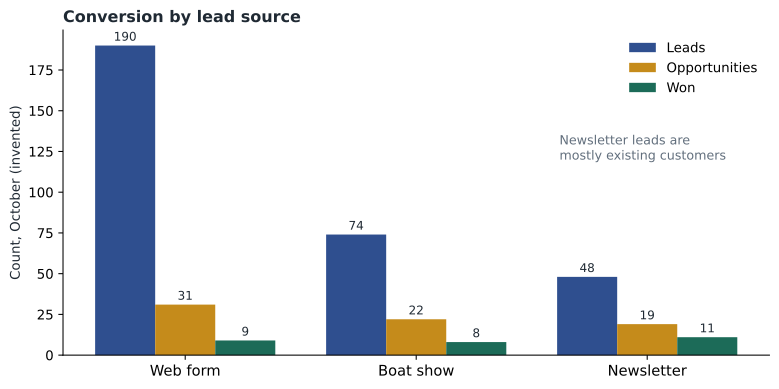
Before Kestrelbay let an agent near its leads, Mirela wanted to know where the leads came from and what happened to them. She exported October's 312 leads into a quick view grouped by source and status, and the picture was uneven. The web form produced the most leads and the fewest sales. The autumn boat show produced fewer, warmer leads, but half of them had no email address because sellers had scribbled names on cards. The marina newsletter produced a steady trickle from existing customers that sellers often treated as new business. "An agent will make all of this faster," Mirela said. "It will not make it cleaner. We clean first."
This lesson covers the lead side of Dynamics 365 Sales: where leads come from, how they are captured and nurtured until they are ready for a seller, and the data quality an agent needs. It sets up lessons 3 and 4, where the Sales Qualification Agent takes over much of the research and first contact.
What a lead is
A lead is a person or organization that has shown interest but has not yet been qualified as a real sales opportunity. In Dynamics 365 Sales a lead is a row in the Lead table that holds contact details, company details, the source and topic of the interest, and qualification information such as budget, purchase timeframe and decision maker. Qualifying a lead can create an account, a contact and an opportunity; disqualifying it closes the lead with a reason such as Lost, Cannot contact or No longer interested.
Leads are deliberately separate from accounts and contacts. That separation keeps unproven interest out of the customer list and lets the team report on conversion: of the leads that arrived from a source, how many became opportunities and how many became revenue? Every agent that works on leads depends on this structure, because its selection criteria, research and hand-over all operate on Lead rows.
Where leads come from
Leads reach Dynamics 365 Sales in several ways, and a team usually uses more than one.
| Source | How it arrives | Typical quality |
|---|---|---|
| Website form | A marketing form or integration creates a lead row | High volume, mixed intent |
| Events and trade shows | Imported lists or leads created by sellers on the mobile app | Warm, often incomplete |
| Inbound email and phone | Seller creates a lead or converts an email | Varies; often existing customers |
| Marketing journeys | Customer Insights – Journeys scores and passes leads to Sales | Nurtured and scored |
| Imports and partners | Data import of purchased or partner lists | Needs consent and deduplication checks |
| Agent and seller research | Sellers create leads from accounts or prospects they find | Targeted, low volume |
Kestrelbay used three of these in October. The web form on the Kestrelbay site posted directly into Dataverse through a small integration the web agency maintained. Boat show leads were typed in by sellers on the Sales mobile app or imported from a spreadsheet afterwards. Newsletter replies came into the shared sales mailbox and were converted to leads by hand.
Lead source and why it matters
In the previous course Mirela had made Lead source a required column and added the value Boat show. That decision paid off now. Lead source lets the team compare conversion by channel, gives scoring models a useful signal, and lets an agent treat different sources differently. The Sales Qualification Agent's selection criteria can include source, so Kestrelbay could, for example, send web leads to the agent while keeping newsletter replies from existing customers with their account managers.
Capturing leads cleanly
An agent researching a lead starts from what is on the record: name, company, email, website, phone, topic and source. Missing or wrong values produce poor research and outreach that bounces. Mirela set four capture rules before the agent pilot.
First, every lead needs either an email address or a company website, so that the agent has something to research and some way to reach the person. The web form already required an email; for boat show leads the mobile quick create form was changed so that email became required and a note field captured anything else.
Second, duplicate detection rules for leads were tightened. Kestrelbay had three duplicate rules from the first project, on accounts, contacts and leads. The lead rule matched on email address; Mirela added a second rule that matched a lead's company name against existing accounts, so a seller saw a warning when a "new" lead was really an existing marina.
Third, the newsletter mailbox was routed so that replies from people already linked to an account created a task for the account owner rather than a new lead. That removed most of the false new business from the lead list.
Fourth, Mirela turned on auditing for the Lead table, which had been enabled for leads, opportunities and accounts in the previous course but not checked. Auditing lets the team see later what an agent or a person changed on a lead, which matters once an agent is updating records.
Consent and outreach rules
Lead generation is regulated. In the United States, the CAN-SPAM Act requires commercial email to identify the sender, avoid deceptive subject lines, include a physical address and honor opt-out requests promptly, and some states add their own rules; privacy law also governs how personal information is collected and used. These rules apply whether a seller or an agent sends the message.
Dynamics 365 records contact preferences on leads and contacts, such as Do not allow email and Do not allow bulk email, and marketing tools record consent. Kestrelbay's web form included a consent box, and the integration wrote its value to a custom column, kb_emailconsent. Mirela made that column a selection criterion for any agent that would send email: leads without recorded consent would be researched but never contacted by an agent.
The principle is simple: agents do not remove legal duties. Before an agent sends outreach, confirm that the organization has a lawful basis for contacting each lead, that opt-outs are honored, and that messages identify the company. Then configure selection criteria so that leads without consent are never contacted automatically, and check a sample of agent emails during the pilot to be sure.
Nurturing: keeping leads warm until they are ready
Nurturing is the work of staying in touch with leads who are interested but not yet ready to buy, so that they come back when they are. A boat owner who asks in October about a spring refit is a good lead in February. Nurturing can be done with marketing journeys, with sales accelerator sequences, or with agent follow-ups.
Customer Insights – Journeys, Microsoft's marketing application, runs multistep journeys with emails, segments and scoring, and can pass sales-ready leads to Dynamics 365 Sales. Kestrelbay had deferred Customer Insights to a later phase, so it used two tools it already had. Sales accelerator sequences handled short, seller-led follow-ups: the New web lead, Boat show follow-up and Quote chase sequences from the previous course. For longer, low-touch nurturing, Ottilie's team used a quarterly newsletter. In lesson 3 the Sales Qualification Agent takes over some first-touch follow-up in research and engage mode.
| Tool | Best for | Who acts |
|---|---|---|
| Marketing journey | Long, multistep nurturing to many leads with scoring | Marketing team, automated sends |
| Sales accelerator sequence | Short, structured follow-up a seller works through | Seller, guided by the work list |
| Sales Qualification Agent (research and engage) | First contact and follow-up until buying interest is detected | Agent, handing over to sellers |
| Manual email and calls | High-value or sensitive leads | Seller |
Lead scoring and rating
Predictive lead scoring, configured in the previous course, gives each lead a score from 0 to 100 and a grade based on how similar leads converted in the past. The lead's rating column (Hot, Warm, Cold) is a simpler manual or rule-based signal. Both help sellers prioritize, and both can be used in agent selection criteria and hand-over rules. Microsoft's training also suggests a simple framework for thinking about lead quality called FIRE: Fit (does the lead match the ideal customer), Intent (have they shown buying interest), Recency (how recent is the interest) and Engagement (how much have they interacted).
Mirela warned the sellers against treating a score as a verdict. The model learned from Kestrelbay's history, which was short and included a migration year. A score is a reason to look first, not a reason to ignore a lead.
Worked problem
Cleaning a lead list before an agent pilot
Of 190 October web leads, 22 have no company name, 15 are duplicates of existing contacts, 9 are students asking for a school project and 30 have no consent recorded. Which should be in scope for an agent that sends outreach?
Show solution
- Merge or close the 15 duplicates against the existing contacts, so the account owners follow them up.
- Close the 9 student enquiries with a disqualify reason, after a polite standard reply.
- Keep the 22 without a company name in scope for research only; the agent can often find the company from the email domain, but outreach waits until a seller checks.
- Exclude the 30 without recorded consent from any automated outreach; they can still be researched.
Answer: About 114 leads are suitable for automated outreach, the 22 incomplete leads can be researched only, and the rest are handled by people or closed.
Lead hygiene as a habit
Clean data at the start of a pilot decays without habits. Kestrelbay set three: a weekly duplicate job on leads, run by Mirela until a sales operations owner was named; a monthly review of disqualify reasons by Ottilie; and a rule that any lead older than 90 days with no activity was disqualified as No longer interested unless a seller set a follow-up date. These habits keep the lead list a true picture of interest, which is what an agent needs to be useful.
Lead capture from events
Trade shows produce leads in bursts, and the burst is where quality is usually lost. Kestrelbay's spring boat show in February would bring three hundred conversations in four days. Mirela set up a boat show routine based on what had gone wrong in the autumn. Sellers would capture leads on the Sales mobile app with the quick create form, which now required email and lead source and offered a short choice list for interest: engines, electronics, mooring, safety, refit. A seller who could not get an email would create a contact task on an existing account instead of a lead. On the evening of each day, one seller would check the day's leads for duplicates and missing consent before anything went to an agent.
Lead routing before agents
Not every lead should go to an agent at all. Kestrelbay's routing rules, written in plain language before any selection criteria, made the decision explicit. Leads from existing accounts went to the account owner. Leads from harbor authorities, fishing fleets and boatyards went to the field rep for the territory. Leads from retail sailors and small clubs with consent went to the agent. Everything else went to the inside seller queue. Writing the rules first meant the agent's selection criteria could be checked against a business rule rather than invented in the settings screen.
| Lead type | First owner | Reason |
|---|---|---|
| Existing account contact | Account owner | Relationship already exists |
| Harbor authority, fleet or boatyard | Territory field rep | High value, complex buying |
| Retail sailor or small club with consent | Sales Qualification Agent | High volume, simple first contact |
| Any other lead | Inside seller queue | Needs a person to judge |
Ottilie added one habit of her own. Every month she read ten random leads that sellers had disqualified and ten that the agent would later disqualify, looking for business the team was throwing away. In November she found a yacht club planning a new clubhouse dock, closed as "no longer interested" because nobody had followed up.
Common mistakes
MistakeTurning on an agent to fix messy lead data.
InsteadClean sources, duplicates and consent first; agents amplify whatever data they are given.
MistakeTreating every newsletter reply as a new lead.
InsteadRoute replies from existing contacts to their account owner as tasks.
MistakeLetting automated outreach reach leads without recorded consent.
InsteadUse a consent column in selection criteria so those leads are researched but never contacted automatically.
MistakeReading a lead score as a final decision.
InsteadUse scores and ratings to order work, and keep human review of low scores.
Summary and key terms
- A lead is unqualified interest; qualifying it can create an account, contact and opportunity.
- Leads come from forms, events, email, marketing journeys, imports and research; lead source should always be recorded.
- Capture rules, duplicate detection and auditing keep lead data fit for agents.
- Consent and anti-spam rules apply to agent outreach exactly as they do to sellers.
- Nurturing uses journeys, sequences or agent follow-up; scores and ratings help prioritize but do not decide.
- Lead
- A person or organization that has shown interest but has not been qualified.
- Lead source
- The channel a lead came from, such as web form or trade show.
- Nurturing
- Staying in touch with interested leads until they are ready to buy.
- Duplicate detection rule
- A rule that warns when a new or updated row matches an existing one.
- Rating
- A simple Hot, Warm or Cold indicator on a lead.
- FIRE
- A lead quality framework: Fit, Intent, Recency and Engagement.
Practice problems
Work each problem on paper first, then reveal the answer to check.
Why should lead source be a required column before an agent pilot?
Show answer
It allows conversion reporting by channel, gives scoring a signal and lets agent selection criteria treat sources differently.
How did Kestrelbay stop newsletter replies from inflating new leads?
Show answer
Replies from existing contacts created tasks for account owners instead of new leads.
What did Kestrelbay do with leads that had no recorded consent?
Show answer
They could be researched, but selection criteria kept them out of automated outreach.
Lesson quiz · 5 questions
Score 60% or more to complete this lesson.
Create a free account to save your progress, take quizzes and earn a certificate.