
MSBA-281 · Lesson 12 of 12 · 18 min
Case study: a pipeline run by sellers and agents
▶ Video coming soon A video version of this lesson is on the way.
This final lesson brings the course together in two parts. The first part follows Kestrelbay's plan for the winter, written by Mirela and approved by the steering group on November 20, 2026: the design of its pipeline with sellers and agents working together, in the order it would be built and measured. The second part is a case for you to solve: a different company, with different constraints, for which you design an agent-assisted pipeline from the start. A model answer follows, but try your own first.
Part 1: Kestrelbay's winter plan
Mirela organized the plan around the work split from lesson 1 and the measures from lesson 11. Every element names an owner, a date and a gate.
| Element | Design | Owner | When |
|---|---|---|---|
| Lead capture | Lead source required; consent column; email required on mobile quick create; weekly duplicate job | Sales operations (Mirela until a hire) | In place |
| Sales Qualification Agent | Upgrade to research and engage, web leads with consent from retail and clubs only, no weekends, supervisor one hour a day | Bronagh (supervisor), Mirela (configuration) | January, if simulation averages 4 or more |
| Hand-over | BANT criteria with authority optional for retail; load-balanced assignment to inside sellers; Teams notification flow | Ottilie | With the upgrade |
| Sales Opportunity Agent | Refits and fleets instance on default refresh; second instance for large accessory orders | Ottilie (criteria), field reps (action on cards) | Second instance in spring, after Q4 outcome review |
| Sales Research Agent | Managers only; Bing consent off; saved monthly lost-reason workspace | Ottilie | In place |
| Simple deals | Seasonal sequence to existing boat owners pointing to the web shop | Inside sellers | February |
| Sales Development agent | Time-boxed test in Kestrelbay-Test with a small credit budget | Mirela | Spring 2027 |
| Capacity | One prepaid pack for Q1 2027; pay-as-you-go with Azure budget as safety net; monthly usage in steering pack | Ravi | From January |
| Reporting | Owners' Power BI report with agent page; monthly one-page review | Mirela and analyst | Monthly |
How a lead moves through the plan
Mirela tested the plan by walking one imagined lead through it. A retail sailor fills in the web form on a Tuesday evening in January, asking about winter storage covers for a 9 meter sailboat, and ticks the consent box. The integration creates a lead with source Web form and consent Yes. The next morning the Sales Qualification Agent picks it up because it matches the selection criteria, researches the sailor's club and boat class from public information, and sends a short email in Kestrelbay's voice from the agent mailbox, offering two cover options and a call with an inside seller. The sailor replies that they want a quote before the end of the month for a club member discount. The reply shows need, timeline and budget, so the agent hands the lead to Callan, who has the fewest open web leads. Callan gets a Teams message, reads the agent summary, qualifies the lead and sends a quote the same day.
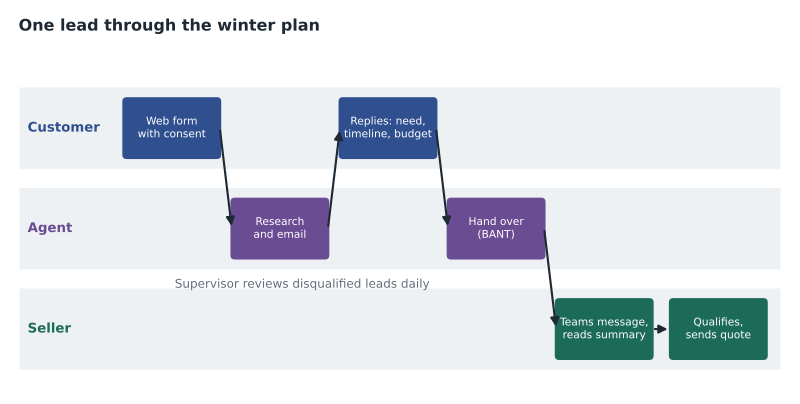
Two alternative paths were tested in the same way. A harbor authority filling in the same form is excluded by the selection criteria and stays with a field rep, because large public buyers need a person from the first contact. A student asking for a project interview is disqualified by the agent as low fit, appears on Bronagh's disqualified list, and gets a polite standard reply from her.
How a deal moves through the plan
For opportunities, the walk-through used a fleet contract. A fishing fleet with eleven vessels asks Joaquim for a winter maintenance contract worth about 95,000 dollars. Because the deal type is Fleet contract and the value is above 40,000, it enters the Refits and fleets instance of the Sales Opportunity Agent. Its value above 75,000 makes it important under Ottilie's criteria. Three weeks later the agent raises a risk card: the fleet's operations manager has not replied to two emails, and a competitor was named in his last message. Joaquim agrees with the card, calls the fleet owner directly, learns that the operations manager is on leave, adds the owner as a decision maker stakeholder and moves the close date by two weeks. The next refresh lowers the risk. In the Monday meeting, the card and Joaquim's response take two minutes instead of the usual ten.
The risks Mirela recorded
| Risk | Likelihood | Mitigation |
|---|---|---|
| Agent emails damage relationships | Medium | Narrow scope, simulation, tone instructions, supervisor review, no weekend sends |
| Agent disqualifies good leads | Medium | Daily review of disqualified leads; monthly fairness check by region and type |
| Capacity runs out mid-month | Low | Prepaid pack plus pay-as-you-go with budget alerts; monthly usage review |
| Preview features change or retire | High for previews | Previews only where a fallback exists; quarterly deprecation review |
| Data quality decays | Medium | Weekly duplicate job; overdue deal tasks; stakeholder rule on large deals |
| Sellers stop reading agent output | Medium | Risk cards first in Monday meeting; survey every six months |
Part 2: your case
Now apply the course to a different company. Gullhaven Marine Electronics is a hypothetical distributor of navigation and communication electronics for commercial and leisure vessels, with offices in Portland, Maine and Boston. It has 10 sellers: 4 inside sellers who handle leisure customers and 6 account managers who handle commercial fleets, ferry operators and boatyards. It runs Dynamics 365 Sales Enterprise. It receives about 400 web leads a month, three quarters from leisure boat owners asking about chart plotters and radios. Commercial deals range from 20,000 to 400,000 dollars and take three to nine months. The company's marketing list has consent records for about 60 percent of contacts. The sales director wants faster response to leisure leads and earlier warning on commercial deals. Finance has set a limit of 15,000 Copilot Credits a month for the first quarter.
Prepare a short design that answers these questions:
| Question | What a good answer covers |
|---|---|
| 1. Which agents, in which mode, for which records? | Mode choice and reasons; selection criteria; what stays with people |
| 2. What must be true before turning anything on? | Prerequisites; data clean-up; consent; mailbox and sync; roles; test environment |
| 3. How will hand-over and supervision work? | Criteria; assignment rules; who supervises and how often |
| 4. Will the credit limit be enough, and how will you know? | Measurement method; controls on consumption; safety net |
| 5. How will you judge success after the first quarter? | Measures at four levels; baseline; comparison; decision gates |
Worked problem
Model answer: Gullhaven Marine Electronics
Design an agent-assisted pipeline for Gullhaven within the constraints above.
Show solution
- Agents and scope: start the Sales Qualification Agent in research-only mode for leisure web leads with recorded consent, because only one mode runs per organization, the upgrade is one way and draft quality is unknown. Exclude commercial leads, which go straight to account managers. Configure one Sales Opportunity Agent instance for commercial opportunities above 50,000 dollars on the default three-day refresh. Give the Sales Research Agent to the sales director and two senior account managers with Bing consent off.
- Before turning on: clean duplicates and make lead source and consent reliable; complete the Sales agent prerequisites, a Copilot Studio license for the administrator, modern UI and data policies that allow the required connectors; add stakeholders and competitors to commercial deals above 50,000; synchronize all mailboxes; check custom roles, including Read on Connector; configure everything in a sandbox and export it as a solution.
- Hand-over and supervision: in research-only mode every processed lead goes to an inside seller by load-balanced assignment with research and a draft; a senior inside seller reviews disqualified leads daily for the first month; account managers review risk cards before a weekly pipeline meeting.
- Credits: measure credits per lead and per opportunity in the sandbox for two weeks. If, for example, a lead costs about 20 credits and a commercial deal about 80 credits a month, 300 leisure leads and 40 commercial deals would use about 9,200 credits, inside the 15,000 limit. Control consumption with narrow criteria and refresh frequency; add pay-as-you-go with a budget alert so agents do not stop if a busy month exceeds prepaid capacity.
- Success after a quarter: activity (leads researched, deals refreshed), quality (drafts sent with light edits, reassigned disqualifications, risk cards agreed with), outcome (leisure lead response time and conversion against the previous quarter, with phone and showroom leads as a comparison group; commercial win rate on flagged deals once enough have closed), and cost (credits per lead and per deal against seller hours saved after supervision). Agree gates before starting, including the conditions for upgrading to research and engage.
Answer: A narrow research-only start for leisure leads, one opportunity agent instance for large commercial deals, managers-only research, measured credits with a safety net, and decision gates agreed in advance.
Common weaknesses in case answers
When this case is used in a classroom, a few weaknesses come up repeatedly. Answers often turn on research and engage mode at once, forgetting that the change is permanent and that 40 percent of contacts lack consent. Some select every open opportunity for the opportunity agent, which would burn the credit limit on small deals nobody needed help with. Many forget the comparison group, so a seasonal rise in spring boating enquiries would look like an agent success. And a surprising number propose the Sales Close Agent for leisure orders, which would have been reasonable in early 2026 but is no longer possible. Checking the current state of each agent is part of the job.
Bringing it together
Across this course, the same ideas returned in each lesson. Agents are workers with assigned records, rules, costs and supervisors. They depend on clean data and clear criteria, and they are only as safe as the narrowest sensible scope. They are built on Copilot Studio and billed in Copilot Credits, so cost grows with use and needs watching. Their features change, sometimes quickly, so plans must allow for previews and retirements. And their value is shown only by measures agreed in advance and read honestly. The AB-210 exam tests these ideas in the context of Dynamics 365 Sales; the next course in the program reviews its domains and practices exam-style questions.
Presenting the design
A design is only useful if the people who must approve and live with it understand it. Mirela presented Kestrelbay's winter plan to the steering group in twenty minutes, in a fixed order that works for any agent design: the business problem in one sentence; the work split, showing what people keep; the scope of each agent; what must be true before each step; how much it will cost and how that is controlled; how success will be judged and when; and the risks with their mitigations. Questions were taken at the end of each part rather than at the end, which kept the discussion on one decision at a time.
For the case in Part 2, prepare your answer in the same order. A design that can be presented clearly in twenty minutes is usually a design that has been thought through.
| Presentation part | Question it answers |
|---|---|
| Business problem | Why are we doing this? |
| Work split | What do people keep, and what do agents do? |
| Scope | Which records does each agent work on? |
| Readiness | What must be true first? |
| Cost | How much, and how is it controlled? |
| Measures and gates | How will we know, and when do we decide? |
| Risks | What could go wrong, and what will we do? |
When you have finished your own answer to the Gullhaven case, compare it with the model answer section by section, and look especially at the choices you made differently. There is rarely a single right design; there are designs whose reasons are clear and designs whose reasons are not.
Common mistakes
MistakeStarting with research and engage mode for all leads.
InsteadStart in research-only mode with a narrow scope, because the upgrade is permanent.
MistakeSelecting every open opportunity for agent research.
InsteadChoose a segment where early warning has real value, such as large commercial deals.
MistakeDesigning a plan around a retired agent.
InsteadCheck the current status of each agent and use supported alternatives.
MistakeLeaving measurement until the end of the quarter.
InsteadAgree measures, baseline, comparison group and gates before starting.
Summary and key terms
- A pipeline run by sellers and agents assigns each step an owner, a human check, a date and a gate.
- Walking individual leads and deals through the design tests it before anything is built.
- Narrow scope, prerequisites, supervision, capacity planning and measurement belong in every design.
- Plans must reflect the current state of agents, including previews and retirements.
- Winter plan
- Kestrelbay's approved design for its agent-assisted pipeline.
- Walk-through
- Testing a design by following one record through every step.
- Risk register
- A list of risks with likelihood and mitigation.
- Safety net
- Pay-as-you-go capacity with a budget that keeps agents running if prepaid capacity runs out.
- Scope
- The records an agent is allowed to work on, set by selection criteria.
- Gate condition
- The result that must be met before the next stage, such as an upgrade.
Practice problems
Work each problem on paper first, then reveal the answer to check.
Why did the model answer start Gullhaven in research-only mode?
Show answer
Only one mode runs per organization, the upgrade is one way, draft quality is unknown and consent covers only 60 percent of contacts.
Which records did the model answer exclude from the qualification agent, and why?
Show answer
Commercial leads, because they are high value and need an account manager from the first contact.
What keeps the agents running if a busy month exceeds prepaid capacity?
Show answer
Pay-as-you-go linked to an Azure subscription with a budget, used after prepaid capacity.
Lesson quiz · 5 questions
Score 60% or more to complete this lesson.
Create a free account to save your progress, take quizzes and earn a certificate.