
MSBA-141 · Lesson 5 of 12 · 21 min
Users and security roles
▶ Video coming soon A video version of this lesson is on the way.
Thandeka had a list of worries about access that she had been keeping for years. In the old system, almost everyone in finance had the same administrator login, because setting up proper permissions had been too hard. She wanted the new system to answer three questions with certainty: who can do what, why they can do it, and whether anyone can do two things that should be kept apart, such as creating a vendor and paying it. Annelise said those were exactly the questions role-based security was designed to answer, and that the fourth session would be spent on users and roles.
Users and Microsoft Entra ID
A user in finance and operations apps is a sign-in account linked to an identity in Microsoft Entra ID, the identity service behind Microsoft 365. The application does not store passwords; people sign in with their work account, and Entra ID handles authentication, multifactor authentication and Conditional Access policies set by the company's identity administrators. Inside the application, the user record holds a user ID, the link to the Entra ID account, a default company, language and other options, and, most importantly, the security roles assigned to the person.
Users are created on the Users page under System administration. An administrator can create them one at a time, or use Import users to select people from Entra ID, optionally by group, and create user records for them in one step. Imported users are given a default role that allows sign-in but very little else; administrators then assign the roles each person needs. Users who leave the company should be disabled in the application as well as in Entra ID, and their roles removed, so that the user list stays an honest picture of who has access.
Some environments also use security groups from Entra ID to manage access at scale, so that membership of a group in Entra ID grants a set of roles. This keeps joiners, movers and leavers in one place, the identity system, which Cobalt Ridge's IT team preferred. Whether to manage roles user by user or through groups is a design choice for each company.
The layers of role-based security
Finance and operations apps use role-based security. Access is never granted to a user directly; it is granted to roles, and users receive roles. The model has layers. A security role represents a job or function, such as Accounts payable clerk, Accounts payable manager, Buyer or System administrator. A role contains duties, each of which represents one part of a business process, such as Maintain vendor invoices or Inquire into vendor status. Duties contain privileges, each of which grants the permissions needed for one task, such as Enter vendor invoice. Privileges grant permissions on entry points, such as menu items, service operations and data entities, and on the tables and fields behind them, with levels such as read, update, create and delete.
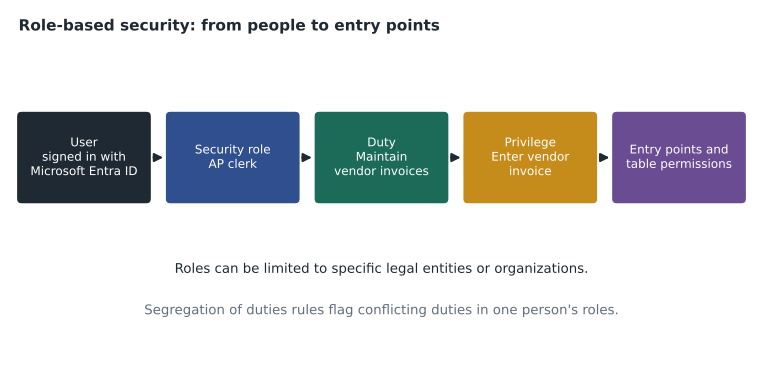
Microsoft ships hundreds of standard roles, duties and privileges that reflect common job functions. Most companies start from them, assign them, test, and then create custom roles where the standard ones do not fit. A custom role is usually built by combining standard duties and privileges, not by granting raw table access. Roles can include sub-roles, so a broad role such as Finance manager can include the clerk roles it supervises.
| Layer | Represents | Example |
|---|---|---|
| Security role | A job or function | Accounts payable clerk |
| Duty | Part of a business process | Maintain vendor invoices |
| Privilege | Access needed for a task | Enter vendor invoice |
| Permission | Access level on an entry point or table | Create on the vendor invoice menu item |
Assigning roles and limiting them by organization
Roles are assigned on the user record or from the Assign users to roles page, where an administrator can see every user who holds a role. By default a role applies in every legal entity. Organization-specific assignment narrows it: a role can be granted for selected legal entities, or for organizations in a hierarchy with the security purpose, so that the person's access applies only there. At Cobalt Ridge, the accounts payable clerks in Hamilton received their role for CRCA only, and the Akron clerks for CRUS only. Thandeka, who supervises both, received the manager role for both legal entities.
Organization-specific assignment is powerful but needs planning, because not every role supports it, and some data is shared and therefore visible regardless. It works best for transactional roles in multi-company environments, which is exactly Cobalt Ridge's situation.
Rules that assign roles automatically
For larger organizations, automatic role assignment rules can grant roles based on data, such as a worker's position or department, or membership of an Entra ID group. When someone changes jobs, their roles change with the data. Rules are reviewed and run on a schedule. Cobalt Ridge, with around 120 users, chose to assign roles manually at first and revisit rules after go-live.
Segregation of duties
Thandeka's concern about one person creating and paying a vendor is a classic segregation of duties problem. Finance and operations apps let administrators define segregation of duties rules, each naming two duties that should not be held by the same person, such as Maintain vendor master and Approve vendor payments. When an administrator assigns a role that would give a user both duties, the system flags the conflict. Existing conflicts can be found by a verification process, and conflicts can be logged with an override reason when a small company has no choice, as long as someone reviews them.
Worked problem
Spotting a conflict
Cobalt Ridge defines a rule that Maintain vendor master conflicts with Maintain vendor payments. A clerk in CRUS already holds the Accounts payable clerk role, which includes vendor invoice duties. Her manager asks for her to also receive the Accounts payable payments clerk role during a colleague's leave. What happens and what should be done?
Show solution
- The administrator assigns the payments role.
- If either role contains Maintain vendor master and the other Maintain vendor payments, the system reports a segregation of duties conflict.
- Options: assign the role temporarily with the conflict logged and a reviewer named, remove the vendor master duty for the period, or give the work to someone without the conflicting duty.
- Thandeka reviews the logged conflict at the end of the leave.
Answer: The system flags the conflict; the business decides whether to accept it temporarily with review or rearrange duties.
Record-level security
Roles decide which pages and tables a user can reach. Sometimes a company also needs to filter which records within a table a user can see, for example limiting buyers to vendors in their own procurement category. Extensible data security policies filter records based on a query, applied for selected roles. They are powerful and are usually designed by a developer and tested carefully, because a wrong policy can hide data that people need or slow down queries. Desmond added a note to evaluate them later.
Licenses follow roles
Every menu item carries a license requirement, so each role implies a license type. A role with access to create vendor invoices requires a full Finance license, while a role that can only approve workflow items or view reports may require a lighter license. Administrators can run reports that show the license each user needs based on their roles. Thandeka's request that every finance person have the administrator role would, apart from the control problem, have required the most expensive license for everyone. Good role design is also cost control.
Tools for understanding security
The security configuration page lets administrators view and edit roles, duties and privileges, see what each contains and create custom ones in a sandbox, then export and import the changes to other environments. Security diagnostics on a page shows which roles, duties and privileges grant access to it, which answers a user's question of why they cannot open something, or an auditor's question of who can. Task recordings can also be analyzed to show the privileges a process needs. Reports list users with their roles and roles with their users, which feed periodic access reviews.
Worked problem
Answering why a user cannot open a page
A buyer at the Denver warehouse cannot open the Vendor collaboration requests page. How does the administrator find out which role would give access?
Show solution
- Open the page as an administrator and run security diagnostics from the page options.
- The diagnostic lists the roles, duties and privileges that grant access to the page's menu item.
- Compare with the buyer's roles and their organization-specific assignment.
- Decide whether the buyer should have one of those duties, mindful of segregation of duties and license impact.
Answer: Security diagnostics shows the paths to access; the administrator then decides on the correct role or duty.
Testing roles before production
A role is only correct when the people who hold it can do their jobs and nothing more. Testing proves that. Annelise set up test users in the sandbox, one per planned role, each linked to a test account in Entra ID, and the key users ran their processes signed in as those test users rather than as themselves. Every failure was logged with the page and the action that was blocked. Each fix was made in the security configuration of the sandbox, retested, and then exported. Testing as an administrator, she pointed out, proves nothing about security, because the administrator role bypasses it; many projects discover broken roles on go-live day for exactly that reason.
Negative tests matter as much as positive ones. For each role the team wrote down two or three things the role must not be able to do, such as a buyer posting a vendor payment or a clerk changing a number sequence, and tried them. A blocked action counted as a pass.
Moving security changes between environments
Custom roles, duties and privileges built in the security configuration page live as data, not code, so they must be moved deliberately. The page can export the changes to a file and import them into another environment, after which they are published. Desmond preferred that security objects with a technical component be added to the code base as part of a deployable package, which keeps them under source control. Either way, the configuration log recorded which version of each custom role was in each environment, so that production never received a role that had not been tested.
Role assignments, by contrast, are environment-specific: who holds which role in the sandbox says nothing about production. For go-live, the team prepared the production role assignments as a data import, reviewed by Thandeka and Piotr line by line, so that each manager signed off on the access of their own staff.
Logging and evidence
Auditors ask for evidence, not intentions. Finance and operations apps can supply several kinds. The user and role reports show who holds what at a point in time. Database logging can record changes to sensitive setup tables, such as vendor bank accounts, number sequences and security assignments, with the user and time of each change; it should be targeted at what matters, because logging everything slows the system and fills storage. Sign-in activity is recorded in Microsoft Entra ID, where the identity team can see who signed in, from where and with what authentication method. Together these let Cobalt Ridge answer the auditors' standard request to show that access was appropriate for the whole year, not just on the day they asked.
The administrator role
The System administrator role has access to everything and bypasses most security checks. It should be held by very few people and used for administration, not daily work. Cobalt Ridge decided that Desmond and one IT administrator would hold it, that their daily work would be done under separate accounts with normal roles, and that the list of administrators would be reviewed every quarter. Annelise also recommended that consultants and partners receive administrator access only in sandboxes, and in production only when needed, with the access removed afterwards.
Designing roles for Cobalt Ridge
The team agreed a method. Start with standard roles that match each job description. Assign them in the sandbox to test users and run each tested process. Where a person needs more, add standard duties; where a role grants too much, create a custom role from a copy with duties removed. Define the segregation of duties rules the auditors expect. Use organization-specific assignment for legal entities. Document every custom role with its purpose and owner. And schedule an access review every six months, using the role reports, because access tends to grow as people change jobs.
Thandeka wrote the method on the first page of her notebook and underlined the access review. It was the answer to the question she had been asking for years.
Common mistakes
MistakeGranting the System administrator role to make a problem go away.
InsteadFind the missing privilege with security diagnostics and grant the narrowest duty that fixes it.
MistakeBuilding custom roles from raw table permissions.
InsteadCombine standard duties and privileges, which already group permissions for tasks.
MistakeIgnoring license impact when adding a duty to a widely used role.
InsteadCheck the license each change requires before deploying it.
MistakeLeaving leavers enabled in the application because Entra ID was disabled.
InsteadDisable the user and remove roles in the application as well.
Summary and key terms
- Users are linked to Microsoft Entra ID identities and are imported or created under System administration.
- Security roles contain duties, duties contain privileges, and privileges grant permissions on entry points and tables.
- Roles can be assigned for specific legal entities or organizations, manually or by automatic rules.
- Segregation of duties rules flag conflicting duties; extensible data security filters records.
- Roles drive license requirements; security diagnostics and reports support troubleshooting and access reviews.
- Security role
- A collection of duties and privileges that represents a job or function.
- Duty
- A group of privileges for part of a business process.
- Privilege
- The permissions needed to perform one task on entry points and tables.
- Entry point
- A way into the application, such as a menu item, service operation or data entity.
- Segregation of duties
- Keeping conflicting duties, such as creating and paying vendors, with different people.
Practice problems
Work each problem on paper first, then reveal the answer to check.
Where do users authenticate when they sign in?
Show answer
Microsoft Entra ID, using their work account.
How can a clerk's role be limited to one legal entity?
Show answer
Assign the role for that legal entity using organization-specific assignment.
What tool shows which roles give access to a page?
Show answer
Security diagnostics.
Lesson quiz · 5 questions
Score 60% or more to complete this lesson.
Create a free account to save your progress, take quizzes and earn a certificate.