
MSBA-141 · Lesson 1 of 12 · 19 min
Finance and operations apps overview
▶ Video coming soon A video version of this lesson is on the way.
On a gray Monday in September 2026, Kiri Langford gathered the Cobalt Ridge Manufacturing project team in the training room above the Akron plant. Cobalt Ridge makes industrial pumps: centrifugal pumps for municipal water systems, slurry pumps for mines and smaller units sold through distributors. It has run for twenty years on an on-premises system that its original accountant chose in 2005, patched and extended until nobody fully understood it. The board had approved a move to Microsoft Dynamics 365 Finance and Dynamics 365 Supply Chain Management, and Kiri, the project manager, had a simple rule for the first month: before anyone configured anything, everyone on the team would understand how the system was put together. Annelise Vorster-Kim, the functional consultant from the implementation partner, would run the sessions.
Around the table sat the people who would live with the decisions. Thandeka Morrow, the controller, owned the general ledger, payables, receivables and the monthly close. Piotr Vasquez-Lind, the supply chain manager, owned purchasing, inventory, the two plants and the two warehouses. Desmond Oyediran-Platt, the company's only in-house developer, had written most of the custom reports in the old system and would build whatever extensions the new one needed. Annelise began by drawing a single wide box on the whiteboard and writing one phrase inside it: finance and operations apps.
What the finance and operations apps are
Microsoft uses finance and operations apps as the umbrella name for a family of Dynamics 365 applications that share one code base, one database design and one set of administration tools. The family descends from the product once called Dynamics AX and, later, Dynamics 365 for Finance and Operations. Today it is sold as separate apps that a company licenses according to what it needs: Dynamics 365 Finance for financial management, Dynamics 365 Supply Chain Management for products, inventory, procurement, sales, warehousing, manufacturing and transportation, Dynamics 365 Commerce for retail and online channels, Dynamics 365 Project Operations for project-based businesses, and Dynamics 365 Human Resources functionality that now runs on the same infrastructure.
The important word is share. When Cobalt Ridge licenses Finance and Supply Chain Management, it does not get two systems connected by an interface. It gets one environment in which a purchase order created by Piotr's buyers produces a vendor invoice that Thandeka's clerks match, approve and pay, and the ledger postings land in the same database the moment each document posts. The apps are different licenses and different menus, but one application underneath.
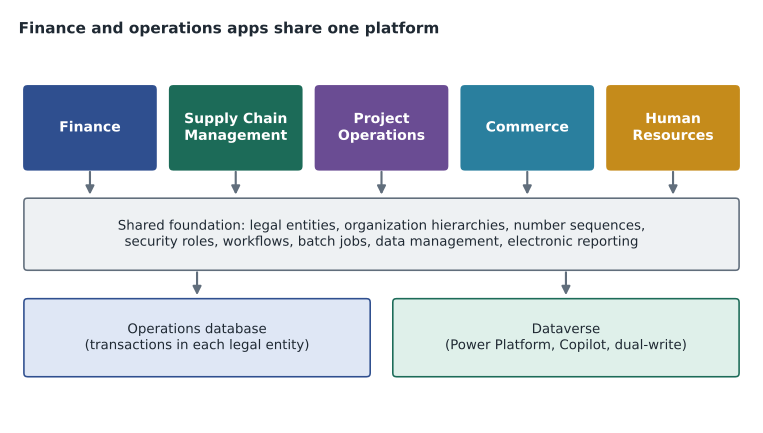
That shared foundation is what this course is about. Every later course in the finance, supply chain and developer programs assumes you can find your way around the screens, know what a legal entity is, understand why a purchase order number looks the way it does, know which security role lets a clerk post an invoice, and can import a list of customers without typing them in. These are the topics Microsoft groups under the heading of common functionality, and they appear on every finance and operations exam.
The course in the certification path
This course is the starting point for three Microsoft certifications: the Dynamics 365 Finance Functional Consultant Associate (Exam MB-310), the Dynamics 365 Supply Chain Management Functional Consultant Associate (Exam MB-330) and the Dynamics 365 Finance and Operations Apps Developer Associate (Exam MB-500). Each exam's study guide includes skills that rest on this common ground: navigating the apps, configuring legal entities and number sequences, setting up security and workflows, and using the data management framework. Microsoft revises study guides several times a year, so always read the current skills-measured list on Microsoft Learn before you book an exam; the skills, not any course outline, define what is tested.
| App | What it covers | Who at Cobalt Ridge uses it |
|---|---|---|
| Finance | General ledger, payables, receivables, cash and bank, budgeting, fixed assets, tax, expenses | Thandeka and the finance team |
| Supply Chain Management | Products, inventory, procurement, sales orders, warehouses, production, transportation, costing | Piotr, buyers, planners, plant and warehouse staff |
| Commerce | Stores, call centers, e-commerce, point of sale, pricing and loyalty | Not licensed; Cobalt Ridge sells through distributors |
| Project Operations | Project contracts, time and expenses, project accounting and billing | Considered for the field service team later |
| Human Resources | Workers, positions, leave, benefits and compensation | Kept in the existing HR system for now |
A cloud service that Microsoft runs
The old Cobalt Ridge system lived on a server in a cupboard. Desmond patched the operating system, Thandeka's assistant ran the backups, and upgrades happened when someone was brave enough. Finance and operations apps are a Microsoft-managed cloud service. Microsoft hosts the application and the operations database in Azure data centers, applies updates, monitors performance and keeps backups. Customers choose a region when the environment is created and are responsible for their own configuration, data, users and any extensions they write.
Updates follow a model Microsoft calls One Version. Everyone runs a supported version of the same product, numbered 10.0 followed by a release number such as 10.0.44. Microsoft ships a small number of service updates each year, each carrying new features and fixes, and in between applies smaller quality updates. Customers can pause or schedule updates within limits so that a release lands at a convenient time, but they cannot stay on an old version indefinitely. For Desmond this changes the rules of development: custom code must be written as extensions that sit beside Microsoft's code rather than edits to it, so that each update can be applied without breaking what Cobalt Ridge built. The developer courses cover that model in depth.
New features often arrive switched off. The Feature management workspace lists features that each update adds, with a description, the version that introduced them and a button to enable them. Some features become mandatory after a set number of releases. Part of an administrator's routine is to read the release plans, test new features in a sandbox and turn on the ones that help.
How the apps relate to Dataverse and the Power Platform
Finance and operations apps keep their transactional data in their own operations database, which is designed for high volumes of ledger and inventory transactions. Other Dynamics 365 apps, such as Sales and Customer Service, store their data in Dataverse, the data platform that also underlies Power Apps, Power Automate and Copilot Studio. For years the two worlds were connected by integrations. Microsoft has steadily brought them together: today a finance and operations environment is created through the Power Platform admin center with a Dataverse database attached, data can flow between the two through dual-write or appear in Dataverse as virtual tables, and features such as Copilot rely on the Dataverse side. Lesson 9 explains how this changes environment management.
For Cobalt Ridge, the practical result is that a low-code app built in Power Apps by Piotr's team can read and update finance and operations data, and a flow in Power Automate can react when a purchase order is confirmed. Desmond was pleased to hear that not every request would need X++ code.
Core concepts that run through every module
Annelise listed on the whiteboard the ideas the team would meet again and again. A legal entity is a company that is registered with authorities and keeps its own books; nearly every transaction belongs to one. Organization hierarchies arrange legal entities and operating units such as departments and business units for reporting and policy. Number sequences give documents their identifiers. Parameters pages hold the settings that switch each module's behavior on or off. Security roles decide what each person can see and do. Workflows route documents for review and approval. The data management framework moves data in and out. Electronic reporting produces regulated documents and files. Batch jobs run work in the background, and alerts tell people when something changes. Copilot adds AI assistance on top. Each of these has a lesson of its own in this course.
Worked problem
Mapping old habits to new concepts
Thandeka described three things the finance team did in the old system: they kept separate company files for the Canadian and US businesses, they typed invoice numbers from a paper log, and they emailed the owner for approval of any invoice over a set amount. Which finance and operations concepts replace each habit?
Show solution
- Separate company files become separate legal entities in one environment, which makes consolidation and intercompany transactions possible without exporting data.
- The paper log of numbers becomes a number sequence attached to the vendor invoice reference in Accounts payable parameters, so the system assigns the next number.
- Approval emails become a vendor invoice workflow with a condition on the invoice amount, so approvals are routed, recorded and auditable.
Answer: Legal entities, number sequences and workflows. Each replaces a manual habit with configuration the system enforces and records.
Implementations follow a method
Kiri explained how the project would run. Microsoft publishes an implementation method called Success by Design, which sets out review points through a project: an initiation phase that confirms scope and solution blueprint, an implementation phase in which the solution is configured and tested in iterations, a preparation phase for training, data migration rehearsals and cutover planning, and operation after go-live. The partner's own method fitted inside it. Kiri cared less about the names than about the order: understand the standard product first, decide what to configure, change processes where the standard way is reasonable, and write code only for genuine gaps.
That order matters because finance and operations apps are broad. Many companies that move from an older system try to recreate every report and screen they had. Annelise's advice was to start from the standard business processes Microsoft documents in its business process catalog, which describes end-to-end processes such as procure to pay and order to cash, and to treat each difference from the standard as a decision with a cost.
Licenses in broad terms
Kiri also wanted the team to understand why the license count mattered to configuration. Finance and operations apps are licensed per user, and the license a person needs depends on what the security roles assigned to them allow. A full user license for an app such as Finance covers people who create and post its transactions. Lighter licenses cover people who only approve, review or record a narrower set of activities, such as time entries or simple requests. Each menu item in the application carries a license requirement, so the roles you build in lesson 5 decide which license each person needs. Microsoft adjusts license names and prices from time to time, and a reseller or the Microsoft licensing guide is the authority for any purchase; the habit that matters for an administrator is to check the license impact before adding a privilege to a widely used role.
Who does what on the project
Annelise finished the morning by describing the roles people play on a typical implementation, because each later lesson belongs more to one role than another. A functional consultant, her own job, translates business requirements into configuration: legal entities, parameters, number sequences, workflows and the setup of each module. A solution architect owns the overall design and its fit with other systems. A developer, Desmond's job, writes extensions in X++ and builds integrations. A system administrator manages users, security, environments, batch jobs and updates. Key users from the business, such as Thandeka's senior clerk, test processes and later train their colleagues. In a company the size of Cobalt Ridge, one person often wears several of these hats, which is one reason every member of the team was taking this foundations course rather than only the consultants.
Working in a sandbox
Before the first session ended, every team member signed in to the project's sandbox environment, a full copy of the application that Cobalt Ridge could break without consequence. Production would come later. Annelise's rule was that nothing would be configured in production that had not first been built and tested in a sandbox, and that every setup decision would be written down in the project's configuration log. Desmond asked whether he could have his own environment for code. He could: lesson 9 explains developer environments and how code moves forward to sandboxes and production.
Piotr left the room with one question that would shape the next lesson: if the apps were this broad, how did anyone find the screen they needed? Annelise smiled and said that was exactly where they would start.
Common mistakes
MistakeTreating Finance and Supply Chain Management as two systems that must be integrated.
InsteadThey are apps in one environment sharing one database, so documents flow between them without an interface.
MistakeExpecting to stay on a version indefinitely.
InsteadUnder One Version, customers receive service updates on a schedule they can adjust within limits, so extensions must survive updates.
MistakeStarting by recreating every screen and report from the old system.
InsteadStart from standard processes and treat each difference as a decision with a cost.
MistakeConfiguring directly in production.
InsteadBuild and test every setting in a sandbox first and record it in a configuration log.
Summary and key terms
- Finance and operations apps are a family of Dynamics 365 apps, including Finance, Supply Chain Management, Commerce and Project Operations, built on one platform.
- They share common functionality: legal entities, organization hierarchies, number sequences, parameters, security, workflows, data management, electronic reporting and batch jobs.
- Microsoft hosts and updates the service under the One Version model; new features are managed in the Feature management workspace.
- The apps keep transactions in an operations database and connect to Dataverse and the Power Platform through dual-write, virtual tables and unified environments.
- This course is the foundation for exams MB-310, MB-330 and MB-500, whose current skills lists are published on Microsoft Learn.
- Finance and operations apps
- The family of Dynamics 365 apps, including Finance and Supply Chain Management, that share one platform and database.
- One Version
- Microsoft's update model in which all customers run supported releases of the same product and receive regular service updates.
- Feature management
- The workspace that lists new features from each update and lets administrators turn them on.
- Operations database
- The database that stores transactional data for finance and operations apps.
- Dual-write
- A near-real-time, two-way data synchronization between finance and operations apps and Dataverse.
Practice problems
Work each problem on paper first, then reveal the answer to check.
Name two finance and operations apps other than Finance.
Show answer
Any two of Supply Chain Management, Commerce, Project Operations and Human Resources.
Why must custom code be written as extensions?
Show answer
So that Microsoft can apply service updates without overwriting or breaking the customer's changes.
Where would an administrator turn on a feature introduced in a recent update?
Show answer
In the Feature management workspace.
Lesson quiz · 5 questions
Score 60% or more to complete this lesson.
Create a free account to save your progress, take quizzes and earn a certificate.