
MSBA-141 · Lesson 12 of 12 · 22 min
Case study: setting up a new legal entity
▶ Video coming soon A video version of this lesson is on the way.
In mid-November 2026, with the main Cobalt Ridge go-live plan settled, Kiri gave the team a final exercise that was also real work. The Monterrey distribution company, CRMX, would start trading in January 2027. Its books, staff and processes would live in the same environment as CRCA and CRUS from the first day. Kiri asked Annelise to lead the team through planning and building CRMX in the CONFIG sandbox, using everything from the previous eleven sessions, and to write the result as a runbook that could be repeated in production. This lesson follows that work, step by step, and asks you to make the decisions with them.
The brief
CRMX would be a distribution company, not a manufacturer. It would buy finished pumps and spare parts from CRCA and CRUS, hold stock at the Monterrey distribution hub, and sell to mining customers in northern Mexico. It would have eight staff at first: a general manager, two sales coordinators, a warehouse lead with two warehouse workers, an accounts clerk and a part-time controller who would report to Thandeka. Its accounting currency would be the Mexican peso, its working language Spanish, with English for group reporting. It would need Mexican electronic invoices from its first sale.
| Requirement | Source | Lesson |
|---|---|---|
| A legal entity in Mexico, in pesos | Board decision | 3 |
| Spanish labels and documents for local staff | General manager | 2, 3 |
| Group numbering conventions with a CRMX scope | Configuration standard | 4 |
| Local staff limited to CRMX data; controller oversight | Thandeka | 5 |
| Vendor invoice approvals with a local limit | Group finance policy | 6 |
| Customers, items and opening stock loaded before go-live | Project plan | 7 |
| Mexican electronic invoices from the first sale | Mexican tax rules | 8 |
| Built and tested in a sandbox, then repeated in production | Project method | 9 |
| Collections and confirmation features piloted later | Copilot plan | 10 |
| Nightly jobs, alerts and owners defined | Operations handbook | 11 |
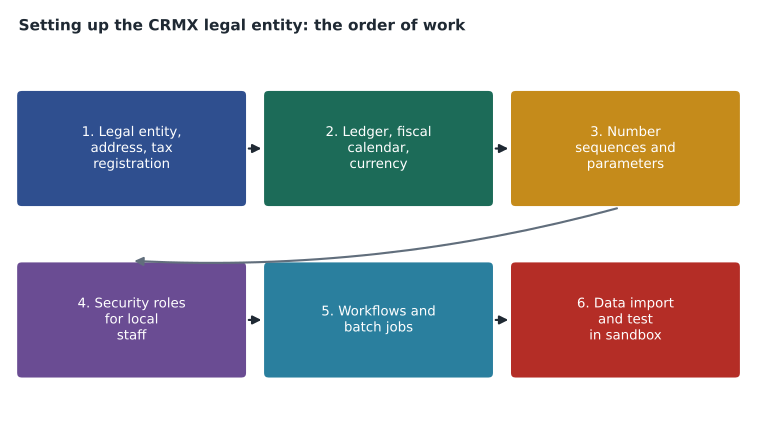
Step 1: the legal entity and its organization data
Annelise began on the Legal entities page in CONFIG. She created CRMX with the name of the registered Mexican company and the country set to Mexico, which activates the Mexican localization features. On the details page she entered the primary address in Monterrey, the tax registration number, known in Mexico as the RFC, the legal entity's language as Spanish and its time zone. Registration information for Mexican electronic invoicing would be added once the certified provider was contracted.
Then she placed CRMX in the organization model. In the legal hierarchy used for statutory reporting, CRMX became a child of the group node beside CRCA and CRUS. In the management hierarchy, the Monterrey hub joined the Mining business unit, which already spanned the other two companies. The procurement hierarchy got a new node for CRMX so that purchasing policies could be attached. Each change was made in a draft and published with an effective date of January 1, 2027, so that reports for 2026 would not show a company that did not yet exist.
Worked problem
Decision point: site, warehouse or legal entity?
The general manager asks whether the Monterrey hub should be a separate legal entity from CRMX, so that it has its own books. What do you advise?
Show solution
- Apply the test from lesson 3: does the hub have its own registration and statutory accounts? No; CRMX is the registered company.
- Model the hub as a site and warehouse inside CRMX.
- Give it a cost center or financial dimension value if management wants its costs reported separately.
Answer: One legal entity, CRMX, with the hub as a site and warehouse. More legal entities would add work without legal reason.
Step 2: ledger, calendar and currency
A legal entity cannot post until it has a ledger. Thandeka's part-time controller for CRMX joined this step remotely. The ledger setup for CRMX used the group's shared chart of accounts, so that consolidated reporting would line up account for account, with a few Mexico-specific accounts added for local taxes. The accounting currency was set to the Mexican peso and the reporting currency to the group's reporting currency, with the exchange rate type already used for CRCA and CRUS. The fiscal calendar was the group's calendar, running January to December. Financial dimensions and account structures came from the group design, with the Monterrey cost center added as a value.
The details belong to the Finance courses, but the order matters for this course: ledger first, then anything that posts.
Step 3: number sequences and parameters
With the company picker on CRMX, Annelise ran the Generate wizard on the Number sequences page for the legal entity scope, then adjusted the formats of the documents that customers and vendors see, following the group convention: CRMX_PO for purchase orders with the format PO-CRMX-######, CRMX_SO for sales orders, CRMX_VINV for vendor invoice vouchers, CRMX_GJ for general journal vouchers, and so on. Vouchers were made continuous, as in the other companies; inventory transactions were not.
Then came parameters. Rather than set each parameters page by hand, the team used Copy into legal entity in the Data management workspace to copy setup entities from CRUS to CRMX: terms of payment, methods of payment, customer and vendor groups, journal names, posting profiles and the parameters for Accounts payable, Accounts receivable, Procurement and Inventory. They then reviewed each copied parameter page for anything that should differ in Mexico, such as tax-related settings, and recorded the differences in the configuration log. Copied number sequence references were reconnected to the new CRMX sequences, because a reference copied from CRUS still pointed to CRUS's sequences.
Worked problem
Decision point: checking a copied setting
After copying parameters from CRUS, a test vendor invoice in CRMX is numbered VINV-CRUS-000213. What went wrong and how is it fixed?
Show solution
- The copied Accounts payable parameters still reference CRUS's vendor invoice voucher sequence.
- Open Accounts payable parameters in CRMX and select the Number sequences tab.
- Connect the vendor invoice voucher reference to CRMX_VINV.
- Check every other reference in the copied parameters the same way.
- Delete the test invoice from the sandbox data or note it, and retest.
Answer: Copied references point to the source company's sequences until reconnected; check every parameters page after a copy.
Step 4: users and security
The eight CRMX staff were imported from Microsoft Entra ID with Spanish as their language and CRMX as their default company. Each received standard roles matching their jobs, assigned for the CRMX legal entity only through organization-specific assignment: sales coordinators received sales order roles, the warehouse team received warehouse roles, and the accounts clerk received the accounts payable and receivable clerk roles. The general manager received inquiry roles across CRMX, and the controller received the accounting manager role for CRMX. Thandeka's existing manager role was extended to CRMX so that she could supervise.
A segregation of duties check found one conflict: with only one accounts clerk, the same person would maintain vendors and enter vendor payments. Thandeka accepted the conflict with a logged reason and a control: the controller would approve every vendor payment journal through workflow, and every new vendor bank account would go through the vendor bank account change workflow. The test users, one per role, were then used to run each CRMX process in CONFIG.
Step 5: workflows and batch jobs
Workflow configurations in the other companies had activation conditions on the legal entity, so CRMX needed its own. The vendor invoice workflow for CRMX followed the group pattern from lesson 6 with a local limit: invoices up to 400,000 pesos needed the general manager's approval, and invoices above that also needed the controller. The general journal workflow required the controller's approval for every manual journal, because the company was small. The vendor payment journal workflow, required by the segregation of duties decision, routed every payment journal to the controller.
Worked problem
Decision point: converting a limit
The group policy sets a second-approval limit of 25,000 US dollars. Thandeka asks for a peso limit for CRMX that is a round number close to the policy at the planning exchange rate of 17.2 pesos to the dollar. What is the exact equivalent, and is 400,000 pesos a reasonable choice?
Show solution
- Exact equivalent: 25,000 x 17.2 = 430,000 pesos.
- 400,000 pesos is about 400,000 / 17.2, roughly 23,256 US dollars, slightly below the policy limit.
- A lower limit is stricter, not looser, so it complies with policy while leaving room for exchange rate movements.
Answer: 430,000 pesos exactly; 400,000 is a reasonable, slightly stricter round number. The workflow condition uses the invoice amount in the legal entity's currency.
Batch jobs were mostly shared with the other companies: workflow message processing, alerts and email distribution run across the environment. CRMX added a daily payment proposal job owned by the controller and, later, a recurring import of bank statements from its Mexican bank. Each was added to the job ownership table in the operations handbook with its schedule, priority and error-alert recipients.
Step 6: data import and testing
CRMX had no old system to migrate from, but it still needed data. The sales team prepared a spreadsheet of 160 mining customers; Piotr's team released 2,300 products from the shared product catalog to CRMX with local item groups and prices; and opening stock, shipped from CRCA and CRUS in December, would arrive as intercompany purchases rather than an import. The team built a data project with the entities in sequence: customer groups and terms first, then Customers V3, then released products and their default order settings. They ran it in CONFIG, fixed the rows that failed in staging, mostly missing tax registration numbers on customers, and saved the files and job history in the rehearsal folder.
Testing followed the end-to-end processes the business would run in January. Each test user executed a script while recording with Task recorder: create a sales order, ship it, invoice it and produce the electronic invoice; receive an intercompany purchase from CRUS; enter, approve and pay a vendor invoice; post a manual journal through approval; run the payment proposal in batch. Failures were logged, fixed in CONFIG and retested. The electronic invoice step could only be partly tested until the certified provider's test service was connected, so Kiri kept it on the risk register with a firm date in early December.
Step 7: Copilot, alerts and readiness
Two smaller items completed the setup. Copilot's generative help would be available to CRMX users, as to everyone else, and the team confirmed that it responded in Spanish for users whose language was Spanish. The collections summary pilot would wait until CRMX had a few months of history. Thandeka set a due date alert for large CRMX customer invoices, and the controller set alerts on vendor bank account changes, which, given the accepted segregation of duties conflict, deserved extra attention.
The runbook
Everything the team did in CONFIG went into a runbook for production, in order, with the owner of each step and the evidence that it was done: legal entity and organization data; hierarchy changes published for January 1; ledger setup; number sequences generated and adjusted; setup copied from CRUS and reviewed; users imported and roles assigned; workflows configured and activated; batch jobs scheduled and assigned; data projects run; features in Feature management matched to CONFIG; electronic reporting configurations for Mexico imported and tested; a final smoke test by each key user. Kiri scheduled the production build for the week before Christmas, with the first CRMX sale planned for the second week of January.
Common mistakes
MistakeCopying setup from another legal entity and assuming it is correct.
InsteadReview every copied page, especially number sequence references and tax settings.
MistakePublishing hierarchy changes immediately for a company that starts next year.
InsteadPublish with an effective date that matches the start of trading.
MistakeLeaving a segregation of duties conflict unmanaged in a small company.
InsteadLog the conflict with a reason and add a compensating control such as workflow approval.
MistakeBuilding directly in production because the company is new.
InsteadBuild and test in a sandbox and repeat from a runbook in production.
Summary and key terms
- A new legal entity starts with organization data, the country, address and tax registration, and its place in hierarchies.
- Ledger, currency and calendar come before anything that posts.
- Number sequences can be generated and setup copied from a similar company, then every copied page must be reviewed.
- Security uses organization-specific roles, with segregation of duties conflicts managed by logged reasons and compensating controls.
- Workflows, batch jobs, data imports, electronic reporting and testing complete the setup, which is captured in a runbook for production.
- Runbook
- An ordered list of steps, owners and evidence for repeating a setup in another environment.
- Compensating control
- An extra control, such as an approval, that reduces the risk of an accepted conflict.
- Copy into legal entity
- A data management function that copies setup data from one legal entity to others.
- Smoke test
- A short test of key processes to confirm an environment works after a change.
- Effective date
- The date from which a published change, such as a hierarchy, applies.
Practice problems
Work each problem on paper first, then reveal the answer to check.
Why must number sequence references be checked after copying parameters from another company?
Show answer
Copied references can still point to the source company's sequences.
What compensating control did Cobalt Ridge use for the single accounts clerk?
Show answer
Controller approval of every vendor payment journal through workflow, plus the vendor bank account change workflow.
What is the exact peso equivalent of 25,000 US dollars at 17.2 pesos per dollar?
Show answer
430,000 pesos.
Lesson quiz · 5 questions
Score 60% or more to complete this lesson.
Create a free account to save your progress, take quizzes and earn a certificate.