
MBA-601 · Lesson 9 of 12 · 20 min
Incentives, benefits and total rewards
Grace starts the ninth session with a bonus plan that went wrong. Last year Fairway paid each store manager a bonus of up to 20 percent of salary based on one measure: the store's labor cost as a share of sales. Labor cost fell in almost every store. So did customer satisfaction scores, fresh-food sales and the retention of part-time staff, as managers cut hours to the bone, left shelves unfilled and scheduled people in fragments that nobody wanted to work. The bonus, she says, worked exactly as designed and the company lost money. Dr. Rahimi says the story is the oldest lesson in incentive design, captured in the title of a 1975 article by Steven Kerr: On the folly of rewarding A, while hoping for B.
Why pay for performance, and why it is hard
Variable pay ties part of what people earn to measured performance: of the individual, the team, the unit or the whole organization. It has two effects that are often confused. The incentive effect is that people work harder or differently because rewards depend on results. The sorting effect is that a performance-based system attracts and keeps people who expect to do well under it and repels those who do not. Edward Lazear's study of Safelite Glass, which switched windshield installers from hourly pay to piece rates in the 1990s, found that productivity rose by about 44 percent, roughly half from existing workers producing more and half from the changing mix of who joined and stayed.
Agency theory frames the problem. The organization, the principal, wants employees, its agents, to act in its interest, but cannot observe everything they do. Tying pay to measured outcomes aligns interests, but outcomes are also affected by luck, so incentives shift risk onto employees, who must then be paid more on average to accept it. The more noise in the measure and the less control the employee has over it, the weaker the incentive should be. And when a job has several dimensions but only some can be measured, strong incentives on the measured dimensions draw effort away from the unmeasured ones, a result formalized by Bengt Holmström and Paul Milgrom in 1991. Grace's labor-cost bonus is a textbook case: the measured dimension crowded out service, freshness and staff retention.
Expectancy theory, from MBA-503, adds the employee's perspective. People will work toward a reward if they believe their effort will improve the measure, that the measure will lead to the reward, and that they value the reward. Line of sight, the employee's ability to see how their actions affect the measure, is therefore critical. A profit-sharing plan for warehouse associates has weak line of sight; a team incentive based on the warehouse's pick accuracy and on-time shipping has strong line of sight. Dr. Rahimi gives the cohort a checklist: choose measures employees can influence, combine several measures to cover the job, use guardrails that cap or cancel rewards if important outcomes fall, keep the plan simple enough to explain, and pay soon enough to connect reward and behavior.
Merit pay
Merit pay is the most common form of pay for performance for salaried employees: annual increases to base salary that vary with performance ratings. Because merit increases compound, being added to base pay permanently, a strong performer who receives a slightly higher raise each year accumulates a substantial advantage. Merit budgets in recent years have typically been in the range of 3 to 4 percent of payroll in both Canada and the United States, which leaves little room to differentiate: if average performers get 3 percent, top performers may get 5 and low performers 1, a difference many employees barely notice after tax.
A merit matrix sets increases by both performance and position in the range, giving larger increases to strong performers who are low in their range and smaller ones to those already near the top. This moves people toward the pay their performance warrants without pushing them past the range maximum. It also helps correct inequities such as those found in lesson 8.
# A merit matrix for Kestrel: increase by performance and compa-ratio, checked against a budget
matrix = {   # performance category: increases for compa-ratio bands (<0.90, 0.90-1.10, >1.10)
    "exceptional": (0.07, 0.05, 0.03),
    "strong":      (0.045, 0.03, 0.015),
    "developing":  (0.015, 0.005, 0.0),
}
def band(cr): return 0 if cr < 0.90 else (1 if cr <= 1.10 else 2)

staff = [  # (salary, compa-ratio, category)
    (98_000, 0.84, "strong"), (112_000, 0.96, "exceptional"), (131_000, 1.12, "strong"),
    (88_000, 0.88, "exceptional"), (104_000, 1.02, "strong"), (95_000, 0.99, "developing"),
    (121_000, 1.05, "strong"), (78_000, 0.81, "strong"), (140_000, 1.15, "exceptional"),
    (101_000, 0.97, "strong"),
]
payroll = sum(s for s, _, _ in staff)
cost = 0
for s, cr, cat in staff:
    inc = matrix[cat][band(cr)]
    cost += s * inc
    print(f"salary {s:7,}  compa {cr:.2f}  {cat:11s} increase {inc:5.1%}  = {s * inc:7,.0f}")
print(f"total increase {cost:,.0f} on payroll {payroll:,} = {cost / payroll:.2%} (budget 3.5%)")salary 98,000 compa 0.84 strong increase 4.5% = 4,410 salary 112,000 compa 0.96 exceptional increase 5.0% = 5,600 salary 131,000 compa 1.12 strong increase 1.5% = 1,965 salary 88,000 compa 0.88 exceptional increase 7.0% = 6,160 salary 104,000 compa 1.02 strong increase 3.0% = 3,120 salary 95,000 compa 0.99 developing increase 0.5% = 475 salary 121,000 compa 1.05 strong increase 3.0% = 3,630 salary 78,000 compa 0.81 strong increase 4.5% = 3,510 salary 140,000 compa 1.15 exceptional increase 3.0% = 4,200 salary 101,000 compa 0.97 strong increase 3.0% = 3,030 total increase 36,100 on payroll 1,068,000 = 3.38% (budget 3.5%)
The matrix spends just under the 3.5 percent budget while giving the largest raises to exceptional and strong performers who are low in their ranges. Leo notices that the engineer earning 78,000 at a compa-ratio of 0.81 receives 4.5 percent but will still be well below the midpoint; correcting a gap that size through merit alone would take years. Dr. Rahimi recommends a separate equity adjustment budget for such cases, so that merit increases reward performance and equity adjustments fix structural problems.
Incentives for individuals, teams and organizations
Individual incentives include piece rates, sales commissions and individual bonuses tied to goals. They work best when output is measurable, individual contributions are separable and quality can be checked. Team incentives reward a group for its collective results; they encourage cooperation and peer pressure to perform, but can let some members ride on others' effort, especially in large teams. Gainsharing plans, such as the Scanlon plan developed in the 1930s and 1940s, share with employees a portion of the savings from improvements in productivity or cost at a plant or unit, usually monthly or quarterly, and are often combined with employee suggestion systems. Profit sharing pays out a share of company profits, which has weak line of sight but can build a sense of shared fate.
Daniel describes a gainsharing plan Northfield negotiated with its union three years ago. Each quarter, if the plant's labor cost per good part falls below a baseline, half the savings are shared equally among hourly employees, provided scrap and safety incidents stay within limits. The plan has paid out in nine of twelve quarters, and the union has become an active partner in improvement projects, because its members share the gains.
| Plan | Measures | Strengths | Risks |
|---|---|---|---|
| Piece rates and commissions | Individual output or sales | Strong incentive and sorting effects | Quality and teamwork neglected, income volatility |
| Individual bonus | Individual goals | Can cover several dimensions | Goals gamed or set too easy |
| Team incentive | Team results | Cooperation and peer support | Free riding in large teams |
| Gainsharing | Unit productivity or cost | Line of sight, joint improvement | Baseline disputes, needs trust |
| Profit sharing | Company profit | Shared fate, flexible labor cost | Weak line of sight |
| Stock and options | Share price | Long-term alignment, retention | Share price driven by markets as much as performance |
Do incentives undermine intrinsic motivation? Laboratory experiments in the tradition of Edward Deci found that paying people for tasks they already enjoyed could reduce their interest once payment stopped. In workplaces, the evidence is more nuanced. A 2014 meta-analysis by Christopher Cerasoli and colleagues found that intrinsic motivation and incentives both predicted performance, with incentives more important for the quantity of output and intrinsic motivation for its quality, and that incentives indirectly tied to performance did little harm to intrinsic motivation. Dr. Rahimi's practical advice: pay people fairly enough that money is off the table, use incentives where measures are clean and output is measurable, and do not try to buy behavior, such as creativity or care, that people offer because they find it meaningful.
Long-term incentives and equity
Long-term incentives reward performance over several years, usually through company shares. Stock options give the right to buy shares at a fixed price, the exercise price, for a period; they have value only if the share price rises above it. Restricted share units promise shares that vest over time, often in installments over three or four years, and have value even if the price falls, which makes them better for retention. Performance share units vest only if targets, such as relative shareholder return or return on capital, are met. Employee share purchase plans let employees buy shares, often at a discount. For start-ups like Kestrel, options are a large part of the value proposition for engineers, but their value is uncertain and illiquid until a sale or public listing.
US tax rules affect equity design. Incentive stock options can qualify for capital gains treatment if holding-period rules are met, though their exercise can trigger the alternative minimum tax; non-qualified options are taxed as ordinary income on exercise. Restricted stock units are taxed as income when they vest. Section 409A imposes rules on deferred compensation, including the exercise price of private-company options, which must be set at fair market value, usually through an independent valuation.
Executive compensation, which the cohort will study further in MBA-612 on corporate governance, is the most visible and controversial use of long-term incentives. Its design problems are the general ones magnified: measures that executives can influence through accounting or timing, targets set too easily, and pay that rises with the market regardless of the company's relative performance.
Benefits
Benefits are the part of compensation provided in forms other than cash pay: health and dental coverage, retirement plans, life and disability insurance, paid time off and a growing list of others such as wellness programs, child care support and education assistance. They typically add 20 to 35 percent to the cost of wages and salaries. Some are required by law; others are voluntary but expected by employees in many jobs. Because employees often value benefits less than they cost, and because their preferences differ, many employers offer flexible plans that let employees choose among options within a budget.
In the United States, employers provide much of what public programs provide elsewhere. Employer-sponsored health insurance covers about half of the population, and under the Affordable Care Act, employers with 50 or more full-time equivalent employees must offer affordable coverage to full-time employees or pay a penalty. Health insurance is the largest benefit cost for most employers. Employers pay 7.65 percent of wages for Social Security and Medicare up to the Social Security wage base, plus unemployment insurance taxes. Retirement savings are mostly through 401(k) plans, often with an employer match; the SECURE 2.0 Act requires most new 401(k) plans established after 2022 to enroll employees automatically from 2025. Health savings accounts paired with high-deductible plans are common.
Grace notes that in her stores, part-time associates value schedule predictability more than any benefit Fairway offers, and that the cost of offering it is mainly management effort. Dr. Rahimi agrees that the most valued rewards are often not cash or insurance: flexibility in when and where people work, predictable schedules, development and recognition. Since 2020, remote and hybrid work arrangements have become part of the reward package for many office jobs, and employers that require full-time office attendance often find they must pay more to recruit.
Total rewards
Total rewards is the idea that everything employees receive in return for their work forms a single package that should be designed and communicated as a whole. Models such as WorldatWork's group it into compensation, well-being and benefits, development, recognition and the work environment, including flexibility and culture. Thinking in total rewards helps employers compete without matching every rival's salary, by offering a combination that particular employees value, and helps them spend where value to employees exceeds cost.
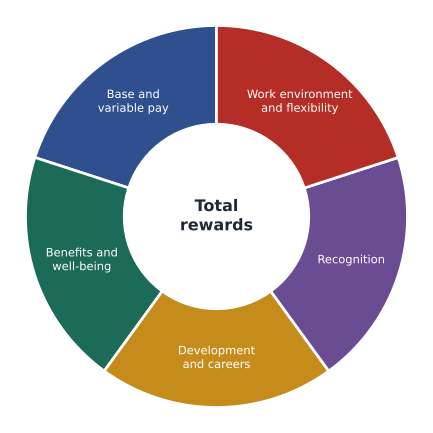
Total rewards statements show each employee the full value of their package, including employer pension contributions, insurance premiums and paid time off. Many employees underestimate the value of benefits, especially health and retirement benefits, and a clear statement can improve perceived fairness and retention at little cost.
Worked problem
Redesigning Fairway's store manager bonus
Fairway wants a new bonus plan for its 40 store managers, with a target of 15 percent of salary, that rewards profitable growth without the damage caused by the labor-cost bonus. Design the plan.
Show solution
- Identify what the role must achieve: sales growth, gross margin after waste, controllable cost, customer experience and a stable team.
- Choose a balanced set of measures with weights: store contribution after waste, 40 percent; sales growth against a comparable-store target, 25 percent; customer satisfaction score, 20 percent; and part-time staff retention, 15 percent.
- Add guardrails: no payout on any measure if the store fails food safety audits, and the contribution measure counts labor as a cost but also counts the sales and waste effects of understaffing.
- Set thresholds, targets and maximums for each measure, with payout from 50 percent of target at threshold to 200 percent at maximum, capped at 25 percent of salary in total.
- Pay half quarterly and half annually to keep line of sight while rewarding sustained results, and explain the plan with worked examples before it starts.
Answer: A balanced scorecard bonus with guardrails replaces the single measure that encouraged understaffing. Store contribution after waste captures the true economics, while customer and staff retention measures protect what the labor-cost bonus damaged. Fairway should review results after the first year, looking for new forms of gaming.
Common mistakes
MistakeAny incentive is better than none.
InsteadIncentives on narrow measures can damage unmeasured outcomes; design measures and guardrails carefully.
MistakeMerit pay strongly differentiates performance.
InsteadSmall budgets limit differentiation; merit compounds, but large gaps need separate adjustments.
MistakeOptions and restricted units have the same retention effect.
InsteadUnderwater options lose their pull; restricted units keep value and retain better.
MistakeEmployees value benefits at their cost.
InsteadMany undervalue benefits and value flexibility and predictability highly; communicate total rewards.
Summary and key terms
- Variable pay has incentive and sorting effects; agency theory explains the trade-off between incentive strength, risk and measurement noise.
- Strong incentives on some measures draw effort from others; use several measures, guardrails and line of sight.
- Merit matrices allocate increases by performance and range position; equity gaps need separate budgets.
- Team incentives and gainsharing encourage cooperation and improvement; profit sharing builds shared fate with weak line of sight.
- Benefits and the wider total rewards package, including flexibility and development, are large and often undervalued parts of what employees receive.
- Variable pay
- Pay that varies with measured performance.
- Line of sight
- Employees’ ability to see how their actions affect the measure that drives their reward.
- Merit matrix
- A table setting pay increases by performance and position in the range.
- Gainsharing
- A plan sharing the savings from unit productivity or cost improvements with employees.
- Restricted share unit
- A promise of shares that vest over time, valuable even if the price falls.
- Total rewards
- Everything employees receive for their work, including pay, benefits, development, recognition and the work environment.
Practice problems
Work each problem on paper first, then reveal the answer to check.
An employee earning 80,000 receives merit increases of 5 percent a year for five years; a colleague at the same starting pay receives 3 percent. What is the gap after five years?
Show answer
80,000 × 1.05^5 ≈ 102,100; 80,000 × 1.03^5 ≈ 92,700; the gap is about 9,400.
Why should a bonus measure be one the employee can influence?
Show answer
Otherwise the reward depends on luck, weakening the incentive and shifting risk onto the employee.
Name one guardrail for a sales commission plan.
Show answer
Clawback of commission on returned or canceled sales, or a minimum customer satisfaction threshold.
Why might a team incentive work less well in a team of 200?
Show answer
Each person’s effect on the result is tiny, so free riding rises and line of sight weakens.
Lesson quiz · 5 questions
Score 60% or more to complete this lesson.
Create a free account to save your progress, take quizzes and earn a certificate.