
MBA-601 · Lesson 11 of 12 · 21 min
Culture, engagement, inclusion and retention
Hana opens the eleventh session with an exit interview she has read many times. A nurse with nine years at Lakeview, rated highly every year, wrote that she was not leaving for money. The new hospital offered about the same pay. She was leaving because she had stopped believing that anyone above her unit manager knew or cared what her shifts were like, because her suggestions about the medication system had disappeared without a reply for three years, and because the colleagues who had made the job bearable had left one by one. Dr. Rahimi says that sentence, I am not leaving for money, is the most common thing departing employees say and the least believed by the managers who hear it.
Culture as the context for every HR practice
The cohort studied organizational culture in MBA-503 through Edgar Schein's three levels: visible artifacts, espoused values and the basic assumptions that guide behavior without being discussed. Dr. Rahimi adds the HR perspective. Culture is shaped less by statements than by the HR practices covered in this course, because they are how the organization shows what it really values: whom it hires and promotes, what it measures and rewards, how it handles mistakes and complaints, and who is let go when times are hard. When stated values and practices diverge, employees believe the practices, and the gap breeds cynicism.
Psychological safety, a concept developed by Amy Edmondson of Harvard, is the shared belief in a team that it is safe to take interpersonal risks: to speak up with a concern, admit a mistake or ask a naive question. Her early research in hospitals found, surprisingly, that better-led nursing units reported more errors, because nurses felt safe to report them, which allowed the errors to be fixed. Google's internal study of team effectiveness, known as Project Aristotle, found psychological safety to be the most important of the factors it examined. For HR systems, the implication is that practices which punish bad news, such as ranking systems that penalize admitted mistakes, undermine the learning they claim to want.
Engagement: what it is and how it is measured
Employee engagement describes the degree to which employees are energized by, involved in and committed to their work. Academic researchers, following William Kahn and later Wilmar Schaufeli, define it as a positive state of vigor, dedication and absorption. Consulting firms measure it with surveys that combine items about satisfaction, commitment, pride, intention to stay and willingness to recommend the employer. Gallup, which has surveyed employees around the world for decades, reported in its 2026 global workplace report that only about 20 percent of employees worldwide were engaged in 2025, with the share of managers engaged falling notably, and estimated the cost of low engagement to the world economy at about 10 trillion dollars. In the United States, Gallup reported 31 percent of employees engaged, down from a peak of 36 percent in 2020.
Engagement matters because it predicts outcomes managers care about. Meta-analyses of business units, including Gallup's own, have found that units with higher engagement have lower turnover, fewer safety incidents, higher customer ratings and higher productivity. As always, causation runs both ways: successful units are pleasanter places to work. But longitudinal studies suggest engagement leads performance at least as much as it follows it. Dr. Rahimi warns against treating the engagement score as a target in itself. Managers pressed to raise a score can coach employees on how to answer, or focus on easy perks rather than the causes of disengagement.
What drives engagement? The job demands-resources model from MBA-503 gives a framework: engagement rises with job resources, such as autonomy, support from supervisors and colleagues, feedback, development and recognition, and falls when demands such as workload, emotional strain and role conflict exceed resources for long periods, which leads to burnout. Christina Maslach's research describes burnout as exhaustion, cynicism and a reduced sense of effectiveness, and identifies six areas of mismatch between people and their work: workload, control, reward, community, fairness and values. Most of these are shaped by HR practices and management, not by individual resilience.
From survey to action
Surveys are useful only if they lead to action. A common failure is to run an annual survey, publish the scores and do nothing visible, which teaches employees that their views do not matter and lowers response rates the next year. Good practice includes keeping the survey short and focused on factors managers can act on, guaranteeing confidentiality by reporting only for groups above a minimum size, sharing results with every team quickly, asking each team to choose one or two issues to work on with its manager, and reporting back on what changed. Pulse surveys, short and frequent, can track whether actions are working.
# Cedarline engagement and turnover by unit: is there a relationship, and where should action start?
from statistics import correlation, mean
units = {  # unit: (employees, engaged %, annual turnover %, average span)
    "design and product":   (90, 41, 11, 6),
    "merchandising":        (45, 24, 19, 5),
    "supply chain and DC":  (520, 14, 38, 22),
    "retail stores":        (640, 29, 46, 12),
    "e-commerce":           (60, 35, 15, 7),
    "corporate functions":  (95, 31, 12, 6),
}
eng = [v[1] for v in units.values()]
tov = [v[2] for v in units.values()]
span = [v[3] for v in units.values()]
print(f"correlation of engagement with turnover across units: {correlation(eng, tov):.2f}")
print(f"correlation of span with turnover across units:       {correlation(span, tov):.2f}")

total = sum(v[0] for v in units.values())
w_eng = sum(v[0] * v[1] for v in units.values()) / total
w_tov = sum(v[0] * v[2] for v in units.values()) / total
print(f"headcount-weighted engagement {w_eng:.0f}%, turnover {w_tov:.0f}%")
for u, (n, e, t, s) in sorted(units.items(), key=lambda kv: -kv[1][0] * kv[1][2]):
print(f"{u:20s} leavers a year {n * t / 100:5.0f}")correlation of engagement with turnover across units: -0.61 correlation of span with turnover across units: 0.75 headcount-weighted engagement 25%, turnover 37% retail stores leavers a year 294 supply chain and DC leavers a year 198 corporate functions leavers a year 11 design and product leavers a year 10 e-commerce leavers a year 9 merchandising leavers a year 9
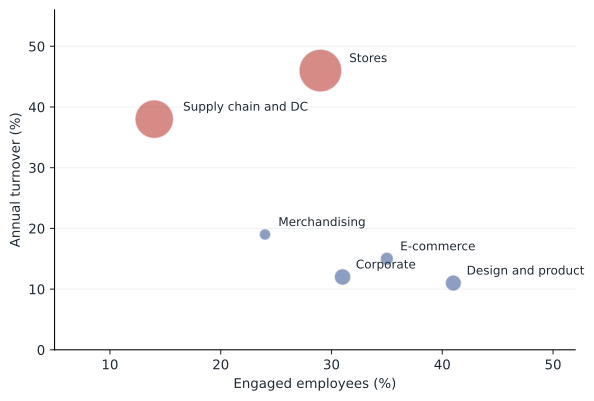
With only six units, the correlations are a rough guide, but they point in the expected direction: units with lower engagement have higher turnover. The stores are the exception that matters. Their engagement is middling, but turnover is the highest in the company, which suggests that store turnover has causes the survey does not capture well, such as schedules, part-time hours and pay relative to other local employers. Ranking units by the number of leavers shows where action matters most: the stores and the distribution center account for almost all of Cedarline's departures. Dr. Rahimi says the analysis tells the leadership team where to look, not what to do; for that, they need to understand why people leave.
Why people leave and why they stay
Turnover research has moved beyond the simple idea that dissatisfied people quit. Thomas Lee and Terence Mitchell's unfolding model found that many departures are triggered by a shock, such as a job offer, a change of manager, a denied promotion or a life event, which prompts the employee to reconsider, sometimes following a script, such as I always said I would leave if they made me work nights. Their later work on job embeddedness asked why people stay and found three forces: links to people and groups inside and outside work, fit with the job, organization and community, and sacrifice, what they would give up by leaving. Embeddedness predicts retention beyond satisfaction, which helps explain why satisfied people sometimes leave and dissatisfied people often stay.
Not all turnover is bad. Functional turnover, the departure of poor performers or of people in roles that are easy to fill, can be healthy; dysfunctional turnover, the loss of strong performers and hard-to-replace people, is costly. Many organizations now track regrettable turnover, departures the organization would have prevented if it could, and analyze it separately. Stay interviews, structured conversations with current employees about what keeps them and what might make them leave, are an inexpensive way to learn before the exit interview. People analytics can identify groups at higher risk of leaving, such as employees passed over for promotion or those with a new manager, but Dr. Rahimi warns that predicting individuals' departures raises ethical issues, and that managers should use such tools to improve conditions for groups, not to label individuals.
| Driver of departure | Typical signals | HR levers |
|---|---|---|
| Manager relationship | Turnover concentrated under certain managers | Manager selection, training, spans, upward feedback |
| Schedules and workload | Overtime, short notice, burnout | Staffing levels, predictable scheduling, workload limits |
| Pay relative to market | Exits to competitors for similar roles | Market pricing, equity adjustments, transparency |
| Career progress | Exits after being passed over | Internal mobility, development, clear career paths |
| Fairness and voice | Complaints about unequal treatment, survey items on fairness | Consistent practices, grievance channels, action on surveys |
| Shocks and life events | Departures after reorganizations or leave | Support during change, flexible work, return-to-work programs |
Diversity, equity and inclusion
Diversity refers to the range of differences among people in an organization, such as gender, race, ethnicity, age, disability, sexual orientation, background and thinking style. Inclusion refers to whether people of all backgrounds feel respected, able to contribute and treated fairly. Equity refers to fair access to opportunity and fair treatment, which sometimes requires removing barriers that affect some groups more than others. HR practices are where these ideas become real or remain slogans: whom recruiting reaches, how selection is structured, who gets stretch assignments and sponsorship, how pay is set and audited, how potential is judged and who is promoted.
The evidence on diversity and performance is more mixed than often claimed. Studies by consulting firms reporting that companies with more diverse executive teams were more profitable have been criticized for being correlational and hard to replicate. Academic research finds that diverse teams can make better decisions and be more innovative, but also face more conflict and coordination costs, and that the benefits depend on inclusion: diversity without inclusion produces faultlines, as the cohort saw in MBA-503, rather than better ideas. The strongest case for fair HR practices, Dr. Rahimi argues, is simpler: an organization that selects, develops and promotes people on criteria unrelated to the job wastes talent and invites legal and reputational risk.
Research also shows which practices work. Frank Dobbin and Alexandra Kalev's studies of hundreds of US firms over decades found that mandatory diversity training and grievance systems often had little effect or backfired, while practices that engaged managers in solving the problem, such as mentoring programs, targeted recruiting, task forces with accountability and cross-training, increased the representation of women and minorities in management. Structured selection and calibrated performance reviews, covered in lessons 5 and 7, reduce the scope for bias in everyday decisions. Transparency in pay and promotion criteria makes inequities visible and harder to sustain.
The legal context in the United States has shifted sharply. Title VII prohibits employment decisions based on protected characteristics, including in favor of under-represented groups, so quotas and preferences in hiring and promotion are generally unlawful, while outreach, mentoring and the removal of barriers are allowed. In January 2025 an executive order revoked the long-standing order that required federal contractors to maintain affirmative action programs, and directed agencies to investigate private-sector diversity programs. The Supreme Court's 2023 decision ending race-conscious university admissions, in Students for Fair Admissions, does not apply directly to employment but has encouraged legal challenges to employer programs. Many companies have renamed or narrowed their diversity programs since 2025, often keeping practices such as structured selection, pay audits and broad outreach that improve fairness for everyone.
Well-being and the changing workplace
Well-being has become a central concern of HR, especially since the pandemic. It covers physical health, mental health, financial security and social connection. Employee assistance programs, mental health benefits, flexible work and training managers to recognize distress all help. But Dr. Rahimi stresses again that the largest influences on well-being at work are the job and the manager: workload, control over schedules, fair treatment and support. A meditation app does not offset a schedule posted two days in advance. Remote and hybrid work have shown both benefits, in flexibility and time saved, and costs, in weaker connections for new and junior employees and in the difficulty of mentoring at a distance. Many employers have settled on hybrid patterns, with the specific arrangements negotiated team by team.
Worked problem
A retention plan for Cedarline's distribution center
Cedarline's distribution center has 520 employees, 14 percent engagement, 38 percent annual turnover and an average supervisor span of 22. Exit interviews mention mandatory overtime announced at short notice, supervisors who have no time for their teams, pay below a new warehouse that opened nearby, and a lack of any path from associate to lead hand. Propose a retention plan with measures.
Show solution
- Address the manager relationship first: hire and develop supervisors to bring spans down to about 12, as MBA-503 recommended, and select new supervisors with structured interviews from lesson 5 that test people leadership, not only operational skill.
- Fix schedules: with the steadier pull system from MBA-513, publish schedules two weeks ahead, offer voluntary overtime first, cap mandatory overtime and give notice of at least 48 hours.
- Review pay: price distribution jobs against the local market, including the new warehouse, and adjust ranges; add a modest skill-based progression from associate to lead hand, as in lesson 8, tied to certifications in picking, equipment and safety.
- Build voice: monthly team huddles where supervisors review the pulse survey and report on actions, and a joint safety and improvement committee.
- Measure results: 90-day and annual turnover, regrettable turnover, pulse engagement by team, overtime hours and pick accuracy, reviewed monthly by the chief operating officer.
Answer: The plan targets the drivers named in the exit interviews: managers, schedules, pay and careers, with voice to sustain improvement. If it cut turnover from 38 to about 25 percent, the lesson 1 model implies savings of roughly 800,000 dollars a year in replacement costs alone, before gains in accuracy and productivity.
Common mistakes
MistakePeople leave for money.
InsteadPay matters, but managers, schedules, careers, fairness and shocks drive many departures.
MistakeRaising the engagement score is the goal.
InsteadScores are indicators; act on the causes, especially job resources and demands.
MistakeDiversity training fixes representation.
InsteadMandatory training often has little effect; manager engagement, structured processes and accountability work better.
MistakeAll turnover is bad.
InsteadDistinguish functional from dysfunctional and regrettable turnover; focus on losing the people you would keep.
Summary and key terms
- HR practices reveal and shape culture more than stated values do; psychological safety enables learning.
- Engagement predicts turnover, safety, customer outcomes and productivity, and depends on job resources and demands.
- Surveys must lead to visible action and follow-up, or they reduce trust.
- Departures often follow shocks; job embeddedness explains why people stay; regrettable turnover deserves special attention.
- Fair, structured HR practices underpin inclusion; their legal context differs sharply between Canada and the United States.
- Psychological safety
- A shared belief that it is safe to take interpersonal risks in a team.
- Employee engagement
- Energy, involvement and commitment to work.
- Burnout
- Exhaustion, cynicism and reduced effectiveness resulting from chronic job stress.
- Job embeddedness
- The links, fit and sacrifices that keep people in their jobs.
- Regrettable turnover
- Departures the organization would have prevented if it could.
- Stay interview
- A structured conversation with a current employee about what keeps them and what might make them leave.
- Inclusion
- The degree to which people of all backgrounds feel respected, able to contribute and treated fairly.
Practice problems
Work each problem on paper first, then reveal the answer to check.
A unit of 200 employees has 30 percent turnover; a unit of 50 has 50 percent. Which loses more people, and how many?
Show answer
The first loses 60 a year, the second 25; the larger unit matters more in absolute terms.
Give an example of a shock in the unfolding model of turnover.
Show answer
A competing job offer, a new manager, a denied promotion, a reorganization or a family move.
Why might a satisfied employee still leave?
Show answer
Low embeddedness: few links, poor fit with the community or little to sacrifice, combined with an attractive offer.
Name two diversity practices that research suggests are effective.
Show answer
Mentoring programs, targeted recruiting, task forces with accountability, structured selection and calibrated reviews.
Lesson quiz · 5 questions
Score 60% or more to complete this lesson.
Create a free account to save your progress, take quizzes and earn a certificate.