
MBA-601 · Lesson 8 of 12 · 21 min
Compensation strategy and job evaluation
Leo admits that Kestrel has never had a pay structure. Salaries were set in each hiring negotiation, by whoever made the offer, against whatever the candidate asked for. The result is a payroll that Leo describes as archaeology: each layer records the labor market at the moment someone was hired. Engineers hired during the 2021 boom earn more than more senior engineers hired before it. Two people doing the same support job differ in pay by 18,000 dollars. Now pay transparency laws will require Kestrel to publish ranges in its job postings, and employees will be able to see what the company is willing to pay new hires. Dr. Rahimi says Kestrel needs what most growing companies eventually need: a pay strategy, a way of valuing jobs and a structure that turns both into ranges.
What compensation is trying to achieve
Compensation includes base pay, variable pay such as bonuses and commissions, long-term incentives such as equity, and benefits; lesson 9 covers the last three. This lesson covers base pay, which for most employees is the largest and most visible element. A compensation system has several objectives that must be balanced. It must attract people the organization needs, retain the ones it has, and motivate the behavior the strategy requires. It must be seen as fair, both internally, comparing jobs within the organization, and externally, compared with the market. It must control cost, because pay is often the largest operating expense. And it must comply with the law on minimum wages, overtime, pay equity and transparency.
Equity theory, which the cohort met in MBA-503, explains why fairness matters so much. People compare the ratio of what they receive to what they contribute with the ratios of others. When they see themselves as underpaid relative to a comparable colleague, they reduce effort, push for more or leave. The comparisons people make are mostly internal and local: to colleagues in similar jobs, to people hired recently, to their manager. A company can pay above the market and still have a pay fairness problem if similar jobs are paid very differently inside it, which is exactly Kestrel's situation.
Pay strategy: where to position against the market
A pay philosophy states how the organization intends to pay relative to the labor markets in which it competes for people. Lead policies pay above the market, typically at the 60th or 75th percentile, to attract and keep scarce talent or to support a strategy that depends on high performance. Match policies pay around the median. Lag policies pay below the market and rely on other parts of the value proposition, such as security, purpose, flexibility or future equity, to compensate. Many organizations use different positions for different jobs: leading for A positions and critical skills, matching for the rest.
Defining the relevant market is the first decision. A store associate's market is local and includes other retailers, restaurants and warehouses. A demand planner's market is regional or national and includes other retailers and consumer goods companies. A senior software engineer's market may be national or global, and since the shift to remote work it can include employers who were never competitors before. Market data come from salary surveys run by consulting firms and industry associations, which report pay by job, level, industry and location, and increasingly from online sources and job postings. Matching an internal job to a survey job requires care: titles mislead, so matches should be based on job content.
Job evaluation: valuing jobs internally
Job evaluation is the systematic process of determining the relative value of jobs within an organization. It values jobs, not people: the question is how much the work is worth, not how well the current holder does it. Simple methods include ranking jobs from most to least valuable and classifying them into predefined grades, as many public services do. The most widely used quantitative method is the point factor method. A set of compensable factors that the organization values is chosen, typically skill, effort, responsibility and working conditions, each broken into sub-factors such as knowledge required, problem-solving, accountability for results and physical demands. Each factor is described at several levels and assigned points, with weights reflecting its importance. Each job is rated on each factor, and its total points place it in a hierarchy.
The Hay method, developed by Edward Hay in the mid-twentieth century and now owned by Korn Ferry, is the best-known proprietary system, based on know-how, problem solving and accountability. Daniel says Northfield's collective agreement uses a point factor plan jointly maintained by the company and the union, and that every new job classification goes to a joint committee. The plan has prevented many disputes, because both sides accept the method even when they disagree about a rating. Dr. Rahimi notes that point factor plans are also central to pay equity compliance, because they allow jobs done mostly by women to be compared with dissimilar jobs done mostly by men.
| Factor | Weight | Levels | Example: demand planner | Example: DC supervisor |
|---|---|---|---|---|
| Knowledge and skill | 40 percent | 1 to 6 | Level 5: analytical methods, planning system, product knowledge | Level 4: operations, safety, systems |
| Problem solving | 25 percent | 1 to 5 | Level 4: ambiguous forecasts, trade-offs | Level 3: daily operating problems |
| Accountability | 25 percent | 1 to 5 | Level 4: inventory decisions worth millions | Level 4: team of 12, safety, output |
| Working conditions | 10 percent | 1 to 4 | Level 1: office | Level 3: noise, cold, shifts |
Building a pay structure
A pay structure combines the internal hierarchy with market data. The first step is a market pay line: plot each benchmark job's job evaluation points against its market pay, usually the survey median, and fit a line by regression. The line predicts the market rate for any number of points, including jobs that have no survey match. The organization then sets its policy line, which is the market line adjusted for its pay philosophy, for example 5 percent above the market line for a lead policy.
Jobs with similar points are grouped into pay grades, and each grade gets a pay range. The midpoint of the range sits on the policy line and represents the pay of a fully competent, experienced employee. The range spread, the difference between maximum and minimum as a share of the minimum, is typically narrow for entry-level jobs, perhaps 30 to 40 percent, and wider for senior and professional jobs, perhaps 50 to 70 percent, where differences in experience and contribution are larger. Adjacent ranges overlap, so a highly experienced employee in one grade may earn more than a new employee in the grade above.
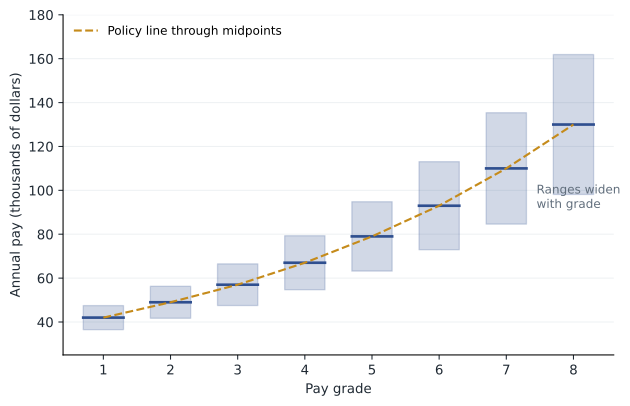
Two measures describe where an individual sits in a range. The compa-ratio is the employee's pay divided by the range midpoint: 1.00 means at the midpoint, 0.90 below it. Range penetration is the employee's position between minimum and maximum, from 0 at the minimum to 100 percent at the maximum. Employees paid below the minimum are called green-circled and are normally raised to the minimum; those paid above the maximum are red-circled and typically have their pay frozen or receive lump sums instead of raises until the range moves past them.
# Building a pay line for Cedarline from benchmark jobs, then compa-ratios for planners
from statistics import linear_regression

# benchmark jobs: (job evaluation points, market median pay in thousands)
bench = [(180, 41), (240, 48), (310, 58), (390, 71), (460, 84), (540, 98), (630, 117), (720, 136)]
pts, pay = zip(*bench)
slope, intercept = linear_regression(pts, pay)
print(f"market line: pay = {intercept:.1f} + {slope:.4f} x points (thousands)")

policy = 1.00                      # match the market
def midpoint(points): return policy * (intercept + slope * points)

planner_points, spread = 470, 0.50
mid = midpoint(planner_points)
lo = 2 * mid / (2 + spread)        # spread = (max - min) / min, midpoint in the middle
hi = lo * (1 + spread)
print(f"demand planner grade: min {lo:.1f}  mid {mid:.1f}  max {hi:.1f}")

for name, p in [("planner 1", 72.0), ("planner 2", 86.0), ("planner 3", 104.0), ("new hire offer", 80.0)]:
print(f"{name:15s} pay {p:5.1f} compa-ratio {p / mid:.2f} range penetration {(p - lo) / (hi - lo):.0%}")market line: pay = 4.9 + 0.1770 x points (thousands) demand planner grade: min 70.4 mid 88.0 max 105.6 planner 1 pay 72.0 compa-ratio 0.82 range penetration 4% planner 2 pay 86.0 compa-ratio 0.98 range penetration 44% planner 3 pay 104.0 compa-ratio 1.18 range penetration 95% new hire offer pay 80.0 compa-ratio 0.91 range penetration 27%
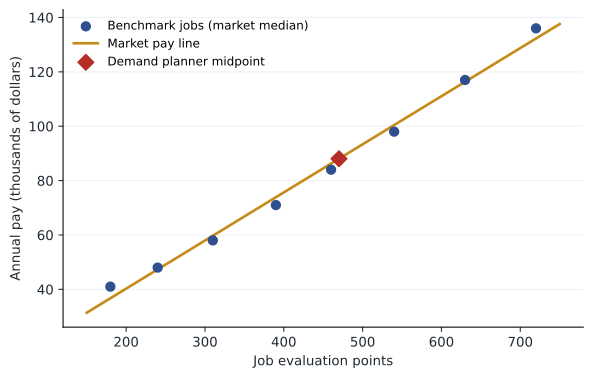
The regression gives a market line from which Cedarline can set a range for demand planners. With a 50 percent spread, the range runs from about 70,000 to 106,000 dollars around a midpoint of about 88,000. The three current planners sit at compa-ratios from about 0.82 to 1.18, one just above the minimum and one near the top of the range. Dr. Rahimi points out the problem the numbers expose: if Cedarline needs to hire five new planners in a tight market, offers near 80,000 will put new hires above the existing planner at 72,000, who has been doing the job for two years. Before the ranges are published, Cedarline should budget to move existing employees who are low in their ranges, or the new structure will create the very inequity it was meant to fix.
Pay for skills and competencies
Not all pay systems are based on jobs. Skill-based pay rewards employees for the skills they acquire and can use, rather than for the job they hold at a given moment. It is common in manufacturing plants with flexible teams, where an operator who can run several machines and do basic maintenance is paid more than one who can run only one. It supports flexibility and learning but raises labor costs if people acquire skills that are not used, so plants usually certify skills only when they are needed. Competency-based pay applies the same idea to professional work. Owen uses a skill-based progression for Prairie Ridge's operators, with pay steps tied to certifications on each unit of the plant.
Pay equity and transparency
Pay equity laws go beyond equal pay for the same job. They require that jobs of equal value to the organization, judged by job evaluation, be paid equally even when the jobs are different, to correct the historical undervaluation of work done mostly by women.
The Equal Pay Act of 1963 requires equal pay for men and women doing substantially equal work in the same establishment, with exceptions for seniority, merit, quantity or quality of production, or any factor other than sex. Title VII also prohibits pay discrimination. Federal law does not require comparisons across different jobs of equal value, but several states go further: California and New York require equal pay for substantially similar work across job titles, and Illinois requires private employers with 100 or more employees to obtain an equal pay registration certificate and submit pay data by gender, race and ethnicity. Pay transparency laws requiring ranges in postings now cover a large share of the US workforce, including Illinois since 2025.
Transparency changes how pay systems work. When ranges are published, employees compare their own pay with the range for new hires, and any inconsistency in how existing employees are paid becomes visible. Research on transparency laws has found that they tend to narrow pay gaps within organizations, partly by compressing pay, and that they make negotiation less important to individual outcomes. Dr. Rahimi also notes the European Union's Pay Transparency Directive, which member states were required to put into national law by June 2026, and which requires gender pay gap reporting and joint assessments where unexplained gaps exceed 5 percent; multinational employers increasingly design their pay structures to meet it everywhere.
Auditing pay for fairness
A pay equity audit tests whether pay differs by gender, race or other characteristics after accounting for legitimate factors such as job grade, experience, performance and location. The usual method is a regression of pay on the legitimate factors plus group indicators; a significant group coefficient indicates an unexplained gap that needs investigation. Dr. Rahimi warns of two traps. Controlling for factors that are themselves affected by bias, such as performance ratings or job level when promotion is biased, can hide a problem. And an audit that finds gaps but does not lead to adjustments creates legal risk rather than reducing it. Good practice is to conduct the audit under legal privilege where appropriate, budget for corrections in advance and fix the processes, such as starting-pay negotiation, that created the gaps.
Worked problem
Designing Kestrel's first pay structure
Kestrel has 180 employees in 34 job titles, no grades and wide variation in pay for similar work. It competes for engineers with large technology companies and wants to publish ranges in postings within six months. Design the process and identify the main risks.
Show solution
- Write a pay philosophy: lead the market, at the 65th percentile, for engineering and implementation roles that are A positions; match the median for other roles; make equity a significant part of total pay for senior roles.
- Define job families and levels, such as engineering levels 1 to 6 with clear descriptions of scope and impact at each level, and map every employee to a level based on the work they do, not their current pay.
- Price benchmark jobs in each family from two or three reputable surveys for the relevant market, using content matches, and set midpoints from the market data and the philosophy.
- Set ranges with spreads of about 40 percent at junior levels and 60 percent at senior levels, then calculate each employee's compa-ratio.
- Budget for adjustments: raise employees below the minimum to the minimum, and plan increases over one or two cycles for employees with low compa-ratios relative to their performance. Run a pay equity audit before publishing ranges and correct unexplained gaps.
Answer: Kestrel should build a level-based structure from job families, market data and a clear philosophy, and fund corrections before ranges become public. The main risks are leveling people by their current pay rather than their work, publishing ranges that expose inequities without the budget to fix them, and ignoring the equity component, which for engineers is often decisive.
Common mistakes
MistakePay the market rate and fairness takes care of itself.
InsteadInternal comparisons drive perceived fairness; similar jobs paid very differently inside the firm cause problems even at market rates.
MistakeJob evaluation rates the person in the job.
InsteadIt values the work, independent of the holder; performance is rewarded within the range.
MistakePublishing ranges is only a posting change.
InsteadTransparency exposes existing inequities; audit and fund corrections first.
MistakeAn audit that controls for everything shows there is no gap.
InsteadControlling for biased factors, such as levels affected by biased promotion, can hide real gaps.
Summary and key terms
- Base pay systems balance attraction, retention, motivation, internal and external fairness, cost and compliance.
- A pay philosophy positions pay against defined labor markets, often differently for critical roles.
- Job evaluation, especially the point factor method, values jobs internally; regression on market data turns points into a pay line.
- Pay structures group jobs into grades with ranges; compa-ratio and range penetration show where individuals sit.
- Pay equity and transparency laws require valuing work fairly and make inconsistencies visible, so audits and corrections should come first.
- Pay philosophy
- A statement of how an organization positions its pay against the market.
- Job evaluation
- A systematic method of determining the relative value of jobs.
- Point factor method
- Job evaluation that rates jobs on weighted compensable factors and totals the points.
- Market pay line
- A regression of market pay on job evaluation points for benchmark jobs.
- Range spread
- The difference between a range’s maximum and minimum as a share of the minimum.
- Compa-ratio
- An employee’s pay divided by the midpoint of their range.
- Range penetration
- An employee’s position between the minimum and maximum of their range.
- Pay equity
- Equal pay for work of equal value, judged by job evaluation.
Practice problems
Work each problem on paper first, then reveal the answer to check.
A range has a minimum of 60,000 and a spread of 50 percent. What are its maximum and midpoint?
Show answer
Maximum 90,000; midpoint 75,000.
An employee earns 69,000 in that range. What are the compa-ratio and range penetration?
Show answer
Compa-ratio 69 / 75 = 0.92; penetration (69 − 60) / 30 = 30 percent.
Why do senior ranges usually have wider spreads than junior ones?
Show answer
Experience and contribution vary more in senior roles, and promotions are less frequent, so more room for growth within the grade is needed.
What is the difference between equal pay for equal work and pay equity?
Show answer
Equal pay compares the same or substantially similar jobs; pay equity compares different jobs of equal value.
Lesson quiz · 5 questions
Score 60% or more to complete this lesson.
Create a free account to save your progress, take quizzes and earn a certificate.