
MBA-601 · Lesson 4 of 12 · 21 min
Recruiting and employer branding
Grace starts the fourth session with a confession. Last December, two of her Fairway stores ran the holiday season about fifteen associates short. Both posted jobs on the same job boards as every other retailer in town, offered the same wage, and received hundreds of applications. Most applicants never replied to the invitation to interview; of those who were hired, a third left within a month. Her district manager's conclusion was that people no longer want to work. Dr. Rahimi asks the cohort to hold that conclusion until they have examined the recruiting process as carefully as they examined Cedarline's supply chain, because a recruiting process is a supply chain too: it has a funnel, yields at each stage, lead times, quality problems and costs.
Recruiting starts with the job
Recruiting is the set of activities that attract qualified applicants for positions an organization needs to fill. It begins before any advertisement, with a clear understanding of the job. Job analysis identifies the tasks, responsibilities and working conditions of a role and the knowledge, skills, abilities and other characteristics needed to perform it, often abbreviated KSAOs. Methods include observing the work, interviewing incumbents and supervisors, questionnaires and analysis of critical incidents, the moments that separate effective from ineffective performance. The result feeds the job description, which describes the work, and the person specification, which describes the qualities needed.
Dr. Rahimi stresses that job analysis is not paperwork. It is the foundation of almost everything that follows. Selection methods in lesson 5 are valid only if they measure qualities the job really requires, which is also the employer's best legal defense if a method is challenged. Performance standards in lesson 7 come from the same analysis, and so do the job evaluations in lesson 8 that set pay. A common failure is inflating requirements: asking for a degree when the work does not need one, or five years of experience when two would do. Inflated requirements shrink the applicant pool, can exclude groups disproportionately and signal to applicants that the employer does not understand its own jobs.
Employer brand and the employee value proposition
An employer brand is the image an organization has as a place to work, among current employees and among the people it wants to hire. Like a product brand in MBA-512, it lives in the minds of its audience and is shaped more by experience than by advertising: what employees tell friends, what former employees write on review sites, how candidates are treated. The employee value proposition is the deliberate statement of what the organization offers in return for people's work, usually grouped as pay and benefits, career and development, the work itself, the people and culture, and the organization's purpose and reputation.
A strong value proposition is specific, true and differentiated. Dr. Rahimi shows the cohort a dozen career pages from retailers and asks them to cover the logos. Every one promises a passion for customers, a family atmosphere and opportunities to grow; none is distinguishable from the others. The value proposition has the same job as a positioning statement: to tell a target group of candidates why this employer is the right choice for them, in terms that the employer can deliver. Promises that the job does not keep are worse than no promises, because they raise expectations that early experience then disappoints, and disappointed new hires leave.
Hana describes Lakeview's attempt to differentiate in a labor market where every hospital is short of nurses. Rather than competing on signing bonuses, which rivals matched within weeks, Lakeview built its value proposition around predictable schedules, a guaranteed mentor for every new graduate during the first year and a clinical ladder that pays for specialist certification. Applications rose modestly, but first-year retention of new graduates rose sharply. The schedule promise was the hardest to keep and the one candidates cared about most.
Sources of candidates
Candidates come from inside and outside. Internal recruiting, through job postings open to current employees, promotion and transfer, rewards development, is cheaper and less risky because the employer knows the candidate, and signals that careers are possible. Its risks are inbreeding of ideas and the chain of vacancies it creates: every internal move opens another job. External sources include employee referrals, job boards and professional networks, the organization's own career site, social media, campus recruiting, recruitment agencies and executive search firms, community organizations, and former employees who might return.
Sources differ in yield, cost and quality. Employee referrals are consistently among the best sources: referred candidates are hired at higher rates, are often cheaper to recruit and tend to stay longer, because the referring employee has screened them informally and given them a realistic picture. Their weakness is that they reproduce the existing workforce's networks, which may narrow diversity. Job boards produce volume but often low yield. Agencies are fast for hard-to-fill roles but expensive, usually charging 15 to 25 percent of first-year pay for professional placements. Dr. Rahimi asks the cohort to judge sources by quality of hire, such as performance and retention after a year, not only by applicants or cost per hire.
Realistic job previews
John Wanous at Ohio State spent much of his career studying a simple idea: tell candidates the truth about the job, including the unattractive parts. A realistic job preview shows what the work is really like, through videos, job shadowing, conversations with current employees or a frank written description. Some candidates withdraw, but those who accept do so with accurate expectations and are less likely to leave when they meet the hard parts. Meta-analyses have found modest but consistent reductions in early turnover, larger in jobs with high turnover and in previews given early in the process.
For Cedarline's distribution center, Dr. Rahimi suggests the preview would show a full shift in peak season: the noise, the walking distances, the cold of the loading docks in January and the production standards. For store associates, it would show weekend schedules and the need to learn several hundred products. Grace realizes that Fairway's postings describe the holiday jobs as fun, flexible and team-oriented, which explains why a third of new hires left in the first month, when the reality was long shifts and short staffing.
The recruiting funnel and its metrics
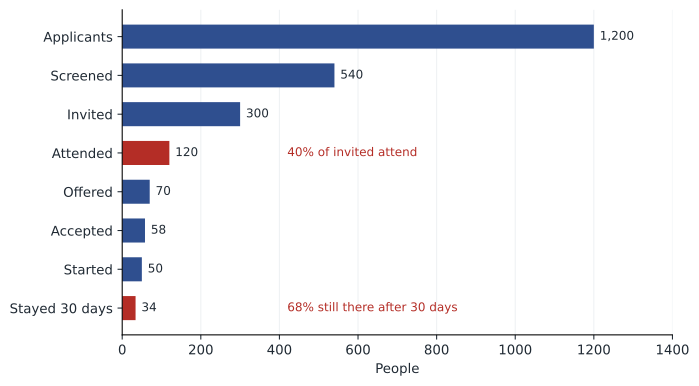
A recruiting process can be described as a funnel with stages: people who see the posting, applicants, screened candidates, interviewed candidates, offers, acceptances, hires who start, and hires still employed after a period. The yield ratio at each stage is the share of people at one stage who pass to the next. Multiplying the ratios backward from the number of hires needed gives the number of applicants required, and the stages where yield is unexpectedly low show where the process loses people. Time to fill measures the elapsed days from approval of a vacancy to acceptance of an offer, and its components show where the delays lie.
# Fairway holiday hiring funnel: yield ratios and the effect of fixing two stages
stages = ["applicants", "screened", "invited", "attended", "offered", "accepted", "started", "retained 30 days"]
counts = [1200, 540, 300, 120, 70, 58, 50, 34]
for i in range(1, len(stages)):
    print(f"{stages[i-1]:>10} -> {stages[i]:<17} yield {counts[i] / counts[i-1]:.0%}")
print(f"applicants per retained hire: {counts[0] / counts[-1]:.1f}")

# Same-day interview scheduling lifts attendance; a realistic preview lifts 30-day retention
improved = counts[:]
improved[3] = round(counts[2] * 0.70)                  # attendance 40% -> 70%
for i in range(4, 7):
    improved[i] = round(improved[i-1] * counts[i] / counts[i-1])
improved[7] = round(improved[6] * 0.85)               # 30-day retention 68% -> 85%
print("improved funnel:", dict(zip(stages, improved)))
needed = 34
print(f"applicants needed for {needed} retained hires: {needed * improved[0] / improved[-1]:.0f}")applicants -> screened yield 45%
screened -> invited yield 56%
invited -> attended yield 40%
attended -> offered yield 58%
offered -> accepted yield 83%
accepted -> started yield 86%
started -> retained 30 days yield 68%
applicants per retained hire: 35.3
improved funnel: {'applicants': 1200, 'screened': 540, 'invited': 300, 'attended': 210, 'offered': 122, 'accepted': 101, 'started': 87, 'retained 30 days': 74}
applicants needed for 34 retained hires: 551The funnel shows Grace that Fairway's problem is not a lack of applicants. Over twelve hundred people applied. The two weakest stages were attendance, where only 40 percent of invited candidates came to an interview, and the first month after starting, when a third of new hires left. Candidates were invited to interviews scheduled a week or more later, by which time many had taken other jobs. With same-day or next-day interviews and a realistic preview, the same thirty-four retained hires could be reached with roughly half the applicants, or the stores could fill all their holiday positions. Dr. Rahimi points out that the fix is operational: speed and accuracy, not advertising.
| Metric | What it measures | Trap to avoid |
|---|---|---|
| Time to fill | Days from approved vacancy to accepted offer | Speed at the cost of quality |
| Cost per hire | Total recruiting cost divided by hires | Cheap sources that produce early leavers |
| Yield ratios | Share passing each stage of the funnel | Ignoring where good candidates drop out |
| Offer acceptance rate | Accepted offers divided by offers made | Hiding pay or schedule problems that cause rejections |
| Quality of hire | Performance and retention of hires after a period | Measuring too early to see results |
| Candidate experience | Surveys of applicants, including those rejected | Surveying only successful candidates |
Candidate experience and speed
Candidates judge an employer by how they are treated. Long application forms, silence after applying, repeated requests for the same information, interviews rescheduled at short notice and rejections that never arrive all damage the employer brand, and candidates talk. In tight labor markets for hourly work, speed is decisive: the employer that makes an offer first often wins. Leo says Kestrel loses about one engineering candidate in four to competing offers that arrive while Kestrel is still scheduling a final interview. Dr. Rahimi suggests mapping the process as the cohort mapped the value stream in MBA-513, measuring the waiting time between steps and removing steps that add no information.
Technology and artificial intelligence in recruiting
Applicant tracking systems manage postings, applications and communication, and most large employers use them. Newer tools use artificial intelligence to write job postings, source candidates from online profiles, screen résumés, schedule interviews through chatbots and analyze recorded video interviews. They can make recruiting faster and more consistent. They also carry risks. A screening model trained on past hiring decisions can learn the biases in them: a widely reported case involved a large technology company that abandoned an experimental résumé screener after finding it penalized words associated with women. Video tools that claim to read personality from facial expressions have weak scientific support. And candidates increasingly use AI to write applications, which makes résumés less informative.
Dr. Rahimi recommends three safeguards. Use AI for tasks where errors are visible and reversible, such as scheduling, before tasks where they are hidden, such as ranking candidates. Test any screening tool for adverse impact on protected groups before and during use, as lesson 5 describes. And be transparent with candidates: New York City has required bias audits and notice for automated employment decision tools since 2023, and Illinois requires notice when artificial intelligence is used in employment decisions from 1 January 2026, as well as consent for AI analysis of video interviews.
Fair and inclusive recruiting
Recruiting determines who has the chance to be selected. Job advertisements must not state preferences based on protected grounds, but subtler choices also matter. Research has found that job descriptions with heavily masculine-coded language, such as dominant or competitive, attract fewer women applicants, that long lists of requirements deter some candidates who would be qualified, and that stating the pay range increases applications. Sourcing from a wider set of schools, community organizations and networks widens the pool. Dr. Rahimi emphasizes that widening the pool is different from lowering the standard: the goal is to find qualified people who would not otherwise have applied.
Pay transparency laws now shape job postings. More than a dozen states and several cities require pay ranges in job postings, including Colorado, California, Washington and New York; Illinois has required employers with 15 or more employees to include pay scales and benefits in postings since 1 January 2025. Many states also bar employers from asking about an applicant's salary history. Lesson 8 discusses how these laws affect pay structures.
Worked problem
Choosing recruiting sources for Cedarline's distribution center
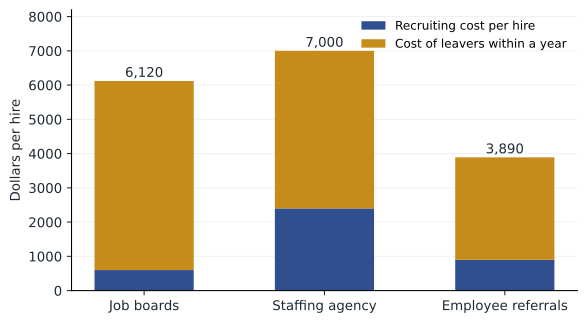
Cedarline's distribution center must hire about 200 associates a year at current turnover. Last year's hires by source were: job boards 120 hires at 600 dollars each, with 52 percent still employed after a year; staffing agency conversions 50 hires at 2,400 dollars each, with 60 percent retained; employee referrals 30 hires at 900 dollars each including a referral bonus, with 74 percent retained. Replacing an associate who leaves costs about 11,500 dollars. Which source is cheapest per retained employee once the cost of early leavers is considered, and what should Cedarline do?
Show solution
- Compute recruiting cost per retained hire: job boards 600 / 0.52 ≈ 1,150; agency 2,400 / 0.60 = 4,000; referrals 900 / 0.74 ≈ 1,220.
- Add the turnover cost of leavers within the year: job boards 0.48 × 11,500 = 5,520 per hire; agency 0.40 × 11,500 = 4,600; referrals 0.26 × 11,500 ≈ 2,990.
- Total cost per hire including turnover: job boards 600 + 5,520 = 6,120; agency 2,400 + 4,600 = 7,000; referrals 900 + 2,990 = 3,890.
- Referrals are the cheapest source once retention is counted, despite costing more per hire than job boards. Their limit is volume: the existing workforce can refer only so many people, and referrals may narrow diversity.
Answer: Cedarline should expand its referral program, perhaps by raising the bonus and paying part of it after the new hire's first six months, and add a realistic job preview to job-board recruiting to raise retention there. Agency hiring should be kept for seasonal peaks. Source decisions should be judged on cost per retained employee, not cost per hire.
Common mistakes
MistakeWe have a shortage of applicants.
InsteadOften the problem is yield: candidates lost to slow scheduling, poor experience or early turnover from unrealistic expectations.
MistakeThe best recruiting source is the cheapest per hire.
InsteadJudge sources by cost and quality of retained hires, including the cost of early leavers.
MistakeSelling the job hard brings better results.
InsteadRealistic previews reduce early turnover by giving accurate expectations.
MistakeAI screening removes human bias.
InsteadModels trained on past decisions can reproduce past bias; test tools for adverse effects and be transparent.
Summary and key terms
- Recruiting starts with job analysis, which defines the tasks and qualities a role really requires.
- An employer brand is built by experience; the value proposition must be specific, true and differentiated.
- Sources differ in yield, cost and quality; referrals are often best but can narrow diversity.
- Realistic job previews reduce early turnover by setting accurate expectations.
- The recruiting funnel and its yield ratios show where candidates are lost; speed and candidate experience matter, especially in tight markets.
- Job analysis
- The systematic study of a job’s tasks, conditions and required qualities.
- KSAOs
- Knowledge, skills, abilities and other characteristics needed for a job.
- Employee value proposition
- What an employer offers in return for people’s work.
- Realistic job preview
- An accurate picture of a job, including its drawbacks, given to candidates.
- Yield ratio
- The share of candidates at one stage of recruiting who pass to the next.
- Time to fill
- Days from approval of a vacancy to acceptance of an offer.
- Quality of hire
- A measure of how well hires perform and how long they stay.
Practice problems
Work each problem on paper first, then reveal the answer to check.
A funnel has yields of 50 percent from applicants to screened, 40 percent to interviewed, 50 percent to offered and 80 percent to accepted. How many applicants are needed for 20 hires?
Show answer
20 / (0.5 × 0.4 × 0.5 × 0.8) = 20 / 0.08 = 250 applicants.
A source costs 1,000 dollars per hire and 70 percent of hires stay a year; another costs 400 and 40 percent stay. If an early leaver costs 8,000, which is cheaper?
Show answer
First: 1,000 + 0.3 × 8,000 = 3,400. Second: 400 + 0.6 × 8,000 = 5,200. The first is cheaper.
Why might inflated job requirements create legal risk?
Show answer
Requirements not needed for the job may exclude protected groups disproportionately without justification.
Name two signs of poor candidate experience.
Show answer
Silence after applying, long delays between steps, repeated rescheduling, or rejections never communicated.
Lesson quiz · 5 questions
Score 60% or more to complete this lesson.
Create a free account to save your progress, take quizzes and earn a certificate.