
MBA-601 · Lesson 12 of 12 · 24 min
Capstone: a people strategy for Cedarline
For the final session, Dr. Rahimi gives the cohort a brief that she says resembles the one she received in her first week as a chief people officer. Cedarline's board has approved the plans the cohort developed in earlier courses: the working-capital and financing plan from MBA-511, the marketing plan built on durability and a lifetime repair service from MBA-512, and the supply chain redesign from MBA-513, with two supply chains, staged buying, monthly sales and operations planning and weekly replenishment of stores. The board has asked the chief executive a simple question: do we have the people to do this? The cohort's task is to answer it with a people strategy that the chief executive can take to the board: a diagnosis, a small number of priorities, a workforce plan, a business case, measures and an implementation plan.
Step 1: start from the business strategy
A people strategy is not a list of HR programs. It starts from what the business must do differently and asks what that requires of people. Dr. Rahimi asks the study groups to list the capabilities each approved plan depends on. The supply chain redesign depends on demand planners who can read early sell-through and make staged buying decisions, a sales and operations planning process that merchandising, planning and supply chain actually use, and a distribution center that runs a weekly pull system accurately. The marketing plan depends on store associates who can explain durability and repairs, a repair service with skilled technicians, and fewer, better-trained people handling a smaller range. The financial plan depends on all of this happening without a large rise in payroll.
The groups then compare these needs with Cedarline's current people data, which the cohort has built up over the program. Cedarline has about 1,450 employees. Engagement is 29 percent in stores and 14 percent in the distribution center. Annual turnover is 46 percent in stores and 38 percent in distribution, which the lesson 1 model priced at about 4.6 million dollars a year. Distribution supervisors manage an average of 22 people each. There are three demand planners where the redesign needs eight. There is no repair workshop. Pay has never been structured, performance reviews are inconsistent, and the merchandising and supply chain teams, whose conflict drove much of the inventory problem, are measured on different goals.
| Capability needed | Current state | Gap |
|---|---|---|
| Demand planning for staged buying | 3 planners, no formal training | 5 more planners within 18 months, trained in forecasting and S&OP |
| Distribution run as a pull system | 520 associates, spans of 22, turnover 38 percent | About 20 more supervisors; lower turnover; predictable schedules |
| Store service built on durability and repairs | 640 associates, turnover 46 percent, little product training | Product and repair training; better schedules; lower turnover |
| Lifetime repair service | None | About 24 repair technicians and 2 workshop leads |
| One integrated plan across functions | Merchandising and supply chain on conflicting goals | Shared goals and decision rights under the chief operating officer |
| Fair, transparent pay | No structure, ranges about to be required in postings | Job evaluation, ranges, equity audit |
Step 2: choose a few priorities
The groups resist the temptation to propose a program for every HR practice in the course. Dr. Rahimi reminds them of the lesson from MBA-503: a diagnosis is useful only if it leads to a small number of priorities. After debate, the cohort agrees on five, each tied to the strategy.
First, build the planning capability. Develop five internal candidates through the twelve-month planner program designed in lesson 6, hire two experienced planners now to anchor the team, place planning roles in a pay grade that reflects their A-position status, and give planners shared goals with merchandising on sell-through, inventory turns and availability, as MBA-503 and MBA-513 proposed.
Second, stabilize the distribution center. Hire and develop about twenty supervisors to bring spans to about twelve, select them with structured interviews, publish schedules two weeks ahead with voluntary overtime first, adjust pay to the local warehouse market, and introduce a skill-based progression from associate to lead hand, as the retention plan in lesson 11 set out.
Third, make stores the face of durability. Train every associate in product construction, fit and the repair service, schedule part-time associates with more predictable hours and a guaranteed minimum for those who want it, and replace the store manager bonus with a balanced scorecard like the one designed for Fairway in lesson 9, including staff retention and customer satisfaction.
Fourth, staff the repair service. Recruit about twenty-four technicians with sewing, gear repair and customer skills, using work samples in selection, a realistic preview of the workshop and an apprenticeship-style ramp-up. Some candidates may come from store and distribution staff who repair gear as a hobby, which offers a career path that did not exist before.
Fifth, build fair foundations. Introduce job evaluation and a pay structure with published ranges, run a pay equity audit before ranges become public and budget for corrections, adopt quarterly check-ins with calibrated annual decisions, and train every manager in the basics of the law from lesson 3.
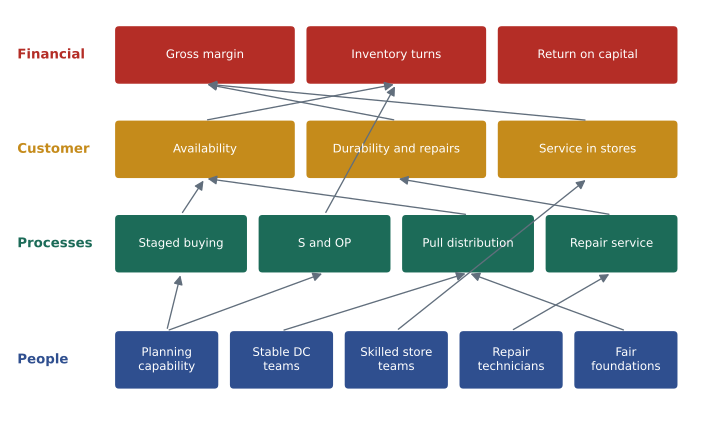
Step 3: the workforce plan
The workforce plan turns priorities into numbers. For each group it states today's headcount, the number needed by the end of the plan, expected turnover, and therefore the number of hires and internal moves required. The distribution center is the most important example. If the pull system and steadier schedules lift productivity modestly, the center needs about the same number of associates despite growing online volume, but more supervisors and lead hands. If turnover falls from 38 to 25 percent, it needs about 130 hires a year instead of about 200, which reduces the load on recruiting and training and raises the average experience of the workforce.
The groups use the Markov approach from lesson 2 for the supervisor pipeline. Promoting lead hands to supervisors through a development program builds the pipeline from inside, but each promotion opens a lead hand role, so the skill-based progression must produce lead hands at the same pace. Owen points out the parallel with Northfield's trades: the long-run supply comes from building, and buying only fills the gap while the pipeline matures.
Step 4: the business case
Dr. Rahimi insists that the strategy be presented in the same terms as the supply chain and marketing plans: costs, benefits, timing and risk. The costs are concrete: supervisors' salaries, pay adjustments for distribution and stores, the planner program, technicians' pay, training and the work of building the pay structure. The benefits are partly measurable and partly not. The measurable ones include lower turnover costs, faster ramp-up and the contribution of the planning capability to the inventory and margin gains in the MBA-513 capstone. The cohort agrees to attribute only a share of those gains to the people strategy, since the supply chain plan also needs systems and process changes, and to count no benefit from the repair service beyond what the marketing plan already counted, to avoid counting the same gain twice.
# Business case for Cedarline's people strategy (millions of dollars a year unless noted)
costs = {
    "20 more DC supervisors (pay and benefits)": 20 * 0.072,
    "DC pay adjustment (3% on 520 associates)": 520 * 0.046 * 0.03,
    "store scheduling and product training": 0.60,
    "planner program and 2 experienced hires": 0.55,
    "manager training and HR capacity": 0.35,
}
setup = 1.5          # one-off: job evaluation, pay structure, equity audit and corrections, systems
annual_cost = sum(costs.values())
savings = {
    "store turnover (46% -> 34%)": 640 * 0.12 * 39_000 * 0.20 / 1e6,
    "DC turnover (38% -> 25%)": 520 * 0.13 * 46_000 * 0.25 / 1e6,
    "DC overtime and picking errors": 0.50,
}
annual_saving = sum(savings.values())
for k, v in costs.items(): print(f"cost    {k:45s} {v:5.2f}")
for k, v in savings.items(): print(f"saving  {k:45s} {v:5.2f}")
print(f"annual cost {annual_cost:.2f}, measurable savings at full effect {annual_saving:.2f}")

wacc, ramp = 0.09, [0.3, 0.7, 1.0, 1.0, 1.0]   # savings and gains build up over three years
def npv(flows): return sum(f / (1 + wacc) ** (t + 1) for t, f in enumerate(flows))
alone = -setup + npv([annual_saving * r - annual_cost for r in ramp])
print(f"people program on measurable savings alone, 5-year NPV: {alone:.1f}")

# The supply chain plan from MBA-513 adds about 7.5 a year of economic profit at full effect.
ep_gain = 7.5
pv_gain = npv([ep_gain * r for r in ramp])
print(f"share of supply chain gains needed to break even: {-alone / pv_gain:.0%}")

# Compare the whole plan with and without the people strategy, assuming that without it
# capability gaps let only 40% of the supply chain gains be realized.
with_people = pv_gain + alone
without = 0.40 * pv_gain
print(f"supply chain plan with people strategy: NPV {with_people:.1f}; without: {without:.1f}")cost 20 more DC supervisors (pay and benefits) 1.44 cost DC pay adjustment (3% on 520 associates) 0.72 cost store scheduling and product training 0.60 cost planner program and 2 experienced hires 0.55 cost manager training and HR capacity 0.35 saving store turnover (46% -> 34%) 0.60 saving DC turnover (38% -> 25%) 0.78 saving DC overtime and picking errors 0.50 annual cost 3.66, measurable savings at full effect 1.88 people program on measurable savings alone, 5-year NPV: -10.1 share of supply chain gains needed to break even: 45% supply chain plan with people strategy: NPV 12.4; without: 9.0
The business case shows annual costs of about 3.7 million dollars against measurable savings of about 1.9 million a year once the program is at full effect, so on turnover and overtime savings alone the program does not pay for itself: its five-year net present value at Cedarline's cost of capital of about 9 percent, the figure from MBA-511, is about minus 10 million. Dr. Rahimi says that this is the moment many people strategies die, and that it is the wrong comparison. The people strategy is not a separate investment but part of the supply chain plan, which adds about 7.5 million dollars a year of economic profit at full effect and cannot work without planners and a stable distribution center. Crediting it with a little under half of the supply chain gains is enough to break even, which is a large share to argue for. A clearer test compares the whole plan with and without the people strategy. If capability gaps would let only 40 percent of the supply chain gains be realized without it, the whole plan is worth about 12 million dollars with the people strategy against about 9 million without, and the advantage grows if the gaps are worse. The board's real question is not whether the people strategy pays for itself, but whether the supply chain plan can succeed without it.
The cohort decides to show the board all three views: the measurable savings, the break-even share, and the comparison of the whole plan with and without the people strategy, rather than a single number that depends on a contested attribution. It also lists the benefits that cannot be priced reliably, such as better service from experienced associates, a lower risk of safety incidents and the reputational value of a fair pay structure, without adding them to the totals.
Step 5: measures and governance
A people strategy needs measures that the leadership team reviews as regularly as sales and inventory. The cohort proposes a short people scorecard: voluntary and regrettable turnover by unit, 90-day turnover of new hires, supervisor spans, engagement from quarterly pulse surveys, time to fill critical roles, the planner pipeline, schedule notice and overtime hours, safety incidents, compa-ratio distributions and the results of the annual pay equity audit. Each measure has an owner and a target, and the scorecard is presented with the operating results each month, so that people data sit beside the numbers they affect.
Governance matters as much as measures. The chief executive owns the people strategy; the chief people officer designs and runs it; line leaders carry it out. The board, or a committee of it, should review the people scorecard and the succession plan for senior roles at least twice a year. Dr. Rahimi notes that boards are increasingly asked to oversee human capital: in the United States, the Securities and Exchange Commission has required public companies since 2020 to describe their human capital resources and measures in annual reports, and investors in both countries ask about turnover, safety and pay equity.
Step 6: implementation and risks
The groups sequence the work over eighteen months. In the first quarter, appoint the chief operating officer's leadership team, start supervisor hiring and the scheduling changes in the distribution center, launch the planner program and begin job evaluation. In the second and third quarters, roll out store training and the new store manager bonus, recruit repair technicians ahead of the repair service launch, complete the pay structure and equity audit and publish ranges. In the fourth quarter and beyond, introduce quarterly check-ins and calibration, extend the skill-based progression, and review the scorecard against targets, adjusting where results fall short.
The main risks are familiar from the course. Managers may implement policies inconsistently, which lesson 1 called the gap between intended and actual practices; the remedy is manager training and measuring practices, not just outcomes. Publishing pay ranges may expose inequities faster than the budget can fix them; the remedy is to complete the audit and fund corrections first. Cost pressure may tempt the company to cut the supervisor hiring if early savings are slow; the remedy is to present the ramp of benefits honestly from the start.
A further risk is collective. Warehouse and retail workers have been the target of high-profile organizing campaigns in the United States, and Cedarline's distribution center has the low engagement, wide spans and schedule complaints that typically precede one. The cohort's advice is not to design the strategy to avoid a union, which would be both unlawful in its tactics if pursued crudely and likely to fail, but to fix the conditions that make employees feel they need one, and to train managers in the rules from lesson 10. If employees do organize, Cedarline should bargain in good faith and use the strategy's measures as a basis for a constructive relationship.
Presenting the strategy
Each study group presents to a panel playing Cedarline's board, with Dr. Rahimi as the chief executive. The strongest presentation begins with the board's question and answers it in one sentence: not yet, but we can within eighteen months, for about 3.7 million dollars a year, half of which comes back in lower turnover and overtime, and without which the supply chain plan is unlikely to deliver its gains. It then shows the gaps table, the five priorities, the strategy map linking each to the approved plans, the business case with its sensitivity to attribution, the scorecard and the timeline. When a board member asks why Cedarline should raise distribution pay when margins are under pressure, the group answers with the lesson 4 and lesson 11 analysis: the center is losing almost two hundred people a year to a nearby warehouse paying more, and each departure costs far more than the raise.
Dr. Rahimi closes the course by returning to her opening slide: people costs that are a third to a half of operating costs, discussed for less than five percent of a board's time. The cohort's work, she says, has been to make people as discussable in the language of strategy and money as inventory and markdowns, without forgetting that the people in the numbers are colleagues whose working lives are shaped by the systems a general manager designs. The next courses in the second year, from entrepreneurship to negotiation, governance and leading change, will draw on this one, because every strategy is in the end carried out by people.
Worked problem
Testing the strategy against an objection
A board member argues that Cedarline should cut payroll instead of adding supervisors, because the company's return on invested capital is only 8 percent. Using the course, respond in a short paragraph that a general manager could say aloud.
Show solution
- Acknowledge the concern: return on capital is low and payroll is a large cost, so any increase must earn its keep.
- Reframe the problem: the low return comes mainly from excess inventory and markdowns, which the supply chain plan addresses; that plan depends on stable distribution teams and capable planners.
- Use the numbers: turnover costs about 4.6 million dollars a year; the supervisor hiring and pay adjustments in the distribution center cost about 2.2 million, less than the roughly 2.3 million a year that turnover in the center costs today, and they cut that cost by about 0.8 million at full effect, with further gains in accuracy, productivity and inventory that the supply chain plan relies on.
- Show the alternative: cutting payroll in the distribution center would raise spans and overtime, increasing turnover and errors, and put the inventory and margin gains at risk.
Answer: A good answer: We share the concern about return on capital, and that is why we are making this investment. Our low return comes from inventory and markdowns, and the supply chain plan that fixes them depends on a distribution center that keeps its people and runs accurately. Turnover already costs us about 4.6 million a year. Adding supervisors and fixing schedules and pay in the center costs about what its turnover already costs us, and cutting staff would put the much larger inventory gains at risk.
Common mistakes
MistakeA people strategy is a list of HR programs.
InsteadIt starts from the business strategy and chooses a few priorities that build the capabilities the strategy needs.
MistakePeople investments cannot be evaluated financially.
InsteadTurnover, ramp-up and capability effects can be priced; present the sensitivity and list what cannot be priced.
MistakeThe HR department owns the people strategy.
InsteadThe chief executive owns it, HR designs and runs it, and line leaders deliver it.
MistakePublishing pay ranges is a quick win.
InsteadAudit and fund corrections first, or transparency will expose inequities without remedies.
Summary and key terms
- A people strategy starts from the capabilities the business strategy requires and compares them with the current workforce.
- A few priorities, each linked to the strategy, beat a program for every practice.
- The workforce plan turns priorities into headcounts, hires and internal moves.
- The business case prices measurable benefits, avoids double counting and shows sensitivity to uncertain attributions.
- A short scorecard reviewed with operating results, clear ownership and a realistic implementation sequence keep the strategy alive.
- People strategy
- A plan for building the people capabilities a business strategy requires.
- People scorecard
- A short set of people measures reviewed with operating results.
- Human capital disclosure
- Reporting on a company’s workforce and people measures to investors.
- Attribution
- The share of a combined gain credited to one initiative in a business case.
- Strategy map
- A diagram linking capabilities and processes to customer and financial outcomes.
Practice problems
Work each problem on paper first, then reveal the answer to check.
A program costs 2 million a year and saves 1.5 million in turnover; it also contributes to a 6 million gain shared with other initiatives. What share of that gain must be credited for the program to break even?
Show answer
It needs 0.5 million more, or about 8 percent of the 6 million gain.
Why should the business case avoid counting the repair service’s revenue again?
Show answer
The marketing plan already counted it; counting it twice overstates the combined return.
Name three measures for a people scorecard.
Show answer
Regrettable turnover by unit, 90-day turnover of new hires, supervisor spans, engagement, time to fill critical roles, safety incidents or pay equity results.
Why should people measures be reviewed with operating results?
Show answer
So leaders see people data beside the outcomes they affect and treat them as part of running the business.
Lesson quiz · 5 questions
Score 60% or more to complete this lesson.
Create a free account to save your progress, take quizzes and earn a certificate.