
MBA-601 · Lesson 2 of 12 · 22 min
Workforce planning and talent strategy
Dr. Rahimi begins the second session with a story from her airline years. A new aircraft type had been ordered five years ahead, with delivery dates fixed and routes already planned around it. Two years before the first delivery, someone asked how many licensed maintenance engineers would be qualified to work on it. Training a technician for a new type took more than a year, the pool of experienced engineers was shrinking as the baby-boom generation retired, and every other airline in the region had placed similar orders. The aircraft arrived on time; for six months several of them sat on the ground for lack of people to sign them off. The lesson, she says, is that capital is easy to plan and people are not, because people take longer to develop than machines take to buy, and because they can leave.
What workforce planning is
Workforce planning is the process of working out what people an organization will need to carry out its strategy, comparing that with the people it is likely to have, and deciding how to close the gap. It has three questions. Demand: how many people, with what skills, in which places and at what times will the strategy require? Supply: how many of today's people will still be here, in which roles, given turnover, retirement, promotion and transfer? Gap: where will demand exceed supply, or supply exceed demand, and what actions will close the difference at the lowest cost and risk?
Planning operates on two horizons. Operational planning looks a few months to a year ahead and deals with headcount budgets, seasonal staffing and scheduling: how many associates Grace's stores need over the holidays, or how many nurses Hana needs on night shifts next quarter. Strategic planning looks three to five years ahead and deals with capabilities: what skills a new business model will need, which roles will shrink as work is automated, and which scarce skills must be developed internally because they cannot be hired. Most organizations do the first well, because the budget forces them to, and the second poorly, because nothing forces them to until a shortage bites.
Forecasting demand
Demand for people follows demand for work. The simplest forecasts use ratios: nurses per occupied bed, associates per million dollars of store sales, engineers per active customer. Ratios are easy to explain and update, but they assume the relationship between work and people stays fixed. Productivity changes, from new equipment, better processes or automation, break the ratio. A distribution center that installs automated sorting may handle more volume with fewer pickers but more maintenance technicians. A better forecast starts from the strategy and the operating model: what volumes, which processes, what technology, and therefore what roles and skills.
Dr. Rahimi asks the cohort to separate headcount from capability. Leo says Kestrel's headcount plan is simple: hire twenty engineers a year. But the strategy from MBA-512 moves Kestrel toward large retailers, which will need people who can lead implementation projects inside clients' supply chains. Those people are rarer than engineers and take longer to find. A plan that counts heads but ignores capabilities will hit its hiring target and still fail. Scenario planning helps when the future is uncertain: Owen builds three scenarios for Prairie Ridge, from slow to fast growth in renewable generation, and asks which roles are needed in all three. Those robust roles are where development should start.
Forecasting supply: turnover, retirement and internal movement
Supply forecasting starts from today's workforce and asks how it will change. People leave voluntarily, retire, are dismissed, are promoted, move sideways or change their hours. Historical rates for each movement can be summarized in a transition matrix, often called a Markov model after the Russian mathematician whose chains of probabilities it uses. Each row is a role at the start of a year; each column gives the share of people in that role who will be in each role, or gone, a year later. Multiplying today's headcount by the matrix projects next year's headcount before any hiring, and repeating the multiplication projects further.
Daniel brings Northfield's skilled trades as an example. The plant has three relevant groups: apprentices, journeyperson tool and die makers, and lead hands who supervise and train. Each year about 75 percent of apprentices stay apprentices, 15 percent complete their training and become journeypersons, and 10 percent leave. Among journeypersons, 82 percent stay, 5 percent become lead hands and 13 percent leave or retire, a rate rising because of the age profile. Lead hands stay at 85 percent; the rest retire.
| From ↓ / To → | Apprentice | Journeyperson | Lead hand | Exit |
|---|---|---|---|---|
| Apprentice | 0.75 | 0.15 | 0.00 | 0.10 |
| Journeyperson | 0.00 | 0.82 | 0.05 | 0.13 |
| Lead hand | 0.00 | 0.00 | 0.85 | 0.15 |
# Markov projection of Northfield's skilled trades over five years, with and without hiring
P = [[0.75, 0.15, 0.00],   # apprentice -> apprentice, journeyperson, lead hand
     [0.00, 0.82, 0.05],   # journeyperson -> ...
     [0.00, 0.00, 0.85]]   # lead hand -> ...
start = [12, 60, 10]
need_j = 62                  # journeyperson positions required each year under the plan

def step(h, hires):
    nxt = [sum(h[i] * P[i][j] for i in range(3)) for j in range(3)]
    return [nxt[j] + hires[j] for j in range(3)]

for label, hires in (("no hiring", [0, 0, 0]), ("10 apprentices a year", [10, 0, 0]),
                     ("10 apprentices + 6 experienced a year", [10, 6, 0])):
    h = start[:]
    print(label)
    for year in range(1, 6):
        h = step(h, hires)
        print(f"  year {year}: apprentices {h[0]:5.1f}  journeypersons {h[1]:5.1f}"
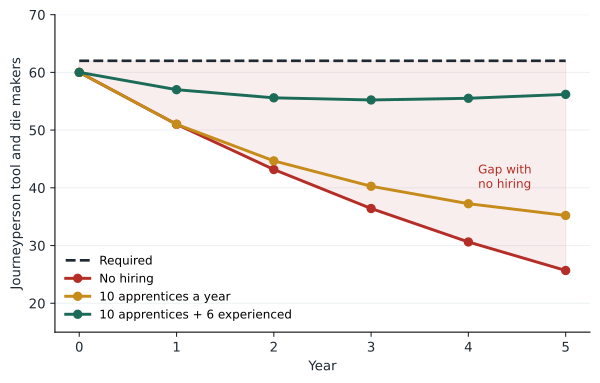
f" lead hands {h[2]:5.1f} journeyperson gap {h[1] - need_j:+6.1f}")no hiring year 1: apprentices 9.0 journeypersons 51.0 lead hands 11.5 journeyperson gap -11.0 year 2: apprentices 6.8 journeypersons 43.2 lead hands 12.3 journeyperson gap -18.8 year 3: apprentices 5.1 journeypersons 36.4 lead hands 12.6 journeyperson gap -25.6 year 4: apprentices 3.8 journeypersons 30.6 lead hands 12.6 journeyperson gap -31.4 year 5: apprentices 2.8 journeypersons 25.7 lead hands 12.2 journeyperson gap -36.3 10 apprentices a year year 1: apprentices 19.0 journeypersons 51.0 lead hands 11.5 journeyperson gap -11.0 year 2: apprentices 24.2 journeypersons 44.7 lead hands 12.3 journeyperson gap -17.3 year 3: apprentices 28.2 journeypersons 40.3 lead hands 12.7 journeyperson gap -21.7 year 4: apprentices 31.1 journeypersons 37.2 lead hands 12.8 journeyperson gap -24.8 year 5: apprentices 33.4 journeypersons 35.2 lead hands 12.8 journeyperson gap -26.8 10 apprentices + 6 experienced a year year 1: apprentices 19.0 journeypersons 57.0 lead hands 11.5 journeyperson gap -5.0 year 2: apprentices 24.2 journeypersons 55.6 lead hands 12.6 journeyperson gap -6.4 year 3: apprentices 28.2 journeypersons 55.2 lead hands 13.5 journeyperson gap -6.8 year 4: apprentices 31.1 journeypersons 55.5 lead hands 14.2 journeyperson gap -6.5 year 5: apprentices 33.4 journeypersons 56.2 lead hands 14.9 journeyperson gap -5.8
With no hiring, the model shows the journeyperson group shrinking from 60 to about 26 within five years, a gap of more than thirty against the plan. Taking on ten apprentices a year slows the decline but does not stop it, because apprentices take years to qualify, some leave before they do, and the apprentice group swells while the qualified group shrinks. Only a combination of ten apprentices and about six experienced hires a year holds the journeyperson group within about six of the target, and the gap closes as the larger apprentice classes begin to qualify. Daniel notes that experienced tool and die makers are exactly what every other manufacturer in the region is trying to hire, which is why the long-run answer has to include building, not just buying.
Markov models have limits. They assume the future rates match past rates, which fails when the labor market tightens or a retirement wave arrives. They work best for large groups; for a role with three people, one resignation swamps the probabilities. And they say nothing about why people move. Dr. Rahimi treats them as a starting point that turns vague worry into a number managers can debate, then adjusts the rates using what managers know: who has said they plan to retire, which groups are being recruited away.
Closing the gap: build, buy, borrow and bot
Once the gap is known, the organization chooses how to close it. The choices are often summarized in four words. Build means developing internal people through training, apprenticeships, rotations and promotion; it is slower but produces people who know the organization and are often more loyal. Buy means hiring from outside, which is faster for skills that exist in the market but can be expensive when everyone wants the same people. Borrow means using contractors, agencies, consultants or partners, which adds flexibility but can leave the organization dependent and without the knowledge when the contract ends. Bot means redesigning work so that technology does part of it, which changes the skills needed rather than removing the need for people.
Peter Cappelli of Wharton argued that many firms rely too much on buying, expecting the market to supply ready-made talent while cutting the training and career paths that once built it. When markets tighten, they find they are all bidding for the same small pool. He described talent management as a supply chain problem: like inventory, talent pipelines can be built to order or held in stock, and the right mix depends on how predictable demand is. Where demand for a skill is uncertain, borrowing and short internal development programs that can be expanded or cut are cheaper than building deep benches that may not be used.
Not all roles are equal
Talent strategy also decides where to invest most. Mark Huselid, Richard Beatty and Brian Becker argued for differentiating roles, not just people. Some positions, which they called A positions, have a large effect on strategy and show wide variation in performance between strong and weak holders. Others matter but show little variation, because the work is standardized, or vary widely but have little strategic effect. Investment in selection, development and pay should be concentrated where both strategic impact and performance variation are high.
For Cedarline, Dr. Rahimi argues, demand planners are A positions after the supply chain redesign. A strong planner who reads sell-through early and triggers the second buy correctly can be worth millions in margin and inventory; a weak one can wipe out the benefit of the whole redesign. Distribution supervisors are another: the gap between a supervisor whose team picks accurately and stays, and one whose team turns over every year, is large. Store associates matter greatly to customers, but variation between them can be narrowed by good training and scheduling, so the emphasis there is on systems rather than on selecting stars. Hana argues that the same logic applies to her charge nurses, whose decisions shape every shift.
Succession and the talent pipeline
Succession planning identifies people who could fill critical roles, especially leadership roles, and prepares them in advance. Old-style succession plans named one successor for each executive and kept the list secret. Modern practice is broader: talent reviews in which senior leaders discuss the readiness of a pool of candidates for families of roles, development plans that give candidates experience they lack, and measures of bench strength such as the share of critical roles with at least one candidate ready within a year. Lesson 7 introduces the nine-box grid often used in these reviews and its limitations.
Owen's problem is knowledge rather than titles. Prairie Ridge's longest-serving operators know which valves stick in cold weather and how a particular compressor sounds before it fails. None of it is written down. He has started pairing each retiring operator with a successor for their final year, recording short videos of non-routine tasks and asking retirees to return as paid mentors for a few weeks a year. Dr. Rahimi calls this the hardest kind of planning, because the risk is invisible until the person has gone.
Labor markets and immigration
US employers fill some shortages through immigration, including employment-based green cards and temporary visas such as the H-1B for specialty occupations and the H-2B for seasonal non-agricultural work. These routes are capped, slow and subject to policy change: a 2025 presidential proclamation added a large fee to many new H-1B petitions, and processing rules have shifted often. For workforce planning, the lesson is that immigration is an uncertain source of supply, so plans should not depend on a single route. Registered apprenticeships overseen by the Department of Labor and state agencies, and community college partnerships, are relevant to Daniel's build option.
Demographics are the deeper force. In both countries, the large generation born after the Second World War has largely retired or is retiring, and labor force growth depends more on immigration and participation than on new entrants. Shortages are concentrated in skilled trades, health care and some technical fields, while other occupations face displacement by automation and artificial intelligence. Dr. Rahimi asks the cohort to treat both as planning problems: shortages need longer-lead development, and displacement needs early redeployment and retraining, which costs less than layoffs followed by rehiring.
Worked problem
Choosing between build and buy
Kestrel needs eight implementation leads within 18 months to support large retail clients. External hires with the right experience cost about 165,000 dollars a year in pay and benefits plus a recruiting fee of 25 percent of first-year pay, take about four months to find and about three months to become fully productive. Internal candidates, senior support engineers now earning 120,000 dollars, would need a nine-month development program costing 30,000 dollars each and a raise to 150,000. About 70 percent of internal candidates complete the program successfully. Kestrel has 10 interested support engineers. Compare the options for the first two years.
Show solution
- Buy: each external hire costs 165,000 × 2 = 330,000 in pay over two years plus a fee of 41,250, about 371,000. Eight hires cost about 2.97 million. They are productive after about seven months from the decision.
- Build: of 10 candidates, about 7 succeed. Each successful candidate costs the 30,000 program plus a raise of 30,000 a year once promoted. If promoted after nine months, the extra pay over the rest of two years is about 30,000 × 1.25 = 37,500, so about 67,500 each, or about 470,000 for seven, plus about 90,000 for the three who do not complete. Their old support roles must be backfilled at about 120,000 a year each, but backfill hiring is easier and cheaper than hiring implementation leads.
- Build costs far less in direct terms, but produces only about seven leads and takes longer. Kestrel can combine the two: develop the internal candidates and hire one or two experienced leads now to cover the first large clients and to coach the developing group.
- Consider risks: external hires may not understand Kestrel's product, while internal candidates know the product but not client project management. A mixed team covers both.
Answer: A mixed strategy is best: build seven internal leads and buy one or two experienced leads immediately. The build option is much cheaper, and the experienced hires reduce the risk of the first large implementations while the internal group develops.
Common mistakes
MistakeWorkforce planning is a headcount budget.
InsteadStrategic workforce planning is about capabilities and skills over several years, not only next year's head count.
MistakeIf we need skills, we can hire them when we need them.
InsteadScarce skills take time to find or develop; when every rival needs the same skills, buying becomes slow and expensive.
MistakeEvery role deserves the same investment.
InsteadConcentrate investment on positions with high strategic impact and wide variation in performance.
MistakeA Markov projection predicts the future.
InsteadIt projects past movement rates forward; adjust it with what managers know about retirements and market changes.
Summary and key terms
- Workforce planning compares future demand for people and skills with likely supply and chooses actions to close the gap.
- Demand forecasts should start from the strategy and operating model, not just ratios to volume.
- Transition matrices project supply from historical rates of turnover, retirement and promotion.
- Gaps can be closed by building, buying, borrowing or redesigning work with technology; most organizations need a mix.
- A positions with high strategic impact and high performance variation deserve the most investment; succession planning and knowledge transfer protect critical roles.
- Workforce planning
- Forecasting the people and skills a strategy needs, comparing with likely supply and planning how to close gaps.
- Transition matrix
- A table of probabilities that people in each role will stay, move to another role or leave within a period.
- Build, buy, borrow
- Developing people internally, hiring externally, or using contractors and partners.
- A position
- A role with large strategic impact and wide variation in performance between holders.
- Succession planning
- Identifying and developing candidates for critical roles before they fall vacant.
- Bench strength
- The share of critical roles with at least one candidate ready to fill them.
Practice problems
Work each problem on paper first, then reveal the answer to check.
A team of 40 has annual voluntary turnover of 15 percent and retirements of 5 percent. With no hiring, how many people are expected at the end of the year?
Show answer
40 × (1 − 0.15 − 0.05) = 32.
In a transition matrix, 80 percent of supervisors stay, 5 percent are promoted and 15 percent leave. With 20 supervisors and 6 new supervisors promoted from below each year, how many supervisors are there after one year?
Show answer
20 × 0.80 + 6 = 22.
Give one advantage and one risk of borrowing talent.
Show answer
Advantage: flexibility and speed without long-term commitment. Risk: dependence on outsiders and loss of knowledge when the contract ends.
Why might demand planners be A positions at Cedarline?
Show answer
Their decisions strongly affect inventory and margin, and strong and weak planners differ widely in results.
Lesson quiz · 5 questions
Score 60% or more to complete this lesson.
Create a free account to save your progress, take quizzes and earn a certificate.