
MBA-601 · Lesson 1 of 12 · 23 min
HR as strategy: people as a source of competitive advantage
The second year of the weekend EMBA at the Lakeshore School of Business in Chicago begins in September, and the first course of the fall term is Strategic Human Resource Management. The cohort that studied leadership with Dr. Ingrid Sato in MBA-503 now meets Dr. Nadia Rahimi, who spent fourteen years in human resources at a national airline, rising from labor relations adviser at a maintenance base to vice-president of people, and then six years as chief people officer of a specialty retailer with three hundred stores. She opens with two numbers on a slide. The first is the share of a typical service company's operating costs that goes to wages, salaries and benefits: often between a third and a half. The second is the share of board meeting time, in a survey she ran among directors she knows, spent discussing those people: under five percent.
Dr. Rahimi explains the difference between this course and MBA-503. Leadership is about what one manager does with a team: motivating, deciding, resolving conflict. Human resource management is about the systems that shape every manager's team at once: how people are planned for, hired, developed, evaluated, paid and represented, and the rules within which all of that happens. A brilliant leader inside a broken system spends her energy working around it. A good system makes ordinary managers more effective, because it hires people who fit the work, tells them clearly what is expected, and rewards what the business needs. The cohort's task over twelve lessons is to learn to design and judge those systems as a general manager, not as an HR specialist.
What human resource management covers
Human resource management, often shortened to HR or people management, is the set of policies and practices through which an organization acquires, develops, motivates and retains the people it needs, and governs its relationship with them. The traditional list of practices is long: workforce planning, job design, recruiting, selection, onboarding, training and development, performance management, compensation, benefits, employee relations, labor relations, health and safety, and compliance with employment law. Strategic HR management adds a question to each of them: how does this practice help the organization carry out its strategy and build an advantage that rivals find hard to copy?
Dr. Rahimi draws a distinction that she will return to many times. HR policies are the stated intentions: the pay philosophy, the performance review procedure, the values on the website. HR practices are what actually happens: what managers really do in interviews, how ratings are really decided, which behavior is really promoted. Employees respond to practices, not policies. Research by Patrick Wright and Lisa Nishii described the chain as intended practices, actual practices and perceived practices; most of the damage in HR systems happens between the first link and the second, when line managers implement policies inconsistently, and between the second and the third, when employees read meanings into practices that nobody intended.
People as a source of competitive advantage
Why should people be a source of lasting advantage rather than a cost to be minimized? The resource-based view of the firm, associated with Jay Barney, offers a test. A resource yields sustained advantage if it is valuable, rare, hard to imitate and supported by an organization that can exploit it. Machines and software can usually be bought by any rival. A workforce whose skills, relationships and habits have been built over years inside a particular system is different. It is valuable because it does the work customers pay for. It may be rare, because the labor market does not offer such teams ready-made. And it is hard to imitate because the advantage lies less in any individual than in how people work together, which is causally ambiguous to outsiders and path dependent: it cannot be bought quickly even by a rival who understands it.
Southwest Airlines in its first decades and Toyota's production system are the textbook cases. Rivals sent study teams, copied visible practices such as quick aircraft turnarounds or kanban cards, and still could not match the results, because the practices worked only as part of a system of hiring, training, job design, team structure, labor relations and culture. Jeffrey Pfeffer of Stanford summarized the evidence in the 1990s as a list of practices that tended to go together in high-performing firms: employment security, selective hiring, self-managed teams, comparatively high pay contingent on performance, extensive training, reduced status distinctions and wide sharing of information.
High-performance work systems and the evidence
The bundle of practices Pfeffer described is now usually called a high-performance work system. Its logic rests on the AMO framework: performance depends on employees' ability, motivation and opportunity to contribute. Selective hiring and training build ability. Pay for performance, career paths and fair treatment build motivation. Job design, teams and information sharing create the opportunity to use ability and motivation on the job. A firm that invests heavily in ability but gives people no opportunity to use it, for example by designing narrow jobs with no discretion, wastes the investment.
Studies across thousands of firms have found a positive association between the use of such systems and outcomes such as productivity, lower turnover and financial performance. Mark Huselid's 1995 study of nearly a thousand US firms was influential, and later meta-analyses, including one by James Combs and colleagues in 2006, found an average correlation between high-performance practices and organizational performance of around 0.2. Dr. Rahimi cautions the cohort not to overread these results. Most studies are cross-sectional, so causation can run both ways: profitable firms can afford generous practices. Practices are often reported by a single HR manager who may describe policy rather than reality. And the effect varies with context. In businesses that compete on low cost with simple, standardized work, heavy investment in discretion and development may not pay.
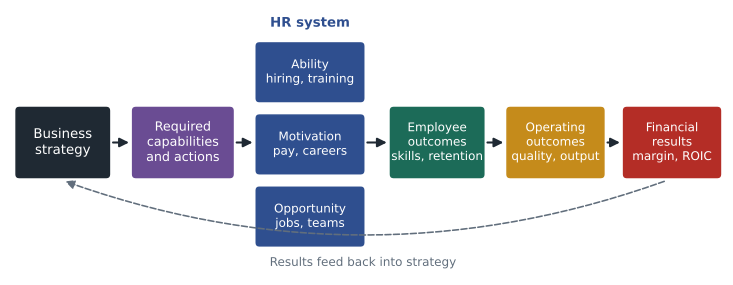
The cohort meets the idea of fit. Vertical fit is the alignment of HR practices with the business strategy: a firm competing on innovation needs different people practices from one competing on cost. Horizontal fit, sometimes called internal fit, is the consistency of practices with one another: an organization that preaches teamwork but pays individual commissions and ranks people against each other sends conflicting signals, and employees believe the pay. Strong HR systems, in a phrase from David Bowen and Cheri Ostroff, send messages that are distinctive, consistent and agreed: employees see clearly what matters, see it reinforced by every practice and see managers agree about it.
| Strategy | Employee behaviors needed | Typical HR emphasis |
|---|---|---|
| Cost leadership | Reliable, efficient work within standard methods | Clear job design, efficient hiring, training in standard methods, pay at market, measures on productivity and quality |
| Differentiation by service | Judgment, care and consistency with customers | Selective hiring for attitude, deep training, discretion within limits, pay above market for key roles, measures on customer outcomes |
| Innovation | Creativity, risk-taking, collaboration across specialties | Hiring for expertise and curiosity, broad roles, long-term incentives, tolerance of failure, team rewards |
| Operational excellence | Continuous improvement and problem solving | Hiring for learning, training in improvement methods, employment security, gain-sharing, team structures |
The role of the HR function
Dave Ulrich's work in the late 1990s reshaped how large companies organize their HR departments. He argued that HR should be judged by what it delivers to the business, not by the activities it performs, and proposed four roles: strategic partner, change agent, administrative expert and employee champion. The model is often implemented as a three-part structure: HR business partners who work alongside line leaders, centers of expertise in areas such as compensation, learning and labor relations, and shared services that handle transactions such as payroll, benefits enrollment and records, increasingly through self-service technology. Dr. Rahimi notes that the structure has its critics. Business partners are sometimes so absorbed in transactions that they never become strategic, and employees can find shared services impersonal at the moments that matter most to them, such as a leave or a dispute.
What matters for the cohort is the division of responsibility. Line managers make most of the decisions that employees experience as HR: whom to hire, what feedback to give, who gets the stretch assignment, how to handle a complaint. The HR function designs the systems, builds managers' skills, provides expertise in law and labor relations, and measures whether the systems work. A general manager who treats HR as something the HR department does has misunderstood where the work happens.
Measuring people: from activity to impact
Traditional HR measures count activities: number of hires, training hours delivered, days to fill a vacancy. Strategic measures connect people to business outcomes. The most common is turnover, because it is easy to measure and expensive. Voluntary turnover is the number of employees who choose to leave during a period divided by average headcount. Its cost is usually underestimated, because most of it is hidden. Direct costs include advertising, recruiter time and agency fees. Indirect costs include the vacancy period, when work is undone or covered by overtime; the time new hires take to reach full productivity; the time of managers and colleagues spent training them; and the errors and lost sales that come with inexperience. Estimates for the full cost of replacing an employee range from a few months of pay for frontline jobs to more than a year's pay for specialized professionals.
Analytics can go further. People analytics uses data on hiring, performance, pay, engagement and turnover to test what works: which recruiting sources produce employees who stay, whether a training program changes performance, which managers' teams have unusually high turnover. Dr. Rahimi warns of two traps. The first is measuring what is easy rather than what matters, which leads to dashboards that nobody uses. The second is treating employees as data subjects without their trust: monitoring keystrokes or scraping messages may be legal in some circumstances, but it can destroy the engagement it was meant to measure.
Cedarline's people problem
The cohort returns to Cedarline Outdoor, the outdoor clothing and equipment company whose finances they diagnosed in MBA-501, whose leadership they examined in MBA-503 and whose marketing and supply chain they redesigned in the first-year winter term. Cedarline has about 1,450 employees. The two largest groups are its 640 store employees across 62 stores and its 520 employees in the distribution center. In MBA-503 the cohort found engagement of 29 percent in stores and 14 percent in distribution, and voluntary turnover of 46 percent and 38 percent a year. The supply chain redesign from MBA-513 and the lifetime repair service from MBA-512 both depend on people Cedarline does not yet have: demand planners, repair technicians, and distribution supervisors who can run a pull system rather than fight daily fires.
Dr. Rahimi asks the cohort to put a price on the turnover first, because a general manager who wants investment in people must speak the language of the rest of the business. She provides Cedarline's assumptions: store associates earn about 39,000 dollars a year in pay and benefits and distribution associates about 46,000; replacing a store associate costs about a fifth of annual pay, counting hiring, training and the months a new associate sells less; replacing a distribution associate costs about a quarter, because errors and slow picking in the first months are expensive.
# Annual cost of voluntary turnover at Cedarline (dollars)
groups = {
    # name: (headcount, annual turnover rate, pay and benefits, replacement cost as share of pay)
    "stores":       (640, 0.46, 39_000, 0.20),
    "distribution": (520, 0.38, 46_000, 0.25),
}
total = 0
for name, (n, rate, pay, share) in groups.items():
    leavers = n * rate
    cost = leavers * pay * share
    total += cost
    print(f"{name:13s} leavers {leavers:5.0f}  cost per leaver {pay * share:8,.0f}  total {cost:11,.0f}")
print(f"{'total':13s} {'':38s}{total:11,.0f}")

# Value of cutting each turnover rate by ten points
saving = sum(n * 0.10 * pay * share for n, rate, pay, share in groups.values())
print(f"Ten points lower turnover in both groups saves about {saving:,.0f} a year")stores leavers 294 cost per leaver 7,800 total 2,296,320 distribution leavers 198 cost per leaver 11,500 total 2,272,400 total 4,568,720 Ten points lower turnover in both groups saves about 1,097,200 a year
The calculation shows that turnover in the two groups costs Cedarline about 4.6 million dollars a year, and that cutting both rates by ten points would save roughly 1.1 million. Daniel Osei, plant controller at Northfield Components, points out that this understates the cost, because it ignores the effect of inexperienced staff on sales and service. Grace Mwangi of Fairway Grocers adds that in her stores a new associate who does not know the products is not just slower but loses sales a customer would otherwise have made. Dr. Rahimi agrees and says the honest approach is to present the measurable cost as a floor and to describe the harder-to-measure effects separately, rather than inflate the headline number.
The cohort and the course
Each manager brings a people problem from work. Daniel's is a unionized plant at Northfield where a third of the skilled trades will be eligible to retire within five years, and a collective agreement that expires next spring. Hana Kowalski, director of operations at Lakeview Health, faces nurse vacancies and burnout, and an evening clinic expansion that needs staff she cannot find. Leo Brandt, co-founder of Kestrel Analytics, has grown the company to 180 people and has no consistent way of hiring engineers, rating performance or setting pay, which is starting to show in complaints about fairness. Grace manages a group of Fairway stores where scheduling and pay for hourly staff drive both cost and service. Owen Tremblay of Prairie Ridge Energy has a plant workforce with long service, deep knowledge that is not written down, and a safety record he cannot afford to see slip as people retire.
The course follows the employment cycle. Lesson 2 covers workforce planning. Lesson 3 sets out the legal foundations that constrain every later decision, which differ between Canada and the United States. Lessons 4 to 6 cover how people are attracted, selected and developed; lessons 7 to 9 how they are evaluated and rewarded; lesson 10 the collective relationship with unions; and lesson 11 culture, engagement, inclusion and retention. The capstone in lesson 12 asks the cohort to write a people strategy for Cedarline that supports the plans they made in earlier courses.
Worked problem
Testing vertical and horizontal fit
A software company says it competes on innovation and collaboration. Its HR practices are: hiring through employee referrals and a single unstructured interview; a forced ranking that places 10 percent of each team in a bottom category every year; individual bonuses based on each engineer's own features shipped; and annual training budgets of 300 dollars per person. Evaluate the system's vertical and horizontal fit and propose two changes.
Show solution
- Identify the behaviors the strategy requires: creativity, sharing knowledge, helping colleagues, taking sensible risks and learning new tools.
- Check vertical fit practice by practice. Unstructured interviews and referral-only hiring are weak at finding expertise and may narrow the range of thinking. Forced ranking discourages risk-taking and helping colleagues, because colleagues are competitors for the top slots. Individual feature bonuses reward visible output, not collaboration or quality. Small training budgets undercut learning.
- Check horizontal fit. The stated value of collaboration conflicts with forced ranking and individual bonuses; employees will follow the pay and the ranking.
- Propose changes aligned with the strategy: replace forced ranking with calibrated judgments against expectations and shift part of the bonus to team or company results; adopt structured interviews and work-sample tests, as lesson 5 will show; raise development budgets for skills the strategy needs.
Answer: The system has poor vertical fit with an innovation strategy and poor horizontal fit with its stated values. The two most important changes are to remove forced ranking and to rebalance rewards toward team and company results, because together they send the clearest signal about what the company actually values.
Common mistakes
MistakeHR is the HR department's job.
InsteadLine managers carry out most HR practices; the HR function designs systems, builds managers' skills and measures results.
MistakeBest practices work everywhere.
InsteadPractices must fit the strategy and each other; the same practice can help in one firm and harm in another.
MistakeTurnover cost is the cost of advertising and recruiting.
InsteadMost turnover cost is hidden: vacancies, lost productivity while new hires learn, managers' time and errors.
MistakeA good policy guarantees good practice.
InsteadEmployees respond to what managers actually do and how they perceive it, which can differ sharply from the written policy.
Summary and key terms
- Strategic HR management designs the systems that shape how people are planned for, hired, developed, evaluated, paid and represented, in support of strategy.
- People can be a source of sustained advantage because skilled, coordinated workforces are valuable, rare and hard to imitate.
- High-performance work systems build ability, motivation and opportunity; the evidence links them to better performance, but with caveats about causation and context.
- Vertical fit aligns practices with strategy; horizontal fit makes them consistent with one another.
- Turnover is the most common bridge between people and financial results, and most of its cost is hidden.
- Strategic HR management
- Designing people policies and practices to support the strategy and build advantage that rivals find hard to copy.
- High-performance work system
- A bundle of mutually reinforcing practices that build employees’ ability, motivation and opportunity to contribute.
- AMO framework
- The idea that performance depends on ability, motivation and opportunity.
- Vertical fit
- Alignment of HR practices with the business strategy.
- Horizontal fit
- Consistency of HR practices with one another.
- Voluntary turnover rate
- Employees who choose to leave in a period divided by average headcount.
- People analytics
- The use of data on employees and HR practices to test what works and guide decisions.
Practice problems
Work each problem on paper first, then reveal the answer to check.
A company of 800 employees had 200 voluntary leavers last year. What is its voluntary turnover rate?
Show answer
200 / 800 = 25 percent.
If replacing each leaver costs 30 percent of average pay of 50,000 dollars, what did turnover cost?
Show answer
200 × 0.30 × 50,000 = 3.0 million dollars.
Give one example of poor horizontal fit.
Show answer
A firm that promotes teamwork but pays individual commissions and ranks people against each other; any pair of practices that send opposing messages qualifies.
Why are high-performance work systems hard for rivals to copy?
Show answer
Their value lies in how many practices reinforce each other and in skills and relationships built over time, which outsiders cannot see clearly or buy quickly.
Lesson quiz · 5 questions
Score 60% or more to complete this lesson.
Create a free account to save your progress, take quizzes and earn a certificate.