
MBA-513 · Lesson 11 of 12 · 24 min
Global supply chains: logistics, tariffs, risk and resilience
Owen opens the eleventh session with a story from the summer. Prairie Ridge had ordered solar panels for a community solar project from a manufacturer in Southeast Asia, with delivery planned for June. Within the space of a few months, the tariff treatment of the panels changed more than once, a shipping route was disrupted, and the manufacturer's own supplier of solar cells was asked by customs authorities to document where its polysilicon came from. The panels arrived eleven weeks late, the installation crew sat idle, and the project's first-year return fell by almost two points. Owen says that none of the individual events was unforeseeable, but nobody at Prairie Ridge had looked at the supply chain beyond its first supplier. Dr. Raman says that is the normal state of affairs, and the subject of this lesson.
Why supply chains went global
From the 1980s to the 2010s, falling tariffs, containerized shipping, cheaper communications and the entry of China into the World Trade Organization in 2001 made it economic to split production across countries according to cost and capability. Apparel, electronics, furniture and toys moved largely to Asia; auto parts moved across North America under free trade agreements. The gains were large: lower costs for consumers, access to specialized suppliers and, for exporting countries, rapid industrial growth. The costs were less visible until a series of shocks exposed them: long lead times, large pipeline inventories, dependence on a few locations and suppliers, limited visibility into the tiers beyond the first, and exposure to trade policy.
Landed cost
The purchase price is only the start of what an imported item costs. Landed cost adds freight and insurance, customs duties and fees, customs brokerage, port handling, inland transport to the distribution center and any taxes that are not recoverable. Total cost of ownership, from lesson 10, adds the cost of the inventory in the pipeline, which by Little's law equals the flow rate times the transit time; quality inspection and defects; supplier management and travel; and the cost of the forecasting errors that long lead times cause, in markdowns and lost sales. For fashion products, that last item often outweighs the difference in factory prices between distant and nearby suppliers.
Who pays for and controls each part of the journey is set by the Incoterms rules, published by the International Chamber of Commerce and last revised in 2020. Under FOB, free on board, the seller delivers the goods onto the vessel at the port of shipment and the buyer arranges and pays for the ocean freight and everything after. Under CIF, cost, insurance and freight, the seller pays freight and insurance to the destination port, though the risk passes to the buyer when the goods are loaded. Under EXW, ex works, the buyer collects the goods at the seller's premises; under DDP, delivered duty paid, the seller delivers to the buyer's door with duties paid. Cedarline buys FOB, which gives it control of ocean freight contracts but also the risk of rate swings.
Moving goods
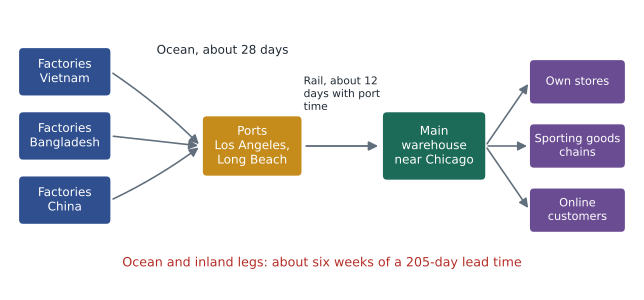
Each transport mode trades cost against speed and reliability. Ocean container shipping is by far the cheapest per unit for long distances and carries most world trade by volume, but it is slow, typically four to six weeks from Asian factories to North American distribution centers including port and inland time. Air freight costs many times more per kilogram but takes days; it suits high-value, urgent or perishable goods and is often used to rescue late fashion deliveries at a heavy cost. Rail moves containers inland from ports, and trucks provide door-to-door flexibility, dominating trade within North America. Ocean freight rates are quoted per forty-foot container, which holds roughly 1,500 to 2,500 jackets depending on their bulk, and they are volatile. Drewry's World Container Index, a composite of spot rates on eight major routes, stood at about 4,585 US dollars per forty-foot container on 22 October 2026, with Shanghai to Los Angeles at about 8,000 and Shanghai to Rotterdam at about 3,600. During the pandemic peak of 2021, rates on the main routes were several times higher than they had been in 2019.
Routes matter as well as rates. After attacks on ships in the Red Sea from late 2023, most container lines diverted Asia–Europe services around the Cape of Good Hope, adding one to two weeks to voyages and absorbing a large share of the world's container capacity. Carriers began returning to the Suez Canal route in 2026, but plans were set back by renewed conflict in the region in late February, and in October the chief executive of the logistics company Kuehne+Nagel said most lines should resume Suez routings by late in the first quarter or early in the second quarter of 2027. Earlier, in March 2021, the grounding of the container ship Ever Given closed the canal for six days and delayed hundreds of ships. For North American importers, labor disputes at ports and on railways are a recurring risk: Canadian ports on both coasts and the main US East and Gulf Coast ports have been shut or slowed by disputes in recent years.
Trade rules and tariffs
Customs duties depend on three things: the classification of the product in the Harmonized System, the international nomenclature of about 5,000 product headings used by more than 200 countries; its customs value, usually the transaction value; and its origin, which determines whether a free trade agreement or a special tariff applies. Rules of origin define when a product counts as made in a country, often by requiring a change in tariff classification or a minimum share of regional value. For apparel, North American and trans-Pacific agreements generally apply a yarn-forward rule: the yarn and fabric, not just the sewing, must come from member countries. A jacket sewn in Mexico from Chinese fabric does not qualify for duty-free treatment under the Canada-United States-Mexico Agreement. Importers can reduce duty costs legitimately through correct classification, using agreements, duty drawback on goods that are re-exported and, in the United States, foreign-trade zones, but misdeclaring origin to avoid duties is fraud.
Trade policy in North America has been unusually unsettled since 2025, and Dr. Raman insists that the cohort know the current position while treating it as provisional. On 20 February 2026, the US Supreme Court held that the International Emergency Economic Powers Act does not authorize tariffs, ending the tariffs imposed under that law in 2025, including those on Canada, Mexico and China, and starting a process of refunds to importers. The administration replaced them within days with a temporary 15 percent global tariff under section 122 of the Trade Act of 1974, which expired after its 150-day limit on 24 July 2026. From that date, additional tariffs under section 301 applied to imports from 60 economies following an investigation into forced labor, at 10 percent for Canada with an exemption for goods that qualify under the Canada-United States-Mexico Agreement. Tariffs under section 232 on steel, aluminum, copper, autos and parts, lumber and some furniture remain. At the first joint review of that agreement on 1 July 2026, the United States declined to confirm its renewal, so it moves to annual reviews while remaining in force until 2036.
For US importers of apparel, the main cost drivers are the ordinary duties on clothing, which are high by US standards, often between 15 and 30 percent for synthetic outerwear, the section 301 duties on most goods from China dating from 2018 and 2019, and the additional section 301 duties from July 2026 on goods from 60 economies. In August 2026 the United States also imposed a 50 percent tariff under section 338 of the Tariff Act of 1930 on many Canadian goods, including textiles, toys and sporting goods, with no exemption for goods that qualify under the agreement, and Canada responded with surtaxes on about 27.6 billion Canadian dollars of US goods, including clothing. Apparel made in Mexico from North American yarn and fabric enters duty-free under the agreement and is exempt from the 2026 section 301 duties. For Cedarline, which buys finished goods from Asia and sells in the United States, the tariff changes have raised landed costs on its Asian products and made qualifying Mexican and Central American production relatively more attractive. The exact rate on any jacket depends on its classification and must be confirmed with a customs broker.
Forced labor rules add another requirement. The Uyghur Forced Labor Prevention Act, in force since June 2022, presumes that goods made wholly or in part in the Xinjiang region of China, or by listed entities, are made with forced labor and bars them from entry unless the importer proves otherwise with clear and convincing evidence. US Customs and Border Protection has detained shipments of apparel, solar products and other goods under the law, so Cedarline must be able to trace its cotton and synthetic fibers beyond its sewing factories.
# Landed cost and mismatch cost per jacket (dollars), three sources
price, rate = 149, 0.25      # full retail price; annual holding rate on goods in the pipeline

def total(fob, freight, duty, inland, weeks, risk):
    carry = fob * rate * weeks / 52          # cost of the pipeline inventory (Little's law)
    landed = fob + freight + fob * duty + inland + carry
    mismatch = price * risk * weeks           # expected markdowns and lost sales grow with lead time
    return landed, landed + mismatch

sources = {  # fob price, freight, duty rate, brokerage and inland, weeks from order to warehouse
    'Vietnam':  (50, 4.0, 0.30, 1.8, 16),   # duty: assumed ordinary duty plus 2026 additional duty
    'Mexico':   (61, 1.9, 0.00, 1.2, 5),     # duty-free if it meets the rules of origin
    'Domestic': (78, 0.8, 0.00, 0.6, 3),
}
print("Source     landed   total for fashion items   total for core items")
for name, (fob, fr, du, inl, wk) in sources.items():
    landed, fashion = total(fob, fr, du, inl, wk, 0.009)
    _, core = total(fob, fr, du, inl, wk, 0.0015)
print(f"{name:9} {landed:7.2f} {fashion:15.2f} {core:22.2f}")Source landed total for fashion items total for core items Vietnam 74.65 96.10 78.22 Mexico 65.57 72.27 66.68 Domestic 80.52 84.55 81.20
The model compares three sources for a jacket that sells for 149 dollars. A Vietnamese factory has the lowest price but, under the team's assumption of a combined duty of 30 percent, a much higher landed cost, and a lead time of 16 weeks. A Mexican factory using North American fabric costs more at the factory gate but pays no duty and takes five weeks, and a small domestic factory takes three. Landed cost already favors Mexico, at about 66 dollars against about 75 for Vietnam. Adding the expected cost of mismatch between what is bought and what sells, assumed to grow by 0.9 percent of the retail price for each week of lead time for fashion items and 0.15 percent for core items, widens the gap for fashion to about 72 dollars against about 96. For core items, Mexico is also cheaper, at about 67 dollars against 78. The numbers are illustrative and depend heavily on the duty assumption, but the pattern is robust: tariffs and lead time both push innovative products toward nearby sources, as Fisher's framework predicts.
Supply chain risk
Supply chain risks can be grouped by where they arise: supply risks, such as a supplier's failure, quality problems or capacity shortages; demand risks, such as sudden shifts in what customers buy; process risks inside the firm, such as an IT failure or a fire; and environmental risks outside everyone's control, such as natural disasters, pandemics, wars, cyberattacks, trade policy and port closures. Managers often map risks on a grid of likelihood against impact. Frequent, low-impact risks, such as late deliveries, are managed with routine buffers and supplier performance management. Rare, high-impact risks, such as an earthquake at a sole supplier's plant, are harder: they are easy to ignore until they happen, and their cost can threaten the firm.
Two events in 2011 changed how manufacturers thought about such risks. The earthquake and tsunami in Japan in March damaged plants that made specialized semiconductors, paints and other inputs for automakers worldwide, and many firms discovered that suppliers several tiers back, whom they had never heard of, were sole sources. Floods in Thailand later that year shut factories producing a large share of the world's hard disk drives. David Simchi-Levi and colleagues, working with Ford, proposed measuring exposure with two numbers for each supplier site: time to recover, how long it would take the site to return to full output after a disruption, and time to survive, how long the firm could keep meeting demand from inventory and alternative sources. When time to recover exceeds time to survive, the firm faces lost sales, and the size of the gap times the margin at risk measures the exposure. They found that the largest exposures often came not from the biggest suppliers by spend but from cheap, specialized parts.
Building resilience
Yossi Sheffi of MIT argued in his 2005 book The Resilient Enterprise that firms can build resilience through redundancy and through flexibility. Redundancy means spare inventory, spare capacity and second suppliers that are held in case of disruption. It is simple but costly, because it is idle most of the time. Flexibility means designing the supply chain so that it can adapt: standardized parts that several suppliers can make, plants that can switch between products, contracts that allow volumes to shift, and processes that can be reconfigured. William Jordan and Stephen Graves showed in 1995 that a little flexibility goes a long way: in a network of plants and products, letting each plant make two products, arranged in a single chain that links all plants and products, captures most of the benefit of full flexibility, in which every plant can make everything.
Visibility is the third ingredient. A firm that knows only its first-tier suppliers cannot see where its real dependencies lie. Mapping the supply chain several tiers back, at least for critical items, identifies hidden concentrations, such as several apparently independent fabric suppliers that all buy from the same membrane maker, as Daniel's steel suppliers all relied on one mill in MBA-501. Many firms also diversify geographically, adding production in a second country to reduce dependence on one, often called a China-plus-one strategy, or moving some production closer to their markets, nearshoring, or to allied countries, friend-shoring. Each option has costs: second sources may be more expensive or less capable, and splitting volume can weaken relationships with the main supplier. Dr. Raman's rule is to concentrate redundancy where time to recover is long and the margin at risk is high, rather than spreading it evenly.
Sustainability has become part of supply chain design. For most retailers and manufacturers, the emissions in their supply chains, known as scope 3 emissions, far exceed those of their own operations. Shipping a jacket by ocean produces a small fraction of the emissions of flying it, so a responsive supply chain that relies on emergency air freight can undo much of its environmental benefit. Moving production closer to markets can shorten transport but may shift production to regions with more carbon-intensive electricity. Investors, regulators and customers increasingly expect firms to measure and reduce these emissions, and to show that their suppliers treat workers fairly, which requires the same multi-tier visibility as risk management.
Worked problem
Cedarline's membrane fabric
Cedarline's waterproof jackets use a membrane fabric from a single mill in Taiwan. A serious disruption at the mill, such as a fire or an earthquake, would take about 20 weeks to recover from. Cedarline holds about 6 weeks of the fabric at its sewing factories and another 3 weeks' worth in finished jackets beyond its normal needs, and it estimates that a second, qualified mill could start supplying within 14 weeks if Cedarline paid to qualify it now. The waterproof range earns about 1.1 million dollars of gross margin a week in the season. Estimate the exposure and evaluate qualifying a second mill at a cost of 400,000 dollars a year.
Show solution
- Time to survive is about 6 + 3 = 9 weeks.
- With a single mill, the gap is 20 - 9 = 11 weeks, an exposure of about 11 × 1.1 = 12.1 million dollars of margin if the disruption hit in season.
- With a qualified second mill able to supply within 14 weeks, the gap is 14 - 9 = 5 weeks, cutting the exposure to about 5.5 million dollars.
- If the chance of such a disruption is, say, 3 percent a year, the expected loss falls from about 360,000 to about 165,000 dollars, a reduction of about 195,000, less than the 400,000 cost. But the loss would fall in one season and could damage relationships with the chains that carry the range, so a cheaper option, such as holding a further 5 weeks of fabric, may be the better first step.
Answer: The calculation focuses attention on the right questions: how long recovery would take, how long Cedarline could survive, and what each mitigation costs relative to the gap it closes. Expected values alone may understate the case for resilience when losses are concentrated and threaten relationships, but they discipline the discussion.
Common mistakes
MistakeThe cheapest factory price gives the lowest cost.
InsteadLanded cost and total cost of ownership add freight, duties, pipeline inventory and the markdowns that long lead times cause.
MistakeA product sewn in a free trade partner country is duty-free.
InsteadRules of origin, often yarn-forward for apparel, decide whether it qualifies.
MistakeSupply chain risk lies with the largest suppliers.
InsteadThe largest exposures often come from cheap, sole-sourced parts with long recovery times.
MistakeResilience means holding extra stock of everything.
InsteadTarget redundancy where time to recover exceeds time to survive, and build flexibility and visibility.
Summary and key terms
- Global supply chains cut production costs but lengthen lead times, enlarge pipeline inventories and expose firms to concentrated and policy risks.
- Landed cost adds freight, duties, brokerage and inland costs; total cost includes pipeline inventory and mismatch costs.
- Incoterms set who pays for and controls each part of the journey; transport modes trade cost against speed.
- Duties depend on classification, value and origin; North American trade policy has changed repeatedly since 2025.
- Time to recover and time to survive measure exposure to disruptions at each supplier site.
- Resilience comes from targeted redundancy, flexibility and multi-tier visibility, balanced against cost and sustainability.
- Landed cost
- The cost of an imported item delivered to the buyer, including freight, duties and inland costs.
- Incoterms
- International Chamber of Commerce rules that allocate costs and risks between buyer and seller.
- Rules of origin
- Criteria that decide which country a product comes from for trade purposes.
- Yarn-forward rule
- A rule of origin requiring yarn and fabric, as well as sewing, to come from member countries.
- Time to recover
- How long a supplier site would take to return to full output after a disruption.
- Time to survive
- How long the firm could meet demand from inventory and alternatives after a disruption.
- Nearshoring
- Moving production closer to the markets it serves.
Practice problems
Work each problem on paper first, then reveal the answer to check.
A factory price is 40 dollars, freight 3, duty 10 percent of the factory price, and brokerage and inland 2. What is the landed cost before pipeline inventory?
Show answer
40 + 3 + 4 + 2 = 49 dollars.
Goods worth 120 million dollars a year at cost spend an average of 6 weeks in transit. What is the average pipeline inventory?
Show answer
By Little's law, 120 × 6 / 52 ≈ 13.8 million dollars.
A supplier site has a time to recover of 12 weeks; the firm's time to survive is 4 weeks and the margin at risk is 200,000 dollars a week. What is the exposure?
Show answer
(12 - 4) × 200,000 = 1.6 million dollars.
Why might two apparently independent fabric suppliers provide little protection?
Show answer
They may share a sub-tier supplier, such as one membrane or yarn maker, so a single disruption hits both.
Lesson quiz · 5 questions
Score 60% or more to complete this lesson.
Create a free account to save your progress, take quizzes and earn a certificate.