
MATH-424 · Lesson 2 of 12 · 25 min
Dimensional analysis and the Buckingham pi theorem
Lesson 1 asked that every quantity in a model carry units and every equation be dimensionally consistent. This lesson shows that consistency is a powerful constraint. Before writing a single differential equation, dimensional analysis can tell us how the period of a pendulum depends on its length, how the speed of ocean waves depends on their wavelength and how the drag on a cyclist depends on speed. The central result is the Buckingham pi theorem, which says that any physically meaningful relation among quantities can be rewritten as a relation among fewer dimensionless groups.
Dimensions and units
A unit is a particular standard of measurement, such as the meter or the second. A dimension is the kind of quantity measured, such as length or time. Mechanics needs three base dimensions: mass \(M\), length \(L\) and time \(T\). Other problems add temperature \(\Theta\), electric current, amount of substance, or counts of individuals, such as fish or people, which modelers often treat as an extra base dimension.
The dimension of a quantity \(q\) is written \([q]\) and is a product of powers of the base dimensions. Velocity has \([v] = LT^{-1}\), acceleration \([a] = LT^{-2}\), force \([F] = MLT^{-2}\) by Newton's second law, energy \([E] = ML^2T^{-2}\), and density \([\rho] = ML^{-3}\). A quantity with all exponents zero is dimensionless, such as an angle measured in radians, a ratio of two lengths, or a percentage.
The principle of dimensional homogeneity says that a physically meaningful equation must have the same dimensions on both sides, and that only quantities with the same dimensions can be added or compared. The arguments of functions like \(e^x\), \(\sin x\) and \(\ln x\) must be dimensionless, since their Taylor series add \(x\), \(x^2\), \(x^3\) and so on. So in the exponential decay law \(N(t) = N_0e^{-kt}\), the rate \(k\) must have dimension \(T^{-1}\).
Worked problem
Checking a formula
A student claims that the distance fallen by a dropped object is \(d = \frac{1}{2}gt^2 + vt^3\), where \(v\) is a speed. Is this dimensionally possible?
Show solution
- \([d] = L\). \([\frac{1}{2}gt^2] = LT^{-2} \cdot T^2 = L\), consistent.
- \([vt^3] = LT^{-1} \cdot T^3 = LT^2\), which is not a length.
- So the second term cannot be added to the first. The formula is wrong, whatever the numerical values.
Answer: No: \(vt^3\) has dimension \(LT^2\), not \(L\).
A first example: the pendulum
How does the period \(P\) of a simple pendulum depend on its length \(\ell\), the mass \(m\) of the bob, the gravitational acceleration \(g\) and the amplitude \(\theta_0\)? Suppose a relation of the form \(P = C\ell^a m^b g^c\) for some dimensionless constant \(C\), possibly depending on \(\theta_0\), which is already dimensionless. Comparing dimensions, \[T = L^a M^b (LT^{-2})^c = L^{a + c}M^bT^{-2c}.\] Matching exponents gives \(a + c = 0\), \(b = 0\) and \(-2c = 1\), so \(c = -\frac{1}{2}\), \(a = \frac{1}{2}\), \(b = 0\). Hence \[P = C(\theta_0)\sqrt{\frac{\ell}{g}}.\]
Without any mechanics, we have learned three things: the period does not depend on the mass, it grows like the square root of the length, and it is inversely proportional to \(\sqrt{g}\), so the same pendulum would swing \(\sqrt{6} \approx 2.45\) times more slowly on the Moon, where gravity is about one sixth as strong. What dimensional analysis cannot give is the function \(C(\theta_0)\). Solving the equation of motion shows that \(C(\theta_0) \to 2\pi\) for small amplitudes, and that \(C\) increases slowly with amplitude, to about \(2\pi \times 1.07\) at \(\theta_0 = 60°\).
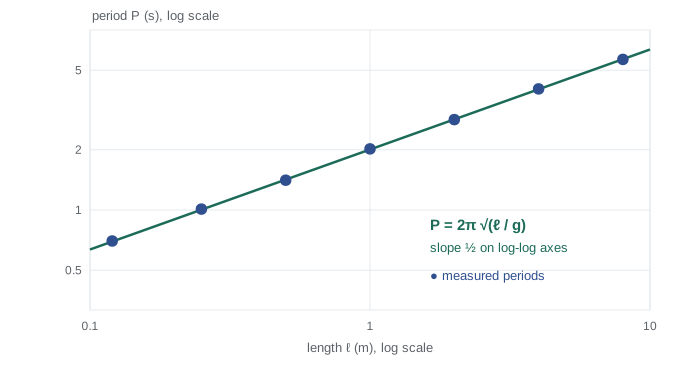
The log-log plot shows why dimensional analysis is so useful in experiments. A power law \(P = C\ell^{1/2}\) becomes \(\log P = \log C + \frac{1}{2}\log \ell\), a straight line of slope one half. Measurements at a handful of lengths confirm the exponent and estimate \(C\), and the dimensional argument assures us that the same relation holds for lengths we did not measure, as long as the assumptions behind it, such as negligible air resistance and a rigid string, remain true.
The Buckingham pi theorem
The pendulum calculation can be organized into a general method. Suppose a physical quantity \(q_1\) depends on quantities \(q_2, \dots, q_n\), so that there is a relation \(f(q_1, q_2, \dots, q_n) = 0\). Write the dimension of each quantity as a column vector of exponents over the base dimensions. The dimension matrix \(D\) has these vectors as columns; with \(k\) base dimensions it is a \(k \times n\) matrix. A product \(\pi = q_1^{a_1}q_2^{a_2}\cdots q_n^{a_n}\) is dimensionless exactly when the exponent vector \(a = (a_1, \dots, a_n)\) satisfies \(Da = 0\), that is, when \(a\) lies in the null space of \(D\).
Theorem 2.1 (Buckingham pi theorem). Let \(r\) be the rank of the dimension matrix. Then any dimensionally homogeneous relation \(f(q_1, \dots, q_n) = 0\) is equivalent to a relation \[F(\pi_1, \pi_2, \dots, \pi_{n-r}) = 0\] among \(n - r\) independent dimensionless products \(\pi_j\), whose exponent vectors form a basis of the null space of \(D\).
The idea of the proof is that the relation cannot depend on the arbitrary choice of units. Changing the unit of length by a factor \(\lambda\) multiplies every quantity by a power of \(\lambda\) determined by its dimension. By choosing the units of the \(r\) independent dimensions cleverly, one can set \(r\) of the quantities equal to 1. The remaining \(n - r\) quantities, measured in these special units, are exactly the dimensionless groups. Since the relation holds in every system of units, it must hold among these groups alone. The rank–nullity theorem of linear algebra gives the count: the null space of a \(k \times n\) matrix of rank \(r\) has dimension \(n - r\).
For the pendulum, the quantities are \(P, \ell, m, g, \theta_0\), with \(n = 5\), and the base dimensions are \(M, L, T\). The dimension matrix has rank 3, so there are \(5 - 3 = 2\) dimensionless groups, which we may take as \(\pi_1 = P\sqrt{\frac{g}{\ell}}\) and \(\pi_2 = \theta_0\). The theorem says \(F(\pi_1, \pi_2) = 0\), or \(\pi_1 = C(\pi_2)\), which is the result found above. If there is only one group, the relation must be \(\pi_1 = \) constant.
A procedure for finding the groups
In practice the pi theorem is applied in five steps. List all the quantities that could matter, including the one to be predicted; this is the modeling step, and leaving out a relevant quantity gives wrong answers. Write the dimension of each. Find the rank \(r\) of the dimension matrix. Choose \(r\) repeating quantities that together involve all the base dimensions and are themselves dimensionally independent. Then form each remaining quantity into a dimensionless group by multiplying it by suitable powers of the repeating quantities.
Worked problem
The speed of deep-water waves
Ocean waves in deep water travel at a speed \(c\) that may depend on the wavelength \(\lambda\), the gravitational acceleration \(g\) and the water density \(\rho\). Find the form of the relation.
Show solution
- Quantities: \(c\) (\(LT^{-1}\)), \(\lambda\) (\(L\)), \(g\) (\(LT^{-2}\)), \(\rho\) (\(ML^{-3}\)); \(n = 4\).
- Only \(\rho\) contains mass, so no dimensionless group can include \(\rho\): its exponent must be 0 to cancel \(M\). The rank is 3, so there is \(4 - 3 = 1\) group.
- Try \(\pi = c\lambda^ag^b\): \(LT^{-1}L^aL^bT^{-2b}\) is dimensionless when \(-1 - 2b = 0\) and \(1 + a + b = 0\), so \(b = -\frac{1}{2}\), \(a = -\frac{1}{2}\).
- With one group, \(\pi = \frac{c}{\sqrt{g\lambda}}\) is a constant: \(c = C\sqrt{g\lambda}\). Water-wave theory gives \(C = \frac{1}{\sqrt{2\pi}} \approx 0.40\).
Answer: \(c = C\sqrt{g\lambda}\): long waves travel faster, and doubling the wavelength raises the speed by a factor \(\sqrt{2}\).
This prediction is observed every day at sea. Swell from a distant storm arrives at a coast in order of wavelength, longest first, because the long waves outrun the short ones. A wave of wavelength 100 m travels at about \(0.40\sqrt{9.8 \times 100} \approx 12.5\) m/s, or 45 km/h.
Drag, the Reynolds number and the cyclist
Now consider the drag force \(F\) on an object of size \(d\) moving at speed \(v\) through a fluid of density \(\rho\) and viscosity \(\mu\), whose dimension is \(ML^{-1}T^{-1}\). Here \(n = 5\) and the rank is 3, so there are two groups. A standard choice is the drag coefficient and the Reynolds number: \[C_D = \frac{F}{\rho v^2d^2}, \qquad \mathrm{Re} = \frac{\rho vd}{\mu}.\] The pi theorem says \(C_D = \Phi(\mathrm{Re})\) for some function \(\Phi\) that depends on the shape of the object but not on its size, speed or the fluid. One curve, measured in a wind tunnel, then serves for every sphere in every fluid.
The Reynolds number compares inertial forces with viscous forces. For a cyclist, with \(d \approx 0.5\) m, \(v \approx 10\) m/s and air with \(\frac{\rho}{\mu} \approx 6.7 \times 10^4\) s/m², \(\mathrm{Re} \approx 3 \times 10^5\), very large. In this range \(C_D\) is nearly constant, so the drag force is close to \(F \approx C_D\rho v^2d^2\), proportional to the square of the speed. The power needed to overcome drag is \(Fv\), proportional to \(v^3\): riding 20% faster takes about 73% more power. For a bacterium, \(\mathrm{Re}\) is around \(10^{-5}\), viscosity dominates, and drag is proportional to \(v\) instead, which is why swimming at small scales is so different from swimming at large ones.
Dimensional analysis also underlies model testing. A ship model one twentieth of full size, tested in a towing tank, behaves like the real ship only if the relevant dimensionless groups match. For surface waves the key group is the Froude number \(\mathrm{Fr} = \frac{v}{\sqrt{gd}}\), so the model must be towed at \(\frac{1}{\sqrt{20}}\) of the ship's speed. Matching the Reynolds number at the same time is impossible in water, which is why naval architects correct for viscous drag separately.
Computing the groups
The null space calculation can be automated. The program below uses exact rational arithmetic to row-reduce the dimension matrix and print a basis of dimensionless groups, here for the drag problem.
from fractions import Fraction as Fr

def nullspace(D):
    """Basis of {a : D a = 0} by exact row reduction."""
    A = [[Fr(x) for x in row] for row in D]
    rows, cols = len(A), len(A[0])
    pivots, r = [], 0
    for c in range(cols):
        p = next((i for i in range(r, rows) if A[i][c] != 0), None)
        if p is None:
            continue
        A[r], A[p] = A[p], A[r]
        A[r] = [x / A[r][c] for x in A[r]]
        for i in range(rows):
            if i != r and A[i][c] != 0:
                A[i] = [x - A[i][c] * y for x, y in zip(A[i], A[r])]
        pivots.append(c); r += 1
    basis = []
    for free in [c for c in range(cols) if c not in pivots]:
        a = [Fr(0)] * cols; a[free] = Fr(1)
        for i, c in enumerate(pivots):
            a[c] = -A[i][free]
        basis.append(a)
    return r, basis

names = ["F", "rho", "v", "d", "mu"]
#        F   rho  v   d   mu
D = [[ 1,   1,   0,  0,  1],    # M
     [ 1,  -3,   1,  1, -1],    # L
     [-2,   0,  -1,  0, -1]]    # T
rank, basis = nullspace(D)
print("rank", rank, "-> number of groups", len(names) - rank)
for a in basis:
print(" * ".join(f"{n}^{str(x)}" for n, x in zip(names, a) if x != 0))rank 3 -> number of groups 2 F^-1/2 * rho^1/2 * v^1 * d^1 F^-1/2 * rho^-1/2 * mu^1
The program finds the rank 3 and two groups, \(\pi_1 = F^{-1/2}\rho^{1/2}vd\) and \(\pi_2 = F^{-1/2}\rho^{-1/2}\mu\). These are not the conventional groups, but they are equivalent: \(\pi_1^{-2} = \frac{F}{\rho v^2d^2} = C_D\) and \(\frac{\pi_2}{\pi_1} = \frac{\mu}{\rho vd} = \frac{1}{\mathrm{Re}}\). Any basis of the null space is equally valid, since products and powers of dimensionless groups are dimensionless; the conventional choices are made because they have clear physical meanings.
Dimensional analysis beyond physics
The same reasoning applies whenever quantities have units. In the fishery model the quantities \(N, t, r, K, H\) involve two dimensions, fish and time. There are \(5 - 2 = 3\) groups, for example \(\frac{N}{K}\), \(rt\) and \(\frac{H}{rK}\). Any conclusion of the model can be stated in terms of these. For instance the maximum sustainable catch must be of the form \(H = c\,rK\) for a pure number \(c\); lesson 5 shows that \(c = \frac{1}{4}\). In the influenza model, a group combining the contact rate, the infectious period and the population size gives the basic reproduction number. Lesson 3 develops this into the systematic technique of nondimensionalization.
In biology, dimensional reasoning combined with empirical data gives scaling laws. Metabolic rate across mammals scales roughly as body mass to the power \(\frac{3}{4}\), a relation known as Kleiber's law. Pure dimensional analysis does not give the exponent, because the relevant mechanisms involve the geometry of transport networks, but it frames the question: once we know which quantities matter, the possible forms of the relation are severely restricted.
Limitations
Dimensional analysis is only as good as the list of quantities. If an important quantity is omitted, such as surface tension for very short water waves, the result is wrong without warning. If too many are included, there are more groups and the analysis says less. It also cannot determine dimensionless constants, such as the \(2\pi\) in the pendulum period, nor the shape of a function of several groups, such as \(\Phi(\mathrm{Re})\). Those require a mechanistic model or experiments. Within these limits it is the quickest way to check a model and to plan experiments, since it reduces the number of variables that must be varied.
Common mistakes
MistakeLeaving a relevant quantity out of the list.
InsteadThink physically about every effect that could matter; the pi theorem cannot detect a missing quantity.
MistakeExpecting dimensional analysis to give numerical constants.
InsteadIt gives the form, such as \(P \propto \sqrt{\ell/g}\); constants like \(2\pi\) need a model or a measurement.
MistakeChoosing repeating quantities that are not dimensionally independent.
InsteadThe repeating set must have full rank, together involving every base dimension.
MistakePutting a dimensional quantity inside an exponential or logarithm.
InsteadArguments of \(e^x\), \(\ln x\) and \(\sin x\) must be dimensionless, such as \(kt\) or \(\frac{x}{L}\).
Summary and key terms
- Equations must be dimensionally homogeneous; only quantities with the same dimensions can be added.
- The pi theorem: a relation among \(n\) quantities whose dimension matrix has rank \(r\) is a relation among \(n - r\) dimensionless groups.
- Dimensionless groups are products of powers whose exponent vectors lie in the null space of the dimension matrix.
- With one group, the group is a constant, which fixes the form of the relation completely.
- The drag coefficient is a function of the Reynolds number, so one curve serves for all sizes, speeds and fluids.
- Dimensional analysis gives forms, not constants, and fails if a relevant quantity is omitted.
- Dimension
- The kind of a quantity, expressed as powers of base dimensions such as M, L and T.
- Dimensionless group
- A product of powers of quantities with all exponents of base dimensions zero.
- Dimension matrix
- The matrix whose columns are the dimension exponent vectors of the quantities.
- Reynolds number
- \(\mathrm{Re} = \frac{\rho vd}{\mu}\), the ratio of inertial to viscous effects.
- Froude number
- \(\mathrm{Fr} = \frac{v}{\sqrt{gd}}\), the group governing surface waves made by moving bodies.
Practice problems
Work each problem on paper first, then reveal the answer to check.
The time \(t\) for a ball dropped from height \(h\) to hit the ground may depend on \(h\), \(g\) and the mass \(m\). Find the form of the relation.
Show answer
Three base dimensions and four quantities of rank 3 give one group, \(t\sqrt{\frac{g}{h}}\). So \(t = C\sqrt{\frac{h}{g}}\); mechanics gives \(C = \sqrt{2}\).
A planet of mass \(M\) has a moon in a circular orbit of radius \(R\). The period \(P\) may depend on \(M\), \(R\) and the gravitational constant \(G\), with \([G] = M^{-1}L^3T^{-2}\). Find the form.
Show answer
One group: \(P\sqrt{\frac{GM}{R^3}}\). So \(P = C\sqrt{\frac{R^3}{GM}}\), which is Kepler’s third law \(P^2 \propto R^3\).
For the drag problem, how many groups would there be if the viscosity were left out, and what would the relation be?
Show answer
Four quantities, rank 3, one group: \(F = C\rho v^2d^2\), the high-Reynolds-number law.
Show that \(\frac{H}{rK}\) is dimensionless in the fishery model.
Show answer
\([H] = \) fish/time, \([r] = \) 1/time and \([K] = \) fish, so \([rK] = \) fish/time, the same as \([H]\).
A ship 100 m long is to be tested with a 4 m model. If the ship travels at 10 m/s, at what speed should the model be towed to match the Froude number?
Show answer
\(\frac{v_m}{\sqrt{g \cdot 4}} = \frac{10}{\sqrt{g \cdot 100}}\), so \(v_m = 10\sqrt{\frac{4}{100}} = 2\) m/s.
Lesson quiz · 5 questions
Score 60% or more to complete this lesson.
Create a free account to save your progress, take quizzes and earn a certificate.