
LVT-330 · Lesson 3 of 12 · 20 min
Cable ratings, listings and markings
Every cable Cobalt Line installs carries a printed legend on its jacket, repeated every meter or two along its length. Most installers glance at the footage marks and the category and ignore the rest. Inspectors read the rest. The legend tells them which fire test the cable passed, which kind of circuit it is for and who certified it, and those three facts decide where the cable may legally run. Greta's rule for the closeout crew is that Maya should be able to read any cable legend in the building and say, without looking anything up, where that cable is allowed. This lesson covers why cables have fire ratings, how the ratings are tested, how they are marked and the hierarchy that decides which cable may stand in for another.
Why cables have fire ratings
A modern office floor can hold several hundred kilometers of copper and fiber cable, most of it with plastic insulation and jackets. In a fire, those plastics burn, spread flame along the cable runs and produce dense, toxic smoke. Cables in a ceiling space that also serves as the air return carry that smoke straight into the air system; cables in a vertical shaft act as a wick that carries fire from floor to floor. Fire tests measure how a cable behaves when exposed to a standard fire: how far flame travels along it, whether it keeps burning when the flame is removed, and, for the most demanding ratings, how much smoke it releases. The rating a cable earns decides the spaces where it may run without a raceway.
The ratings say nothing about performance as a cable. A Category 6A cable can be made with jackets for any of the ratings, and so can a Class 2 cable or a fiber cable. The rating is about the materials. Plenum-rated cables use fluoropolymers or low-smoke compounds that resist burning, which is why they cost more and are stiffer to pull.
The fire tests
In the United States the fire tests for cables are defined in UL and NFPA standards, and a cable that passes is listed with a type letter code that shows the test it passed. The ones Cobalt Line meets every day are these:
| Test | Used for | What it measures |
|---|---|---|
| NFPA 262 (UL 910) tunnel test | Plenum types such as CMP, CL2P, OFNP | Flame spread and smoke along a horizontal bundle in an air stream |
| UL 1666 riser test | Riser types such as CMR, CL2R, OFNR | Flame spread up a vertical shaft |
| UL 1685 vertical tray test | General types such as CMG, CM, CL2, OFNG | Flame spread on a vertical tray of cables |
| VW-1 vertical wire test | Limited types such as CMX, CL2X | Flame on a single vertical cable |
The plenum tunnel test is the demanding one. The cables are laid in a long horizontal tunnel with air drawn along them and a burner at one end, and both the distance the flame travels and the optical density of the smoke are measured. The riser test sets cables in a two-story vertical shaft. The vertical tray test measures how far the char travels up a bundle; Canadian FT4 is a similar test, which is why many cables are marked with both, for example CMG FT4 or CMP FT6, so they can be used on either side of the border.
Cable types by circuit
Each kind of circuit has its own family of cable types, with the same pattern of plenum, riser, general and limited ratings within each family:
| Circuit | Plenum | Riser | General | Limited |
|---|---|---|---|---|
| Communications (Article 800) | CMP | CMR | CMG, CM | CMX |
| Class 2 (Article 722) | CL2P | CL2R | CL2 | CL2X |
| Class 3 (Article 722) | CL3P | CL3R | CL3 | CL3X |
| Power-limited fire alarm (Article 722) | FPLP | FPLR | FPL | none |
| Optical fiber, nonconductive (Article 722) | OFNP | OFNR | OFNG, OFN | none |
| Optical fiber, conductive (Article 722) | OFCP | OFCR | OFCG, OFC | none |
Section 800.154 and the matching section of Article 722 set where each type may run, as lesson 4 explains. In short: plenum types in plenums, riser types in vertical runs between floors, general types elsewhere, and limited types only in dwellings and short exposed lengths. A cable with a higher rating may always be used where a lower one is required.
The substitution hierarchy
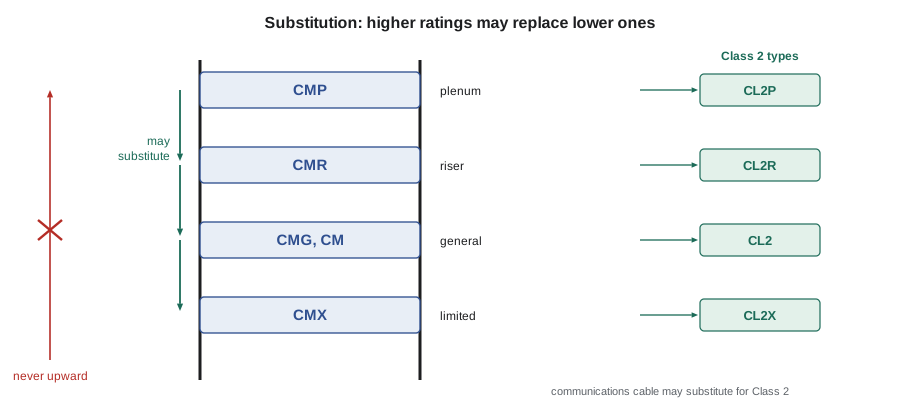
Because the tests are progressively more demanding, the types form a ladder: CMP over CMR over CMG and CM over CMX. A cable higher on the ladder may substitute for one lower down, never the reverse. The NEC also allows substitution across circuit families, in the substitution tables of Articles 800 and 722: a communications cable may substitute for a Class 2 or Class 3 cable of the same or lower rating, and a Class 3 cable for a Class 2 cable, so a CMP cable may be used where CL2P, CL2R or CL2 is required. The reverse is not allowed: a CL2P cable may not be used as a communications cable. Fiber follows its own ladder, OFNP over OFNR over OFNG over OFN, and nonconductive fiber may substitute for conductive, not the reverse.
# Cable substitution check: may the cable on site be used where the design requires another rating?
LADDER = [{"CMP"}, {"CMR"}, {"CMG", "CM"}, {"CMX"}]          # highest rating first
def rank(t):
    for i, group in enumerate(LADDER):
        if t in group:
            return i
    raise ValueError("unknown type " + t)
def may_substitute(on_site, required):
    return rank(on_site) <= rank(required)
checks = [("CMP", "CMR", "riser shaft"), ("CMR", "CMP", "return-air ceiling"), ("CM", "CMG", "office wall"), ("CMX", "CM", "exposed in office ceiling")]
for on_site, required, where in checks:
    ok = may_substitute(on_site, required)
print(f"{where:30s} required {required:5s} on site {on_site:5s} -> {'OK' if ok else 'NOT ALLOWED'}")riser shaft required CMR on site CMP -> OK return-air ceiling required CMP on site CMR -> NOT ALLOWED office wall required CMG on site CM -> OK exposed in office ceiling required CM on site CMX -> NOT ALLOWED
The substitution check is something Maya now does in her head every time she opens a box of cable: what is the space, what rating does it need, and is this cable at or above that rating? When the answer is no, the cable goes back to the shop, however tempting it is to pull it anyway.
Reading a cable legend
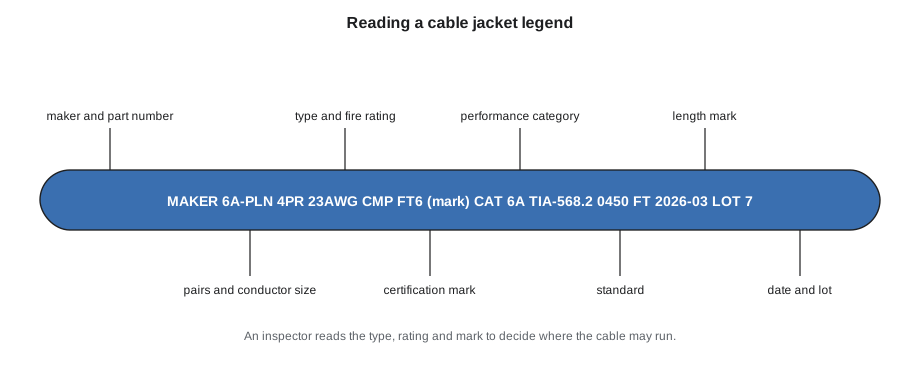
A jacket legend packs a lot of information into one line. On a typical Category 6A cable it includes:
- The manufacturer's name and part number, which lead to the data sheet.
- The listing type, such as CMP or CMR, and often a Canadian FT rating as well.
- The listing mark of the laboratory, such as UL or cULus.
- The conductor size, such as 23 AWG, the number of pairs and the performance category, such as Category 6A, often with the TIA standard named.
- Sequential length marks in feet, and a date or lot code.
- Additional markings for special properties: LP ratings for cables carrying power, -LS or low-smoke, sunlight resistance, direct burial or wet location ratings.
If a cable has no legend, a smudged legend or a legend that does not include a rating, the inspector will treat it as unrated. Cheap patch cords and some imported bulk cables fall into this category. They have no place in a building's permanent cabling, and patch cords left coiled above a ceiling become permanent cabling in the inspector's eyes.
Counterfeit and mislabeled cable
Cable that claims a rating it does not have is a real problem in the industry. Some imported cable printed with a plenum rating has failed fire tests badly, and some cable sold as solid copper is copper-clad aluminum, which is weaker, heats more under PoE and is not permitted by the cabling standards. Cobalt Line buys bulk cable only from its regular distributors, checks the certification on the testing laboratory's online directory when a new product appears and rejects reels whose legend does not match the data sheet. A simple field check for copper-clad aluminum is to scrape a conductor: the silvery core shows through the copper coating.
Specialty ratings
Some cables carry ratings beyond the basic fire test. Low-smoke, zero-halogen jackets, often marked LSZH, produce less corrosive smoke and are used in transit tunnels and some institutional buildings by specification. Limited-combustible cables, marked with -LC on some fiber types, meet a stricter material test. Cables for outdoor or underground use carry ratings for sunlight, moisture and burial, and indoor-outdoor cables combine an outdoor jacket with an indoor listing so the same cable can run from a conduit into a building without a splice, within the length the NEC allows unlisted entrance cable to run inside. Circuit integrity cables, marked CI, keep working for a stated time in a fire and are used for some emergency communication and fire alarm circuits.
Worked problem
A truck full of the wrong cable
On Riverside school's expansion, the second-floor ceilings are not used for return air. A delivery arrives with ten boxes of Category 6 cable marked CMX, ordered by mistake instead of CMG. The foreman wants to use them, since the ceilings are not plenums. Maya checks the rules.
Show solution
- The space is not a plenum, so a plenum type is not required.
- Cable run in a commercial ceiling must be at least a general type such as CMG or CM; CMX is limited to dwellings and short exposed lengths.
- CMX is below CM on the ladder, so it may not substitute.
- The CMX cable could only be used inside a raceway, which is not the design.
Answer: The boxes go back. Maya also checks the remaining stock on the truck before anyone pulls a meter of it.
Ratings on raceways, trays and other products
Cables are not the only combustible products in a cable pathway. Non-metallic raceways, innerduct, surface raceways, cable ties, J-hooks with plastic saddles, labels and the plastic parts of pathway devices all burn, and the codes and standards rate them too. A listed plenum raceway or plenum innerduct is marked like a cable. Non-metallic cable ties and supports used in plenums must be rated for low smoke and heat release, which is why plenum ties are usually a distinctive color. Plastic J-hooks and other supports must carry a rating suitable for the space where they are used. When Maya reviews submittals, she checks the rating of every non-metallic product that will sit in a plenum or riser, not just the cable.
The same thinking applies to equipment. Wireless access points, small switches and sensors mounted above a ceiling in a plenum must be suitable for use in air-handling spaces, which manufacturers state on their data sheets; many access points carry a plenum rating for exactly this reason. Equipment that is not suitable must be mounted in a listed enclosure or below the ceiling.
Finally, the rating must survive the installation. A plenum cable whose jacket is cut back too far at a patch panel, or spliced with tape in the ceiling, no longer matches its tested construction. Cobalt Line's practice is to run cables continuously from termination to termination, with no splices in ceilings or risers except at listed enclosures, and to strip jackets only as far as the termination requires.
Keeping the records
Inspectors increasingly ask to see cable submittals, and owners expect them in the closeout package. For every cable type on a job, Cobalt Line keeps the data sheet showing the type, rating and certification, the delivery slips showing what actually arrived, and photos of the legend on a sample of each type in its installed location. Those records answer most questions an inspector or a future contractor will ask about what is behind the ceiling. They also protect the company: when a tenant's contractor later leaves unrated cable in a ceiling, Cobalt Line's records show what it installed and where. Maya builds the cable schedule for Kellerman as she goes, one line per cable type, with its rating, where it was used and the photo reference.
One more habit helps on site: when cable from two different reels is used on the same run, check both legends. A crew pulling from a mixed cart can end up with one plenum cable and one general cable in the same bundle, and the inspector will find the one that is wrong.
Common mistakes
MistakeReading only the category on a cable legend.
InsteadRead the rating and certification too; they decide where the cable may run.
MistakeSubstituting a lower rating because the space looks safe.
InsteadClassify the space first; a higher rating may replace a lower one, never the reverse.
MistakeUsing unrated patch cords as permanent cabling.
InsteadOnly rated, certified cable belongs in the building's pathways.
MistakeTrusting a printed rating without checking the source.
InsteadBuy from known distributors and check the certification directory for new products.
MistakeAccepting copper-clad aluminum cable.
InsteadScrape a conductor and reject it; the standards require solid copper.
Summary and key terms
- Fire ratings control flame spread and smoke from cable jackets, not cable performance.
- Plenum types pass the tunnel test with smoke limits; riser types pass the shaft test; general types the vertical tray test.
- Higher ratings may substitute for lower ratings, never the reverse.
- Communications cables may substitute for Class 2 and Class 3 cables of the same or lower rating, not the reverse.
- The jacket legend identifies the maker, type, rating, certification, size, category and length.
- Counterfeit ratings and copper-clad aluminum are real risks; buy from known sources and check.
- Plenum type
- A cable listed to the tunnel test with low flame spread and smoke, such as CMP.
- Riser type
- A cable listed to the vertical shaft test, such as CMR.
- General type
- A cable listed to the vertical tray test, such as CMG or CM.
- Limited type
- A cable listed only to a single-wire test, such as CMX.
- Listing mark
- The mark of the laboratory that tested and listed the cable.
- Copper-clad aluminum
- An aluminum conductor with a thin copper coating, not allowed by the cabling standards.
Practice problems
Work each problem on paper first, then reveal the answer to check.
A design calls for CMR. Which types may be used?
Show answer
CMR or CMP.
May a CMP cable be used for a Class 2 circuit that requires CL2R?
Show answer
Yes; a communications cable of the same or higher rating may substitute.
May a CL2P cable be used as a communications cable?
Show answer
No; the substitution only runs the other way.
How can you check for copper-clad aluminum in the field?
Show answer
Scrape a conductor; the silvery core shows through.
Lesson quiz · 5 questions
Score 60% or more to complete this lesson.
Create a free account to save your progress, take quizzes and earn a certificate.