
LVT-330 · Lesson 7 of 12 · 19 min
Optical fiber cable rules
Optical fiber carries light, not electricity, so it is tempting to think the electrical code has little to say about it. It has quite a lot. A fiber cable's jacket burns like any other, many fiber cables contain metal that can carry fault current or lightning surges, and a growing number of cables combine fiber with copper conductors that carry power. The codes therefore classify fiber cables by whether they contain metal, give them fire ratings like copper cables and set rules for where they may run with power conductors. Maya spent a term on the fiber crew in LVT-210 learning to splice and test. This lesson is about the rules the inspector checks on the same work.
Three kinds of fiber cable
The codes sort optical fiber cables into three groups, according to what they contain besides fiber:
- Nonconductive cables contain no metal at all. The fibers, buffers, strength members (usually aramid yarn or glass-reinforced rods) and jacket are all dielectric. They cannot carry current.
- Conductive cables contain non-current-carrying metal: a steel armor, a metallic moisture barrier, a steel strength member or a metal tracer wire. The metal is not used to carry power or signals, but it can carry fault or surge current.
- Composite or hybrid cables contain both optical fibers and current-carrying electrical conductors, for example a cable that carries fiber and copper pairs to power a remote unit, or fiber and power conductors in one jacket for a camera or wireless radio.
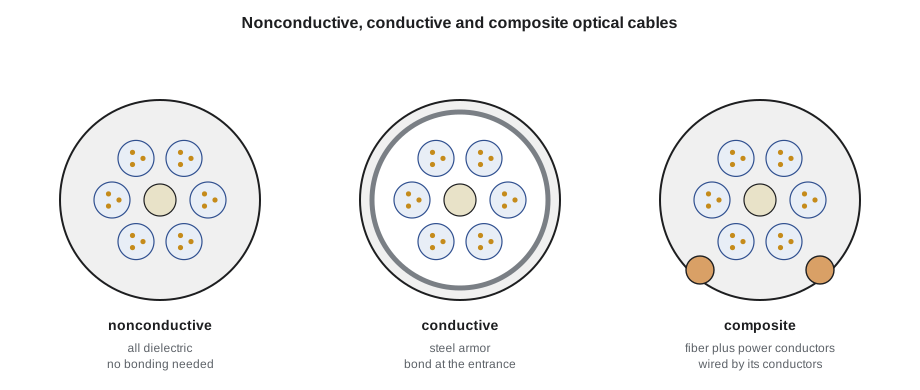
The group matters for three rules: whether the cable needs bonding where it enters a building, whether it may share a raceway or enclosure with power conductors, and which rating ladder applies to it.
Ratings and markings
Optical fiber cables are listed like copper cables, and since the 2023 NEC their listing requirements are in Article 722 with the cables for power-limited circuits. Common types are OFNP and OFCP for plenum use, OFNR and OFCR for risers and OFNG, OFN, OFCG and OFC for general use. The N or C tells the inspector whether the cable contains metal. The same space rules from lesson 4 apply, set out for fiber in Article 770 and the application tables: plenum types in plenums, riser types in vertical runs, general types elsewhere, and suitable raceway changes the requirement.
The substitution ladder for fiber has one extra step. Within each fire rating, a nonconductive cable may substitute for a conductive one, because it is safer in every respect, but a conductive cable may not substitute for a nonconductive one. So an OFNR cable may be used where OFCR is specified, and OFNP may be used for any of them.
# Optical cable substitution: rating ladder plus the nonconductive-over-conductive rule
RANK = {"P": 0, "R": 1, "G": 2, "": 3}          # plenum, riser, general, unmarked general
def parse(t):                                    # e.g. OFNR -> ("N", "R"), OFC -> ("C", "")
    kind = t[2]
    tier = t[3:]
    return kind, tier
def may_use(on_site, required):
    k1, t1 = parse(on_site)
    k2, t2 = parse(required)
    if RANK[t1] > RANK[t2]:
        return False                             # lower fire rating
    if k1 == "C" and k2 == "N":
        return False                             # conductive may not replace nonconductive
    return True
pairs = [("OFNP", "OFCR"), ("OFCR", "OFNR"), ("OFNR", "OFNG"), ("OFNG", "OFNR"), ("OFN", "OFC")]
for a, b in pairs:
print(f"required {b:5s} on site {a:5s} -> {'OK' if may_use(a, b) else 'NOT ALLOWED'}")required OFCR on site OFNP -> OK required OFNR on site OFCR -> NOT ALLOWED required OFNG on site OFNR -> OK required OFNR on site OFNG -> NOT ALLOWED required OFC on site OFN -> OK
Fiber with power conductors
Article 770.133 sets out when optical fiber cables may share raceways, cable trays and enclosures with electrical conductors. A nonconductive cable may occupy the same raceway or tray as conductors for light, power and Class 1 circuits operating at 1000 V or less, but may not occupy the same cabinet, outlet box or panel as those conductors unless the fiber is functionally associated with them. Conductive cables have more restrictions, because their metal could be energized by a fault. Cobalt Line's practice is stricter than the code in most cases: fiber goes in its own innerduct or pathway, both to protect the fiber and to keep it out of the electrician's raceways, where later pulls could damage it.
Composite cables that carry current-carrying conductors are treated as electrical cables of the type their conductors require. A hybrid cable with power conductors for a remote radio is installed under Chapter 3 wiring rules for those conductors, not as a communications cable. A hybrid cable whose copper pairs carry only Class 2 power is installed under Article 725 for those pairs, and new fault-managed power systems under Article 726 use their own listed cables. The cable's listing and the equipment manufacturer's instructions say which applies.
Bonding conductive cables
Where a conductive optical cable enters a building from outside, its non-current-carrying metal must be bonded or grounded as close as practicable to the point of entrance, or interrupted by an insulating joint there, under 770.93 and 770.100. The bonding conductor runs to the intersystem bonding termination or another point the code allows, usually through the PBB in the entrance room. Inside, conductive cables that could become energized are also bonded where the code requires it. All-dielectric cable avoids the step entirely, which is why Riverside's link to the portable building uses it.
Armored fiber cable inside a building is common in data centers and industrial plants, where the armor protects against crushing and rodents. Each length of armor should be bonded at one end at least, usually at the telecommunications room where the cable is terminated, with a bonding kit designed for the cable. An armor that is cut back and left unbonded inside a patch panel is a common inspection finding.
Raceways and innerduct
Fiber is usually pulled into innerduct, a flexible plastic tube that protects it inside larger conduits and trays. Listed innerduct is a raceway with its own fire rating, marked like cable: plenum, riser or general grade. The raceway's rating must suit the space, so an OFNP fiber cable inside general-grade innerduct in a plenum is a defect, because the innerduct itself burns and smokes. Cobalt Line's innerduct is always ordered to the same grade as the most demanding space on the route.
Abandoned fiber
Abandoned fiber adds fire load just as copper does, and renovations often find many generations of it: multimode cables from the 1990s, riser cables to tenants long gone and patch cords coiled in ceilings. 770.25 requires the accessible portion of abandoned optical fiber cable to be removed and cable kept for future use to be tagged with the date and intended use. Before cutting any fiber out, the crew traces it end to end and checks with the owner; dark fiber that looks abandoned may be a spare the owner is counting on.
# Abandoned cable removed from the Kellerman riser: mass and fire load estimate (illustrative per-length values)
cables = [  # (type, count, length each in ft, mass per ft in lb, heat of combustion MJ/kg)
    ("riser optical, 12-strand", 9, 158, 0.047, 28),
    ("riser copper, 25-pair", 14, 158, 0.215, 24),
    ("patch cords, coiled", 60, 10, 0.02, 24),
]
total_m = total_e = 0.0
for kind, n, length, mass, hoc in cables:
    kg = n * length * mass * 0.4536
    mj = kg * hoc
    total_m += kg; total_e += mj
    print(f"{kind:24s} {n:3d} x {length:4} ft -> {kg:6.1f} kg, {mj:7.0f} MJ")
print(f"Total removed: {total_m:.0f} kg of cable, about {total_e/1000:.1f} GJ of fuel taken out of the building")riser optical, 12-strand 9 x 158 ft -> 30.3 kg, 849 MJ riser copper, 25-pair 14 x 158 ft -> 215.7 kg, 5177 MJ patch cords, coiled 60 x 10 ft -> 5.4 kg, 131 MJ Total removed: 251 kg of cable, about 6.2 GJ of fuel taken out of the building
The heat of combustion values are typical for PVC and polyolefin jackets and are only for illustration, but the conclusion holds: abandoned cable in a riser is hundreds of kilograms of fuel arranged in a vertical shaft, exactly what the fire ratings and firestops are meant to prevent.
Labeling and identification
TIA-606 and most specifications require fiber cables to be labeled at both ends and at intermediate points such as handholes and pull boxes. Many owners also require a distinctive marking on fiber in shared pathways, such as colored innerduct or tags reading fiber optic cable, so that other trades do not cut or crush it. Outdoor fiber may need a tracer wire or a locatable marker, and if the tracer is metallic it makes an otherwise dielectric route need bonding at the building entrance, a detail designers sometimes miss.
Worked problem
An inspector's question about a shared tray
At St. Brendan's, the electrical contractor's ladder tray in the basement corridor carries 480 V feeders. Cobalt Line's design runs a 48-strand riser fiber, rated OFNR, along the same tray for 65 ft to reach the riser shaft. The inspector asks whether that is permitted.
Show solution
- The cable is nonconductive, so the stricter rules for conductive cables do not apply.
- 770.133 permits nonconductive optical fiber cable in the same tray as power conductors of 1000 V or less.
- The cable's riser rating is above the general rating the corridor requires.
- The specification, however, requires separate pathways for communications cabling, so the code question is not the end of it.
Answer: The fiber is permitted by the code, but the specification is stricter. The crew adds a short run of wire basket tray beside the ladder tray, and the inspector notes both the code check and the specification compliance.
Fiber in risers and shared shafts
Risers carry the largest fiber cables in a building, and they are where the code rules for fiber are tested most. A riser fiber must have the rating the shaft requires, its innerduct must match, its armor if any must be bonded in the entrance room or main equipment room, and every floor it passes through must be sealed with a system tested for that cable type and fill. Riser fiber is also vulnerable during later work: other trades working in a shared shaft may lean ladders against it, pull new cable past it or cut it when removing what they think is abandoned cable. Cobalt Line protects riser fiber in rigid innerduct or conduit through each floor and labels it at every level, and its closeout records show which strands carry service.
In multi-tenant buildings, several providers may bring their own fiber into the same entrance room and riser. Each provider's cable must still meet the code, and the building owner usually controls the pathways through a riser management policy that says where each provider may run and how penetrations are to be sealed. At Kellerman, the new riser has dedicated sleeves for carriers at each floor, with pathway devices so carriers can add cable without breaking a seal, and the building manager keeps the log.
Optical fiber does not remove the need for bonding in a building. Even an all-dielectric backbone connects equipment that is powered and bonded at each end, and the racks, trays and panels in each room still bond to the TIA-607 system described in lesson 11. Fiber simply removes one path for surges between rooms, which is a large part of its value.
Fiber's freedom from the electrical rules is limited, then: it does not carry current, but its jacket burns, its metal parts can carry current, and its pathways cross rated construction like any other cable's. The inspector checks fiber with the same care as copper.
Hybrid cables for remote equipment
Hybrid cables are becoming common for equipment far from a telecommunications room: outdoor wireless radios, cameras on poles, distributed antenna remotes and remote network switches. The cable carries fiber for data and copper conductors for power, sometimes with a fault-managed power system that can send hundreds of watts over long distances safely. Each of these has its own installation manual, and the inspector checks the power conductors against the wiring rules that apply to them. Cobalt Line treats every hybrid cable as two installations in one jacket: a fiber installation for the strands and an electrical installation for the conductors, each checked against its own rules.
Common mistakes
MistakeAssuming all fiber cable is nonconductive.
InsteadCheck the type: the C in OFCR means metal that must be bonded.
MistakeSubstituting conductive cable for nonconductive.
InsteadOnly nonconductive may replace conductive, never the reverse.
MistakeLeaving armor unbonded inside a patch panel.
InsteadBond armored cable with a kit made for it.
MistakeUsing general-rated innerduct in a plenum.
InsteadInnerduct must have the rating the space requires.
MistakeTreating a hybrid cable as communication cable.
InsteadIts electrical conductors decide which wiring rules apply.
Summary and key terms
- Optical cables are nonconductive, conductive or composite; the group decides bonding, separation and substitution.
- Fiber cables are listed in Article 722 as OFNP, OFCP, OFNR, OFCR and general types, and the space rules apply as for copper.
- Nonconductive may substitute for conductive at the same or lower rating, not the reverse.
- 770.133 allows nonconductive fiber in raceways and trays with power under 1000 V, but not in the same boxes unless functionally associated.
- Metal in conductive cables is bonded at the building entrance and where required inside.
- Innerduct is a raceway and must have the rating of the space; abandoned fiber must be removed or tagged.
- Nonconductive cable
- An optical cable with no metal parts.
- Conductive cable
- An optical cable with non-current-carrying metal parts.
- Composite cable
- A cable with both optical fibers and current-carrying conductors.
- Innerduct
- A flexible plastic raceway inside a larger pathway for fiber.
- Dark fiber
- Installed fiber not currently carrying light.
Practice problems
Work each problem on paper first, then reveal the answer to check.
What does the N in OFNR mean?
Show answer
Nonconductive: the cable has no metal.
May OFCR be used where OFNR is specified?
Show answer
No; conductive may not replace nonconductive.
May nonconductive fiber share an outlet box with power conductors?
Show answer
Not unless it is functionally associated with them.
What grade of innerduct is needed in a plenum?
Show answer
Plenum grade.
Lesson quiz · 5 questions
Score 60% or more to complete this lesson.
Create a free account to save your progress, take quizzes and earn a certificate.