
LVT-330 · Lesson 1 of 12 · 20 min
How electrical codes apply to low-voltage work
Maya Okonkwo starts her ninth term at Cobalt Line Systems on the closeout crew. For two years she has pulled, terminated, tested and commissioned cable. Now she works with Greta Lindqvist, the company's safety and quality coordinator, and Sanjay Iyer, the designer, on the part of every job that decides whether the owner can move in: the inspections. Greta's first lesson is blunt. A cabling system can pass every certification test in LVT-130 and still be refused, because the jacket rating is wrong for the space, a cable runs against a power feeder, a hole through a fire-rated wall was left open, or the bonding conductor never reached the electrical service. This course is about the rules that decide those questions. In the United States the main rulebook is the National Electrical Code, NFPA 70, adopted by the state and by cities such as Austin, together with the building code and the industry standards that the codes and contracts call up.
Why low-voltage work is in an electrical code
It is easy to think that a cable carrying a few volts of Ethernet signal has nothing to do with electrical safety. The codes see three reasons it does. First, low-voltage cables can carry dangerous energy when something goes wrong: a telephone or cable television line can be struck by lightning outdoors or cross a power line, and a building's communications wiring can become energized by a fault. Second, cables are fuel. A building with tens of thousands of meters of plastic-jacketed cable in its ceilings has a large fire load, and burning jackets make smoke that kills people far from the fire. Third, cables pass through the walls and floors that are meant to hold a fire in one part of the building, and every hole weakens those barriers unless it is sealed. The codes therefore set rules for how much power a circuit may carry, how cables must perform in a fire, where they may run, how they are protected where they enter from outside, how far they stay from power wiring, how penetrations are sealed and how everything is bonded.
None of those rules is about how well a network performs. The cabling standards in LVT-120 decide whether a link will carry 10 gigabits; the codes decide whether the installation is safe. An inspector does not care whether a link passes Category 6A, and a certification tester does not care whether the jacket is the right rating. Both must be satisfied.
Codes, standards and specifications
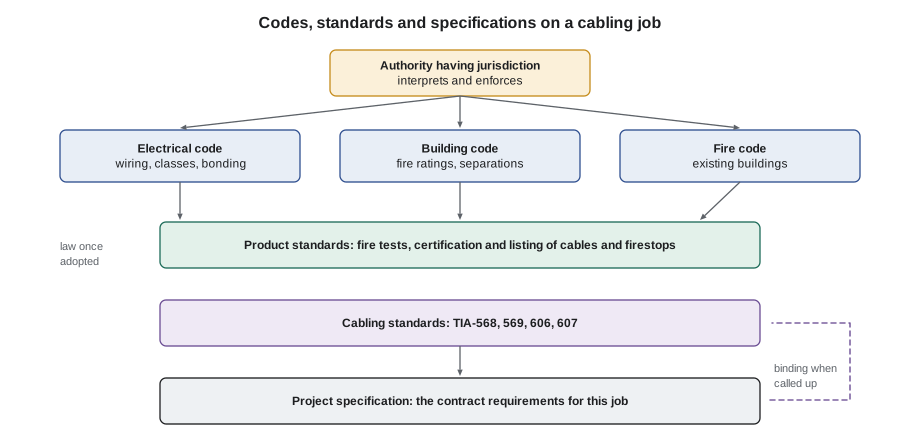
Three kinds of documents govern the work, and an installer needs to know which is which, because they carry different weight.
- A code is law. It becomes law when a government adopts it, by regulation or by-law, sometimes with amendments. Electrical codes, building codes and fire codes are the main ones for this trade. An installation that does not meet the adopted code can be refused, ordered corrected or, in serious cases, disconnected.
- A standard is a technical document written by a standards body: TIA-568 for cabling, TIA-569 for pathways and spaces, TIA-606 for labeling and TIA-607 for bonding are examples. A standard is not law on its own. It gains force when a code refers to it, when a contract or specification requires it, or when it is used as evidence of good practice after something goes wrong.
- A specification is the owner's or designer's document for one project. It can require more than the code, never less, and it usually says which standards apply. The specification is what Cobalt Line signed up to deliver.
In practice the layers stack. The NEC, as adopted in Texas and amended by the city, sets the minimum for wiring. The building code, usually the International Building Code as adopted locally, sets the fire-resistance rules for walls and floors and the requirements for sealing penetrations. Product standards from UL define how cables are tested, and listing by a recognized testing laboratory is how a cable shows it meets them. The TIA standards define good cabling practice, and the project specification turns them into contract requirements.
Who enforces the rules
In Texas the Department of Licensing and Regulation adopts the NEC as the state minimum; the 2023 NEC has applied to work started on or after September 1, 2023. Cities with their own inspection departments, Austin among them, adopt the NEC with local amendments and inspect within city limits. A city electrical inspector checks the low-voltage rough-in and final, and a building inspector checks fire-rated assemblies and penetrations. The fire marshal's office has a say on fire-rated construction and on systems such as fire alarm. Licensing of the people who do the work is separate again, as LVT-110 explained. Greta checks the city's current adopted editions and amendments at the start of every job rather than relying on what was true last year.
Codes call the person or office that interprets and enforces them the authority having jurisdiction, AHJ. The AHJ can approve alternatives, ask for proof that a product is suitable and decide what a rule means when the wording is unclear. A good relationship with inspectors is built on preparation: drawings that match the work, product data sheets and firestop system sheets on hand, labels in place and a crew that can explain why each choice was made.
Code editions and why they matter
The NEC is revised every three years. States and cities adopt each edition on their own schedule, and some stay on an older edition for years. Article and section numbers move between editions: the 2020 edition created a general Article 800 for communications, cable television and broadband, and the 2023 edition added Article 722 for the cables of power-limited and optical fiber circuits. An installer quoting a section from an old pocket guide may be quoting one that has moved. Cobalt Line's practice is to note on every job file which NEC edition, building code edition and standard editions apply, taken from the permit date and the specification.
# Which editions apply to a job: pick the edition in force on the permit date
from datetime import date
editions = {  # jurisdiction: list of (in force from, edition) - illustrative table kept in the job file
    "Texas electrical": [(date(2020, 9, 1), "NEC 2020"), (date(2023, 9, 1), "NEC 2023")],
    "Austin building": [(date(2019, 1, 1), "IBC (older edition)"), (date(2025, 1, 1), "IBC (current edition)")],
}
def edition(juris, permit):
    found = None
    for start, name in editions[juris]:
        if permit >= start:
            found = name
    return found
jobs = [("Kellerman riser", "Texas electrical", date(2025, 3, 10)),
        ("Riverside expansion", "Texas electrical", date(2025, 9, 2)),
        ("Juniper Point garage", "Austin building", date(2024, 11, 18))]
for name, j, permit in jobs:
print(f"{name:22s} permit {permit} -> {edition(j, permit)}")Kellerman riser permit 2025-03-10 -> NEC 2023 Riverside expansion permit 2025-09-02 -> NEC 2023 Juniper Point garage permit 2024-11-18 -> IBC (older edition)
The table in a real job file would come from the AHJ's published adoption list. The point of keeping it is that two jobs a few months apart can fall under different editions, and the crew must know which one their work will be inspected against.
How the electrical code is organized for this trade
The NEC has nine chapters. Chapters 1 to 4 apply generally: Article 100 holds definitions, Article 110 general requirements, Article 250 grounding and bonding and Article 300 wiring methods, including 300.21 on the spread of fire through penetrations. Chapter 7 holds special conditions, including Article 722 for the cables of power-limited and optical fiber circuits, Article 725 for Class 2 and Class 3 circuits, Article 760 for fire alarm circuits and Article 770 for optical fiber. Chapter 8 covers communications systems: Article 800 holds the general requirements, Article 805 communications circuits, Article 820 cable television, and Articles 830 and 840 network-powered and premises-powered broadband. A key principle, in 90.3, is that Chapter 8 stands alone and does not pick up Chapters 1 to 7 unless it refers to them. Lesson 2 goes through Chapters 7 and 8 in detail.
| Topic | Where in the NEC |
|---|---|
| General, fire spread | Articles 110 and 300 (300.21) |
| Grounding and bonding | Article 250 |
| Power-limited and fiber cables | Article 722 |
| Class 2 and Class 3 circuits | Article 725 |
| Fire alarm circuits | Article 760 |
| Optical fiber | Article 770 |
| Communications, general and circuits | Articles 800 and 805 |
Reading a rule
Code language is precise, and the details matter. A rule usually states a requirement, then its exceptions or conditions. Words such as shall, shall be permitted and recommended have exact meanings: shall is mandatory, shall be permitted allows something without requiring it, and explanatory notes or appendix material explains intent but is not itself enforceable. Definitions matter as much as rules: whether a space is a plenum, whether a conductor is a communication conductor or a Class 2 conductor, whether a cable is exposed or in a raceway, all change which rule applies. Greta's method is to read the rule, then the definitions of every key word in it, then the exceptions, and only then decide.
The codes are protected publications. Cobalt Line keeps licensed copies in the office and on the crew tablets, and the crew paraphrase rules in their notes rather than copying them. When a question comes up on site, the right move is to look up the current rule and, if it is still unclear, ask the inspector before the work is closed in, not after.
Where low-voltage work meets the electrician's work
Low-voltage and electrical work share a building and some of the same rules. The electrical contractor installs the service, the panels and the grounding electrode system, including the intersystem bonding termination near the service; the low-voltage contractor installs the communications cabling, the bonding busbars and the backbone that ties them to the electrical system. Power supplies for Class 2 equipment are often fed from a branch circuit the electrician provides. Where the two meet, at the service, in shared pathways and in rooms that contain both, the job needs clear agreement on who does what. On the Kellerman retrofit, the electrical contractor's foreman, Ravi Menon, and Greta walk the riser together in week one and write down every interface: who lands the bonding conductor at the service, who provides the receptacles in each telecommunications room and who seals the shared sleeves.
The inspection mindset
Inspectors look first at the things that are hard to fix later. Rough-in inspections, before ceilings close, check cable ratings in the spaces where they run, supports, separation from power, pathways and penetrations. Final inspections check labels, protectors, bonding connections, firestops with their identification and the removal of abandoned cable. An installer who works to pass inspection does the following without being asked:
- Keeps the product data sheets for every cable, connector, busbar and firestop product on the job, and the firestop system drawings for every penetration type.
- Photographs work before it is concealed, with a label in the frame, so the inspector and the owner can see what is behind the ceiling.
- Labels firestops, bonding conductors and busbars as the specification and standards require, as the work is done rather than at the end.
- Keeps a running deficiency list and closes items with photos and dates.
This course follows Maya through those tasks on four buildings: the Kellerman Building riser retrofit, the expansion of Riverside school, St. Brendan's Hospital's new east wing and the Juniper Point condo tower. The capstone is the Kellerman final inspection.
Worked problem
Sorting the rules on a scope sheet
Colette Brennan hands Maya the scope sheet for the Riverside school expansion: data cabling in the new wing, a new paging and intercom system, access control on six doors and a fiber link to the existing building. Maya must list which part of the electrical code covers each item.
Show solution
- Data cabling is communications wiring: Articles 800 and 805.
- The paging and intercom amplifiers feed speaker circuits that are Class 2 on their listed outputs: Article 725, with cable listings in Article 722.
- Access control readers and locks are fed by Class 2 power supplies: Article 725.
- The link to the existing building is optical fiber cable: Article 770, with its listings in Article 722.
Answer: Each system sits under its own part of the code, and the jacket ratings, separation and support rules follow from that choice. Maya adds the code references to the scope sheet so the crew leads know where to look.
Common mistakes
MistakeTreating a TIA standard as if it were law.
InsteadA standard binds only when a code or the contract calls it up; check the specification.
MistakeQuoting a rule from an old pocket guide.
InsteadConfirm the edition adopted for the permit date and look the rule up in that edition.
MistakeAssuming the inspector checks performance.
InsteadThe inspector checks safety; certification tests check performance. Both must pass.
MistakeLeaving interfaces with the electrician unstated.
InsteadAgree in writing who lands bonding conductors, who provides power and who seals shared penetrations.
MistakeClosing ceilings before the rough-in inspection.
InsteadBook the inspection and photograph the work before anything is concealed.
Summary and key terms
- Electrical codes cover low-voltage work because of energized faults, fire load and smoke, and penetrations through fire-rated construction.
- Codes are law once adopted; standards bind through codes or contracts; specifications set the project's requirements.
- The authority having jurisdiction interprets and enforces the code and can approve alternatives.
- Code editions change every three years and are adopted on different schedules; record the editions that apply to each job.
- NEC Chapters 7 and 8 cover power-limited, fiber and communications systems; Chapter 8 stands alone unless it refers to Chapters 1 to 7.
- Preparation, records and photos are what pass inspections.
- Code
- A set of rules that becomes law when a government adopts it.
- Standard
- A technical document that binds when a code or contract calls it up.
- Specification
- The project document setting the owner's requirements.
- Authority having jurisdiction
- The office or person that interprets and enforces a code.
- Rough-in inspection
- An inspection of work before it is concealed.
- Edition
- A dated version of a code or standard; requirements and numbering change between editions.
Practice problems
Work each problem on paper first, then reveal the answer to check.
Name two reasons low-voltage cabling falls under the electrical code.
Show answer
Possible energized faults from lightning or power crosses, the fire load and smoke of jackets, and penetrations of fire-rated construction.
What makes a TIA standard binding on a job?
Show answer
A code that refers to it, or the contract and specification that require it.
Why record the code edition on the job file?
Show answer
Requirements and numbering change between editions, and the work is inspected against the edition in force.
When is the best time to resolve a doubtful code question?
Show answer
Before the work is concealed, by checking the current rule and asking the inspector.
Lesson quiz · 5 questions
Score 60% or more to complete this lesson.
Create a free account to save your progress, take quizzes and earn a certificate.