
LVT-130 · Lesson 8 of 12 · 19 min
Modular plugs, patch cords and field-terminated plugs
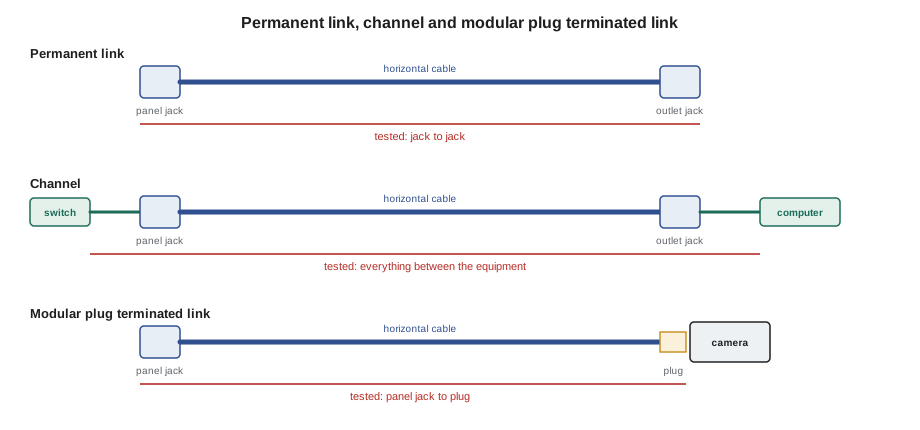
A permanent link ends at two jacks, but the network never sees a permanent link. It sees a channel: the permanent link plus a patch cord in the room and a cord at the device, with plugs at every end. On many projects the cords are treated as an afterthought, bought in bulk and plugged in by whoever is around on move-in day. Yet the cords are the most handled, most damaged and most often replaced part of the system, and a poor cord can make a perfect permanent link fail as a channel. This lesson covers modular plugs and cords, the field-terminated plugs used for devices, and the rules that tie the cords to the rest of the channel.
The modular plug
An eight-position modular plug has eight blade contacts that pierce the conductors when the plug is crimped onto a cable. Its latch clicks into the jack, and its blades mate with the jack's spring contacts. For Category 6A, plug design is part of the system's performance, because the plug's geometry creates crosstalk that the jack's compensation is designed to cancel. Category 6A plugs often include a load bar or a two-piece design that holds the conductors in a precise arrangement, and a shield or ground clip on shielded versions.
Plugs come in two kinds for two kinds of cable. Plugs for stranded conductors, used on patch cords, have blades with points that pass between the strands. Plugs for solid conductors, used on horizontal cable, have blades that straddle the solid wire. Using a stranded-conductor plug on solid cable, or the reverse, makes a connection that may test well on the day and fail later as the contact loosens. The packaging names the conductor type, and the installer must check it.
Factory patch cords
TIA-568.2 and most manufacturers strongly prefer factory-made patch cords for the channel. A factory cord is made with stranded cable and plugs assembled under controlled conditions, then tested to the patch cord limits for its category. A cord crimped in the field on a reel of patch cable, however carefully, cannot match the consistency of a factory cord and cannot be tested to the same limits with ordinary field equipment. Manufacturers' system warranties typically require the cords to be from the manufacturer's own product line, which is another reason the sixth floor's first set of cords is part of Cobalt Line's scope.
Patch cords have their own cable construction. Most use stranded conductors, which are flexible but have higher loss than the solid conductors of horizontal cable. Thinner cords, 26 AWG or even 28 AWG, are popular in dense rooms because they take less space in the managers, but they have still more loss. That extra loss is why the channel's ten meters of cords is a budget, not a fixed allowance, as LVT-120 described with the derating factor for MUTOA cords.
| Cord type | Conductor | Typical use | Cord derating factor |
|---|---|---|---|
| Standard Category 6A cord | 24 AWG stranded | Equipment and work area cords | About 0.2 |
| Reduced-diameter cord | 26 AWG stranded | High-density patching | About 0.5 |
| Very small cord | 28 AWG stranded | Very dense rooms; check limits | Larger; allowed lengths are shorter |
| Shielded cord | 26 or 24 AWG with foil | Shielded systems | Depends on construction |
Checking a channel's cords
Every channel is limited to 100 m in total, with at most 90 m of horizontal cable and four connections, and its cords must fit within the loss budget. The TIA-568.1 formula from LVT-120 can be turned around into a single check: the horizontal cable length plus each cord's length multiplied by one plus its derating factor must not exceed about 102 m. The code below checks four channels Maya is planning for the sixth floor, with lengths in meters as the standard writes them.
# Channel check: horizontal length, cords and connections (lengths in meters)
D = {24: 0.2, 26: 0.5, 28: 0.95}     # cord derating factors (28 AWG figure illustrative)

def check(name, H, cords, connections, mptl=False):
    C = sum(length for length, gauge in cords)
    equivalent = H + sum((1 + D[g]) * length for length, g in cords)
    problems = []
    if H > 90:
        problems.append("horizontal over 90 m")
    if H + C > 100:
        problems.append("channel over 100 m")
    if connections > (2 if mptl else 4):
        problems.append("too many connections")
    if equivalent > 102:
        problems.append(f"cord loss too high ({equivalent:.1f} m equivalent)")
    print(f"{name:30s} H={H} m, cords={C} m: " + ("ok" if not problems else "; ".join(problems)))

check("desk through zone box Z4", 64, [(3, 24), (2, 24)], 3)
check("training room, 26 AWG cords", 88, [(5, 26), (5, 26)], 2)
check("training room, 24 AWG cords", 88, [(5, 24), (5, 24)], 2)
check("camera, plug-terminated link", 52, [(2, 26)], 1, mptl=True)desk through zone box Z4 H=64 m, cords=5 m: ok training room, 26 AWG cords H=88 m, cords=10 m: cord loss too high (103.0 m equivalent) training room, 24 AWG cords H=88 m, cords=10 m: ok camera, plug-terminated link H=52 m, cords=2 m: ok
The desk channel through a zone box is comfortable. The training room is the interesting one: 289 ft of horizontal cable with 16 ft of cord at each end is inside the 100 m channel limit, but with thin 26 AWG cords the loss budget is exceeded, while ordinary 24 AWG cords pass. Brightwater's IT group had planned thin cords throughout to save space in the managers. Maya's cord schedule now specifies 24 AWG cords for the training room and the far northeast offices, where the horizontal cables are longest, and thin cords only where links are short.
Modular plug terminated links
Many devices on a modern floor have no wall nearby: wireless access points, cameras, displays, sensors and building controllers in ceilings or on structure. A jack and a short cord at each device add cost and two connections, and there may be nowhere to mount a box. The alternative is a modular plug terminated link, or MPTL: the horizontal cable ends in a field-terminated plug that connects directly to the device. TIA-568.2-D recognizes the MPTL as a permanent link configuration, with a jack at the room end and a plug at the device end, and gives it its own test method.
The plugs used for MPTLs are made for the purpose: field-terminable plugs for solid horizontal cable, usually with a tool-less termination like a jack's, and with performance designed to Category 6A. They are not the crimp plugs used for patch cords. On the sixth floor, Sanjay's design uses MPTLs for the six cameras, which mount on the ceiling surface. The access points use surface boxes with short cords, because Brightwater wants to be able to replace the access points without touching the horizontal cable.
Terminating a field plug
A field-terminated plug for an MPTL is prepared much like a jack: the jacket is stripped to the length on the instructions, the pairs are kept twisted to a lacing piece, laid in the order of the specified scheme, trimmed flush and pressed into the plug body, which is then closed and latched. Some designs crimp; most current Category 6A field plugs use a press or a simple tool. The plug's boot or strain relief grips the cable jacket so that pulling on the cable does not pull on the conductors.
Because the plug is the end of the permanent link, it must be terminated as carefully as the room-end jack, and it is tested with an adapter that accepts a plug, as lesson 10 explains. Maya keeps a service loop of about 3 ft above each camera, so the plug can be cut off and re-terminated once if it is damaged.
Handling cords
Cords wear out. Their latches break, their plugs are crushed under chair wheels, and their cables are kinked by being pulled around furniture. The specification makes Cobalt Line responsible for the first set and for leaving the room tidy, but it is worth teaching the owner's staff the basics at handover.
- Use the right length: excess cord is coiled in managers or stuffed behind desks.
- Do not pull a plug out by its cable; press the latch and pull the plug.
- Replace a cord with a broken latch; a plug that does not latch can work loose.
- Do not tie cords tightly with cable ties; use hook-and-loop straps in the managers.
- Keep spare cords in their bags; cords left loose in a room collect dust and get crushed.
- Never make up a cord by crimping plugs on horizontal cable; solid cable is not made for flexing.
Cords and testing
Certification of the permanent link, the standard acceptance test on most projects, does not include the cords. The tester's permanent link adapters connect to the jacks with specially designed test cords whose effect the tester removes from the results. A channel test, by contrast, includes the actual cords in use, and the tester's channel adapters measure from the cords' plugs. Channel tests are done when the owner asks for them, when the cords are part of the warranty or when diagnosing a problem at a desk, and lesson 10 covers both. Patch cords can also be tested on their own to patch cord limits, but that requires special adapters, and most projects rely on factory testing.
Worked problem
A desk that works on one cord and not another
A Brightwater user in zone Z6 reports that the network drops several times an hour. The permanent link 6A-C31 passed certification with about 5 dB of NEXT margin. Maya runs a channel test with the user's work area cord and the room's equipment cord in place, and it fails NEXT at the work area end. What should she check?
Show solution
- The permanent link passed, so the problem is in the channel's added parts: the cords and the plugs.
- A NEXT failure at the work area end points to the work area cord or its plug in the outlet.
- She looks at the user's cord: it is an old Category 5e cord the user brought from the previous office, with a cracked boot and a loose latch.
- She replaces it with one of the project's Category 6A cords and retests; the channel passes with about 4 dB of margin, and the drops stop.
Answer: The installed link was good; an old, damaged cord at the desk caused the failure.
Power over Ethernet at the plug
Most of the sixth floor's ceiling devices are powered over their cable: access points at up to about 30 W, cameras at a few watts and displays and controllers at up to 60 or 90 W under the highest IEEE 802.3bt types. When a powered plug is unplugged under load, a small arc forms as the contacts separate, which can pit the plug and jack contacts over many cycles. Category 6A connectors from major manufacturers are designed and tested for this, with contact geometry that makes the arc occur away from the final mating point, which is one more reason the system's components must match.
PoE also makes DC resistance and resistance unbalance matter. A poor crimp on a field plug, or a conductor half-seated in a jack, adds resistance to one conductor of a pair. The pair then carries unequal currents, which can upset the power equipment and the data signal. Certification testers measure resistance unbalance within each pair and between pairs, and lesson 10 lists it among the parameters. Maya's crews pay particular attention to the field-terminated camera plugs, because each one carries both data and the camera's power through a connection made on a ladder.
Cords for PoE devices should be no longer than needed and kept out of tight bundles, for the heating reasons LVT-120 discussed, and their latches should be checked: a powered plug that works loose can drop a camera or an access point without any obvious sign.
Common mistakes
MistakeCrimping plugs onto horizontal cable to make cords.
InsteadUse factory cords; solid cable is not made to flex.
MistakeUsing a stranded-conductor plug on solid cable.
InsteadMatch the plug to the conductor type.
MistakeSpecifying thin cords everywhere to save space.
InsteadCheck the cord loss budget for the longest links.
MistakeUsing a patch cord crimp plug for an MPTL.
InsteadUse a field-terminable plug designed for solid cable and Category 6A.
MistakeIgnoring the cords when a permanent link passes but a user has problems.
InsteadTest the channel with the actual cords.
Summary and key terms
- The network sees the channel: the permanent link plus cords and plugs.
- Plugs must match the conductor type; Category 6A plugs are designed with the jack's compensation in mind.
- Factory patch cords are preferred and usually required for the warranty.
- Thinner cords have more loss; the horizontal length plus derated cord lengths must stay within about 102 m.
- A modular plug terminated link ends in a field-terminated plug at the device and is a recognized permanent link configuration.
- Cords wear out and should be the right length, handled by the plug and replaced when damaged.
- Permanent link certification excludes the cords; channel tests include them.
- Modular plug
- An eight-position plug with blade contacts, crimped or pressed onto a cable.
- Patch cord
- A short, flexible cable with plugs on both ends, used at the room or the work area.
- Stranded conductor
- A conductor made of many fine wires, flexible but with more loss than solid wire.
- Cord derating factor
- A factor expressing how much more loss a cord has per meter than horizontal cable.
- Modular plug terminated link (MPTL)
- A permanent link ending in a field-terminated plug connected directly to a device.
- Field-terminable plug
- A plug designed to be terminated on solid horizontal cable on site.
Practice problems
Work each problem on paper first, then reveal the answer to check.
A channel has 80 m of horizontal cable and two 5 m cords of 26 AWG with D = 0.5. Does it pass the cord loss check?
Show answer
80 + 1.5 × 10 = 95 m equivalent, under 102 m; it passes.
The same channel with 90 m of horizontal cable?
Show answer
90 + 15 = 105 m equivalent; it fails, though the channel is 100 m.
Why must patch cords not be made from horizontal cable?
Show answer
Solid conductors are not made for repeated flexing and the plugs for stranded cords will not grip them properly.
What is at each end of a modular plug terminated link?
Show answer
A jack at the room end and a field-terminated plug at the device.
Lesson quiz · 5 questions
Score 60% or more to complete this lesson.
Create a free account to save your progress, take quizzes and earn a certificate.