
LVT-130 · Lesson 3 of 12 · 19 min
Pulling cable: tension, bend radius and bundling
A Category 6A cable is a precise electrical component. The four pairs inside the jacket are twisted at carefully chosen rates, held in a set geometry by a separator, and wrapped so that each pair keeps its distance from the others. The cable's performance depends on that geometry staying the way the factory made it. Pulling is the one moment in the cable's life when large forces act on it, and a pull that stretches, kinks, crushes or twists the cable can change the geometry permanently. The damage may be invisible on the jacket and may still pass a simple continuity test, then show up as a failed or marginal certification result. This lesson covers how Maya's crews pull cable so that what reaches the outlet is the same cable that left the box.
Setting up the pull
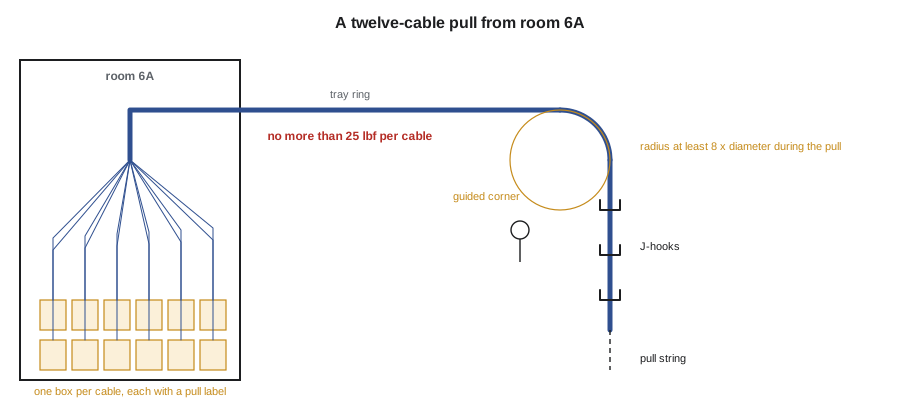
A horizontal pull on the sixth floor starts in room 6A. The boxes for one pull, usually 6 to 12, are lined up on the floor or in a box rack, each with its cable paying out from the top. Every cable gets a pull label at its end with its permanent identifier, and its number is written on the pull sheet against its box. The ends are gathered, the cables are taped together over a short length in a staggered pattern so the bundle has a tapered nose, and a pull string or rope is tied to them through a loop of the cable or a mesh pulling grip. The pull is made by the cable's jacket and the whole bundle, never by the bare conductors.
In the ceiling, one or two people guide the bundle. On a J-hook route, the pull is often done by hand from hook to hook rather than with a long rope: the bundle is lifted into each hook in turn as the puller walks it forward. On a tray, the bundle is laid in rather than dragged where possible. At each change of direction, a person or a pulling sheave keeps the cable in a smooth curve so that it does not drag around a corner, over a tray edge or through a sleeve at a sharp angle.
Pulling tension
The usual maximum pulling tension for a four-pair cable is 25 lbf. Some manufacturers allow more for particular Category 6A designs, and the cable's data sheet is the governing number, but 25 lbf is the default that appears in the standards and that Dev's crews use unless told otherwise. Pulling harder stretches the conductors slightly, which changes their diameter and the pair's twist and impedance. The cable may look perfect and still have damaged return loss and crosstalk.
The tension in a pull is not constant along the route. Friction between the bundle and its supports adds tension along every straight section, in proportion to the bundle's weight and the length pulled. At each bend, the tension coming into the bend is multiplied by a factor that rises steeply with the angle of the bend and the friction, which is why pulls around several corners get hard so quickly. The capstan relation, the same one that explains why a rope wrapped around a post can hold a boat, describes the bend effect.
Here T is tension, μ is the coefficient of friction between the cable and the support, and θ is the angle of the bend in radians. With a friction coefficient of about 0.4, a single 90-degree bend multiplies the tension by about 1.9, and four bends by about 12. The code below follows a twelve-cable pull through the four sections of the route to zone Z4.
import math
# Tension along a pull of 12 Category 6A cables to zone Z4 (illustrative friction)
LIMIT = 25          # per cable, lbf
n = 12
mu = 0.4               # cable on hooks and tray edges
w = 0.042                # weight of one cable per ft, lbf
route = [(40, 90), (60, 90), (65, 0), (25, 90)]           # (straight length in ft, bend in degrees at its end)
T = 0.0
for k, (length, bend) in enumerate(route, 1):
    T = T + mu * w * n * length
    T = T * math.exp(mu * math.radians(bend))
    print(f"after section {k}: {T:6.1f} lbf on the bundle, {T / n:5.1f} lbf per cable")
print(f"per-cable limit {LIMIT} lbf: " + ("within the limit" if T / n <= LIMIT else "over the limit"))after section 1: 15.1 lbf on the bundle, 1.3 lbf per cable after section 2: 51.0 lbf on the bundle, 4.3 lbf per cable after section 3: 64.1 lbf on the bundle, 5.3 lbf per cable after section 4: 129.6 lbf on the bundle, 10.8 lbf per cable per-cable limit 25 lbf: within the limit
Even at the end of the route, the share of tension on each cable is well under the limit, because the bundle is light and the straight sections are short. The pull would be very different through a long conduit with three or four bends and a heavy bundle, which is why conduit pulls are planned with pull boxes and why some contractors use a pulling device with a breakaway swivel set at the cable's limit. The calculation also assumes the tension is shared evenly among the cables; in practice, the cables on the outside of a bend and those tied tightest at the nose carry more. Dev's rule is simple: if the bundle needs more than one person's steady hand pull, stop and find out why.
Bend radius
Cable must never be bent more tightly than its minimum bend radius. For four-pair cable, the installed bend radius must be at least four times the cable's outside diameter, and during the pull, when the cable is under tension, at least eight times. For a Category 6A cable of about 0.29 in diameter, those are about 1.2 in installed and 2.4 in under tension. Some manufacturers specify larger radii for their Category 6A designs, and the data sheet governs.
The places where the bend radius is lost are predictable: the drop from a tray into a wall, the corner of a tray where the bundle cuts across the inside, the edge of a sleeve, the turn from a ladder rack down to a rack, the back of an outlet box, and anywhere a cable tie pulls a bundle tight. A kink, where the cable folds over itself, is permanent damage; the cable should be replaced, not straightened. Maya carries a small gauge, a disc cut to the minimum radius, and checks every corner after a pull.
Bundling and hook-and-loop ties
Cables in a pathway are bundled for neatness and support, but bundling has costs. A bundle that is squeezed tightly deforms the cables on the outside, changing their pair geometry, and a bundle of PoE cables traps heat, as LVT-120 described. TSB-184-A recommends bundles of 24 or fewer for cables carrying higher PoE power, and Sanjay's design follows that.
Cable ties are not used on Category cable. A plastic tie pulled tight, even moderately, creates a pinch point that shows up on a certification test as a small return loss reflection at that distance. Every bundle on the sixth floor is held with hook-and-loop straps, snug enough to keep the bundle together but loose enough that a single cable can be slid out. The straps go at the supports and at intervals along tray, not every few centimeters. Combing the cables perfectly parallel, which looks impressive in photographs, is acceptable but not required, and an over-tight combed bundle can perform worse than a loosely bundled one.
Handling: what damages cable during a pull
- Stepping on cable or rolling equipment over it: the crush can deform the pairs even if the jacket springs back.
- Pulling cable around a sharp corner or over a sharp tray edge: the bend and the scraping both cause damage.
- Letting a box pay out with a twist or a figure-eight snarl, then pulling the snarl tight: this creates a kink.
- Over-tightening ties, staples or clips: each one is a pinch point.
- Pulling in cold weather without letting the cable warm: jackets stiffen below the manufacturer's installation temperature, often about 32 °F for plenum cable, and can crack.
- Leaving cables coiled on a floor where other trades walk or drive lifts over them.
If a cable is damaged during the pull, it is replaced, not repaired. Splices are not allowed in horizontal cable. A damaged cable in a bundle is pulled out, the pull label is moved to a new cable, and the pull sheet is updated with the new box and length marks.
Service loops and coiling
Each cable is left with slack at both ends. In room 6A, the specification calls for a service loop of about 10 ft stored on the ladder rack above the racks, so that a panel can be moved to another rack or a cable re-terminated without pulling new cable. At each outlet, about 12 in is left in the ceiling above the wall drop. At zone boxes and access points, a loop of about 3 to 10 ft is stored according to the specification. Slack is stored in large loops or figure-eights laid on the support, never in tight coils tied off with a cable tie.
Too much slack is also a problem. Every extra meter adds loss and counts toward the 90 m limit, and large coils of slack in a ceiling or on a rack are untidy and trap heat. A service loop is a measured allowance, not whatever is left after the pull.
Worked problem
Planning a conduit pull to an office
Office 6-14 is fed by 40 ft of conduit from the ceiling down and along the wall to a floor box, with three 90-degree bends. Four Category 6A cables will be pulled through it. With a friction coefficient of 0.5 in conduit, what multiplier do the bends add, and what should Maya do?
Show solution
- Each 90-degree bend multiplies tension by e^(0.5 × 1.571) ≈ 2.19.
- Three bends multiply it by 2.19³ ≈ 10.5.
- Ten times the tension at the start of the run makes the pull sensitive to anything that drags, and three bends already exceed the two-bend rule from LVT-120.
- Maya asks the electrical contractor to add a pull box after the second bend, so each section has at most two bends and the multiplier is at most about 4.8.
Answer: A pull box splits the run so that no section has more than two bends, keeping tension manageable and meeting the design rule.
Vertical runs and pulling from above
Not every pull is horizontal. In a riser, or on a long drop down a wall to a floor box, the cable's own weight adds to the tension at the top. A Category 6A cable weighs roughly 4 lb per 100 ft, so a 100 ft vertical drop puts about 4 lbf on each cable at the top before any friction or pulling force is added. That is well inside the limit for a short drop, but it is why long vertical runs are supported at intervals with clamps or hook supports on the backbone, so that each section carries only its own weight, and why cable is lowered from above rather than hauled up from below wherever the building allows.
Pulling from above has its own hazards. The boxes must be secured at the top so they cannot fall, the cable is lowered under control with a person at each floor, and the opening is guarded. Maya's crews use the same approach on the sixth floor for the short drops in the walls: the cable is fed down from the ceiling by one person and guided out of the box by another, rather than pulled hard from below.
Temperature matters for vertical and outdoor runs too. If cable has been stored overnight in a cold truck or an unheated floor, it is brought into the warm room for a few hours before the pull, so the jacket and the pairs are flexible when they are bent.
Common mistakes
MistakePulling the bundle by its conductors.
InsteadPull by the jackets with a taped nose or a mesh grip.
MistakeUsing cable ties to keep a bundle neat.
InsteadUse hook-and-loop straps, snug but not tight.
MistakeStraightening a kinked cable and carrying on.
InsteadReplace any kinked cable.
MistakeLeaving slack in a tight coil tied with a tie.
InsteadStore measured service loops in large loops or figure-eights.
MistakeMuscling a pull that has stopped moving.
InsteadStop, find the snag, and use a pull box or a second person at the corner.
Summary and key terms
- Pulling is the moment the cable's internal geometry is most at risk, and damage may not be visible.
- Pulls are set up with labeled ends, boxes that pay out cleanly and a tapered nose or mesh grip.
- The usual limit is 25 lbf per four-pair cable; friction adds tension along straights and bends multiply it.
- Minimum bend radius is four times the cable diameter installed and eight times under tension.
- Bundles are held with hook-and-loop straps; PoE bundles are kept to 24 or fewer cables.
- Damaged cable is replaced, never spliced.
- Measured service loops are left at both ends and stored in large loops.
- Pulling tension
- The force applied to a cable during installation, limited to protect the conductors and pairs.
- Capstan relation
- The rule that tension around a bend grows exponentially with friction and angle.
- Bend radius
- The radius of the tightest curve a cable may be bent into.
- Kink
- A permanent fold in a cable that damages its internal geometry.
- Hook-and-loop strap
- A soft, reusable fastening strap used to bundle cable without crushing it.
- Service loop
- A measured length of slack left at a termination for future work.
Practice problems
Work each problem on paper first, then reveal the answer to check.
A Category 6A cable is 0.28 in in diameter. What is its minimum installed bend radius and its radius during the pull?
Show answer
About 1.1 in installed and 2.2 in during the pull.
With μ = 0.4, what does a 90-degree bend multiply tension by?
Show answer
e^(0.4 × 1.571) ≈ 1.87.
Twenty cables are pulled together. What does a per-cable limit of 25 lbf suggest for the bundle, and why should the crew stay well below it?
Show answer
About 500 lbf if shared evenly, but the tension is not shared evenly, so stay well below it.
Why are cable ties not used on Category 6A bundles?
Show answer
A tight tie pinches the cable and shows up as a return loss reflection.
Lesson quiz · 5 questions
Score 60% or more to complete this lesson.
Create a free account to save your progress, take quizzes and earn a certificate.