
LSAT-130 · Lesson 9 of 12 · 19 min
Clarity, concision and style
▶ Video coming soon A video version of this lesson is on the way.
On Saturday, November 7, five days before Marcus's test, Harriet opened with a reassurance aimed at him. 'Nothing today will change how you take the multiple-choice sections on Thursday,' she said. 'Your writing sample is already on file. Treat this as practice for the essays you will write in law school.' Marcus said he was glad to think about something other than Logical Reasoning for an hour.
The topic was style: not elegance, Harriet said, but clarity. 'Readers of the writing sample are not looking for beautiful prose. They are looking for prose that is easy to follow. Every habit in this lesson serves that one goal.'
The plain style
Legal writing has moved steadily toward plain language over the past several decades. Courts, law societies and bar associations encourage lawyers to write so that clients and judges can understand them quickly. The writing sample rewards the same plain style: short to medium sentences, concrete nouns, active verbs and familiar words.
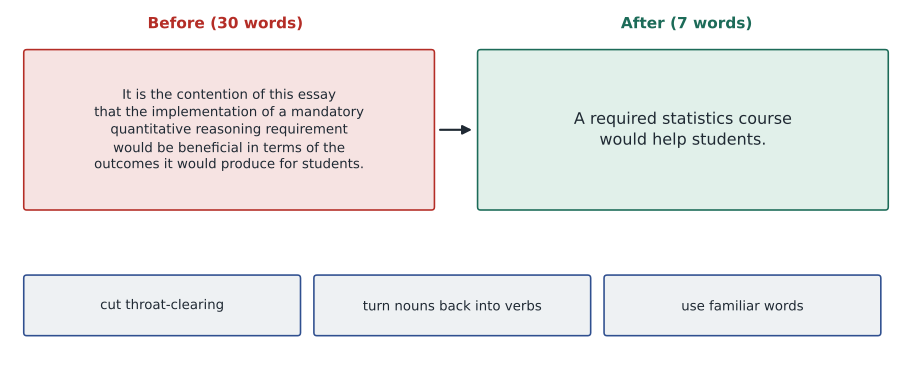
Harriet put two versions of the same sentence on screen.
- "It is the contention of this essay that the implementation of a mandatory quantitative reasoning requirement would be beneficial in terms of the outcomes it would produce for students."
- "A required statistics course would help students."
The second says the same thing in seven words instead of thirty. It is not less intelligent; it is easier to read. Harriet said that candidates under pressure often reach for the first style because they think it sounds more serious. Readers find it tiring.
Five habits of clear sentences
Harriet listed five habits that fix most unclear sentences.
First, cut throat-clearing. Phrases like "it is important to note that," "it should be pointed out that" and "in this essay I will argue that" delay the point. Usually the sentence improves when they are deleted.
Second, turn nouns back into verbs. "The implementation of the requirement" becomes "implementing the requirement" or simply "requiring." "Make a decision" becomes "decide." Hidden verbs make sentences longer and vaguer.
Third, prefer the active voice when the actor matters. "Fines are imposed on borrowers" hides who imposes them. "Libraries impose fines on borrowers" is clearer. The passive voice is not wrong, and it is useful when the actor is unknown or unimportant, but a string of passive sentences makes an argument feel evasive.
Fourth, keep the subject and verb close together. A sentence that puts a long clause between them forces the reader to hold the subject in mind: "The requirement, which would apply to every first-year student regardless of program and which the university has been considering for some time, would..." Moving the clause or splitting the sentence helps.
Fifth, use one idea per sentence when the idea is important. Long sentences can carry several ideas, but the key claims of your argument deserve their own sentences, so the reader cannot miss them.
Concision without losing the reasoning
Concision means saying what you mean in as few words as clarity allows. It does not mean saying less. Harriet returned to Marcus, whose paragraphs had been too short. 'Your problem is not wordiness,' she said. 'It is skipped steps. You state a claim and an example and move on, and the reader has to supply the reasoning that connects them.'
She showed one of Marcus's practice sentences: "Integration works better than a separate course. Nursing students read clinical trials." The reader has to infer why reading clinical trials shows integration works better. A revised version adds the missing step: "Integration works better than a separate course because students learn a skill more durably when they use it on material they care about. A nursing student who learns to interpret a clinical trial in a nursing course is practicing statistics and nursing at once, and is more likely to remember both." The revision is longer, but every added word does work.
The lesson, Harriet said, is that concision and completeness are not opposites. Cut words that do nothing; keep, and sometimes add, words that carry reasoning. Marcus said that in engineering reports he was trained to state results and leave the reader to check the calculations. In an argument, the calculation is the point.
Precision
Precise words make an argument stronger. Vague words make it weaker. Harriet listed common vague words in practice essays: "things," "aspects," "factors," "issues," "very," "really," "a lot." Each can usually be replaced with something specific. "Fines affect a lot of people" becomes "fines fall hardest on borrowers with the least money." "There are many factors to consider" becomes a statement of the factor that matters.
Precision also applies to claims. Absolute words such as "always," "never," "everyone" and "no one" are rarely accurate and invite an easy objection. "Fines never bring books back" is almost certainly false; "fines may matter less than reminders in bringing books back" is defensible. Harriet connected this to Logical Reasoning, where the group had learned to treat strong language in answer choices with suspicion. Readers of essays apply the same suspicion.
Facts and claims about the world
The prompt supplies the issue and the perspectives, and the essay should rest mainly on reasoning about them. Writers sometimes want to add facts from outside the prompt. Harriet's rule: general knowledge that a reasonable reader shares is fine, such as the fact that libraries lend books for free or that universities have required courses. Specific statistics, study results and dates are risky, because a wrong figure undermines your credibility and readers know you cannot check sources during the session.
If a point depends on evidence you do not have, frame it as a reason or a condition. "If daily fines bring back few items that reminders would not, then their cost in lost borrowers outweighs their benefit" is a conditional argument that holds without any statistic. It also shows the kind of careful reasoning law schools value.
Tone
The tone should be measured and respectful. Harriet suggested imagining that the reader holds the opposing view and is open to persuasion. That reader is not won over by sarcasm, exaggeration or insult, but by reasons. Phrases such as "anyone with common sense can see" or "it is ridiculous to suggest" weaken an essay even when the argument behind them is sound.
First person is acceptable in moderation. "I believe" and "in my view" are not errors, but they add little, because the whole essay is your view. Harriet suggested stating claims directly, "Libraries should drop daily fines," and using the first person mainly where it adds something, such as acknowledging a limit: "I do not claim that fines never work."
Mechanics
Spelling, punctuation and grammar matter less than reasoning, but frequent errors distract a reader and suggest carelessness. Because there is no grammar checker during the session, Harriet recommended two habits. First, use words and constructions you are sure of. Second, reserve the last few minutes for a quick reread, looking for the errors you make most often.
Each member made a short personal list. Thomas tended to leave words out when he edited mid-sentence. Élodie sometimes used French punctuation habits, such as a space before a colon, and occasionally a false friend: "actually" when she meant "currently," from the French "actuellement." Dani mixed up "its" and "it's." Ji-won wrote run-on sentences when excited about an idea. Marcus, as he put it, wrote telegrams. Harriet said knowing your own list is more useful than any general rule, because it tells you exactly what to look for in the final minutes.
Élodie asked whether Canadian or American spelling mattered. Harriet said readers do not care which convention you use, as long as you use it consistently. Élodie would keep the Canadian spellings she always used, and that was fine for any school.
Practice: revising a paragraph
For the last part of the session, Harriet handed out a deliberately weak paragraph on prompt B, written for the course, and asked each member to revise it in eight minutes.
"It is important to note that there are many aspects to the question of whether a statistics course should be required. In terms of the benefits, it is the case that students would gain a lot of skills that are very useful. The implementation of the requirement would, however, have the effect of reducing the number of electives that could be taken by students, which is an issue. All things considered, the requirement is a good idea because the benefits are bigger."
Dani's revision: "A required statistics course would give every student a skill they will use for life: judging claims built on numbers, from medical risks to opinion polls. The requirement has a cost, since one fewer elective fits into each student's program. But one course in four years is a small price for a skill that every graduate, in every field, will need." Harriet said that was a model revision: shorter, specific, active, and with the weighing made explicit.
Thomas noticed that the original paragraph had a reasonable structure, a benefit, a cost and a judgment, but buried it under filler. Harriet said that was common. Many weak paragraphs contain a good argument; clear style is what lets the reader find it.
Reading sentences in your head
Élodie's habit, suggested on October 3, was to read each sentence silently in her head as she finished it, listening for anything awkward. Harriet said that habit helps every writer, not only those writing in a second language. A sentence that is hard to "hear" is usually hard to read. The habit takes only a second per sentence and catches missing words, doubled words and tangled clauses before they accumulate.
Élodie reported that the habit had changed her writing more than any rule. When a sentence sounded stiff, she usually found a French structure underneath it, such as an abstract noun where English would use a verb, and could fix it in seconds. Harriet said that was exactly the kind of personal knowledge that makes revision efficient.
Varying sentence length
Clear writing is not the same as uniformly short sentences. A paragraph of identical short sentences reads like a list and can feel choppy. Harriet suggested mixing lengths: a short sentence for a key claim, a longer one for the reasoning that supports it, and a short one to drive the point home. She showed an example: "Fines exclude the poor. A few dollars may be trivial to one borrower and a real barrier to another, and once fines accumulate and a card is blocked, the borrower who most needs the library is the one shut out. That is a strange result for a public institution." The first and last sentences are short; the middle one carries the reasoning.
Marcus, whose sentences tended to be short, said this was the first style advice that made sense to him. His habit had been to write every sentence as a separate result. Combining a claim and its reason into one longer sentence, he said, was like adding the calculation under a result in a report.
Words that weaken
Some words weaken an argument without the writer noticing. Harriet listed three groups. Intensifiers such as "very," "extremely" and "truly" usually add nothing; "a very important point" is weaker than "an important point" followed by a reason. Hedges stacked on hedges, such as "it might perhaps be possible that," make a writer sound unsure. And "I feel" in place of "I think" or a direct claim suggests emotion rather than reasoning.
One hedge, placed where it is accurate, is a sign of care. "Fines may matter less than reminders" is precise. "It could possibly be argued that fines might sometimes matter somewhat less than reminders" is not.
Revising for style after practice essays
Harriet recommended a specific review routine for style. After a practice essay, wait a day, then pick the weakest paragraph and revise it using the five habits: cut throat-clearing, turn nouns into verbs, prefer active voice, keep subject and verb together and give key claims their own sentences. Compare the before and after. Doing this once a week for a month builds habits that show up automatically under time pressure, because the revised patterns become the ones you reach for first.
Ji-won said she found it hard to see her own wordiness. Harriet suggested reading the paragraph aloud, quietly, and marking every phrase that could be removed without changing the meaning. Ji-won tried it on a paragraph from her October essay and removed 31 words of 140 without losing anything.
At the end of the session Harriet asked each member to name one style habit they would practice before the next Saturday. Thomas chose cutting throat-clearing, which crept into his introductions. Élodie chose turning abstract nouns back into verbs. Dani chose replacing vague words with specific ones. Ji-won chose giving each key claim its own sentence. Marcus chose adding the missing reasoning step to every paragraph. Harriet wrote the five habits on the group's shared page and said she would look for them in the capstone essays.
Élodie also asked whether contractions were acceptable. Harriet said that a formal register without contractions is the safer default for a writing sample, though an occasional contraction will not hurt anyone. Consistency matters more than any single choice.
Common mistakes
MistakeWriting in a formal, wordy style to sound serious.
InsteadUse plain words, active verbs and short to medium sentences.
MistakeCutting words that carry reasoning.
InsteadCut filler, but keep or add the steps that connect claim and example.
MistakeUsing vague words such as "things," "aspects" and "a lot."
InsteadReplace them with the specific point.
MistakeCiting statistics from memory.
InsteadUse shared knowledge and conditional reasoning instead.
MistakeSarcasm or insult toward opposing views.
InsteadWrite for a reader who disagrees but is open to persuasion.
Summary and key terms
- Readers want prose that is easy to follow; the plain style serves the writing sample best.
- Cut throat-clearing, turn hidden nouns into verbs, prefer the active voice, keep subject and verb close and give key claims their own sentences.
- Concision removes filler, not reasoning; skipped steps are as harmful as wordiness.
- Prefer precise words and qualified claims; avoid absolutes and unsupported statistics.
- Know your own common errors and check for them in the final minutes.
- Plain language
- Writing designed to be understood quickly, with familiar words and direct sentences.
- Throat-clearing
- Phrases that delay the point without adding meaning.
- Nominalization
- A verb turned into a noun, such as "implementation" for "implement."
- Conditional argument
- An argument of the form "if X, then Y," which holds without proving X.
Practice problems
Work each problem on paper first, then reveal the answer to check.
Revise: "It is important to note that fines are imposed on borrowers by libraries."
Show answer
For example: "Libraries impose fines on borrowers."
What was Marcus's style problem?
Show answer
Skipped steps: claims and examples without the reasoning that connects them.
Why are absolute words risky?
Show answer
They are rarely accurate and invite an easy objection.
How can you use a point that depends on evidence you lack?
Show answer
State it as a conditional argument or a consideration to be checked.
Does Canadian or American spelling matter?
Show answer
No, as long as you are consistent.
Lesson quiz · 5 questions
Score 60% or more to complete this lesson.
Create a free account to save your progress, take quizzes and earn a certificate.