
LSAT-130 · Lesson 7 of 12 · 19 min
Counterarguments and rebuttal
▶ Video coming soon A video version of this lesson is on the way.
On Saturday, October 24, Harriet returned the group's first timed essays on prompt A with written comments. Before discussing them, she shared one pattern across all five. 'Every essay took a position, which is a real achievement for a first attempt,' she said. 'Four of the five dealt with the opposing view in a single sentence near the end, usually something like "Some people argue that fines teach responsibility, but this is not convincing." That sentence does almost no work. Today is about making the counterargument the strongest paragraph in your essay instead of the weakest.'
Why counterarguments matter
An argumentative essay that never considers the other side reads as one-sided, however good its reasons. Readers know the prompt contains perspectives that disagree with you, because they wrote or chose those perspectives to have merit. If you ignore the strongest one, they will notice. If you answer it well, you show the very skill law schools care about: anticipating and responding to the best argument against you.
Harriet described a lawyer's habit she had learned in practice. Before filing a brief, a good litigator writes down the strongest thing the other side will say and makes sure the brief answers it. A brief that leaves the opponent's best point unanswered invites the judge to supply the answer, usually against you. The writing task rewards the same instinct on a small scale.
Choosing the right counterargument
The first step is choosing which counterargument to address. The temptation is to pick a weak one that is easy to defeat. That is a mistake. Readers judge your rebuttal by the strength of the objection you chose, not just by how cleanly you defeated it. Defeating a weak objection proves little.
Harriet's rule: address the objection that, if true, would most damage your position. In prompt A, for a writer arguing to drop fines, that is the responsibility perspective's point about other borrowers waiting. The perspective's point that fines teach respect for public commitments is real but less damaging, because it is about character rather than practical harm. The waiting-list point attacks the outcome the writer cares about.
The structure of a rebuttal
A strong rebuttal paragraph usually has four parts. Harriet called it state, credit, answer, return.
State. Present the objection fairly and specifically, in its strongest form. "The most serious objection to eliminating fines is that other borrowers pay the price: when a popular book or a children's title sits at home for weeks, the next family on the waiting list goes without it."
Credit. Acknowledge what is right about it. "That concern is real, and a library that ignored it would be failing its other users."
Answer. Explain why your position still holds. There are several kinds of answer: show that the harm can be prevented another way, show that the objection rests on an assumption that does not hold, show that the harm is smaller than the harm of the alternative, or show that your position already accommodates it. "But fines are not the only tool, and probably not the most effective. Automatic reminders, renewal limits on popular items and a full replacement charge for items that never return all protect waiting borrowers without the daily fines that deter the users who most need the library."
Return. Connect the answer back to your position. "Dropping daily fines therefore need not mean abandoning other borrowers; it means protecting them with tools that do not shut anyone out."
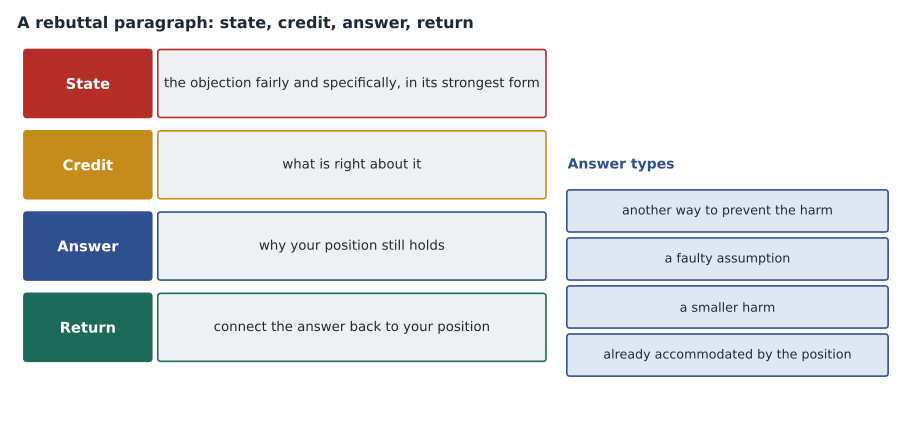
Kinds of answers
Harriet went through the four kinds of answer in more detail, because choosing the right one is what makes a rebuttal convincing.
Another way to prevent the harm. This is often the strongest answer, because it accepts the objection's concern and shows that your position can meet it. The library example uses this answer.
A faulty assumption. Many objections rely on an unstated premise. The responsibility perspective assumes that fines are what bring items back. If borrowers return items mainly because of reminders, habit and wanting to borrow again, the fine adds little. The writer cannot cite a study proving this, but can point out that the objection depends on an assumption it does not support, and that a library could test it.
A smaller harm. Sometimes both choices carry a cost, and the answer is that the cost of your position is smaller. "Even if some items come back a little later, that cost is smaller than the cost of permanently losing borrowers who stop coming because of a debt they cannot pay."
Already accommodated. A qualified position may already address the objection. Élodie's position, dropping fines only for children's materials, partly accommodates the responsibility objection because adults are still held to their promise.
Dani asked whether she could use more than one answer in a paragraph. Harriet said two answers can work if they are short, but one well-developed answer is usually more persuasive than a scattering. The paragraph should not feel like a list of excuses.
Where the counterargument goes
There are two common places for the counterargument. One is a separate paragraph, usually the last body paragraph, after your own reasons. The other is inside a body paragraph, where a reason naturally invites an objection. Harriet recommended the separate paragraph for this task. It makes the essay's engagement visible at a glance, and a reader skimming for whether you considered the other side will find it. It also simplifies planning: the five-line plan has a dedicated line for the objection and reply.
Some writers prefer to open the body with the counterargument, answering it before presenting their own reasons. That can work when the objection is the obvious first thought a reader would have. But it risks spending your best minutes on the other side's case. On a timed essay, Harriet suggested putting your own strongest reason first.
Avoiding common rebuttal errors
Harriet listed the errors she had seen in the group's first essays and in years of tutoring.
The dismissal: "Some argue that fines teach responsibility, but this is clearly wrong." No reason is given. The reader is left to guess why the writer thinks it wrong.
The misstatement: answering a weaker or distorted version of the objection. Marcus recognized this from his April 2025 essay.
The concession that swallows the argument: "Fines do help other borrowers, and libraries need them to function, but I still think they should be dropped." The concession is bigger than the answer, and the reader is left convinced by the objection.
The irrelevant answer: responding to the objection with a reason that does not meet it. "Fines are a hassle for staff" does not answer the concern that other borrowers wait.
The rebuttal by assertion: replacing reasoning with confident words such as "obviously," "clearly" or "undeniably." Those words signal that an argument is missing.
Returning the first essays
Harriet's comments on the first essays followed these themes. Thomas had a thoughtful counterargument, but placed it in the conclusion, where it raised a doubt the essay never resolved. Moving it to its own body paragraph would fix that. Élodie's rebuttal was well structured, and her qualified position accommodated the objection elegantly; her comment was to cut a sentence that repeated the introduction. Dani dismissed the responsibility perspective in one line; Harriet asked her to rewrite the paragraph using state, credit, answer, return. Ji-won's essay had three reasons but no counterargument at all; she had planned one but run out of time, and the next lesson on structure and Lesson 10 on timing would help. Marcus's rebuttal was accurate but only two sentences long. Harriet said it needed the credit and return steps to land.
Dani rewrote her paragraph during the session. Her new version stated the waiting-list objection fairly, credited it, answered with reminders, renewal limits and a replacement charge, and returned to her position. It was 120 words instead of 20. Harriet read it aloud and said it was now the most persuasive paragraph in the essay.
When you cannot fully answer an objection
Sometimes, honestly, an objection is hard to answer. Harriet said not to pretend otherwise. You can acknowledge that the objection identifies a real cost, explain why your position is still better on balance, and if appropriate adjust your position's qualification in the introduction. Readers respect an essay that says "this is a real cost, and here is why it is worth bearing" more than one that claims the objection collapses when it does not.
Ji-won asked whether that would look weak. Harriet said it looks honest, and that honesty about trade-offs is a mark of mature reasoning. Lawyers spend their careers explaining why a client's position is better on balance despite real weaknesses. The writing task is a small rehearsal of that skill.
Rebuttals for qualified positions
Qualified positions need rebuttals too, but the strongest objection may come from either side. Élodie's position on prompt A, dropping fines for children's materials but keeping them for adults, faced objections from both directions. The access perspective could argue that low-income adults are also deterred by fines. The responsibility perspective could argue that children's books are among the most requested items, so dropping fines on them hurts other families most. Harriet asked Élodie which objection was more damaging. After some thought, Élodie chose the access objection, because it attacked the line she had drawn between children and adults, which was the heart of her position.
Her rebuttal used the "already accommodated" and "another way to prevent the harm" answers together: the library could offer adults fine forgiveness through volunteering or reading programs, which preserves the expectation of responsibility while removing the barrier for those who cannot pay. Harriet said that was a good example of a short combination of two answers that fit together, rather than a scattering of excuses.
A worked rebuttal for prompt B
Harriet modeled a full rebuttal paragraph for Dani's firm position on prompt B, that the university should adopt the requirement.
"The strongest objection is that a universal requirement takes a scarce slot from every student's program, and that a reluctant student forced into statistics may learn little. That objection deserves weight: programs are already crowded, and resentment is a poor foundation for learning. But the cost is one course in a degree of thirty or more, and the reluctance is not fixed. Students who arrive doubting that statistics concerns them often change their minds when the course uses examples from health, sports or elections that matter in their own lives. A well-designed requirement can turn the reluctant student's question, 'why do I need this?', into the course's opening lesson. The modest cost to choice is outweighed by a skill every graduate will use."
The paragraph states the objection, credits it, answers it with a smaller-harm argument and a challenge to an assumption (that reluctance is fixed), and returns to the position. It is about 130 words. Dani compared it with her own October 24 rewrite and said hers had the same structure but less specific language; Harriet said the specificity was the next step for her, and that "examples from health, sports or elections" was the kind of concrete detail that made an answer persuasive.
When two perspectives object
Sometimes two perspectives object to your position from different angles. Harriet said to choose the stronger one for the full rebuttal paragraph and to handle the other briefly elsewhere, perhaps with a sentence in a body paragraph. Trying to rebut two objections fully in one paragraph usually produces two thin answers.
Thomas asked how to decide which was stronger when both seemed serious. Harriet suggested imagining a thoughtful reader who disagrees with you: which objection would that reader raise first? That is the one to answer at length.
The rebuttal as the essay's high point
Harriet ended the lesson by returning to her opening point. In many strong essays the rebuttal paragraph is the most impressive part, because it shows the writer at work: taking a serious objection, granting what is right about it and still finding a reason to hold the position. Readers who see that paragraph know they are reading someone who can think under pressure. That is the impression the writing sample should leave.
Marcus asked whether a rebuttal could ever be longer than a reason paragraph. Harriet said it often should be, because it has four jobs to do and the reader values it highly. A rebuttal of 140 to 170 words is normal in a strong essay. What matters is that the extra length goes into the answer, not into restating the objection at length. A good rule is that the answer should take at least as many words as the statement and credit combined.
Common mistakes
MistakeAnswering the weakest objection because it is easy.
InsteadAddress the objection that would most damage your position if true.
MistakeDismissing an objection in one sentence with "this is wrong."
InsteadUse state, credit, answer, return.
MistakeConceding so much that the objection wins.
InsteadKeep the concession smaller than the answer.
MistakeAnswering with a reason that does not meet the objection.
InsteadMake sure the answer addresses the specific harm the objection names.
MistakePlacing the counterargument in the conclusion.
InsteadGive it its own body paragraph so it is resolved before you conclude.
Summary and key terms
- Answering the strongest objection shows the skill law schools value: anticipating and meeting the best argument against you.
- Choose the objection that would most damage your position if true.
- Structure a rebuttal as state, credit, answer, return.
- Answers include another way to prevent the harm, a faulty assumption, a smaller harm or an already accommodating position.
- When an objection identifies a real cost, acknowledge it and explain why your position is better on balance.
- Counterargument
- An argument against your position, usually drawn from an opposing perspective.
- Rebuttal
- Your answer to a counterargument.
- State, credit, answer, return
- A four-part structure for a rebuttal paragraph.
- Dismissal
- Rejecting an objection without giving a reason.
Practice problems
Work each problem on paper first, then reveal the answer to check.
Which objection should you address?
Show answer
The one that would most damage your position if it were true.
What are the four parts of a rebuttal paragraph?
Show answer
State the objection, credit what is right, answer it, return to your position.
What assumption does the responsibility perspective in prompt A rely on?
Show answer
That fines are what bring items back.
Where should the counterargument usually go?
Show answer
In its own body paragraph, usually after your own reasons.
What should you do if you cannot fully answer an objection?
Show answer
Acknowledge the real cost and explain why your position is better on balance.
Lesson quiz · 5 questions
Score 60% or more to complete this lesson.
Create a free account to save your progress, take quizzes and earn a certificate.