
LSAT-130 · Lesson 1 of 12 · 19 min
The writing task
▶ Video coming soon A video version of this lesson is on the way.
On Saturday, October 3, at ten in the morning Eastern time, Harriet Nakamura-Fox opened the first session of a new Saturday writing workshop for the Thursday Circle. The weekday sessions had covered Logical Reasoning and Reading Comprehension. This series, she said, would cover the part of the LSAT that most candidates leave until the last week and then regret leaving: LSAT Argumentative Writing.
'It is the only part of the test where you produce something instead of choosing something,' she said. 'It is not scored, and that leads people to treat it as an afterthought. But it goes to every school you apply to, admissions readers can and do read it, and it is the one piece of writing in your file that you produced under controlled conditions with no one helping you. That makes it unusually honest evidence of how you write.'
Dani said she had assumed the writing was a formality, something like signing a form. Thomas said he had planned to "wing it" the night before his test. Harriet said both reactions were common, and that by the end of seven Saturdays they would have a method that took the guesswork out of fifty minutes of writing.
What the task is
LSAT Argumentative Writing replaced the older LSAT Writing prompt in 2024. According to LSAC's LawHub description, each prompt presents a debatable issue together with several perspectives on it, each described in a few sentences. The perspectives reflect different values or ways of thinking about the issue. Your job is to write an argumentative essay that takes a position on the issue and engages with some of the arguments and ideas in the perspectives.
Three features of that description shape everything in this course. First, the issue is debatable: there is no correct answer, and readers are not checking whether you chose the "right" side. Second, the perspectives are given to you: you do not need outside knowledge, and the essay is judged on what you do with the material in front of you. Third, the essay is argumentative: it must take a position and defend it, not merely summarize the perspectives.
LSAC describes the skills the task draws on as organizing evidence into a position, arguing logically and producing structurally sound writing. Those are the same skills first-year law students use in exam answers and legal memos, which is why schools are interested in the result.
How the session runs
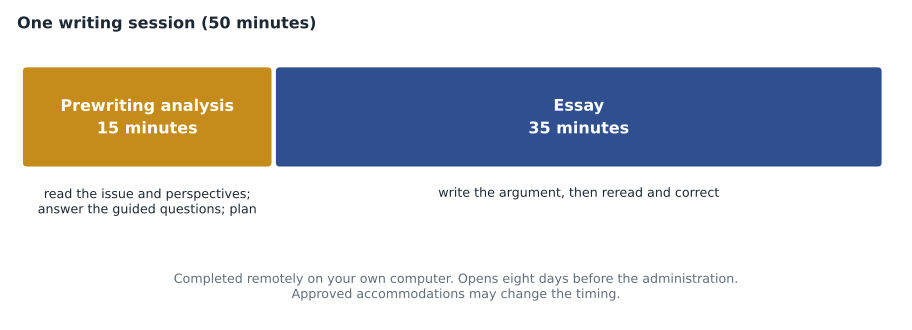
The session has two timed parts. The first is a 15-minute prewriting analysis. You read the issue and the perspectives and work through a short set of guided questions designed to help you analyze the perspectives and generate ideas. Your notes are typed into the interface. LSAC has described a minimum time in this stage before you can move on; check the current instructions for your administration. The second part is 35 minutes of essay writing. Candidates with approved testing accommodations may have different timing, as LSAC sets out in their approval.
The prewriting notes are for you. The essay is what schools receive. That division matters. The prewriting stage is not a draft to be polished; it is thinking time that produces a plan. Students who try to write paragraphs during the prewriting stage often run out of time to choose a position, and their essays wander.
The interface is plain: a text box, a timer and digital scratch space. LSAC's test-day guidance tells candidates to close grammar-checking applications, such as browser extensions that correct writing, before starting. You should practice without any automatic correction, so that the spelling and punctuation you see in practice is what you will produce on the day.
When and where you write it
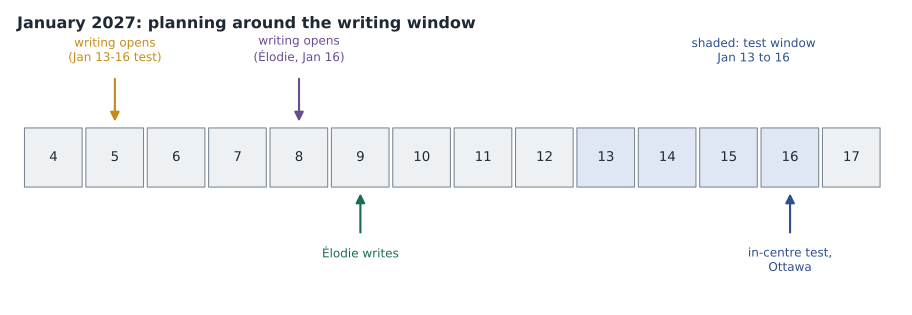
LSAT Argumentative Writing is completed separately from the multiple-choice sections. All test takers complete it remotely, on their own computer, with remote proctoring through a webcam and microphone. The writing becomes available eight days before the start of an LSAT administration. That is true even now that, since August 2026, nearly all candidates take the multiple-choice sections in person at a test center: the writing stays remote for everyone.
For the group, that produced a small calendar exercise. Élodie's multiple-choice appointment is Saturday, January 16, 2027, in Ottawa, and her writing window opens on Friday, January 8. Dani and Ji-won test in the January 13 to 16 window as well, so their writing opens on January 5. Thomas plans to test in April 2027; for the April 8 to 10 administration, his writing would open on March 31.
Harriet's advice was to finish the writing early in the window rather than leave it for the last evening. A remote session needs a quiet room, a working webcam, a stable connection and an approved form of identification, and any of those can fail on a busy night. Élodie decided to write on Saturday, January 9, a week before her multiple-choice appointment, so that the writing would not be on her mind on test day.
Why an unscored task deserves preparation
The writing receives no score, and LSAC will not release your multiple-choice score until you have a writing sample on file. A writing sample from the reportable period remains valid, so a candidate who already has one on file does not have to write another to receive a later score. First-time test takers must complete it. Those rules, which LSAT-101 introduced, mean the writing is never optional for a new candidate, even though nobody grades it on a scale.
Marcus already has a sample on file from his April 2025 test. He joined the Saturday sessions anyway. 'I wrote that essay in a hurry,' he said. 'I do not even remember what I argued. If the schools read it, I would like to know what they are looking at, and I want the next one, if I write one, to be better.' Harriet said that was a reasonable reason to attend, and that the rules about which samples go to schools are LSAC's; candidates should read LSAC's current explanation rather than rely on what friends say.
An unscored essay can still help or hurt. A clear, well-organized argument confirms that a candidate can write under pressure. An essay that is disorganized, off-topic or unfinished raises a question, especially if other parts of the file, such as a personal statement, read far more polished. Readers know that personal statements can be revised many times with help. The writing sample cannot.
What a strong response looks like
LSAC does not publish a scoring rubric, because there is no score. But the description of the task tells you what readers will look for, and Harriet summarized it in four questions that the course will return to repeatedly:
- Does the essay take a clear position on the issue?
- Does it support the position with reasons that follow logically?
- Does it engage seriously with perspectives that disagree, rather than ignoring them or treating them as foolish?
- Is it organized so that a reader can follow the argument from beginning to end?
What is not on the list matters too: impressive vocabulary, outside facts, legal terminology or a dramatic opening. Harriet said that candidates who try to sound like lawyers usually sound like people trying to sound like lawyers. Plain, precise sentences that make a clear point serve far better.
A first look at the method
The course builds a method in stages. Lessons 2 and 3 look at how schools use the writing and how prompts are built. Lessons 4 to 7 cover the prewriting stage, choosing a position, using the perspectives and answering counterarguments. Lessons 8 to 10 cover structure, style and timing. Lesson 11 examines strong and weak sample essays, and lesson 12 is a timed capstone with a self-review rubric.
The method, in brief: read the issue and decide what question it really asks; map what each perspective values; choose a position you can defend in 35 minutes, often a qualified one; plan three body paragraphs, at least one of which answers the strongest opposing perspective; write; and leave a few minutes to reread and fix errors. It sounds simple. The work of the course is making each step reliable under time pressure.
Who is in the room
Harriet asked each member to say what worried them most. Thomas worried about running out of time, because he writes slowly and edits as he goes. Élodie said English was her second language for academic writing, after French, and that under pressure she sometimes produced sentences that were grammatical but stiff. Dani worried that she did not know how to write a formal essay at all; her paralegal work involved forms, letters and summaries. Ji-won said her challenge was structure: she had many ideas and tended to write them in the order they occurred to her. Marcus said engineering reports had taught him to be concise, perhaps too concise.
Harriet said those five worries covered most of what goes wrong on the writing task. She promised each member a specific habit to build. Thomas would learn to separate drafting from editing. Élodie would build a short list of natural transitions and practice reading her sentences aloud in her head. Dani would learn a reliable essay template. Ji-won would plan before writing a single sentence. Marcus would learn when an extra sentence of explanation earns its place.
Practicing the right way
Practice for the writing task has to resemble the real thing. That means typing, not handwriting; using a plain text box with no automatic grammar correction; timing both stages strictly; and working from prompts you have not seen before. LSAC offers a sample prep session in LawHub that uses the actual interface, including timing and digital notes, and additional prompts are available with a paid LawHub subscription. This course adds original practice prompts written in the same general shape.
Harriet set a modest goal for the series: one complete timed essay every second week, plus short exercises on single skills in between. More practice than that, she said, tends to crowd out the multiple-choice preparation that still counts for far more in admissions. But less than three or four full practice essays before test day leaves too much to chance.
How the writing differs from the multiple-choice sections
It helps to see the writing task beside the parts of the LSAT the group already knew. The multiple-choice sections reward recognizing a credited answer among five choices; the writing rewards producing an argument from nothing but a prompt. The multiple-choice sections are scored on the 120 to 180 scale and reported with a percentile; the writing has no score at all. The multiple-choice sections are now taken at a test center by nearly everyone; the writing is taken at home by everyone. And while every multiple-choice question has one best answer, every writing prompt has many good essays.
Those differences change how you prepare. For the multiple-choice sections, volume of practice and careful review of every miss are what move a score. For the writing, a small number of complete, carefully reviewed essays matters more than volume, because the goal is a reliable method rather than recognition of question types. Harriet compared it to learning to give a short speech: three rehearsals with feedback do more than twenty without.
Ji-won asked whether the skills from Logical Reasoning would help. Harriet said they help more than most people expect. Identifying a conclusion and its support is exactly what you do when you plan an essay, in reverse. Spotting a flaw in someone else's argument is what you do when you answer a counterargument. The writing task asks you to build arguments with the same parts the multiple-choice sections asked you to take apart.
What to do this week
Harriet closed the first session with three small assignments. First, each member would read LSAC's own description of the writing task on LawHub and note anything that differed from what she had said, since LSAC's pages are the authority and details can change. Second, each would try the free sample prep session in LawHub, without worrying about quality, simply to see the interface and the timer. Third, each would write down, in one sentence, the writing habit they most wanted to change. The sentences went into the group's shared document, where Harriet would return to them at the end of the series.
Common mistakes
MistakeTreating the writing as a formality because it is unscored.
InsteadPrepare for it: it goes to schools and is the one piece of writing produced under controlled conditions.
MistakeLeaving the writing until the last evening of the window.
InsteadSchedule it early in the window, with a tested room, webcam, connection and ID.
MistakeWriting paragraphs during the prewriting analysis.
InsteadUse the 15 minutes to analyze and plan; draft only in the essay stage.
MistakeTrying to sound like a lawyer with jargon and outside facts.
InsteadUse plain, precise sentences and the material in the prompt.
MistakePracticing by hand or with a grammar checker running.
InsteadType in a plain text box with no automatic correction, under strict timing.
Summary and key terms
- LSAT Argumentative Writing presents a debatable issue and several perspectives; you write an essay that takes a position and engages with the perspectives.
- The session has a 15-minute prewriting analysis and a 35-minute essay stage; accommodations may change the timing.
- Everyone completes the writing remotely on their own computer; it opens eight days before the administration.
- It is unscored, but LSAC will not release a multiple-choice score until a writing sample is on file, and schools receive it.
- Readers look for a clear position, logical support, serious engagement with other perspectives and clear organization.
- LSAT Argumentative Writing
- The unscored, remotely proctored writing task that accompanies the LSAT; it replaced LSAT Writing in 2024.
- Perspective
- One of several short statements in a prompt that present a viewpoint on the issue.
- Prewriting analysis
- The first, 15-minute stage of the session, in which guided questions help you analyze the perspectives and plan.
- Writing window
- The period, opening eight days before an administration, during which you can complete the writing.
Practice problems
Work each problem on paper first, then reveal the answer to check.
How long is the prewriting analysis, and how long is the essay stage?
Show answer
15 minutes and 35 minutes, unless approved accommodations change the timing.
Where do candidates complete the writing since August 2026?
Show answer
Remotely, on their own computer, for everyone; only the multiple-choice sections moved to test centers for most people.
When does the writing open for an administration?
Show answer
Eight days before the administration begins.
Can a candidate receive a multiple-choice score without a writing sample on file?
Show answer
No. LSAC releases the score only once a writing sample is on file.
Name the four qualities readers look for.
Show answer
A clear position, logical support, serious engagement with other perspectives and clear organization.
Lesson quiz · 5 questions
Score 60% or more to complete this lesson.
Create a free account to save your progress, take quizzes and earn a certificate.