
LSAT-130 · Lesson 10 of 12 · 19 min
Timing the essay and avoiding common mistakes
▶ Video coming soon A video version of this lesson is on the way.
On Saturday, November 14, two days after his test, Marcus was back. His score would not be released until December 2, and he said he was trying not to think about it. Harriet said a session on timing and mistakes was a good distraction, because it was practical and short on theory.
'You now know what a good essay looks like,' she said. 'The remaining risk is the clock. Most weak samples I see are not weak because the writer could not argue. They are weak because the writer ran out of time, or spent the time in the wrong places.'
A budget for the 35 minutes
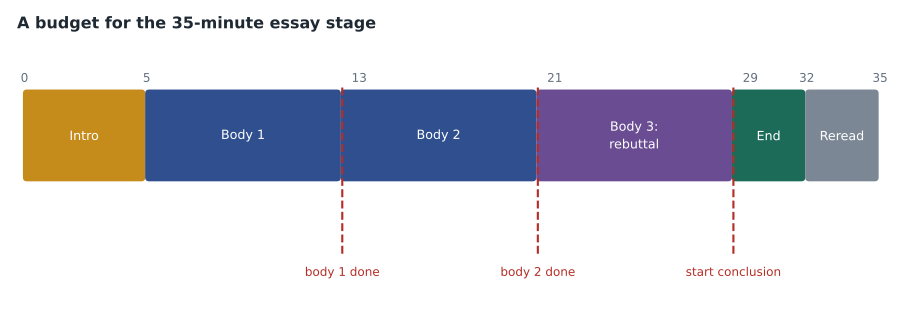
Harriet proposed a time budget for the essay stage, assuming the plan was finished in the prewriting stage.
- Minutes 0 to 5: introduction, written quickly from the plan.
- Minutes 5 to 13: body paragraph 1.
- Minutes 13 to 21: body paragraph 2.
- Minutes 21 to 29: body paragraph 3, the objection and rebuttal.
- Minutes 29 to 32: conclusion.
- Minutes 32 to 35: reread and correct.
The budget gives about eight minutes to each body paragraph, which is enough for 120 to 160 words at a moderate typing speed when you know what you want to say. It leaves three minutes at the end for a reread, which is short but essential.
Checkpoints
A budget is useful only if you check it. Harriet suggested three checkpoints: by minute 13, body paragraph 1 should be finished; by minute 21, body paragraph 2; by minute 29, you should be starting the conclusion, whatever state body paragraph 3 is in. The last checkpoint is the most important. An essay without a conclusion feels unfinished, and an unfinished essay is one of the few things that clearly hurts a sample.
Ji-won asked how to scale the budget for accommodations. Harriet said to keep the proportions: introduction about a seventh of the time, each body paragraph a little under a quarter, conclusion and reread about a sixth together. Ji-won should check her approval for the writing timing and convert the checkpoints accordingly.
When you fall behind
Everyone falls behind sometimes. Harriet described what to do at each checkpoint if you are late.
If body paragraph 1 is not done by minute 15, finish its main point in a sentence or two and move on. A complete argument with a slightly thin first paragraph is better than a long first paragraph and a missing rebuttal.
If body paragraph 2 is not done by minute 23, consider merging the second reason into a shorter paragraph and moving straight to the objection. The rebuttal is often the paragraph readers value most, so protect it.
If the rebuttal is not done by minute 30, write a one-sentence answer to the objection and go to the conclusion. Then write a two-sentence conclusion. An essay with a brief rebuttal and a conclusion is better than one that ends mid-rebuttal.
Thomas asked what to do if he finished early. Harriet said to use the extra minutes to reread carefully and to add one sentence of explanation where a step was skipped, not to start a new paragraph. Adding new arguments at the end is how essays become disorganized.
Drafting versus editing
Thomas's main challenge was editing as he typed. He would write a sentence, decide it was not quite right, rewrite it, and lose minutes on each paragraph. Harriet suggested a simple rule: in the drafting minutes, never go back more than one sentence. If a sentence is awkward but understandable, leave it and fix it in the reread. If it is wrong, rewrite it immediately, but only that sentence.
He had tried the rule on a practice essay on his own earlier that week. He said it felt uncomfortable to leave awkward sentences, but he finished with four minutes to spare for the first time, and the awkward sentences took less than a minute to fix at the end. Harriet said that was the typical result: separating drafting from editing almost always saves time overall.
The reread
The final three minutes are for correction, not revision. Harriet listed what to look for, in order.
First, the position: is it stated clearly in the introduction and restated in the conclusion, without contradiction?
Second, the topic sentences: does each body paragraph open with a clear point?
Third, your personal error list from Lesson 9: missing words, false friends, "its" and "it's," run-on sentences.
Fourth, anything that would confuse a reader, such as a pronoun with an unclear reference or a sentence that trails off.
Harriet said not to try to rewrite paragraphs in the reread. There is no time, and partial rewrites create new errors.
The ten most common mistakes
Harriet then went through the ten mistakes she saw most often in practice essays, many of which the group had met already.
One: no clear position. The essay summarizes the perspectives and concludes that each has merit.
Two: answering a different question. The essay drifts to a broader or narrower issue than the prompt asked.
Three: ignoring the strongest opposing perspective, or dismissing it in a sentence.
Four: summarizing the perspectives instead of using them.
Five: a long introduction that eats the time needed for the body.
Six: an unfinished essay, usually caused by poor timing or by editing while drafting.
Seven: invented or remembered statistics presented as facts.
Eight: a conclusion that introduces new reasons or reverses the position.
Nine: a disorganized order, with ideas presented as they occurred to the writer.
Ten: a hostile or sarcastic tone toward opposing views.
She asked each member which mistake they were most at risk of on the day. Thomas said six. Élodie said none of the ten worried her much now, but under stress she might write a longer introduction than needed, so five. Dani said three, though her rewritten rebuttal on October 24 had shown her how to fix it. Ji-won said nine, which the plan now prevented, and six, which the checkpoints would address. Marcus said four, because his habit of brevity sometimes made him mention a perspective and move on without saying what he made of it.
Test-day logistics for the writing
Because the writing is remote, its logistics differ from the multiple-choice sections. Harriet reviewed LSAC's guidance on LawHub for the session. Use a supported, up-to-date operating system and browser. Check that the webcam and microphone work. Use a strong internet connection, ideally wired. Close nonessential applications, including grammar checkers. Have an acceptable photo ID ready and capture it clearly when asked. Remove watches, fitness trackers, phones, headsets and earphones; soft foam earplugs without cords are allowed. Physical scratch paper is not allowed; use the digital scratch space. Be ready to show the room with a slow scan, including the desk surface.
Élodie planned to write in a small study room at home with a wired connection, on Saturday, January 9. Dani planned to write on the first weekend her window was open, at her kitchen table early in the morning before her children were awake, after a test run of the system check the day before. Ji-won planned to write in the morning, when she focused best, and to follow her approval's timing. Thomas, testing in April, would decide later but planned to follow the same steps.
Harriet added one piece of practical advice: do the writing on a day with no other major commitment, and not on the evening after a long working day. Fifty minutes of focused work is easier when you are rested.
A warm-up routine
Finally, Harriet suggested a warm-up for the day of the writing: a short walk, ten minutes reviewing your five-line plan template and your personal error list, and a glance at your transition list. No new practice prompts on the day. The goal is to arrive at the session with the method fresh and the mind calm.
Typing speed and the budget
The budget assumes a moderate typing speed. Harriet asked each member to measure theirs by typing a practice paragraph for five minutes from a plan, counting the words and dividing by five. The results ranged from about 22 words a minute to about 45. At 22 words a minute, 24 minutes of body-paragraph drafting yields about 500 words before any pauses for thought; at 45, it yields far more, and the limit becomes thinking, not typing.
For slower typists, Harriet said, the plan matters even more, because there is no time to think on the page. Thomas, who measured about 25 words a minute, decided to make his prewriting plans more detailed, with a rough topic sentence for each paragraph written out in the notes. That way, during the essay stage, he could start each paragraph immediately. For faster typists, the risk is the opposite: writing more than needed and running out of time to reread. Ji-won, who typed fastest, decided to stop each body paragraph at about 160 words.
The first five minutes of the essay stage
The first minutes of the essay stage set the pace for the rest. Harriet suggested starting immediately with the introduction, written straight from the plan, and not pausing to admire it. The introduction should take no more than five minutes; three sentences can often be typed in two or three. If the introduction is taking longer, it is usually because the writer is drafting the position from scratch rather than copying it from the plan.
Dani admitted that in her first practice essay she had spent nine minutes on the introduction, rewriting the opening sentence four times. With the drafting rule and the plan's position line, her second essay's introduction took four minutes. She said the difference was that she no longer tried to make the first sentence impressive; she made it accurate and moved on.
What a finished essay looks like at 35 minutes
Harriet described what she wanted the group to see on the screen when the timer sounded: five paragraphs, a position in the first and the last, a rebuttal in the fourth, and a few corrections made in the final minutes. Not a perfect essay, but a complete one. She said that a complete, organized essay is the outcome that matters, and that most of what separates a strong sample from a weak one is simply arriving at that outcome reliably.
Practicing timing without full essays
Timing can be practiced in pieces. One drill is the eight-minute paragraph: take a plan line and write one body paragraph in exactly eight minutes, then check its length and structure. Another is the five-minute ending: write a rebuttal sentence and a conclusion in five minutes, which simulates the situation of falling behind. A third is the three-minute reread: take an old practice essay and spend exactly three minutes correcting it, using your error list. Each drill takes less than ten minutes and builds a sense of how long things take.
Marcus said the eight-minute paragraph drill was useful for him in the opposite direction: it showed him how much more he could say in eight minutes than he had been saying. His paragraphs grew from about 80 words to about 130 without feeling padded, because he used the time to add the reasoning steps he had been skipping.
Recovering from a bad start
Sometimes the essay stage starts badly: the plan seems wrong, or the first paragraph comes out muddled. Harriet said the worst response is to delete and restart. A better one is to keep going with the plan, writing the clearest version you can, and use the reread to fix the muddled paragraph's topic sentence. A complete essay with one weak paragraph is far better than a restarted essay that ends halfway through. Thomas said that knowing he was allowed to leave a weak paragraph behind took some of the pressure off.
Building the budget into practice
Harriet asked each member to write the checkpoints on a sticky note during practice essays only, so that the numbers 13, 21 and 29 became automatic. On the real day no written notes are allowed, but by then the checkpoints should be in memory. Thomas said the numbers already felt familiar after one practice essay. Dani said she would check the timer at the end of each paragraph rather than mid-sentence, which kept her from losing her train of thought. Harriet said both approaches work; the essential point is that the timer is checked at planned moments, not only when panic sets in near the end.
Ji-won converted the checkpoints for the timing in her approval and wrote the new numbers on her own note. She said that having her own numbers, rather than trying to scale the standard ones in her head during the essay, removed one more thing to think about.
Common mistakes
MistakeWriting without checking the time until the end.
InsteadUse checkpoints at minutes 13, 21 and 29.
MistakeLetting body paragraph 1 run long and losing the rebuttal.
InsteadFinish the point and move on; protect the rebuttal and the conclusion.
MistakeEditing each sentence while drafting.
InsteadNever go back more than one sentence; fix awkwardness in the reread.
MistakeStarting a new paragraph in the final minutes.
InsteadUse spare time to reread and add a missing step of explanation.
MistakeDoing the writing on the evening after a long day.
InsteadChoose a rested time with no other major commitment.
Summary and key terms
- Budget the 35 minutes: introduction 5, each body paragraph about 8, conclusion 3, reread 3.
- Check progress at minutes 13, 21 and 29; start the conclusion by 29 whatever happens.
- When behind, shorten earlier paragraphs to protect the rebuttal and the conclusion.
- Separate drafting from editing; use the reread to correct, not rewrite.
- Prepare the remote setup in advance and write when rested.
- Checkpoint
- A planned time to compare progress with the budget.
- Reread
- The final minutes spent correcting errors, not rewriting paragraphs.
- Drafting rule
- Never go back more than one sentence while drafting.
- System check
- LSAC's test of your computer, camera, microphone and connection before the session.
Practice problems
Work each problem on paper first, then reveal the answer to check.
What should be done by minute 29?
Show answer
You should be starting the conclusion.
If body paragraph 2 is late at minute 23, what should you do?
Show answer
Shorten or merge it and move to the objection to protect the rebuttal.
What are the four things to check in the reread?
Show answer
The position, the topic sentences, your personal error list and anything confusing.
Is physical scratch paper allowed in the remote writing session?
Show answer
No. Use the digital scratch space.
How should Ji-won scale the budget?
Show answer
Keep the same proportions under the timing her approval sets.
Lesson quiz · 5 questions
Score 60% or more to complete this lesson.
Create a free account to save your progress, take quizzes and earn a certificate.