
LSAT-130 · Lesson 3 of 12 · 19 min
Reading the prompt: the issue and the perspectives
▶ Video coming soon A video version of this lesson is on the way.
The Saturday session on October 10 fell on Canadian Thanksgiving weekend. Thomas joined from his parents' kitchen in Halifax and Élodie from Gatineau before a family dinner, and Harriet kept the session to its usual ninety minutes. The topic was the first thing you see when the writing begins: the prompt itself.
'Most weak essays go wrong in the first three minutes,' Harriet said. 'The writer skims the issue, latches onto the perspective that matches what they already think, and starts typing. Ten minutes later they discover the essay does not answer the question that was actually asked. Reading the prompt well is the cheapest improvement available.'
The parts of a prompt
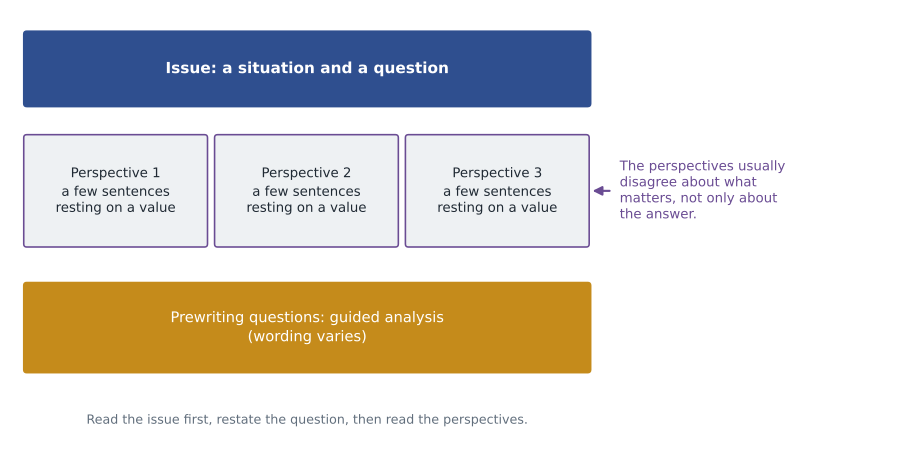
Every prompt has the same basic parts. The issue is a short paragraph that describes a situation and ends with a question, usually one that can be answered yes or no, or by choosing between options. The perspectives follow: several short statements, each a few sentences long, each presenting a different way of thinking about the issue. LSAC describes the perspectives as reflecting different values or belief systems, which is a useful clue. They are not just different opinions; they usually rest on different ideas about what matters.
In the prewriting stage you also see guided questions. LSAC does not publish a fixed list, and you should not expect the same wording every time, but their purpose is consistent: to help you analyze the perspectives and generate ideas before you write. Lesson 4 covers how to use them. This lesson concentrates on reading the issue and the perspectives accurately.
Reading the issue
The issue paragraph does two jobs. It sets the scene, and it poses the question. Read the question twice. Then put it in your own words as a single sentence beginning "Should..." or "Is it better to...". This sounds trivial, but it prevents the most common error: writing about a related question that the prompt did not ask.
Harriet showed the group the first practice prompt of the series and asked them to restate the question.
Practice prompt A: overdue fines at public libraries (written for this course)
Issue. Many public libraries charge small daily fines when borrowed items are returned late. Some library systems have eliminated these fines; others keep them. Should public libraries stop charging overdue fines?
Perspective 1: Access. A public library exists to make knowledge available to everyone. Fines fall hardest on the people who can least afford them, and a blocked card can keep a child or a job seeker away from the library entirely. Whatever small sums fines raise are not worth the people they turn away.
Perspective 2: Responsibility. Borrowing is a promise to return shared property on time so that others can use it. Fines are a modest, predictable reminder of that promise. Without some consequence for lateness, popular items will sit on shelves at home while others wait, and the library teaches that commitments to the public do not matter.
Perspective 3: Practical management. The question should be settled by results, not principles. Libraries that drop fines should track whether items come back, how long waiting lists grow and what collecting fines actually costs in staff time. A library might keep a charge for items that are never returned while dropping daily fines, or waive fines for children only.
Restating the question
Dani wrote: "Are library fines fair?" Harriet said that was close but not quite the question. Fairness is one consideration, but the issue asks whether libraries should stop charging fines, which is a decision about policy. A fine might be fair and still be a bad policy, or unfair in some cases and still worth keeping. Ji-won wrote: "Should public libraries stop charging overdue fines?" That matched the prompt exactly.
Harriet then asked about scope. Does the issue ask about all charges, or only daily overdue fines? Thomas noticed that the issue speaks of fines "when borrowed items are returned late," which leaves room to treat charges for items that are never returned differently. The third perspective makes that distinction explicit. Noticing scope early gives you options: you can argue for dropping daily fines while keeping replacement charges, and that position is still a direct answer to the question.
Marcus asked whether he could answer "it depends." Harriet said an essay that simply says "it depends" and stops has not taken a position. But an essay that says "libraries should drop daily fines for children and keep replacement charges for unreturned items, because..." has taken a clear, qualified position. Lesson 5 develops that distinction.
Reading each perspective
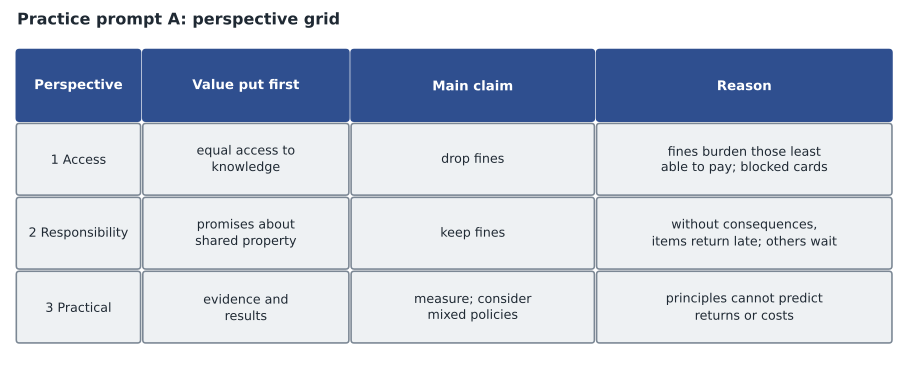
For each perspective, Harriet asked the group to identify three things: the value it puts first, its main claim about the issue, and the reason it gives. She modeled the first one.
- Perspective 1 (Access): value, equal access to knowledge; claim, libraries should drop fines; reason, fines fall hardest on those least able to pay and drive people away, which defeats the library's purpose.
The group worked through the other two.
- Perspective 2 (Responsibility): value, keeping promises about shared property and fairness to other borrowers; claim, libraries should keep fines; reason, without a consequence items come back late, others wait, and the library teaches that public commitments do not matter.
- Perspective 3 (Practical management): value, decisions based on evidence and results; claim, decide by measuring outcomes and consider mixed policies; reason, principles alone cannot tell you whether items will come back or what collection costs.
Élodie noticed that the third perspective does not take a side on the yes-or-no question. Harriet said that is common. One perspective often reframes the issue, proposes a middle path or questions the terms of the debate. Such a perspective can be the foundation for a qualified position, or the target you answer if you take a firm side.
What the perspectives agree on
After the grid, Harriet asked a question the group had practiced in comparative reading: where do the perspectives agree? All three accept that the library's purpose is to serve the public. The first and second disagree about whether fines serve or undermine that purpose. The third agrees with both that outcomes matter but thinks the answer depends on evidence. All three implicitly accept that late returns are a real problem for other borrowers; even the first perspective argues only that fines are too costly a remedy, not that lateness does not matter.
Finding shared ground is not a polite exercise. It tells you which claims you can take as common ground in your essay and where the real disagreement lies. An essay that argues at length that libraries serve the public wastes words, because nobody in the prompt disputes it. An essay that tackles the real disagreement, whether fines help or hinder the library's mission in practice, engages readers immediately.
Reading for the strongest version
A tempting habit is to read the perspective you disagree with as weakly as possible, so that it is easy to defeat. Readers notice. Harriet called it the "straw person" problem, borrowing the Logical Reasoning flaw name. The essay that engages the strongest version of an opposing view is more persuasive and shows the fair-minded reasoning that legal writing requires.
She asked Dani, who instinctively agreed with the access perspective, to state the responsibility perspective as persuasively as she could. Dani tried: "If borrowers can keep popular books as long as they like, the people who suffer are other patrons, often the same people the access argument worries about, waiting weeks for a book their child needs for school. A small fine protects them." Harriet said that was exactly the kind of statement that makes an essay better, because now Dani knew what she had to answer.
Reading actively in a few minutes
All of this has to happen quickly. Harriet suggested a time budget for the reading itself: about one minute on the issue, including the restatement, and about a minute on each perspective, writing a three-part note for each. That leaves most of the 15 minutes for the guided questions and the plan.
Ji-won asked what to do if a perspective was confusing. Harriet said to restate it in the simplest possible words, even if crudely: "Fines are fine because promises matter." A crude summary that is accurate is far more useful than an elegant one that misreads the perspective.
Thomas asked whether it helped to read the perspectives before the issue. Harriet said no. The issue tells you what question the perspectives are answering; without it, each perspective looks like a free-floating opinion. Read the issue first, restate the question, then read the perspectives with that question in mind.
Common misreadings
Harriet listed the misreadings she saw most often in practice essays. The first is answering a broader question, such as whether public services should ever charge fees. The second is answering a narrower one, such as whether one particular library in your town should change its policy. The third is treating a perspective as if it said more than it does: the access perspective does not claim that lateness is harmless, only that fines are the wrong remedy. The fourth is missing the value beneath a perspective, which leads to an essay that argues facts while the real disagreement is about priorities.
Marcus said the third misreading was the one he recognized from his April 2025 essay. He thought he had argued against one perspective, but on reflection he had argued against a stronger claim than the perspective made. Harriet said that was a precise diagnosis and an easy habit to fix: before arguing against a perspective, quote or closely paraphrase what it actually says.
Practice with the second prompt
Harriet ended the first half of the session with a short exercise. Each member restated the question of a second practice prompt, about a statistics requirement for first-year university students, which the group would use in later lessons, and wrote a three-part note for each perspective. They compared notes in pairs. Élodie and Dani found they had both read the integration perspective as opposing statistics education, until Harriet pointed out that it supports teaching data reasoning but disputes the method: a stand-alone course versus teaching within each subject. Reading the perspective again carefully settled it.
A second reading of each perspective
Harriet suggested a quick second pass after the first notes: read each perspective once more and ask what it would say about the others. The access perspective would say the responsibility perspective protects shared property at the expense of the people the library exists to serve. The responsibility perspective would say the access perspective ignores the borrowers left waiting. The practical management perspective would say both argue from principle without evidence. Imagining those exchanges takes less than a minute and often reveals the strongest objection to whatever position you are considering.
Dani tried it and found that it changed her plan. She had intended to argue for dropping fines on access grounds and to dismiss the responsibility perspective in a sentence. Imagining the responsibility perspective's reply, "and what about the family waiting for the book?", showed her that this was the objection she had to answer properly. Harriet said the exercise was a preview of Lesson 7.
Words that set the scope
Some words in an issue paragraph set its scope, and missing them changes the question. Harriet listed common ones: "should" (a policy recommendation, not a prediction), "public" or "private" (which institutions are covered), "all," "some" or "most" (how broad the change is), and time words such as "during peak season" or "in the first year." In prompt A, "public libraries" excludes university and private libraries, and "overdue fines" excludes other charges. An essay that drifts into university library policy or membership fees is answering a different question.
Ji-won asked whether it was ever acceptable to widen the question. Harriet said you can mention a broader principle to support your answer, such as the general idea that public institutions should avoid charges that exclude the poor, but the essay must come back to the specific question asked. A sentence of context is fine; a paragraph about the broader principle is drift.
A one-minute check before planning
Before moving to the guided questions, Harriet suggested a final check: say the question aloud in your head, then name the value behind each perspective in one word. For prompt A, that is "Should public libraries stop charging overdue fines? Access, responsibility, evidence." If you can do that, you have read the prompt well enough to plan. If you cannot, read again; a few seconds spent here saves minutes later.
Common mistakes
MistakeStarting to write after skimming the issue.
InsteadRead the question twice and restate it in one sentence before reading the perspectives.
MistakeAnswering a broader or narrower question than the one asked.
InsteadCheck the scope words in the issue and keep the restated question in view.
MistakeReading an opposing perspective in its weakest form.
InsteadState it as persuasively as you can before deciding how to answer it.
MistakeTreating a perspective as claiming more than it does.
InsteadParaphrase what it actually says before arguing against it.
MistakeArguing about facts when the perspectives disagree about values.
InsteadIdentify the value each perspective puts first.
Summary and key terms
- A prompt has an issue ending in a question, several perspectives and guided prewriting questions whose wording varies.
- Restate the issue's question in one sentence and check its scope before reading the perspectives.
- For each perspective, note the value it puts first, its main claim and its reason.
- Find shared ground so the essay can focus on the real disagreement.
- Read opposing perspectives in their strongest form; a fair reading makes a stronger essay.
- Issue
- The paragraph that sets the scene and poses the debatable question.
- Scope
- The exact range of what the issue asks about, as defined by its wording.
- Perspective grid
- A short note recording each perspective's value, claim and reason.
- Straw person
- A weak or distorted version of an opposing view, set up to be easily defeated.
Practice problems
Work each problem on paper first, then reveal the answer to check.
Restate the question in practice prompt A.
Show answer
Should public libraries stop charging overdue fines?
What value does the responsibility perspective put first?
Show answer
Keeping promises about shared property and fairness to other borrowers.
Which perspective in prompt A does not take a yes-or-no side?
Show answer
Perspective 3, practical management, which proposes deciding by evidence and mixed policies.
What do all three perspectives in prompt A accept?
Show answer
That the library's purpose is to serve the public, and that late returns are a real problem for other borrowers.
Should you read the perspectives before the issue?
Show answer
No. The issue tells you what question the perspectives answer.
Lesson quiz · 5 questions
Score 60% or more to complete this lesson.
Create a free account to save your progress, take quizzes and earn a certificate.